What Is SMS? How Text Messages Actually Work
SMS is a carrier-routed short-text service. Its encoding, delivery status, consent requirements, and security limits matter as much as the message bubble.
Read articleIndependent software guidance for creators and small teams.
 ToolMerit
UNDERSTAND THE CONCEPT
Plain-English explanations of software, files, web infrastructure, security, and workflow concepts—plus the practical decision each concept changes.
ARTICLES IN THIS COLLECTION
SMS is a carrier-routed short-text service. Its encoding, delivery status, consent requirements, and security limits matter as much as the message bubble.
Read articleName common punctuation and keyboard symbols, distinguish similar-looking characters, and verify the exact code point when context or software matters.
Read articleA wireframe is useful when it exposes decisions about purpose, structure, content, behavior, and states—not when it merely makes a page gray.
Read articleA data warehouse turns changing data from multiple operational systems into governed historical models that people can query consistently.
Read articleA session cookie is defined by the absence of Expires and Max-Age—not by its name, purpose, security, or the server's login timeout.
Read articleA contactless payment uses short-range communication at checkout, but the tap is only the first step in a larger authorization process.
Read articleA prompt is a cue that requests a response. In generative AI, it works best as a compact work specification with a task, context, input, constraints, output format, and examples chosen for the job.
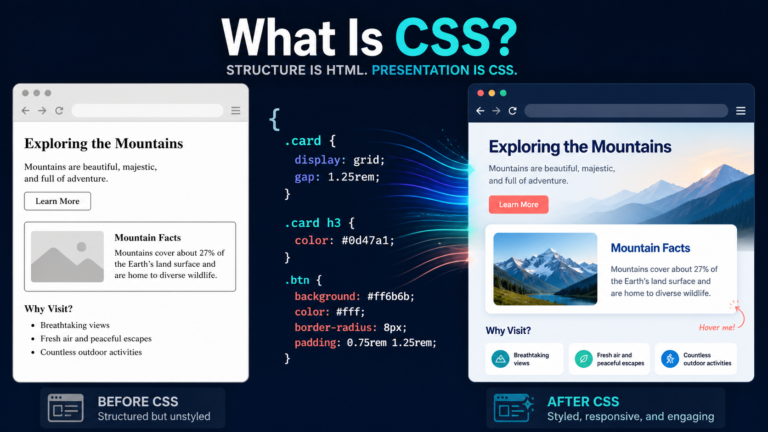
Read articleCSS is the web language that describes how structured documents are presented. It selects HTML elements, assigns visual and layout values, and resolves competing rules through the cascade.
Read articleGPT means Generative Pre-trained Transformer: a model that generates sequences, is trained before use, and uses the transformer architecture to process context.
Read articleA CMS is more than a page editor. See how models, roles, assets, publishing, templates, and APIs turn one content source into digital experiences.
Read articleA practical explanation of how PDF readers render files, which interactions they support, and when the task requires an editor, signing tool, or OCR instead.
Read articleUnderstand subnet prefixes and masks, calculate an unfamiliar IPv4 range, and follow a verified /24-to-/26 split without misusing the subtract-two rule.
Read articleA practical explanation of encrypted password vaults, autofill, recovery, browser and standalone options, and a staged plan for replacing reused passwords.
Read articleA favicon is a website's tiny recognition mark. Learn where it appears, how browsers choose it, which files to provide, and how to test it at real tab size.
Read articleA virtual desktop may be a local window workspace or a complete desktop running elsewhere. Use workload location, persistence, and ownership to tell the models apart.
Read articleA practical explanation of vanity URLs, including the difference between public and destination links, redirect choices, UTM handling, safety controls, and retirement checks.
Read articleA bounded identity-check workflow for unknown websites, emails, calls, profiles, and images—without treating a display name or lookup result as proof.
Read articleDigital signatures can prove origin and integrity, but not secrecy or consent by themselves. Follow the signing flow and a four-layer verification test.
Read articleBROWSE BY TOPIC