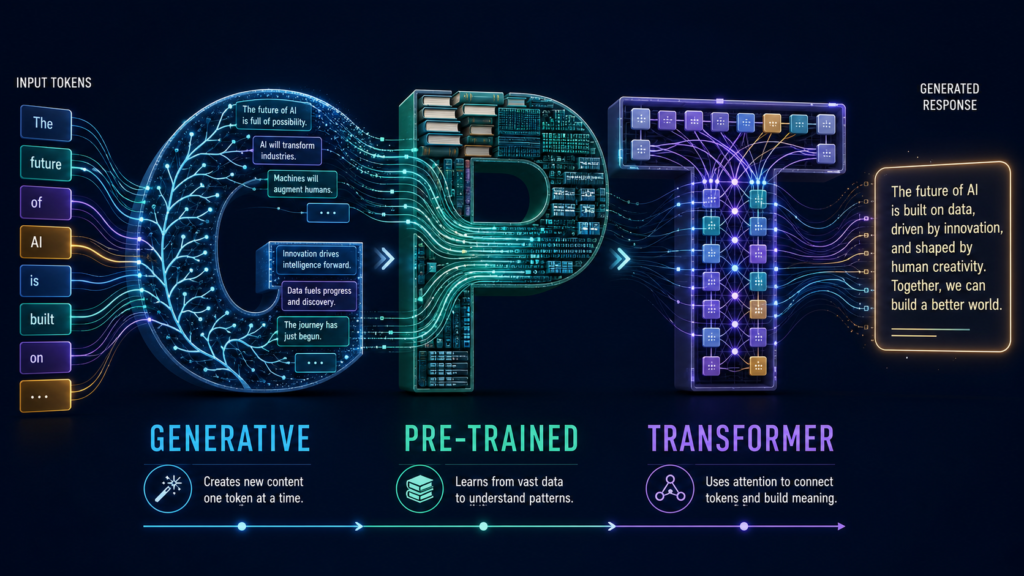
GPT means Generative Pre-trained Transformer: a model that generates sequences, is trained before use, and uses the transformer architecture to process context.
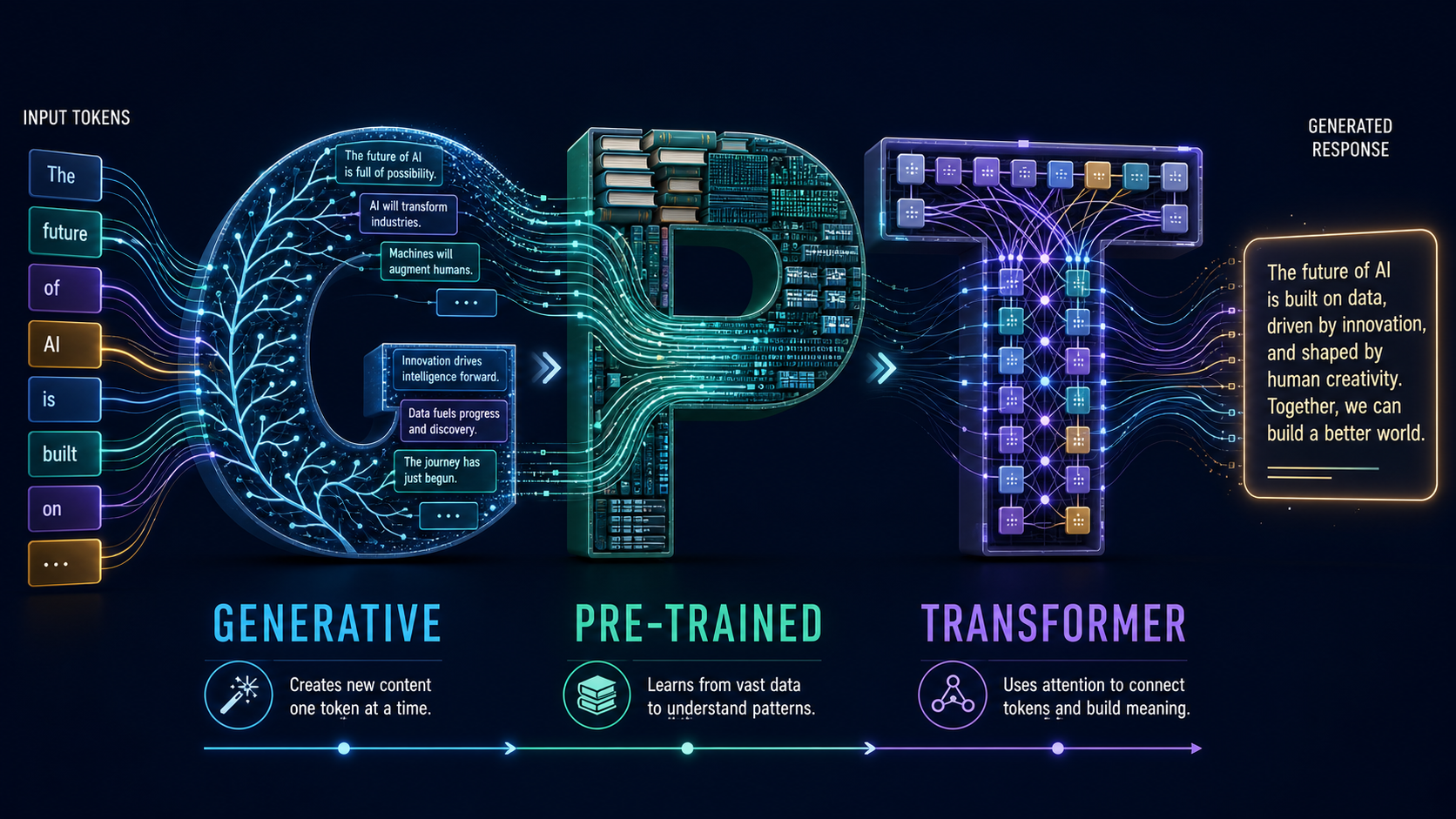
GPT stands for Generative Pre-trained Transformer. Generative means the model produces a new sequence in response to input. Pre-trained means it learns broad patterns during training before a user supplies a prompt. Transformer names the neural-network architecture used to process relationships among tokens in context. The acronym describes a model type; it does not guarantee that an answer is factual, current, conscious, or connected to live information.
OpenAI’s official Key concepts page uses the same expansion and describes GPT models as text-generation models trained to understand natural and formal language and return text output from input prompts.
Unpack the three words
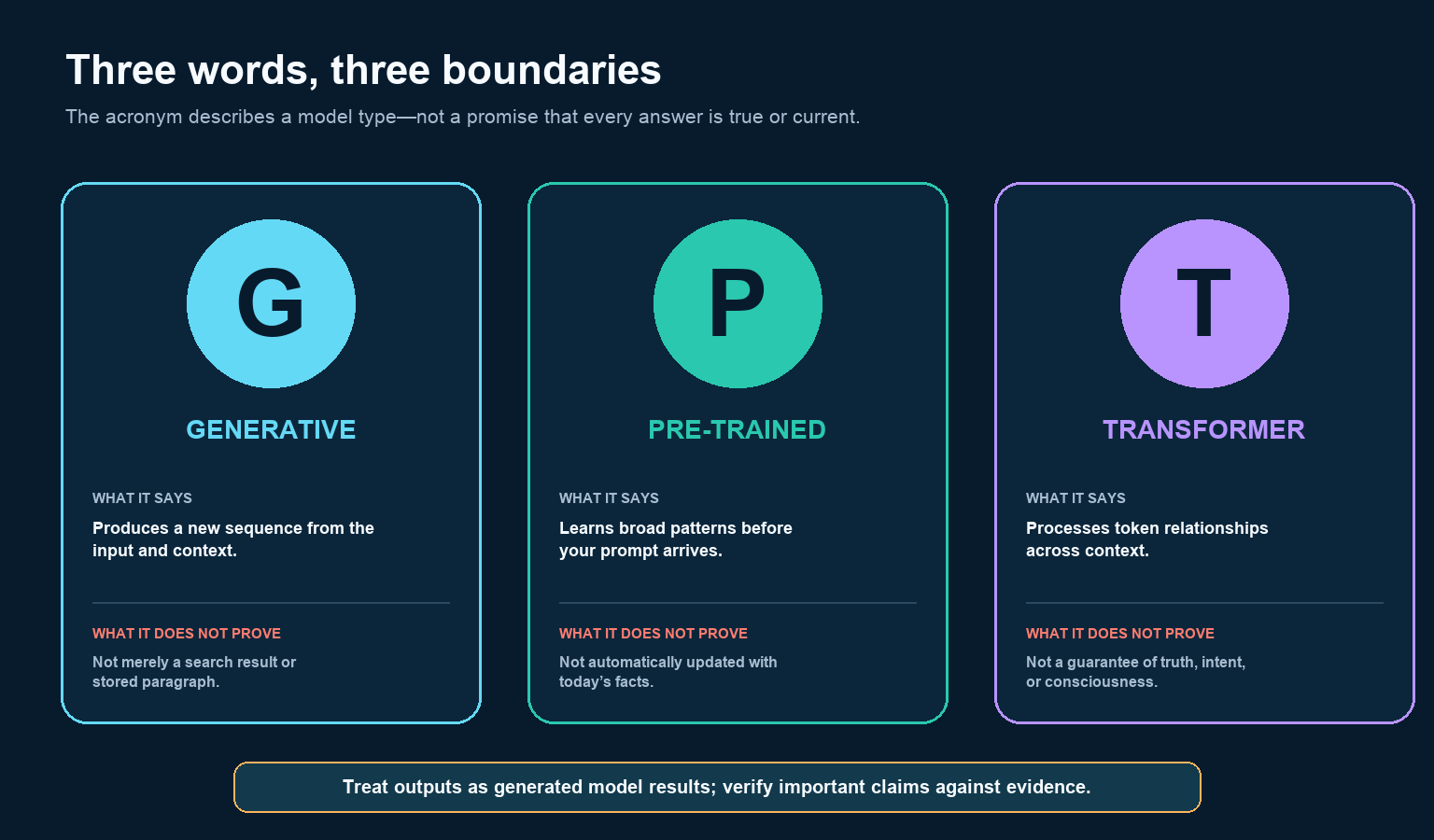
Generative: it constructs an output
A generative model produces a continuation or response from the input and its available context. The output is assembled during inference; it is not necessarily a stored paragraph retrieved verbatim from a database. That generative ability supports drafting, summarizing, rewriting, extracting, classifying, coding, and conversation.
Generative does not mean original in the legal or artistic sense, and it does not prove that a sentence is true. It describes how output is produced, not the evidentiary status of the result.
Pre-trained: broad learning happened before the prompt
Pre-training is the earlier learning phase in which model parameters are adjusted from large amounts of data. By the time a person sends a prompt, the base model already contains learned statistical patterns that let it work across many language tasks. Additional post-training can make a model more useful at following instructions, reasoning through tasks, or operating within product policies, but those stages are not spelled out in the acronym.
Pre-trained does not mean continuously updated. It also does not mean the model memorized a reliable encyclopedia or learns a permanent new fact every time one user corrects it. Current information may require an attached search, retrieval system, supplied document, or later model update.
Transformer: it processes relationships in context
A transformer is the architecture. Its attention mechanisms let the model weigh relationships among token representations across the available context. That design supports parallel training and flexible use of preceding instructions, examples, data, and generated text.
Transformer does not mean the model literally understands intent as a person does, and it is unrelated to robots that physically transform. It is the name of a computational architecture.
How a GPT produces text
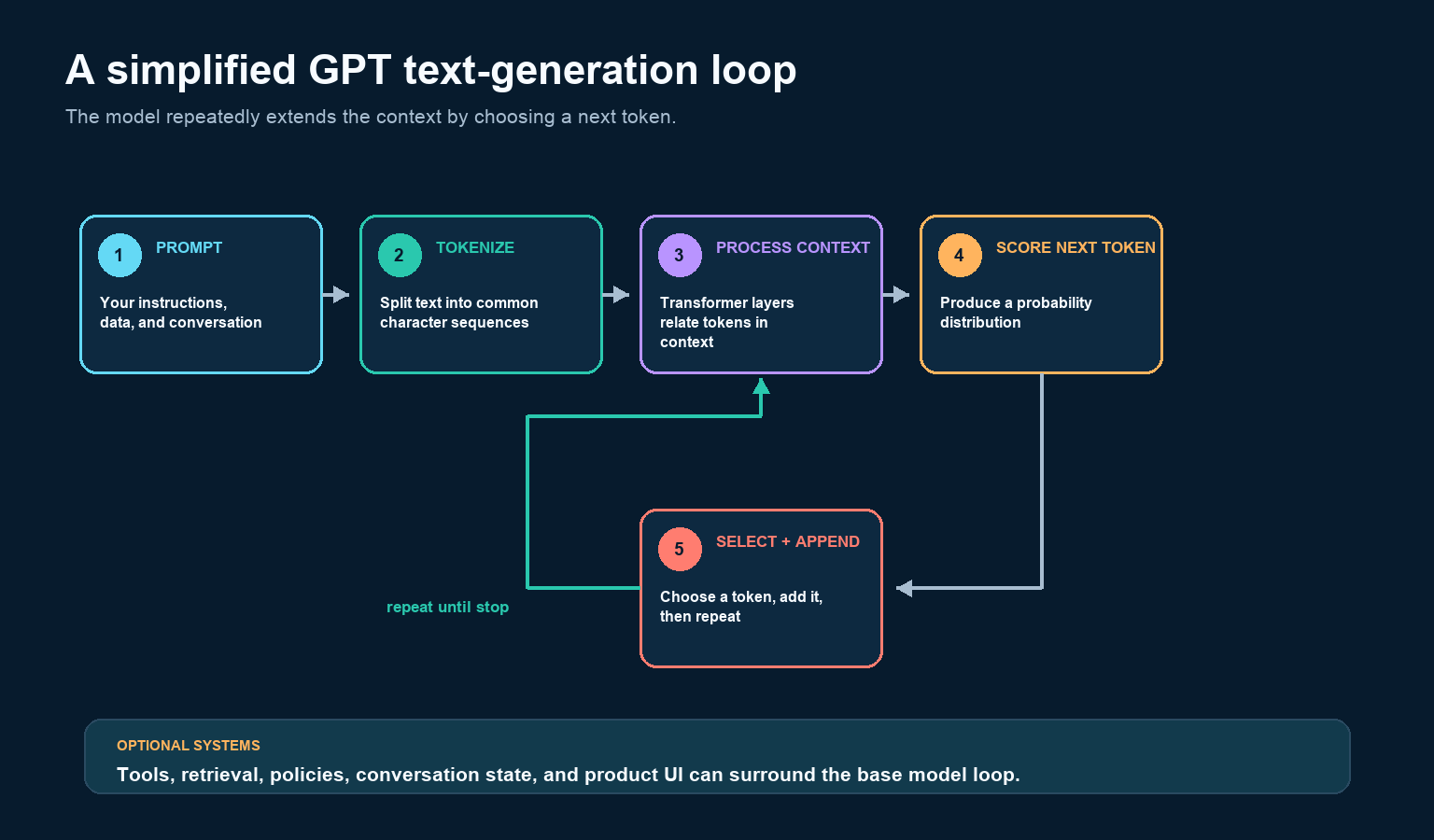
- The system assembles instructions, conversation state, user input, and any supplied content into context.
- A tokenizer represents text as tokens—commonly occurring character sequences rather than always whole words.
- Transformer layers process the token representations and their relationships.
- The model scores possible next tokens as a probability distribution.
- A token is selected, appended to the context, and the process repeats.
OpenAI’s official documentation says tokens may be whole short words or pieces such as “ token” and “ization.” Token boundaries matter because input limits, output limits, latency, and cost are commonly measured in tokens. The token-counting guide is the appropriate current reference for an API application; word count is only a rough proxy.
This loop is simplified. Production systems can add reasoning processes, retrieval, tools, structured-output constraints, safety checks, conversation memory, and product logic. Those additions can change what the overall system does without changing what the acronym expands to.
GPT is not the same thing as ChatGPT
A GPT is a model type or family label. ChatGPT is a product experience that can select models and surround them with an interface, instructions, conversation handling, files, tools, safety systems, and account features. Saying “GPT” when you mean the complete product hides important layers that affect behavior.
The distinction is visible in OpenAI’s official model catalog, where model entries list different modalities, context windows, output limits, tools, endpoints, and other capabilities. A product-facing model alias can also change its underlying snapshot, while a versioned API model may be pinned for stability. The letters alone do not tell you the exact capability sheet.
Repair five common misunderstandings
| Misunderstanding | Better interpretation |
|---|---|
| “Generative” means it searches and copies the right answer. | It constructs an output from learned patterns and current context; retrieval is a separate capability when attached. |
| “Pre-trained” means it knows everything published before a date. | Training creates useful parameters, not a complete, perfectly retrievable database of facts. |
| “Transformer” means a conscious general intelligence. | Transformer names the architecture; consciousness and intent do not follow from the term. |
| A larger GPT number guarantees the best choice. | Model selection depends on task quality, latency, cost, modality, tools, limits, and measured evaluation results. |
| A fluent answer is a verified answer. | Fluency is generated form. Important claims still require evidence, calculations, or expert review. |
OpenAI’s model-selection guidance treats selection as a workload decision, not a naming contest. Evaluate candidate models on representative tasks and the failure modes that actually matter.
Prompts do not retrain the base model
A prompt supplies temporary input and instructions for the current generation context. It can ask for a role, format, audience, source boundary, examples, or required checks. Better context can dramatically improve the answer because it changes the problem the model is solving.
That is different from changing the model’s learned parameters. Prompting programs behavior through context; training or fine-tuning changes parameters through a separate process. OpenAI’s prompt-engineering guide focuses on instructions, examples, relevant context, and clear output requirements for this reason.
Why generated answers can be wrong
The next-token objective rewards plausible continuation, not an internal proof that every claim corresponds to reality. Ambiguous prompts, missing context, stale knowledge, weak retrieval, arithmetic errors, misleading premises, and long multi-step tasks can all produce confident mistakes.
Tools can reduce some failure modes. Search can provide current sources, file retrieval can ground an answer in supplied material, a calculator can execute arithmetic, and structured output can enforce a shape. None makes every result automatically correct. The surrounding application must decide when to retrieve, validate, reject, escalate, or ask a human.
Use the acronym without overclaiming
A precise explanation is short: “GPT means Generative Pre-trained Transformer, a model type that generates sequences from context using a transformer architecture learned through prior training.” Then add the capability that actually matters: which model, what input it accepts, what tools it can call, what context it received, and how the output was checked.
For brainstorming, rewriting, or low-stakes drafts, direct review may be enough. For medical, legal, financial, safety, identity, security, or other consequential decisions, require authoritative sources and qualified human review. OpenAI’s safety best practices likewise emphasize testing and human oversight for high-stakes uses.
The acronym tells you the mechanism’s broad category. It does not certify the answer. Use GPT to describe the model; use evidence to decide whether to trust a particular output.