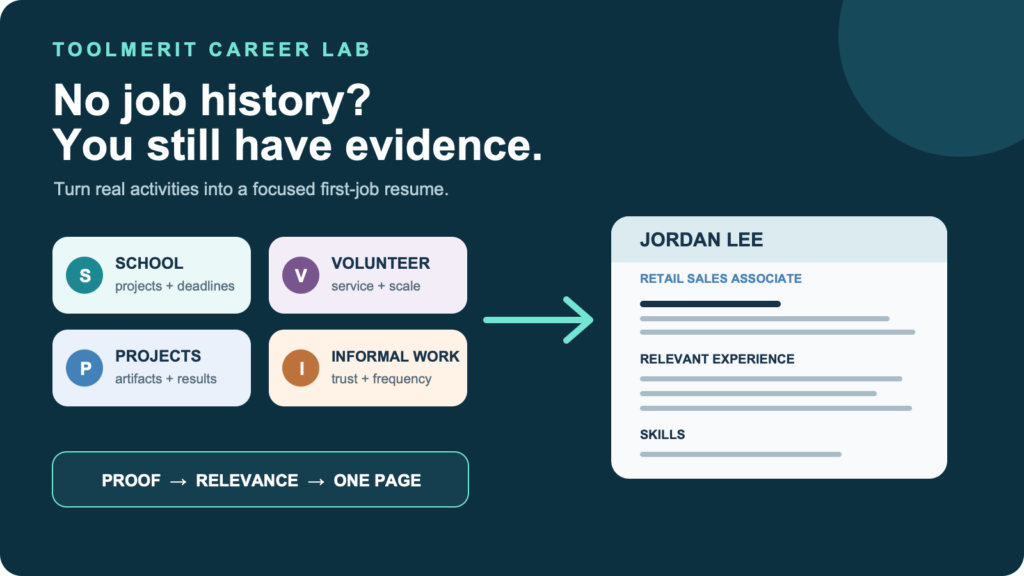
A complete route from no formal work history to a truthful, targeted first-job resume, including an evidence inventory, job-match method, bullet formula, and filled example.
A first-job resume is not a blank resume. It is a record of useful things you have already done, arranged around one employer’s needs. School assignments, team roles, volunteering, informal paid work, caregiving, and self-directed projects can all supply evidence. The important distinction is not “paid versus unpaid.” It is “specific and relevant versus vague and unproven.”
To make a resume for your first job, begin with one job posting, list proof from school, projects, volunteering, clubs, caregiving, and informal work, then place the most relevant evidence in a simple one-column resume. Build each bullet from an action, a task, its scope, and an honest result. Put education near the top when it is your strongest qualification, omit claims you cannot explain in an interview, and tailor a copy for every role.
This guide follows a fictional applicant, Jordan Lee, who is applying for a retail sales associate position without formal employment history. The details are examples, not results you should copy. Your numbers, role names, and outcomes must come from your own experience.
Build a proof inventory before writing
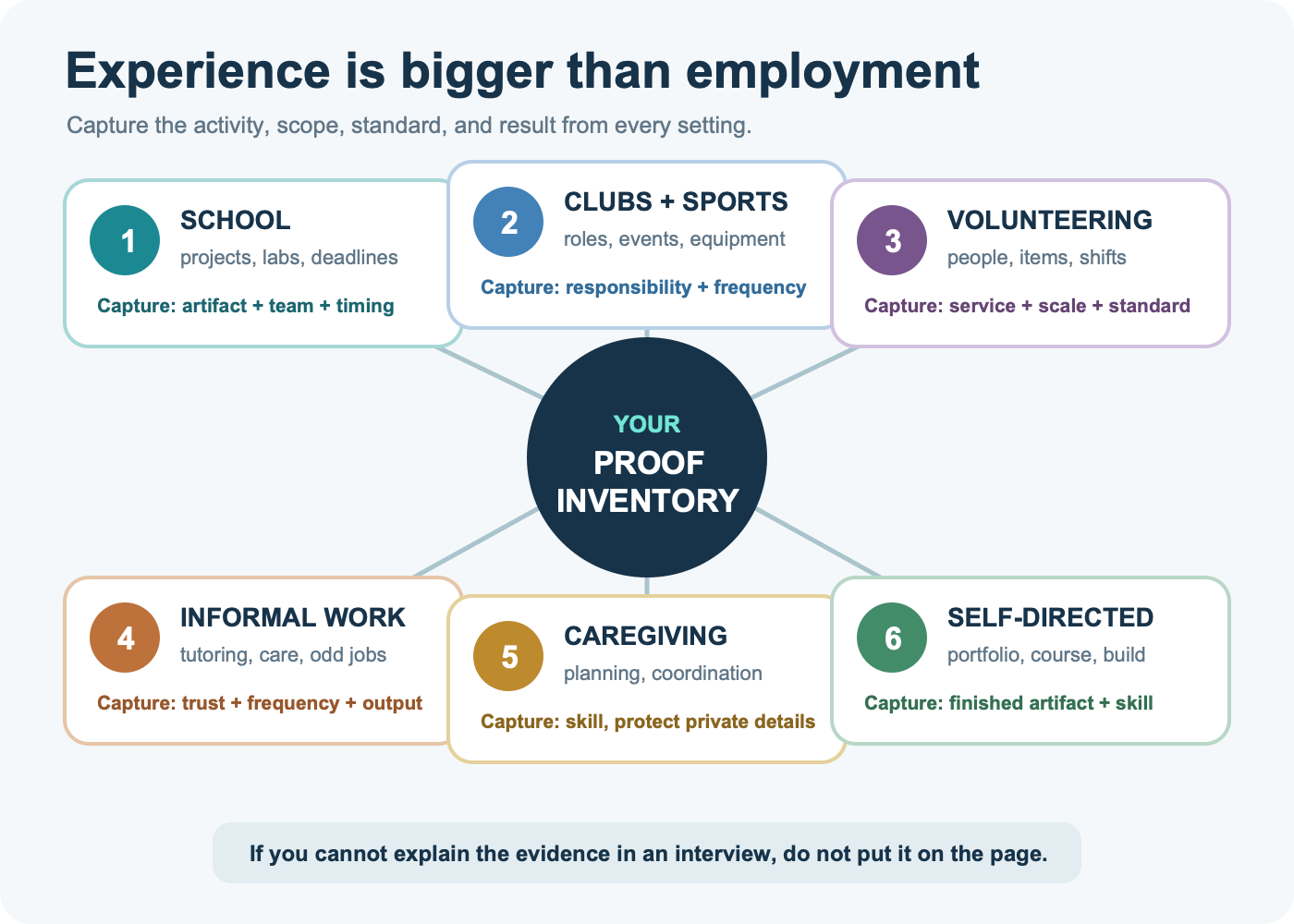
Do not start inside a resume template. A template encourages you to fill headings before you know which facts matter. Start with a rough evidence inventory instead. For each activity, write what you did, who or what it affected, the scale or frequency, the standard you followed, and any result you can support.
The National Association of Colleges and Employers’ career-readiness framework names communication, critical thinking, leadership, professionalism, teamwork, and technology among eight broad competencies. Use those categories as memory prompts—not as unsupported labels. “Teamwork” belongs on a resume only after you show what you did with a team.
| Evidence source | What to look for | Useful proof question |
|---|---|---|
| School and coursework | Research, presentations, labs, deadlines, group deliverables | What did you make, analyze, explain, or finish? |
| Clubs and sports | Schedules, equipment, events, communication, leadership | What responsibility did other people rely on you to handle? |
| Volunteering | People served, items handled, shifts, logistics, records | What changed because you showed up and completed the work? |
| Informal paid work | Babysitting, tutoring, lawn care, selling, family-business help | What did the customer trust you to do, and how often? |
| Caregiving or household work | Planning, coordination, budgeting, translation, recurring tasks | Which job-relevant skill can you show without exposing private family details? |
| Self-directed projects | Portfolios, repairs, code, designs, content, certificates | What finished artifact or demonstrated skill exists? |
Jordan’s rough inventory contains these facts:
- Worked in a four-person marketing class team, collected 35 survey responses, and delivered a six-slide recommendation two days before the deadline.
- Sorted and labeled 480 donated items during a community food drive with eight volunteers.
- Tracked 42 pieces of soccer equipment across 12 games using a shared spreadsheet.
- Prepared two 45-minute math practice sessions each week for 10 weeks for a middle-school student.
- Completed an introductory spreadsheet course and can sort data, enter formulas, and format a basic table.
None of those facts requires inventing a job title. Each can support a skill if the target role needs it. CareerOneStop’s guidance for people new to the workforce likewise recommends drawing from coursework, volunteering, paid or unpaid projects, and even relevant personal interests when formal experience is limited.
Match your evidence to one real job posting
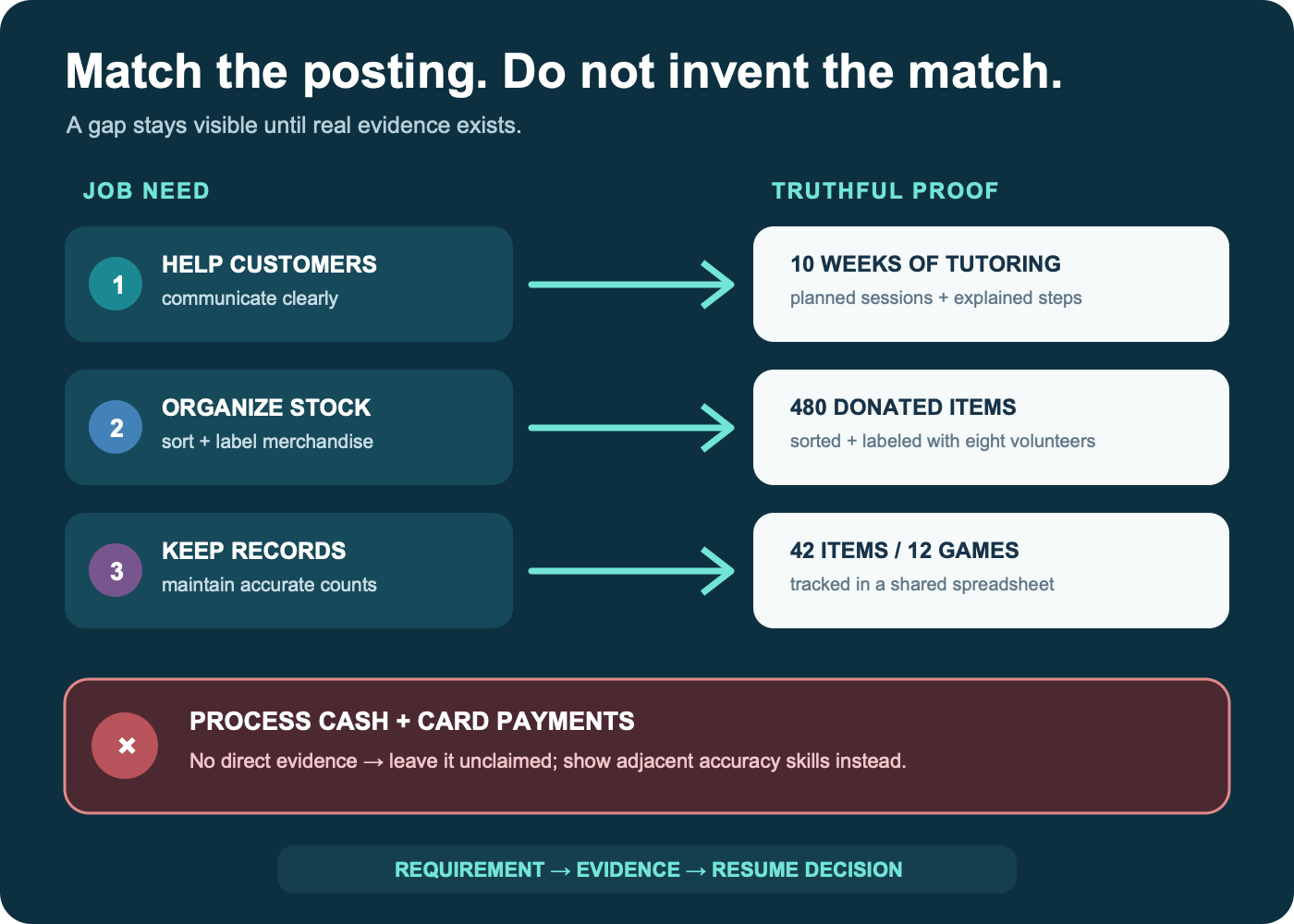
A general resume forces the employer to do the matching. A targeted resume does the matching for them. Copy the five or six most important requirements from one posting into a private worksheet, then place your strongest truthful proof beside each requirement. Do not copy the employer’s wording unless it accurately describes what you did.
Here is Jordan’s map for a fictional retail sales associate posting:
| Posting requirement | Jordan’s evidence | Resume decision |
|---|---|---|
| Help customers and communicate clearly | Explained math steps in recurring tutoring sessions | Keep; write as an informal tutoring role |
| Organize and restock merchandise | Sorted and labeled 480 food-drive items | Keep; lead with the handling volume |
| Work reliably with a team | Shared responsibility in a four-person class project | Keep; show the deliverable and deadline |
| Maintain accurate records | Tracked 42 equipment items for 12 games | Keep; name the spreadsheet and scope |
| Process cash and card payments | No direct evidence | Do not claim it; show adjacent accuracy skills |
CareerOneStop recommends emphasizing the tasks and outcomes most relevant to the target job and using posting language where it truthfully fits. That does not mean stuffing every keyword into the page. A term belongs only where your evidence supports it.
If you use an assistant from ToolMerit’s AI writing tools collection, give it your actual inventory and the job posting rather than asking it to “make me sound impressive.” A structured request based on the task, context, constraints, and output format of a good prompt can help sort evidence, but you must reject any invented tool, number, title, result, or responsibility. A safe starting request is:
Compare this job posting with my evidence inventory. Return a three-column table: requirement, exact supporting evidence, and gap. Do not infer facts, create numbers, rename unpaid work as employment, or write a match when the evidence is missing.
Assemble a one-page structure around your strongest proof
For a typical private-sector first job, use one column and familiar section headings. This is not a universal format: federal applications, academic CVs, and some country-specific applications require different information. Follow the employer’s instructions when they conflict with this layout.
- Name and contact details: include your preferred name, city and state, phone number, professional personal email, and a maintained portfolio or LinkedIn URL only if it adds evidence. CareerOneStop says a full street address is unnecessary in its resume contact guidance.
- Optional target line: use the exact role name when it clarifies your direction. Skip a generic objective such as “seeking an opportunity to grow.”
- Education: put current or recent education near the top when it is your strongest qualification. Include the credential or program, school, location, and expected or completed date. Add selected coursework, honors, or a project only when relevant. CareerOneStop specifically allows relevant courses and projects for students and recent graduates.
- Relevant experience: include paid jobs, volunteering, school projects, clubs, and informal work under honest labels. Give each item an organization or context, a role description, dates, and evidence bullets.
- Skills: list specific, demonstrable skills such as software, languages, certifications, equipment, or job methods. Do not use the section as a row of unsupported personality adjectives.
Leave out “References available upon request.” Keep references in a separate document, ask each person for permission, and share them when requested. Also leave out a photo, date of birth, health information, marital status, and other personal details that do not establish job qualifications. The U.S. Equal Employment Opportunity Commission says pre-employment information should be limited to what is essential for determining qualification and notes that employers generally should not ask for applicant photographs. Requirements vary outside the United States, so check local norms when applying elsewhere.
Turn ordinary activities into evidence bullets
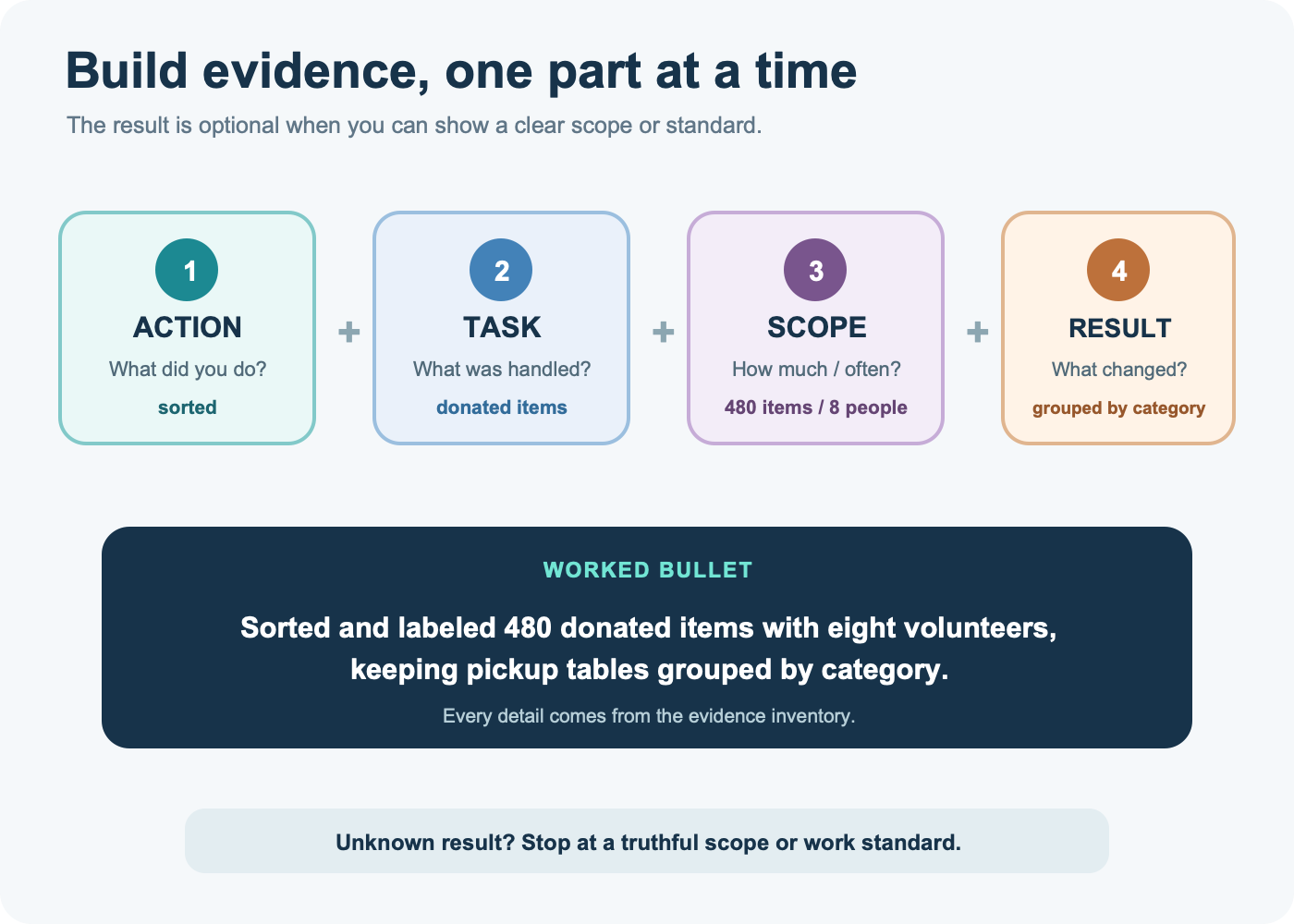
A first-job bullet does not need a dramatic achievement. It needs a verifiable action and enough context to understand its value. Use this four-part formula:
Action + task + scope + result or standard
| Weak draft | Evidence bullet | Why it is stronger |
|---|---|---|
| Helped with a food drive | Sorted and labeled 480 donated items with eight volunteers, keeping pickup tables grouped by category. | Names the action, scale, team, and work standard |
| Good at teamwork | Collaborated in a four-person class team to collect 35 survey responses and deliver a six-slide recommendation two days early. | Shows teamwork through a deliverable and deadline |
| Tutored math | Prepared two 45-minute math practice sessions each week for 10 weeks and tracked completed problem sets. | Shows frequency, preparation, and recordkeeping without inventing a grade change |
| Responsible for team gear | Tracked checkout and return of 42 equipment items across 12 games in a shared spreadsheet. | Turns “responsible” into observable work |
Start with a verb that reflects what you actually did. Harvard’s college resume guide and action-verb list can help you find precise language, but the verb must not inflate your role. Use “assisted” if you assisted, “organized” if you controlled the organization, and “led” only if you led.
Numbers should clarify, not decorate. Count people, items, sessions, weeks, pages, events, or deadlines only when you can defend the figure. If the result is unknown, end with the scope or standard. “Handled 40 orders with zero errors” is not acceptable if you never tracked errors.
A completed planning project can supply evidence without becoming a fake job; the business-plan writing workflow shows the research, assumptions, and deliverables you can describe truthfully.
See the finished first-job resume
Here is the fictional case assembled into a compact resume. The placeholder contact details use the reserved example.com domain and a fictional phone number. Replace every line with your own facts.
Jordan Lee
Phoenix, AZ | (602) 555-0142 | jordan.lee@example.com
Target role: Retail Sales Associate
Education
Desert View High School, Phoenix, AZ
High School Diploma, May 2026
- Relevant project: collaborated in a four-person marketing team to collect 35 survey responses and deliver a six-slide recommendation two days before the deadline.
Relevant Experience
Community Food Drive — Volunteer, Phoenix, AZ | April 2026
- Sorted and labeled 480 donated items with eight volunteers, keeping pickup tables grouped by category.
- Answered visitor questions and directed donations to the correct intake station during a four-hour shift.
Independent Math Tutor, Phoenix, AZ | January–March 2026
- Prepared two 45-minute math practice sessions each week for 10 weeks and tracked completed problem sets.
- Explained multi-step problems using written examples and adjusted the next session to the topics still causing difficulty.
Desert View Soccer Team — Equipment Assistant, Phoenix, AZ | August–November 2025
- Tracked checkout and return of 42 equipment items across 12 games in a shared spreadsheet.
- Prepared sideline equipment before scheduled departure times and reported missing items to the coach.
Skills
Google Sheets: data entry, sorting, basic formulas, table formatting | Customer communication | English and conversational Spanish
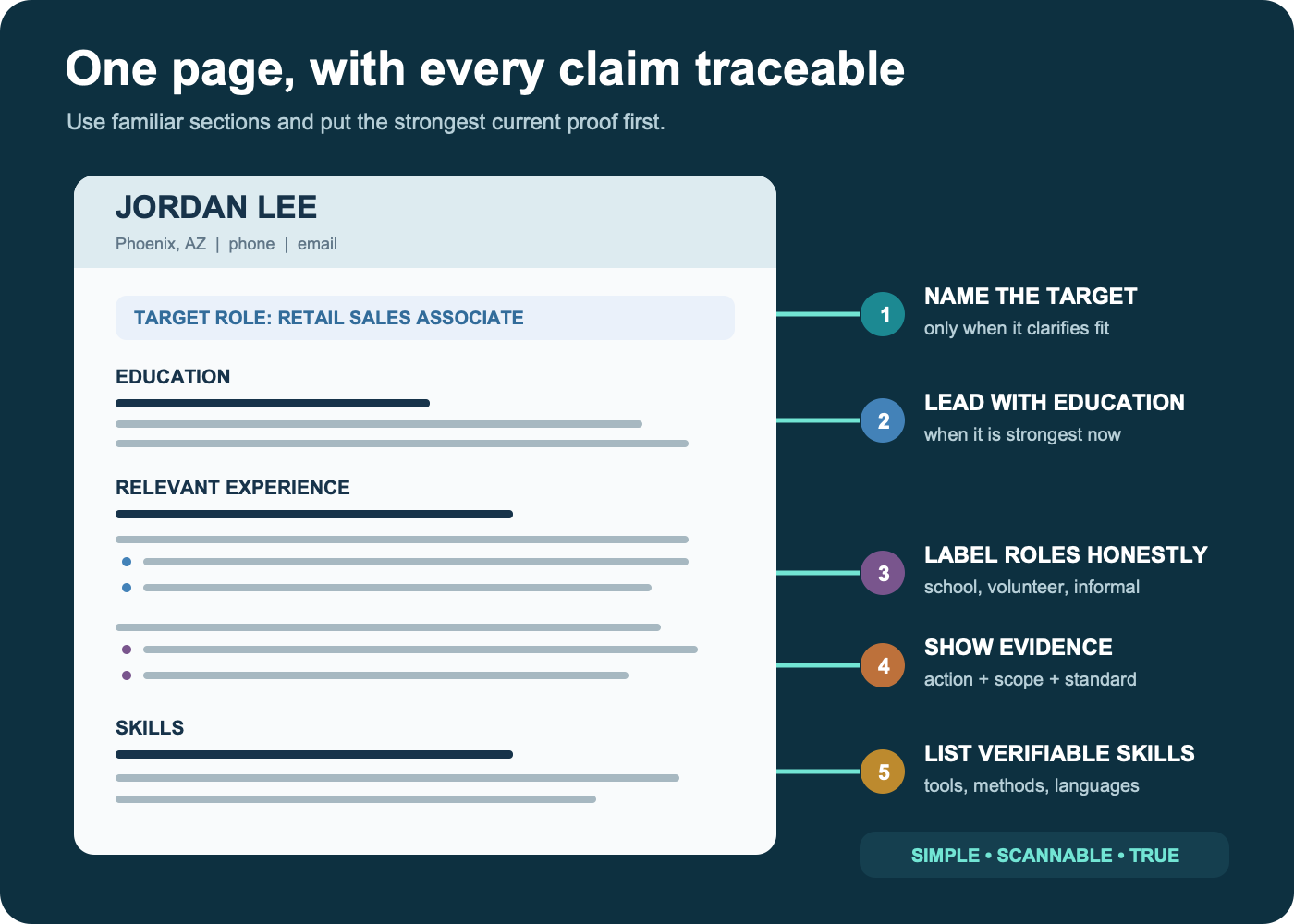
The example does not pretend Jordan has operated a cash register. It demonstrates adjacent evidence—accuracy, organization, communication, and reliability—while leaving the missing skill visible. It also does not add a generic summary. For a new applicant, the evidence earns the page space.
Format for both people and application systems
Keep the actual resume visually quieter than this article. CareerOneStop’s formatting guidance recommends a simple single-column layout, standard headings, consistent spacing, common 10–12 point fonts, and no tables, text boxes, logos, columns, images, or graphics that could scramble parsing. A creative portfolio can carry visual work; the resume should carry readable evidence.
- Aim for one page when your relevant evidence fits comfortably. Do not shrink the type or margins to force it.
- Use reverse chronological order within a section unless another order clearly improves relevance.
- Keep dates consistent, such as “January–March 2026” throughout.
- Use plain bullet characters and standard section names.
- Save as PDF unless the employer asks for DOCX, plain text, or another format.
- Name the file clearly, such as
Jordan-Lee-Retail-Resume.pdf.
If a word looks wrong, do not rely on a visual guess; ToolMerit’s spelling verification method shows how to check pronunciation, meaning, grammar, and an authoritative source. When you export, it also helps to understand what a PDF preserves and what it does not. Open the exported file in a separate PDF reader, zoom in, select some text, and confirm the last line did not move to a blank second page.
Run the 60-second submission test
- 0–10 seconds: relevance. Does the top half show the strongest evidence for this role rather than everything you have ever done?
- 10–20 seconds: truth. Can you explain who, what, when, and how for every bullet without improvising?
- 20–30 seconds: scan. Are the name, education, roles, dates, and skills easy to locate at normal zoom?
- 30–40 seconds: file. Does the exported document open, copy as readable text, and stay on the intended number of pages?
- 40–50 seconds: contact. Are the phone number and email current, professional, and typed correctly?
- 50–60 seconds: instructions. Did the employer request a particular file type, filename, application field, availability statement, or supporting document?
If you email the file instead of using an application portal, state the role, your name, and the attached document clearly. ToolMerit’s email subject line helper can generate alternatives, but use the employer’s requested subject format when one is provided.
If the 60-second scan exposes recurring language errors, use the multi-pass proofreading workflow before producing the final PDF.
If the portal produces or returns a file, use the file-download verification workflow to confirm that you saved the intended resume rather than a shortcut, preview page, or renamed HTML file.
Use one decision rule before you submit
Submit when the resume is truthful, readable, and relevant enough that a hiring manager can trace each important claim to something you actually did. If a must-have requirement has no supporting evidence, do not conceal the gap with a confident adjective. Apply to a better-fit opening, show a nearby transferable skill, or gain the missing evidence through a class, volunteer shift, personal project, or training activity.
Your resume’s job is to earn the next conversation, not to tell your entire life story. Prepare for that conversation by turning the same evidence into a short introduction with ToolMerit’s five-part elevator pitch template: background, value, proof, relevance, and next step.