
An evidence-first method for turning a business idea into a one-page plan, a reconciled operating model, and a funder-ready document when needed.
A mobile bicycle-repair founder can write “monthly revenue: $7,600” by multiplying 80 appointment slots by a $95 average ticket. But that forecast silently assumes every slot sells. At a 75% booked rate, the same operation produces 60 jobs and $5,700 in revenue. A business plan becomes useful when it exposes that difference instead of decorating the larger number.
You do not need a long document before you have evidence. Start with one page, reconcile the operating model, and expand only when a lender, investor, partner, landlord, or internal decision requires more detail.
Choose the decision before the format
The U.S. Small Business Administration distinguishes traditional and lean startup plans. Its business-plan guidance says a lean plan can fit on one page, while a traditional plan is more detailed and is commonly requested by lenders and investors. Neither format is automatically better; the reader and decision determine the useful depth.
| Decision | Primary reader | Smallest useful format | What must be convincing |
|---|---|---|---|
| Should we launch, stop, or run another test? | Founder or operating team | One-page plan plus a 12-month cash model | Customer evidence, delivery capacity, economics, next milestone, and stop condition |
| Can this business repay a loan? | Lender | Traditional plan plus lender-requested statements and projections | Use of funds, repayment capacity, owner contribution, risks, and supporting records |
| Can capital create a valuable next stage? | Equity investor | Focused plan, model, team evidence, and milestone case | Market, advantage, growth mechanism, ownership tradeoff, and measurable value-creation milestones |
| Can we operate together without hidden assumptions? | Partner or key hire | Lean plan plus roles, resources, decision rights, and milestones | Responsibilities, constraints, compensation assumptions, dependencies, and failure response |
Write the audience and decision at the top of the working file. If a paragraph does not help that reader make that decision, move it to the appendix or remove it.
Draft the one-page evidence plan
Use the prompts below as a working template. Keep each response to one or two concrete sentences. Brackets are instructions, not public copy.
- Customer: We serve [specific group in a defined situation or location], not “everyone who needs this.”
- Problem and current alternative: They need [job or outcome] and currently use [competitor, workaround, delay, or doing nothing].
- Offer: We provide [product or service] with a measurable scope, price logic, and important exclusions.
- Evidence: We currently know [observed fact] from [dated source, order, interview, experiment, quote, or operating record]; we are still assuming [uncertain claim].
- Acquisition: Customers will encounter, evaluate, and buy through [specific channel sequence]; the first conversion test is [test].
- Delivery and capacity: Each sale requires [time, people, inventory, equipment, supplier, permission], which caps output at [units per period].
- Economics and cash: Price is [amount or rule], variable cost is [amount], fixed cost is [amount per period], and payment arrives [timing].
- Funding and milestones: We need [amount] by [date or trigger] for [specific uses] to reach [observable milestone].
- Risk and next test: The assumption most likely to invalidate the plan is [claim]; by [date] we will test it with [bounded action] and change course if [result].
This one page is the control document. A longer plan should add evidence and explanation without changing the underlying customer, capacity, price, costs, or funding figures.
Replace adjectives with an evidence ledger
“Large market,” “affordable,” and “strong demand” are not evidence. Put every decision-controlling claim into a ledger so the reader can see what is known, what is assumed, and which number changes if the claim fails.
| Claim | Current evidence and date | Status | Next test | Financial line affected |
|---|---|---|---|---|
| Enough target customers exist in the service area | [Census or industry source, geography, retrieval date] | Observed / estimated / unknown | Compare reachable customer count with required monthly buyers | Lead volume and maximum demand |
| Customers will accept the planned price | [Competitor prices plus an actual offer or preorder test] | Observed / estimated / unknown | Make a defined offer to a defined segment | Average ticket and conversion |
| The operation can deliver the promised volume | [Timed trial, supplier quote, staffing schedule, or past record] | Observed / estimated / unknown | Run one end-to-end delivery cycle | Capacity, labor, variable cost, and refunds |
| The acquisition channel is repeatable | [Dated campaign or referral data, not a platform-wide average] | Observed / estimated / unknown | Test a fixed spend or outreach batch | Leads, acquisition cost, and cash timing |
The SBA’s market research framework separates broad existing data from direct customer research. Existing sources can quantify demographics, income, trends, and market structure; direct research is better for reactions to your specific offer, price, or buying experience. For U.S. location-based businesses, Census Business Builder provides demographic and economic data by business type and geography, with maps, comparisons, and downloadable reports.
Build the operating model before the forecast
A forecast should follow the path a customer and an order actually take. Connect evidence to operations before opening a polished financial template.
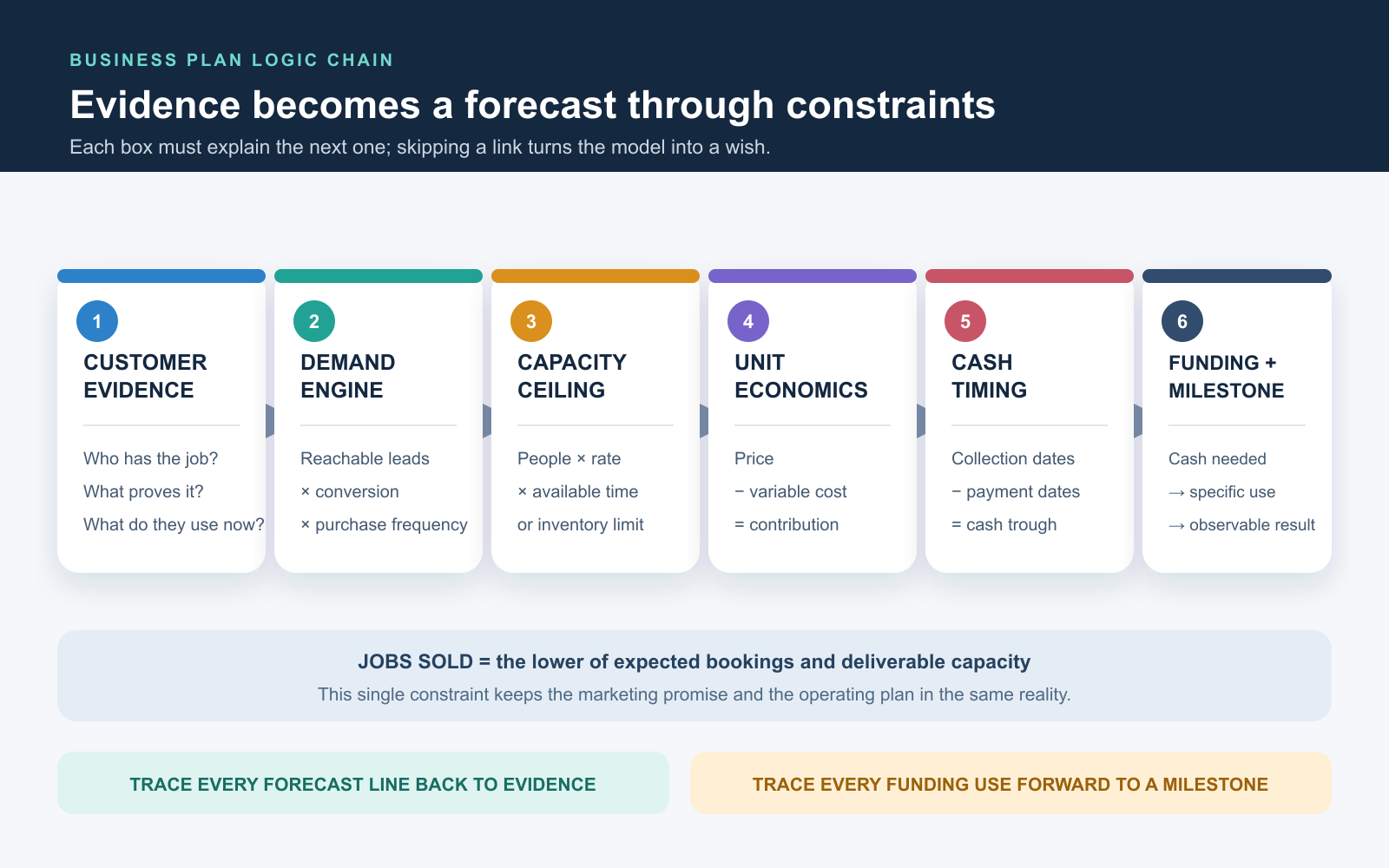
For a capacity-limited service business, a compact model can begin with these relationships:
Qualified leads × conversion rate = expected booked jobs
People × jobs per person per day × working days = maximum job capacity
Jobs sold = the lower of expected booked jobs and maximum capacity
Monthly revenue = jobs sold × average ticket
Monthly contribution = jobs sold × (average ticket − variable cost per job)
The “lower of demand and capacity” rule prevents a common contradiction: the marketing section forecasts more sales than the operating section can deliver. Product businesses need the equivalent constraint—available inventory, supplier lead time, production yield, fulfillment throughput, or working capital.
Cash needs a separate timeline. A profitable invoice does not pay today’s payroll if the customer pays in 45 days. Record when cash is collected, deposits are paid, inventory is purchased, taxes are due, debt is serviced, and owner compensation begins. The SBA’s finance guide emphasizes tracking assets, liabilities, equity, costs, and cash-flow projections rather than treating revenue as the whole financial picture.
Work the numbers: a mobile repair example
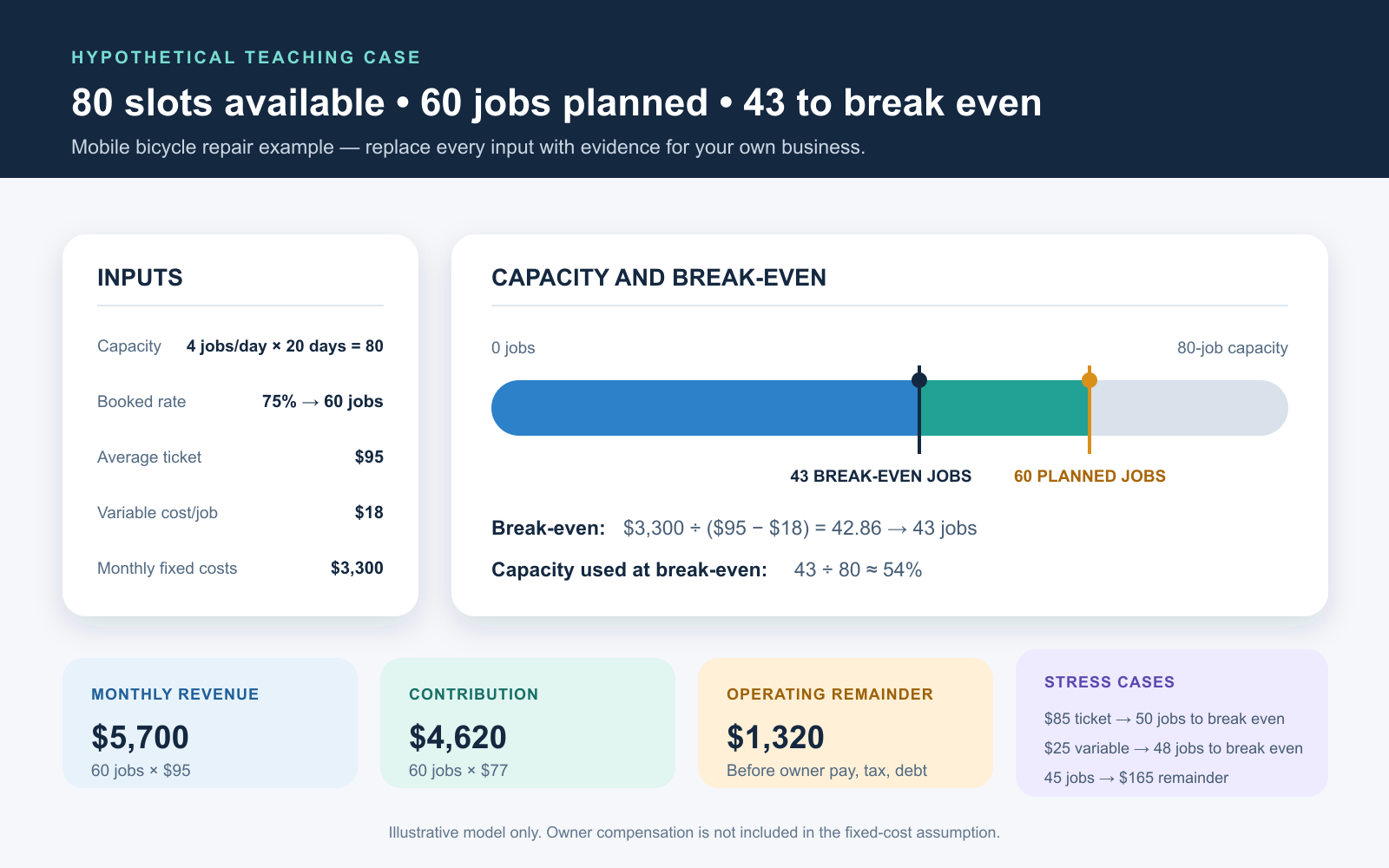
The figures below are a hypothetical teaching case, not a benchmark or claim about bicycle-repair businesses. Replace every input with a sourced quote, measured operating result, or clearly labeled assumption for your own company.
| Input | Illustrative assumption | How it enters the model |
|---|---|---|
| Daily service capacity | 4 jobs | Measured or scheduled jobs per working day |
| Working days per month | 20 | 4 × 20 = 80 available appointment slots |
| Booked rate | 75% | 80 × 75% = 60 planned jobs |
| Average ticket | $95 | 60 × $95 = $5,700 monthly revenue |
| Variable cost per job | $18 | $95 − $18 = $77 contribution per job |
| Monthly fixed costs | $3,300 | Illustrative vehicle, insurance, software, marketing, facilities, and other fixed costs; owner pay is excluded in this example |
The SBA’s break-even formula is:
Break-even units = fixed costs ÷ (price per unit − variable cost per unit)
For this case: $3,300 ÷ ($95 − $18) = 42.86, so the business must complete 43 jobs to cross break-even. That is about 54% of the 80-job monthly capacity. At 60 jobs, contribution is 60 × $77 = $4,620; subtracting $3,300 of fixed costs leaves $1,320 before owner compensation, income taxes, debt service, and reinvestment.
Now stress the assumptions rather than presenting one precise-looking answer:
- At an $85 average ticket and the same $18 variable cost, break-even rises to 50 jobs.
- At a $95 ticket but $25 variable cost, break-even rises to 48 jobs.
- At only 45 completed jobs with the original inputs, the illustrative operating remainder is just $165 before owner pay, taxes, debt, and reinvestment.
If break-even volume exceeds maximum capacity, the plan is not conservative—it is mechanically impossible. Change price, variable cost, fixed cost, capacity, or the offer before polishing the document. Use the ROI guide separately when judging whether a specific investment earns enough return; break-even only answers when revenue covers the modeled costs.
Expand into a formal plan only when the reader needs it
A traditional plan can organize the same evidence into these reader-facing modules:
- Company and decision: legal status, location, ownership, purpose, and the decision or funding request.
- Customer and market: defined segment, reachable geography, demand evidence, market size method, and important trends.
- Competition and position: direct alternatives, indirect substitutes, buying criteria, your advantage, and where competitors are stronger.
- Offer: product or service scope, pricing logic, intellectual property if material, roadmap, and exclusions.
- Go-to-market system: channels, customer journey, sales cycle, conversion assumptions, retention, and acquisition economics.
- Operations and team: workflow, capacity, suppliers, facilities, technology, permissions, owners, key roles, and hiring triggers.
- Financial model: startup costs, monthly cash timing, unit economics, break-even, base/downside/upside scenarios, and assumptions.
- Funding and milestones: amount, source, timing, use, ownership or repayment consequence, milestone, and contingency.
- Risks and appendix: decision-controlling uncertainties plus the quotes, resumes, licenses, contracts, research, and statements that support the plan.
The SBA notes that a financing-oriented traditional plan may include projected income statements, balance sheets, cash flow statements, and capital expenditure budgets, often with more detail in the first year. Follow the actual lender or investor request rather than assuming every reader needs the same horizon or appendix.
Make the funding request auditable
Do not choose a round amount and invent uses afterward. Build the request from dated costs and the cash timeline. The SBA recommends separating one-time and monthly expenses in its startup-cost process, then using the calculation to estimate funding needs and support loan or investor conversations.
| Use | Amount and source | When cash is needed | Milestone unlocked | Fallback if delayed or higher |
|---|---|---|---|---|
| [Equipment, deposit, inventory, launch payroll, or working capital] | [Vendor quote or model line, with date] | [Date or prerequisite] | [Operational result, not “growth”] | [Lease, smaller batch, later phase, alternate supplier, or stop] |
| [Second use] | [Amount and evidence] | [Timing] | [Measurable result] | [Contingency] |
Then match the source of money to its consequence. SBA’s funding overview distinguishes self-funding, equity, and loans: each changes who bears risk, who controls decisions, and whether cash must support repayment. State those tradeoffs rather than labeling capital “non-dilutive” or “flexible” without showing the obligation.
Run the contradiction audit
Before sharing the plan, trace every important statement across the narrative, operating model, and financial sheets. Fix any contradiction you find.
- Demand versus capacity: planned units cannot exceed deliverable units without a dated capacity expansion.
- Leads versus sales: required customers must reconcile with channel volume, conversion, sales-cycle timing, and marketing cost.
- Price and mix: the offer table, revenue model, invoice assumptions, and executive summary must use the same price logic.
- People and timing: a hire cannot create capacity before recruiting, onboarding, equipment, payroll, and supervision are funded.
- Profit versus cash: inventory, deposits, accounts receivable, taxes, debt, and owner draws must occur in the month cash moves.
- Break-even versus ceiling: break-even units must fit within realistic capacity and reachable demand.
- Market share versus customer count: convert a market percentage into actual buyers, purchase frequency, and revenue.
- Funding versus model: requested funds, founder contribution, cash trough, use table, and financing terms must reconcile.
- Base case versus evidence: assumptions with weak evidence belong in a downside case or a near-term test, not hidden in the “most likely” line.
After launch, replace plan assumptions with actual records using a consistent expense-tracking process. A plan becomes an operating tool only when real revenue, cost, capacity, and cash data can challenge it.
Write the executive summary last
The executive summary is a compressed decision case, not an introduction written before the analysis. Draft it after the evidence ledger, operating model, funding table, and contradiction audit are stable. Six sentences are enough for a first version:
- Company and customer: what the business is and exactly whom it serves.
- Problem and alternative: what the customer needs and how they solve it now.
- Offer and position: what you sell, how it is delivered, and why the target customer would choose it.
- Evidence: the strongest dated proof of demand, delivery ability, or traction—and the largest remaining uncertainty.
- Economics and milestone: capacity, revenue mechanism, break-even logic, cash runway, and the next measurable operating result.
- Request: the decision, amount, partnership, or action needed and what it unlocks.
Put a version date and assumption owner on the plan. Review it when decisive evidence changes—such as a supplier quote, conversion result, permit, lease, staffing constraint, or customer payment pattern—not merely when the calendar says the document is old.
Your next action is small and testable: fill the nine one-page prompts, calculate maximum capacity and break-even with your own sourced inputs, then circle the weakest assumption. Gather evidence for that one assumption before expanding the plan. The result may be shorter than a template-driven document, but it will answer harder questions.