
A reusable system for moving from a vague learning goal to focused practice, useful feedback, spaced retrieval, and evidence that the skill transfers.
Imagine finishing three hours of spreadsheet lessons, closing the course, and opening a blank file. You recognize every menu the instructor used, yet you cannot decide what to build first. The activity was real; the performance never became yours.
To learn a new skill, define one observable performance, break it into subskills, practice the weakest part with fast feedback, retrieve it later, and prove it in a new context. A course, book, coach, or video can support that process, but none is the unit of progress. The unit is something you can do after the example disappears.
This guide provides a reusable project template for practical digital, creative, and professional skills. It does not promise a universal number of hours. The time required depends on the starting point, the performance standard, the quality of feedback, the practice design, and the domain itself.
Write a learning outcome contract
“Learn photography,” “get good at Excel,” and “understand public speaking” name territories, not finish lines. Replace the topic with a performance that another person could observe and evaluate.
Copy this learning outcome contract and fill every field before choosing a course:
Skill territory:
By [date], given [realistic input and conditions],
I can [observable performance]
to [quality bar],
without [support I plan to remove],
proven by [artifact, test, or live demonstration].
For example:
By September 15, given an unfamiliar 300-row sales CSV, I can clean the data, build a pivot summary and one decision-ready chart, and explain the result in 45 minutes without replaying a tutorial, proven by a screen recording and a correctly refreshed workbook.
The contract has six controls:
- A bounded territory prevents an endless curriculum.
- A realistic input makes practice resemble the eventual work.
- An observable verb replaces “know” or “understand” with build, diagnose, perform, edit, explain, or decide.
- A quality bar separates completion from competence.
- A no-support rule defines which scaffolds must disappear.
- A proof makes self-assessment less vulnerable to familiarity and confidence.
If the goal is large, define one useful slice. Our book-writing workflow turns a large ambition into draftable units; the same principle applies to coding, video editing, language practice, analytics, and design.
A bounded skill such as the multi-pass proofreading workflow is a useful model because the learner can define passes, criteria, and a transfer document.
Build the skill decomposition canvas
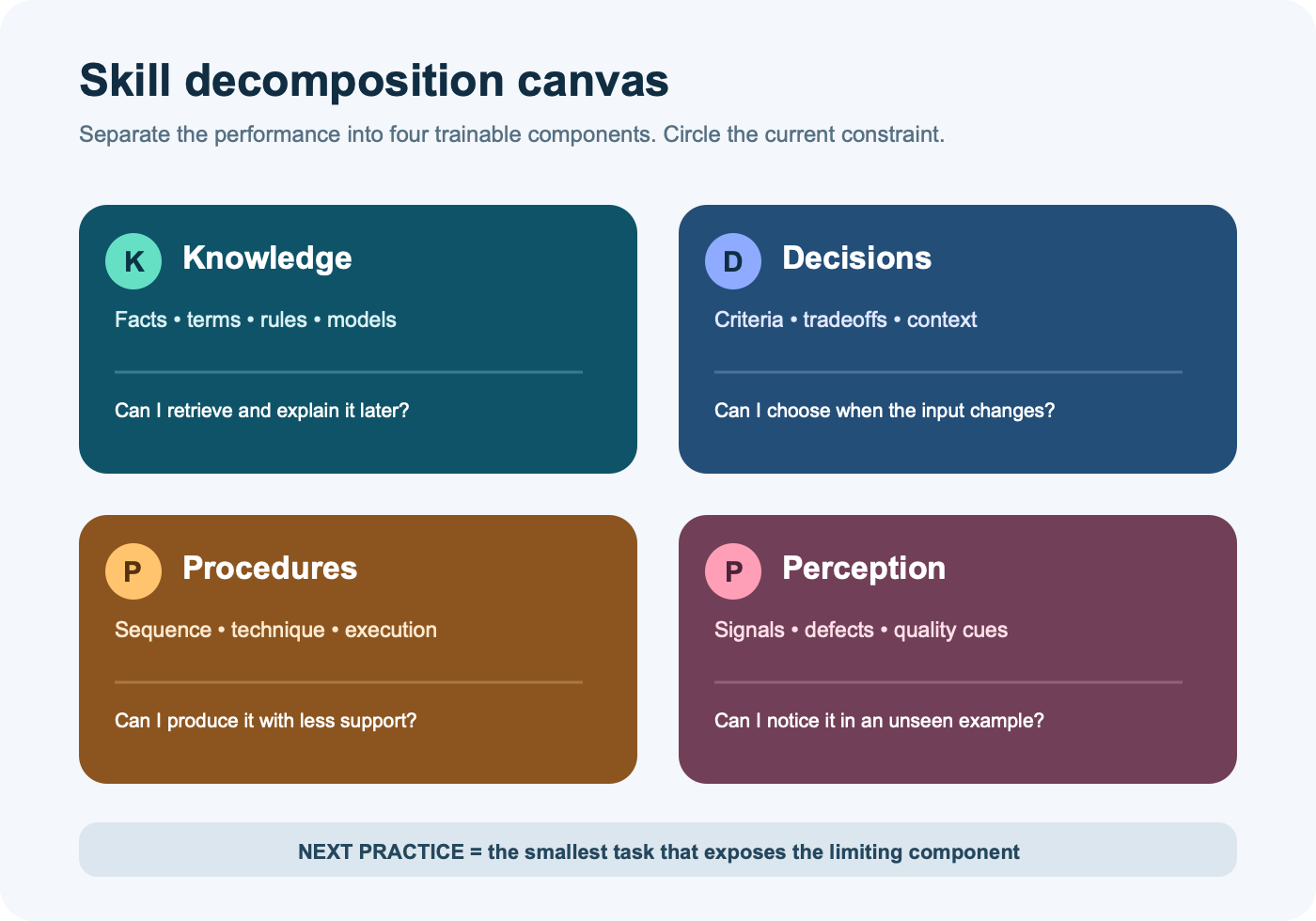
Most practical skills are bundles. A person can know the vocabulary yet make poor decisions, perform the steps yet miss defects, or recognize quality yet lack the procedure to reproduce it. Split the target into four trainable components:
| Component | Question | Example practice | Evidence of improvement |
|---|---|---|---|
| Knowledge | What facts, terms, rules, or mental models must be available? | Recall an explanation from a blank page; answer why and when questions. | Accurate retrieval after a delay, not recognition while notes are open. |
| Decisions | What choice changes with context? | Compare two cases and state the criterion for choosing a method. | The choice remains defensible when the input changes. |
| Procedures | What sequence must be performed reliably? | Complete one small run, inspect the failure, and repeat the corrected segment. | Fewer errors, less help, or a cleaner result under the same conditions. |
| Perception | What pattern, defect, signal, sound, or quality difference must be noticed? | Classify contrasting examples and explain the cue that separates them. | Correct detection on examples that were not used during instruction. |
Now name three to seven subskills and mark dependencies. A chart cannot communicate well if the learner cannot validate the underlying numbers. Pronunciation practice cannot repair a word that was never heard accurately. Choose the current limiting component, not the most entertaining lesson.
Use the canvas as a living diagnosis. A beginner may need a worked example for the procedure, then later discover that judgment or perception has become the constraint. The map should change as the performance changes.
Choose learning resources by the job they perform
Do not assemble a large library before the first attempt. Start with four resource jobs, and allow one resource to fill several jobs:
- Orientation: one coherent explanation that names the parts and demonstrates the full target once.
- Reference: a searchable source for syntax, controls, standards, or definitions during practice.
- Feedback: a rubric, model output, automated check, coach, peer, recording, or measurable result.
- Practice input: realistic files, prompts, cases, materials, or scenarios that vary enough to prevent memorizing one example.
For software skills, the ToolMerit tutorial library provides bounded task routes that can serve as orientation or reference. The learner still needs an unaided attempt and a transfer task; following a route once is not proof that the skill has transferred.
Worked examples are particularly useful when a novice cannot yet see the hidden decisions in a finished result. Research on worked examples for novice problem solving and learner-generated self-explanations supports studying not just what an expert did, but why each step applied. As competence grows, fade the support: cover the next step, complete a partially worked case, then solve an unfamiliar case. Guidance that never fades becomes dependence.
ToolMerit’s view is simple: choose a course for the quality of its practice and feedback, not for the number of videos. A strong learning resource exposes decisions, supplies usable examples, makes errors visible, and helps the learner operate without it.
For knowledge that must stay findable between attempts, the knowledge-base structure guide explains how durable answers differ from a pile of saved links.
Run the attempt feedback transfer loop
The useful loop is not watch–watch–watch. It is attempt–compare–repair–retrieve–transfer.
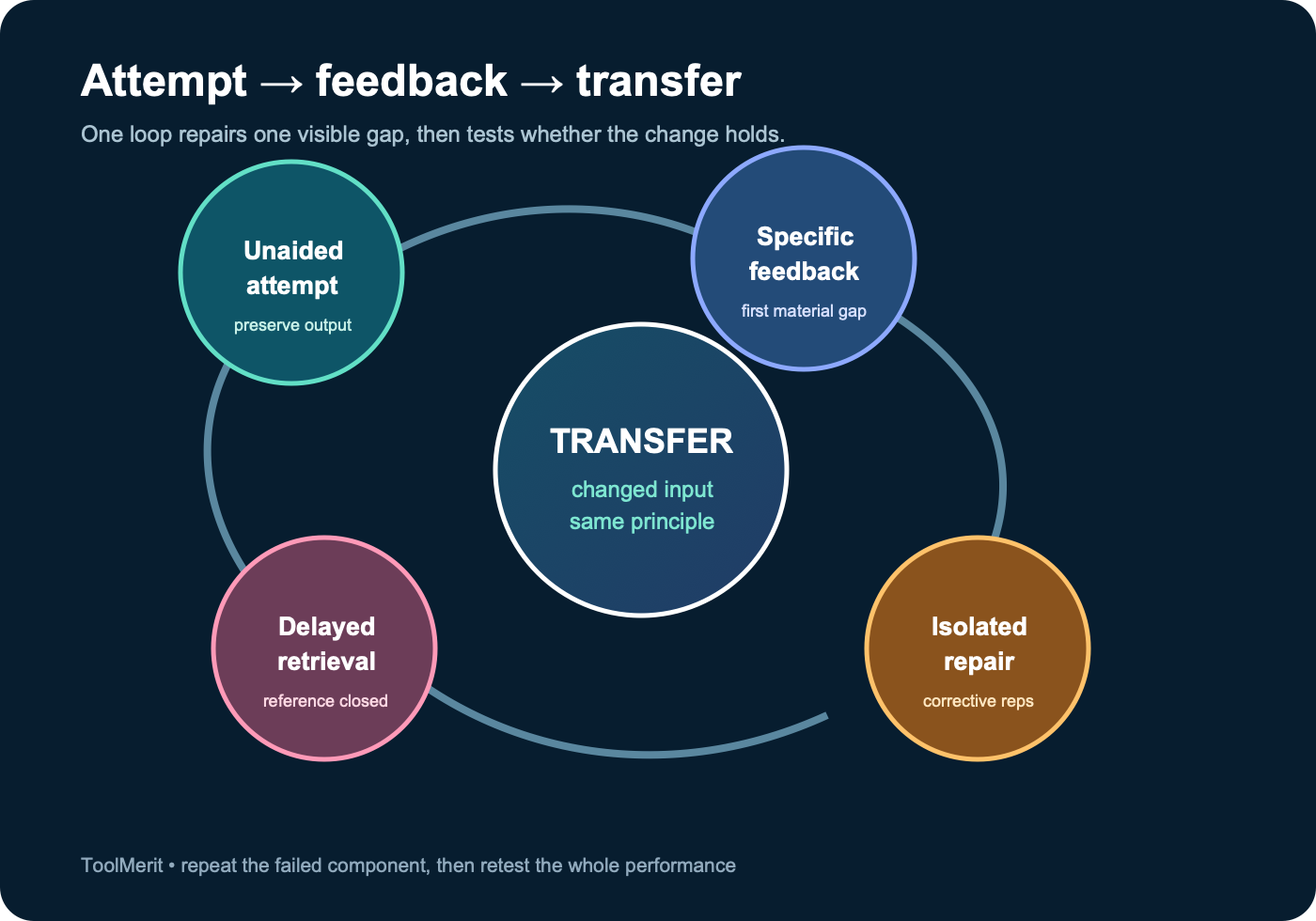
- Make a short unaided attempt. Use the support allowed by the outcome contract, but do not copy the demonstrated sequence line by line. Preserve the output.
- Compare against a criterion. Use a reference result, rubric, test, linting tool, teacher, coach, peer, or playback. Ask for the first material difference, not a general score.
- Isolate one repair. Rehearse the smallest subskill that caused the difference. If a chart fails because categories are sorted incorrectly, repair sorting before rebuilding the entire dashboard.
- Retrieve after a delay. Explain the decision or reproduce the critical move with the reference closed. A controlled retrieval-practice study using science material shows why reconstruction can produce more durable learning than another exposure, especially for knowledge and conceptual material.
- Transfer to a variation. Change the input, constraint, tool, audience, or order. A correct repetition of the training example is evidence of reproduction; a correct response to a new case is stronger evidence of a skill. Current experimental work also shows that the effects of variability, worked examples, and retrieval depend on the available instruction and task.
Match feedback to the component. A spell checker can reveal a surface error but not whether an argument is persuasive. A compiler can reject invalid code but not decide whether the program solves the right problem. A camera recording can expose timing, cursor movement, posture, or delivery that is hard to notice during performance. Mac users can follow the screen-recording workflow for a reviewable practice artifact, taking care to exclude private information.
Feedback is not automatically helpful. A broad comment such as “be more confident” gives no next repetition. A major meta-analysis of feedback interventions is one reason to avoid treating all feedback as uniformly beneficial. Prefer feedback that identifies the task, the observed gap, the criterion, and the next correctable action. Preserve only enough evidence to compare attempts; do not turn the learning log into a second hobby.
Use the seven session practice plan
Distributed practice generally supports longer-term retention better than compressing all exposure into one sitting, but there is no universal ideal gap for every skill or deadline. A quantitative synthesis of spacing in verbal recall found that the useful gap interacts with the desired retention interval. Use this seven-session plan as a starting sequence, then shorten a gap when retrieval repeatedly fails or lengthen it when performance is effortless.
| Session | Primary job | Required output | Support level |
|---|---|---|---|
| 1 | Baseline and decomposition | An honest first attempt, outcome contract, and skill canvas | Reference available; no step-by-step copying |
| 2 | Worked example and self-explanation | Annotations explaining why each important decision applies | Full example visible |
| 3 | Reconstruction | A second attempt plus one specific feedback item | Reference closed until comparison |
| 4 | Delayed retrieval and repair | Blank-page explanation or unaided critical procedure, then corrective repetitions | Hints only after the attempt |
| 5 | Variation | The same performance with a changed input or constraint | Searchable reference allowed; no tutorial replay |
| 6 | Realistic integration | A complete small project under the intended conditions | Only the support permitted by the contract |
| 7 | Transfer test and remap | A novel task, scored result, and next limiting subskill | No worked example |
A sample calendar might place these on days 1, 2, 4, 7, 11, 16, and 23. That cadence is an implementation choice, not a scientific constant. Keep the session short enough to protect attention and long enough to produce an inspectable output. If scheduling and handoffs become the failure point, a lightweight board from the project management tools collection can hold the next session, artifact, feedback owner, and due date.
Record four fields after each session: attempt made, largest observed gap, repair performed, next retrieval date. Hours watched and pages highlighted are inputs; they do not replace these records.
Worked example: learn a spreadsheet dashboard
Here is the complete system applied to the example from the opening.
1. Contract
Given an unfamiliar sales CSV, produce a clean table, pivot summary, and one defensible chart in 45 minutes; verify totals, explain the chart choice, and refresh the result after one source change without replaying a tutorial.
2. Canvas
- Knowledge: table structure, data types, relative versus absolute references, pivot vocabulary, chart encodings.
- Decisions: which metric answers the question, the time grain, grouping, chart form, and what must be excluded.
- Procedures: import, clean, convert to table, validate totals, build pivot, chart, refresh.
- Perception: notice blank rows, mixed date formats, duplicate records, implausible totals, truncated labels, and misleading axes.
3. Orientation and baseline
Use the first useful Excel spreadsheet project as a worked orientation. Before following it, attempt to turn a small expense list into a table with a total and chart. Save that baseline; it will reveal whether the initial constraint is navigation, formulas, structure, or chart judgment.
4. Practice loops
In one loop, rebuild the table from a different CSV without notes. Compare row counts and totals, then isolate the first mismatch. In another, inspect three candidate charts and state what decision each supports before building one. Later, use a file with renamed columns and an extra category so the procedure cannot be copied mechanically.
5. Transfer proof
On the final session, use an unseen dataset. The result passes only if the workbook refreshes, the totals reconcile to a simple independent calculation, the chart answers the stated question, and the learner can explain one rejected alternative. Speed is useful only after those controls pass.
This worked project can finish without covering every Excel feature. That is the point: capability grows around a meaningful performance, while the skill canvas reveals what to learn next.
Once the table and totals are reliable, continue with the Excel chart-building workflow and use its checks as the transfer task.
Diagnose why learning has stalled
| Symptom | Likely design problem | Next repair |
|---|---|---|
| “I understand the lesson, but I freeze on a blank task.” | Recognition is being mistaken for unaided production. | Close the example, reconstruct the smallest complete output, then compare. |
| “Practice feels smooth, but a new case breaks me.” | The same input and sequence are being repeated. | Change one meaningful condition and state which principle should remain invariant. |
| “I keep making the same mistake.” | Feedback arrives too late, is too broad, or never becomes a corrective repetition. | Isolate the causative subskill and perform several corrected attempts immediately. |
| “I keep switching courses.” | The resource has become the project because no performance contract controls selection. | Freeze new resources until one baseline attempt identifies a real gap. |
| “I remember it during the session and lose it later.” | There is exposure without delayed retrieval, or the first gap is too long. | Schedule an earlier closed-reference recall, correct it, and try the longer gap again. |
| “I can perform the parts but the whole project collapses.” | Subskills were drilled but not integrated under realistic conditions. | Run a smaller end-to-end project and diagnose the handoff between components. |
| “The plan is exhausting before I begin.” | The outcome includes too many variables or an expert quality bar. | Shrink the performance, preserve one useful result, and define a novice-appropriate criterion. |
If the practice plan is sound but sessions keep disappearing, use the timesheet field and workflow guide to compare planned sessions with observed time and distinguish missing capacity from a weak learning method.
Know what progress actually proves
Practice matters, but it does not explain every difference in performance, and no learning technique works identically across every domain. A meta-analysis across music, games, sports, education, and professions found very different relationships between deliberate practice and performance by domain. Retrieval strengthens accessible knowledge; it does not replace physical movement, perceptual discrimination, judgment under pressure, or supervised practice where safety matters. Deliberate practice is structured work aimed at improvement, not a guaranteed formula for expertise.
Use four progressively stronger claims:
- I completed it with a model open. Evidence of guided reproduction.
- I completed it after a delay with less support. Evidence of retention.
- I diagnosed and corrected my own error. Evidence of monitoring and control.
- I completed a changed task and explained the decisions. Evidence of transfer within the tested boundary.
After the transfer test, return to the canvas and circle the new limiting subskill. Write the next outcome contract around that constraint, keep the artifact that proves the starting point, and schedule the first unaided attempt.
For a complex writing application, the research-paper workflow provides visible question, evidence, outline, draft, and revision artifacts to assess.