

A diagnostic spelling method that starts with the clue you have and verifies every candidate through pronunciation, meaning, grammar, and authority.
You heard a word, can almost see it on the page, and still cannot type enough of it for a spellchecker to help. How do you spell something when the spelling itself is the missing information?
If you do not know how to spell a word, start with the clue you actually have—its sound, part of the spelling, meaning, sentence, or official name—generate a small set of candidates, and accept one only after its pronunciation, meaning, grammatical role, and authoritative form all match.
The important distinction is between finding a plausible word and proving that it is the word you need. A search result, autocorrect change, or AI suggestion can produce candidates. It cannot decide your intended meaning for you. The method below works even when your first attempt is far from the final spelling.
Choose a route from the clue you have
Do not begin by trying random letter combinations. First name the information that is reliable. Your best route changes according to that starting clue.
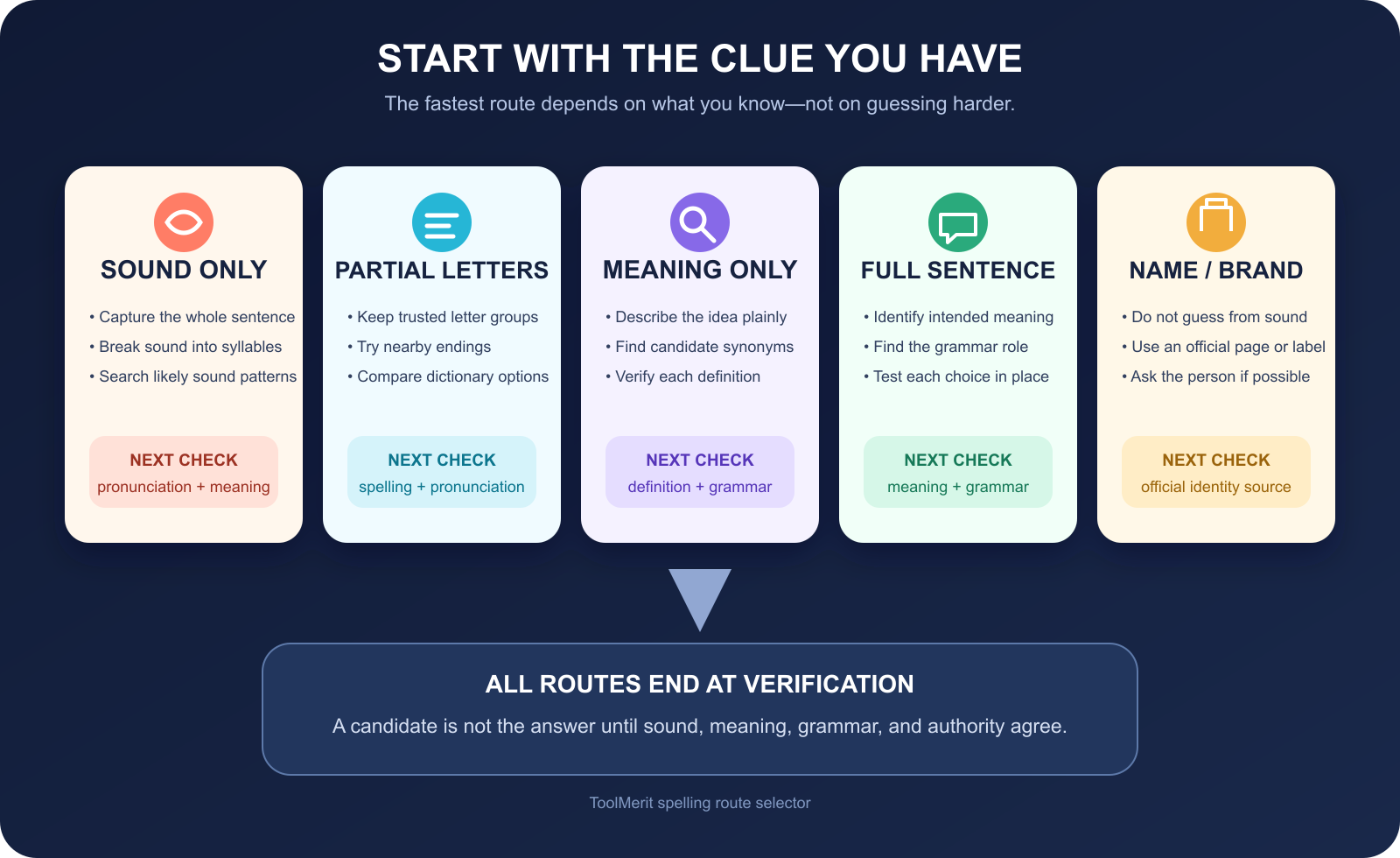
| What you know | How to generate candidates | First proof to check |
|---|---|---|
| The sound | Write the complete sentence, divide the sound into syllables, and search one or two plausible sound patterns. | Dictionary pronunciation |
| Some letters | Keep the letter group you trust; vary an uncertain vowel, doubled consonant, prefix, or ending. | Spelling plus pronunciation |
| The meaning | Describe the idea in ordinary words, then use a thesaurus or reverse-dictionary search to find candidate terms. | Definition |
| The sentence | Replace the gap with each candidate and identify the job the missing word performs. | Meaning plus grammar |
| A person, place, product, or organization | Find an official profile, page, label, email signature, or publication. | Identity source |
Preserve the sentence whenever you can. The same sound can point to different words, while the sentence supplies meaning and grammar. “The bicycle remained ___” asks for an adjective describing lack of movement; “I bought new ___” asks for a noun naming writing materials. Sound alone cannot separate those answers.
Build candidates without committing to one
Candidate generation is a short search, not a spelling test. Write two or three possibilities, even if they look strange, and keep a note of the intended meaning. When you know the sound, pronounce it slowly but do not assume every sound maps neatly to one letter. When you know part of the word, protect the certain letters and vary only the doubtful region. When you know only the meaning, search the concept rather than inventing phonetic spellings.
A useful candidate record contains four pieces:
- Heard or attempted form: what you heard or first typed.
- Source sentence: the words immediately before and after it.
- Intended meaning: a plain-language description.
- Candidate list: no more than a few forms worth checking.
This prevents the first visually familiar suggestion from winning by default. If a tool gives ten options, reduce them by meaning before examining tiny spelling differences.
Run the four-proof spelling check
A dictionary entry is useful because it brings several kinds of evidence together. For example, the Merriam-Webster entry for definitely identifies the word as an adverb, supplies pronunciations and meanings, and traces it to definite plus -ly. Use those fields as separate tests rather than glancing only at the large headword.
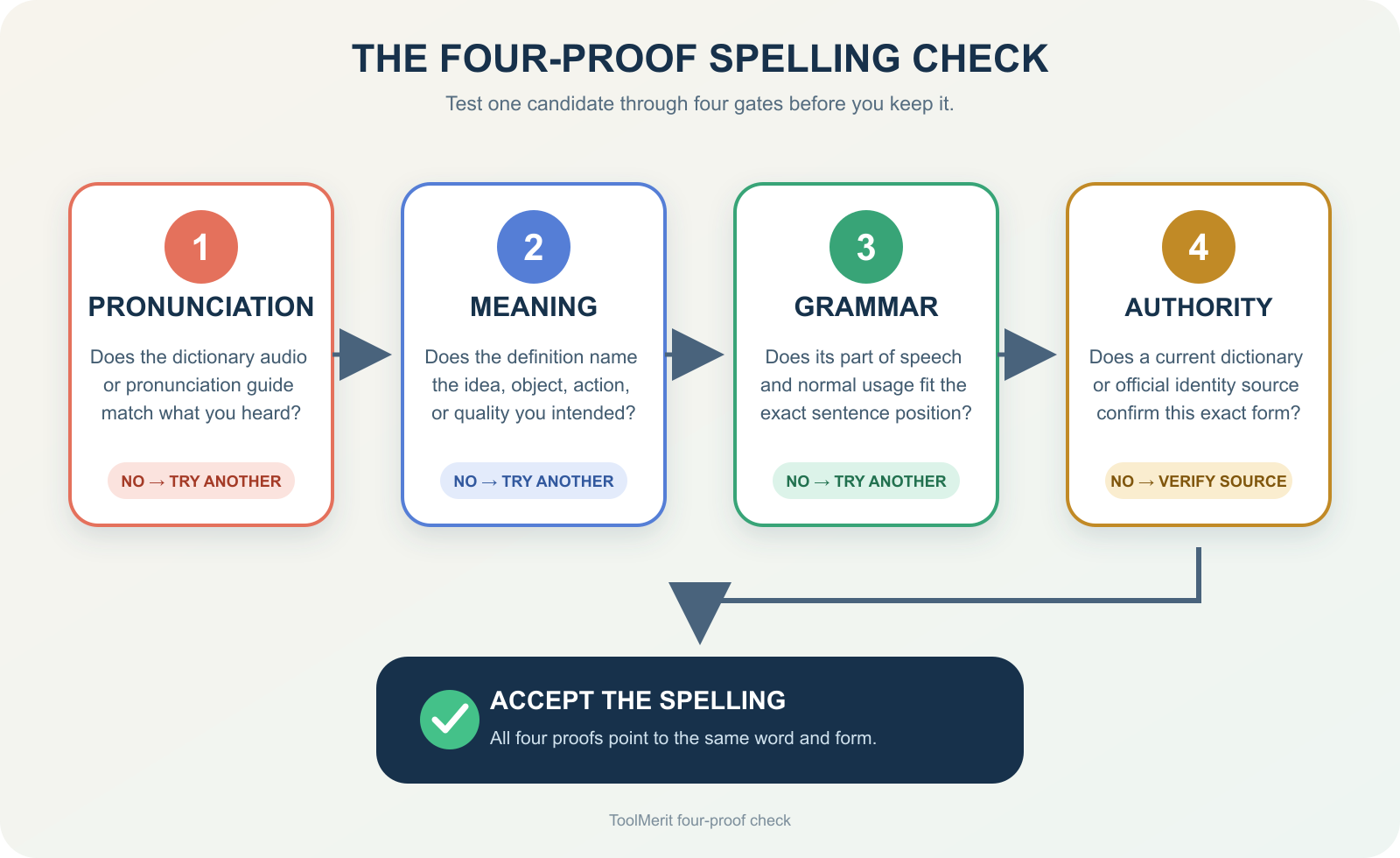
- Pronunciation: Does the recorded pronunciation match the word you heard? Allow for the speaker’s accent, but investigate a major mismatch.
- Meaning: Does the definition name the intended thing, action, quality, or relationship?
- Grammar: Does the part of speech fit the slot? An adjective cannot silently do the work of a noun just because it sounds right.
- Authority: Does a current dictionary confirm the ordinary word, or does an official identity source confirm the proper name?
For ordinary vocabulary, one reputable dictionary may provide all four checks. For specialist terms, compare the dictionary with an official glossary or the organization that defines the term. For names, the person or organization is the spelling authority; a general dictionary is not.
Follow three spelling repair chains
From “definately” to “definitely”
Suppose the attempted form is definately in “I will ___ attend.” A spellchecker may suggest definitely, but the suggestion still needs proof. The dictionary pronunciation is compatible, the definition expresses certainty, and the entry labels it an adverb—the grammar required after “will.” The word history provides a durable structural clue: definite + -ly. The repair is not “replace an a with an i”; it is “recover the visible base word definite.”
From one sound to “stationary” or “stationery”
These candidates share a pronunciation, so the sound test cannot choose between them. Meaning does. Stationary is an adjective meaning fixed or not moving. Stationery is a noun for writing materials or matching letter paper and envelopes. Grammar confirms the distinction:
- “The bicycle remained stationary.” The sentence needs an adjective describing the bicycle.
- “She ordered new stationery.” The sentence needs a noun naming what she ordered.
A memory cue can help after verification—paper and stationery both contain er—but the cue is not the proof. The definition and sentence are.
From “alot” to “a lot” or “allot”
This problem is spacing plus meaning, not merely one wrong letter. Merriam-Webster’s guide to a lot, allot, and “alot” explains that a lot is a two-word phrase for a large amount or high frequency, while allot is a verb meaning to assign a share. “We learned a lot” and “They will allot ten minutes” pass different meaning and grammar tests. The run-together form does not pass the authority check for standard edited prose.
Recognize the cases that sound cannot settle
Some spelling questions are really identity or style questions. Do not force them through a pronunciation-only search.
- Proper names: Many spellings can represent the same pronunciation. Ask the person or copy the form from an official profile, byline, email signature, or organization page.
- Regional variants: Two forms may both be accepted in different English varieties. Follow the dictionary, style guide, school, publisher, or client chosen for the document, then stay consistent.
- Spaces and hyphens: The answer may be one word, two words, or a hyphenated form, and it may change by grammatical use. Check the complete phrase, not only its pieces.
- Specialist vocabulary: An industry term may not appear in a general spellchecker. Verify it in an official manual, standard, product documentation, or field-specific glossary.
If two authoritative sources allow different forms, the task is no longer “find the only correct spelling.” It is “choose the appropriate convention and apply it consistently.” Record that convention in the document’s style notes.
Use spellcheckers and AI as candidate generators
A spellchecker is excellent at surfacing nearby forms, but selecting a suggestion can change a misspelling into the wrong correctly spelled word. Read the revised sentence after every replacement. If the suggestion changes the meaning, reject it even when the red underline disappears.
Be especially careful with “Add to dictionary.” Microsoft’s custom-dictionary documentation explains that an added word is subsequently treated as recognized by the relevant spelling checks. That makes the command useful for a verified name or specialist term—and risky for an unverified typo. Confirm the exact form first, then add it.
The same rule applies to AI. Ask it for possible spellings from a sound, definition, or sentence; then run each answer through a dictionary or official source. A fluent explanation does not replace the four proofs.
Escalate cleanly when no candidate passes
If nothing survives all four checks, uncertainty is information. Do not keep stretching the nearest candidate until it seems acceptable. Instead:
- Return to the original audio, speaker, note, or source sentence.
- Ask for a definition, example, origin, or spelling if a person is available.
- Search a distinctive phrase from the surrounding context.
- Move from a general dictionary to an official specialist source.
- Mark the word as unresolved in a draft rather than publishing a guess.
This is especially important for names, medical or legal terminology, model numbers, and quotations, where a plausible substitution may silently alter the underlying fact.
Keep a personal spelling repair log
Repeated errors become easier to fix when you save the reason for the repair, not only the corrected form. Use one small table in your notes or project file:
| Attempt | Verified form | Why it is correct | Fresh sentence |
|---|---|---|---|
| definately | definitely | Built from definite + -ly | The train will definitely stop here. |
| stationary / stationery | Choose by meaning | -ary = not moving; -ery = writing materials | The shop sells stationery. |
| alot | a lot | Two-word quantity phrase | A lot of the work is complete. |
Add only errors you actually make. Include one new sentence so you must retrieve both the form and its use. For a long manuscript, combine this log with the controlled drafting and revision passes in the book-writing workflow; it is more reliable than repeatedly interrupting the draft to solve the same word.
Use one final decision rule
Accept a spelling only when pronunciation, meaning, grammar, and authority point to the same form. If sound conflicts with meaning, search again. If two standard forms remain, follow the document’s chosen language or style convention. If the term is a name, use the owner’s official spelling. If no form passes, keep the uncertainty visible rather than converting a guess into a fact.
That is how you spell a word you do not yet know: start from the clue you possess, generate candidates without commitment, and let four independent proofs make the final choice.