

A book-writing system that turns one large ambition into a brief, draftable units, a production board, structural revision passes, and a first real session.
Most unfinished books do not fail because the author lacks a perfect opening sentence. They fail because “write the book” remains one enormous, undefined task.
Write a book by defining one reader promise or story change, breaking it into chapter or scene deliverables, drafting one unit at a time, reverse-outlining the completed draft, and revising structure before polishing prose.
This workflow works for both fiction and nonfiction, but the unit of progress differs. A nonfiction chapter must answer a reader question with trustworthy material. A fiction scene must change a character’s situation. The practical goal is not a certain daily word count; it is a manuscript in which every part performs a named job.
Define what the book must deliver
Before choosing chapter titles, make a one-page book brief. Purdue OWL’s current writing-process guide begins with purpose, audience, genre, tone, and required research. Those questions become more important—not less—when the document is book length.
Complete these fields in plain language:
Reader or central character: Who carries the book?
Starting state: What is true on page one?
Ending state: What must become understood, decided, achieved, lost, or changed?
Book promise: What experience or result does the book reliably deliver?
Scope: What belongs—and what tempting material is explicitly outside this book?
Material: Which evidence, interviews, examples, observations, characters, settings, or conflicts can support the promise?
Failure test: What would make the finished manuscript feel incomplete or unearned?
A useful brief is specific enough to reject material. “A book about productivity” cannot guide a chapter decision. “A field guide that helps a first-time remote manager replace status meetings with observable handoffs” can. For fiction, “a family drama” is weaker than a statement naming whose choices drive the story, what relationship changes, and what pressure makes that change unavoidable.
The brief is provisional. Keep it at the front of the project and revise it when the actual book becomes clearer. Do not spend the first week perfecting the title, cover, or sales copy; those cannot rescue an undefined manuscript.
Turn topics into chapter or scene contracts
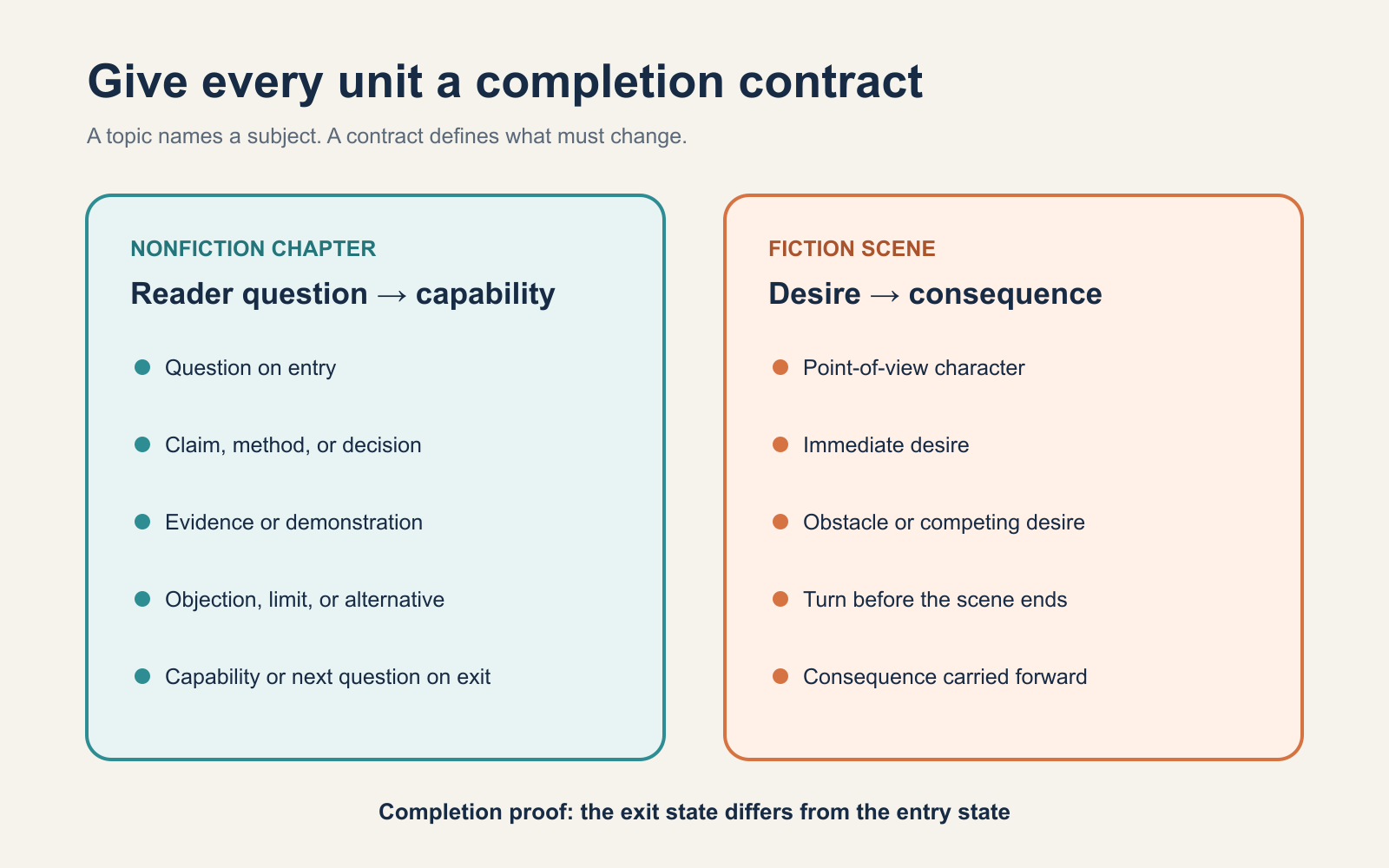
A list of topics is not yet an outline. Give each planned unit a short contract that tells you when the unit is doing its job.
| Nonfiction chapter contract | Fiction scene contract |
|---|---|
| Reader question entering the chapter | Point-of-view character entering the scene |
| Claim, method, or decision the chapter delivers | What that character wants now |
| Evidence, example, or demonstration required | Obstacle or competing desire |
| Important objection, limit, or alternative | Turn: what changes before the scene ends |
| Reader capability or next question on exit | Consequence carried into the next scene |
“Chapter 4: Trust” does not tell you what to write. “Show why visibility without decision rights produces performative reporting, then give managers a two-part handoff test” does. Likewise, “Scene 12: Train station” names a location; “Mara tries to leave unnoticed, but accepting her brother’s help exposes the secret she was protecting” creates a scene.
If a contract needs several unrelated outcomes, split it. If it has no change on exit, merge it with a stronger unit or remove it. This is the book-specific completion test that a generic word target cannot supply.
Outline the uncertainty, not just the headings
Arrange the contracts in the order a reader or character can actually traverse. Then mark what you do not yet know:
- Dependency: information or an event that must appear earlier.
- Gap: missing evidence, motive, transition, or consequence.
- Risk: a claim that may not hold, a coincidence doing too much work, or a chapter duplicating another.
- Open choice: two plausible structures that drafting must test.
The outline should reduce uncertainty without pretending to eliminate discovery. The National Centre for Writing notes in its manuscript-structure guidance that structure can evolve through the first draft and later rewrites, and that the software matters less than whether the method works for the writer. Cards in a document, spreadsheet, notebook, or writing application are all valid if they keep the book visible as separate, movable units.
Choose a production rhythm you can repeat
Do not borrow another author’s daily quota as if it were a law. Choose a commitment you can keep through ordinary weeks: perhaps three 45-minute sessions, two completed scene contracts, or one research-and-draft block. Track the unit you control—sessions or completed contracts—not whether the day’s prose felt brilliant.
Give every session a minimum version:
- Open one ready contract rather than browsing the entire manuscript.
- Write for the smallest period you can reliably protect.
- Mark unresolved facts or continuity with a visible token such as
[VERIFY]or[CONTINUITY]. - Before stopping, leave one sentence describing the next concrete move.
That last sentence reduces restart cost. “Continue chapter five” is vague. “Add the failed handoff example, then test whether the exception belongs before the method” gives the next session an entry point.
The National Centre for Writing’s novel-writing guidance frames regular practice, drafting, and later editing as distinct parts of the work. Your schedule can be flexible; the separation of jobs is what prevents every new paragraph from becoming a referendum on the entire book.
Run a two-lane book production board
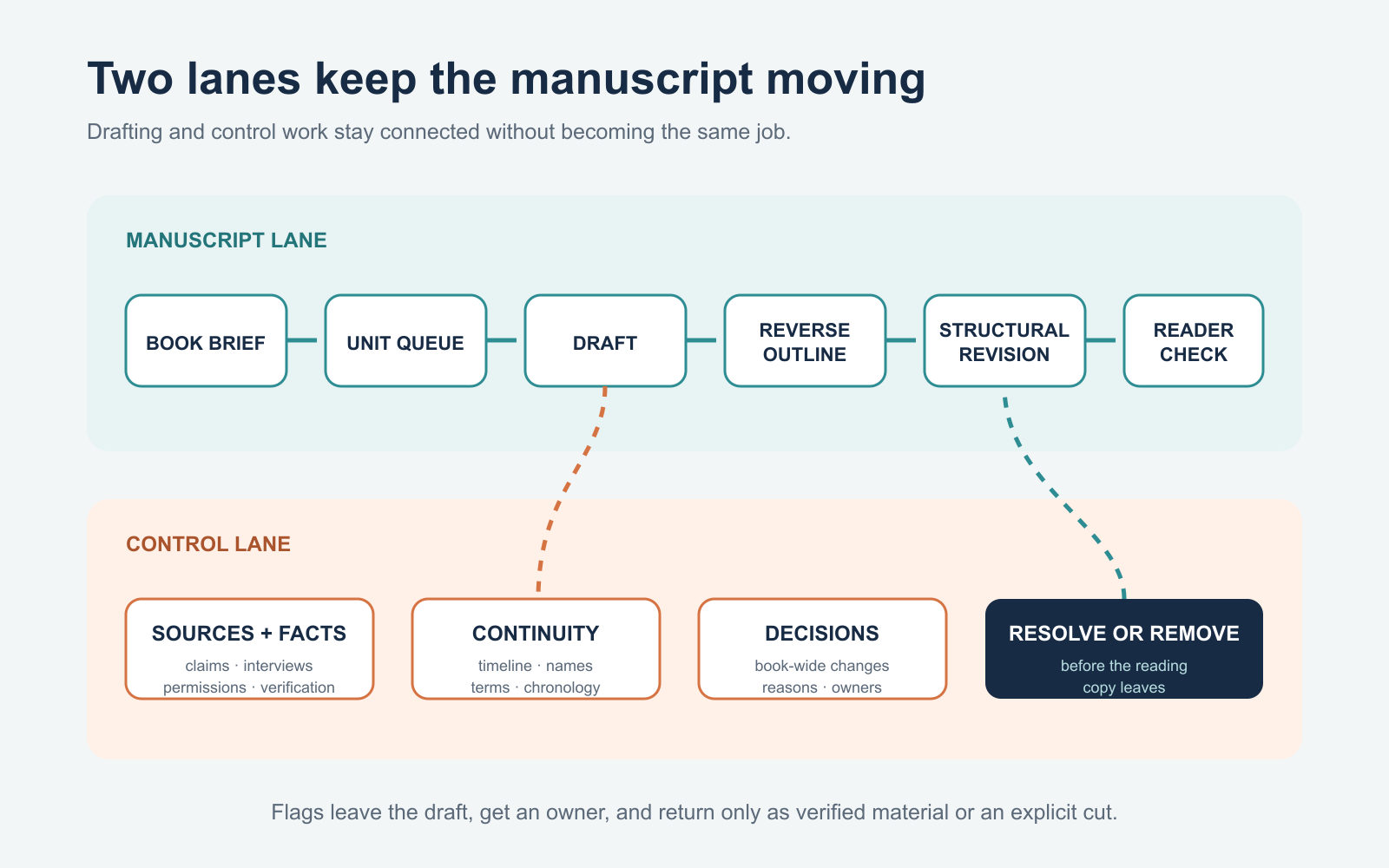
A book generates two kinds of work. Mixing them inside one document makes both harder.
- Manuscript lane: brief → contract queue → drafting → reverse outline → structural revision → reader check.
- Control lane: sources, interview permissions, fact checks, continuity, naming, chronology, cuts, and decisions that affect several units.
During a draft, a missing statistic does not have to stop a whole chapter. Insert [VERIFY: current adoption figure], create a control-lane item with the intended claim and source requirement, and continue. Before external readers see the manuscript, resolve the flag or remove the unsupported specificity. For fiction, use the same lane for dates, ages, locations, injuries, promises, and other continuity that must remain consistent.
Keep a short decision log for changes that affect the whole book: narrator, terminology, timeline, audience level, recurring examples, and spelling conventions. Otherwise one decision will be remade differently in six chapters.
Use AI without surrendering the book’s decisions
An AI writing assistant can help generate questions, challenge an outline, list possible counterarguments, find contradictions in material you provide, or suggest ways to test a weak transition. It cannot take responsibility for your sources, lived claims, interview consent, creative judgment, or final voice.
Use a simple boundary:
- Delegate transformations: turn your notes into questions, compare two structures, extract unresolved claims, or produce an edit checklist.
- Retain authorship decisions: select the premise, interpret evidence, decide what a character does, choose what belongs, and write or deliberately approve the final expression.
- Verify outputs: check every fact, quotation, citation, and attributed idea against the actual source.
- Protect inputs: do not paste confidential interviews, unpublished collaborators’ work, or restricted material into a service without authorization and an acceptable data policy.
If generated prose sounds competent but could belong in any book, it has not solved a manuscript problem. Return to the chapter or scene contract and ask what only this unit can make true.
Finish the first draft before polishing it
A first draft is complete when every necessary unit exists, the beginning reaches an ending, and unresolved flags are collected in a visible list. It can contain awkward transitions, flat sentences, excess material, and placeholders. It cannot omit the central explanation or scene while claiming that a future edit will somehow discover it.
Use this first-draft gate:
- Each chapter or scene has an exit change.
- Every promised section exists in some form.
- The ending answers or transforms the central book question.
- Research and continuity flags are searchable and assigned.
- Major alternative fragments live outside the reading draft.
Do not line-edit chapter one twenty times while later chapters remain imaginary. A beautiful opening can be cut when the full structure reveals where the book actually begins.
Reverse-outline the manuscript you actually wrote
After the full draft, make a new one-line record for every chapter or scene. Do not copy the original plan. Record what the unit now does, what changes, and why it must appear in that position.
Harvard’s Writing Center recommends reverse outlining because ideas develop during drafting; the resulting summary exposes gaps, repetition, overloaded sections, and points that arrived in the wrong order. Scale that method from paragraphs to book units:
| Reverse-outline field | Question to answer |
|---|---|
| Entry state | What does the reader or character know, believe, want, or face beforehand? |
| Unit job | What claim, action, choice, or reversal occurs here? |
| Exit state | What is different afterward? |
| Dependency | What earlier material makes this unit possible? |
| Forward pull | What question, consequence, or capability now moves the book onward? |
Read only that compact outline first. Move, combine, split, or cut units there before rewriting hundreds of pages. Then update the manuscript to match the chosen structure.
Revise in passes that do different jobs
Purdue’s revising and editing guide separates revision from editing and puts revision first. That order prevents writers from polishing prose that a structural pass later deletes.
- Book pass: Does the whole manuscript deliver the brief’s promise or earn its central change?
- Sequence pass: Are units ordered by reader need, cause and effect, pressure, or discovery?
- Contract pass: Does each chapter or scene complete its specific job without duplicating another?
- Truth pass: Resolve facts, citations, permissions, chronology, and continuity.
- Line pass: Improve clarity, voice, rhythm, dialogue, transitions, and unnecessary repetition.
- Proof pass: Correct spelling, punctuation, formatting, references, and production errors after substantive changes stop.
Save a version at major structural milestones. Keep cut material in a separate archive, but do not leave it inside the reading draft “just in case.” An archive makes deletion reversible without asking the reader to carry the weight.
Ask early readers questions they can answer
Choose readers for a job. A target reader can report confusion and usefulness. A practiced genre reader can test expectations and pacing. A subject expert can challenge a nonfiction claim. One person does not automatically cover all three.
Send a clean reading copy with a short brief and ask:
- Where did you stop trusting, caring, or understanding?
- What did you expect the book to address that never arrived?
- Which chapter or scene felt removable without changing the result?
- Where did you need an example, source, motive, or consequence?
- Did the ending fulfill the promise or change established at the start?
Collect observations before defending choices. Look for patterns across readers, then decide what to change. Readers diagnose an experience; the author remains responsible for the repair.
Use the next 60 minutes to begin the actual book
- Minutes 0–15: fill the seven fields in the one-page book brief.
- Minutes 15–30: create three chapter or scene contracts that the book cannot work without.
- Minutes 30–55: draft the contract with the clearest exit change; it does not have to be chapter one.
- Minutes 55–60: move unresolved issues into the control lane and write the next session’s first action.
If the one-sentence promise is still vague, our elevator-pitch template can help compress the book’s audience, problem, difference, and next question without turning the manuscript into sales copy. At minute 60, the useful result is not “I want to write a book.” It is a brief, three draftable units, one piece of manuscript, and a recorded restart point.