
A research workflow that keeps the question, evidence, claims, citations, and final revision connected from the first search to submission.

A student can spend hours collecting articles and still have no paper because the search produced a pile, not an argument. To write a research paper, convert the assignment into a focused research question, search for credible sources, capture each source’s claim and evidence in a ledger, form a provisional thesis from the pattern you find, outline claims rather than topics, draft each paragraph with evidence and reasoning, cite while writing, and revise in separate argument, evidence, structure, and style passes.
This guide covers a source-based academic paper. If the assignment requires interviews, surveys, experiments, human participants, or original data, stop and follow the instructor’s method and institutional ethics requirements before collecting anything.
Decode the assignment before choosing a topic
Copy the prompt and rubric into a one-page constraint sheet. Record:
- the task verb: analyze, compare, evaluate, explain, argue, or synthesize
- required topic, text, population, period, or case
- length, source count or source types, and date range
- required citation style and formatting
- forbidden methods or sources
- submission format, deadline, and grading criteria
“Discuss renewable energy” and “evaluate which policy most reduced residential electricity demand in one country from 2015 to 2025” require different evidence and structure. The rubric decides what successful work must demonstrate; a topic only names the territory.
Make the question small enough to answer
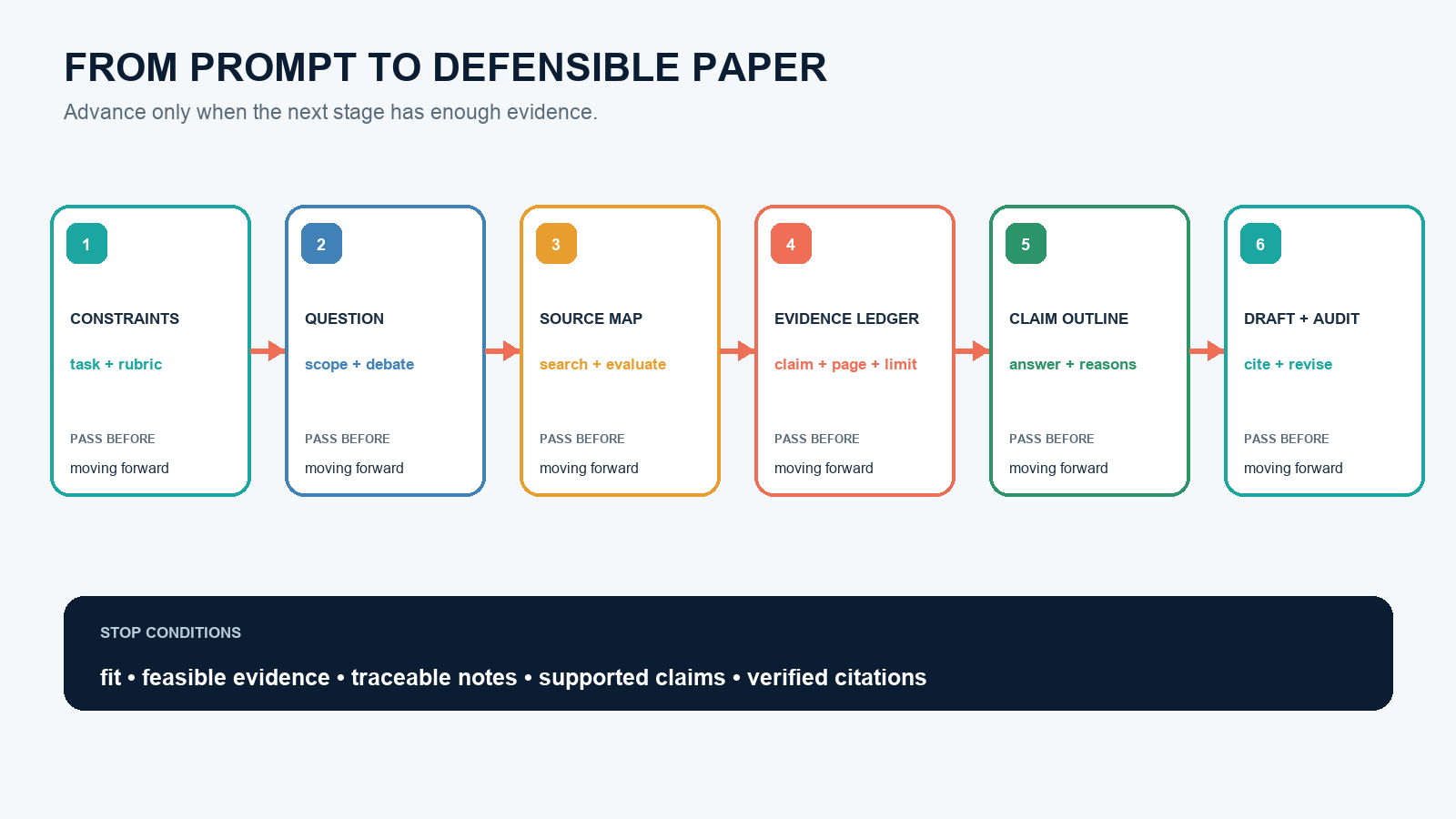
Start with a topic, then add a relationship and boundaries:
Broad: social media and sleep
Narrower: How does late-night short-video use relate to sleep duration among first-year university students?
Bounded: What do peer-reviewed observational studies published from 2020 to 2026 report about the relationship between late-night short-video use and sleep duration among first-year university students?
Pass the question through five tests:
- Assignment fit: does answering it perform the required task verb?
- Scope: can the answer fit the word count without becoming a list?
- Evidence: can you access credible sources that address the same variables, case, or debate?
- Interpretation: does the question require analysis, comparison, or evaluation rather than a one-line fact?
- Time: can you find, read, draft, and revise within the available sessions?
Purdue OWL’s research-question workshop describes a research paper as a project that develops while the writer critically evaluates, organizes, and interacts with sources. That is why the question may tighten after initial reading.
Search in layers, not with one perfect query
Build a search map with four columns: main concept, synonyms, population or case, and method or outcome. For the sleep example, combine terms such as short-form video, social media use, bedtime, sleep duration, college students, and first-year students.
Search in three passes:
- Orientation: recent reviews, reference entries, and course materials reveal vocabulary, major researchers, and recurring debates.
- Targeted retrieval: use library databases, subject indexes, books, journal searches, and authoritative repositories appropriate to the discipline.
- Citation chaining: inspect important papers’ reference lists and later works that cite them, then search the authors, concepts, and instruments directly.
Save the exact search string, database, filters, and date when the assignment values reproducibility. Do not mistake the first page of web results for the literature.
Evaluate each source for this question
A prestigious source can still be irrelevant, and a relevant source can still be weak. Use a compact source matrix:
| Check | Question to ask | Possible warning |
|---|---|---|
| Relevance | Does it address the same claim, population, period, or mechanism? | Similar topic, different question |
| Authority | Who produced it, with what expertise and review? | No accountable author or publisher |
| Method | How were evidence and comparisons produced? | Conclusion stronger than the design permits |
| Currency | Is the date suitable for this field and claim? | Outdated policy, software, or state of evidence |
| Purpose | Is it research, advocacy, marketing, reporting, or opinion? | Commercial claim presented as neutral evidence |
| Traceability | Can you locate the original evidence and stable citation? | Quote or statistic repeated without origin |
Harvard Library’s source-evaluation guide emphasizes currency, relevance, authority, accuracy, and purpose. Cornell Library likewise advises analyzing and independently verifying sources rather than accepting third-party search or social results.
Build an evidence ledger before drafting
Create one row per usable piece of evidence, not merely one row per source:
| Field | What to record |
|---|---|
| Source ID | Short stable key linked to full bibliographic data |
| Source purpose | Background, method, evidence, counterargument, or theory |
| Claim or finding | Your neutral one-sentence summary |
| Evidence detail | Population, method, result, quotation, figure, or example |
| Location | Page, section, paragraph, table, or timestamp |
| Limitation | Scope, design, missing data, conflict, or uncertainty |
| Planned use | Which paper claim this can support or challenge |
Write quotations with quotation marks at the moment of capture. Write paraphrases from comprehension, then compare them with the source for accuracy and independence. Add the citation immediately. Purdue’s plagiarism overview recommends tracking sources as research proceeds and warns that unverified digital citations can create misattribution.
A citation manager can store records and generate formatted citations, but inspect imported authors, title capitalization, date, page range, DOI, and item type. Harvard Library notes that citation tools can organize research and work with word processors; automation does not verify the metadata or whether the cited source supports your sentence.
Let the evidence shape a provisional thesis
A thesis is the paper’s answer to the research question, not a declaration written before reading. Draft it in this form:
Although [important qualification or competing view], the evidence indicates [main answer] because [reason 1], [reason 2], and [reason 3].
Mark it provisional. If the evidence is mixed, the thesis should explain the pattern or boundary rather than force unanimity. “Studies prove social media ruins sleep” overstates causation and uniformity. A better thesis could distinguish association, timing, measurement, and populations while naming what the available designs cannot establish.
Outline claims, not chapter-like topics
Replace headings such as “History,” “Benefits,” and “Problems” with sentences that advance the answer. Under each claim, list:
- the evidence-ledger rows that support it
- the reasoning needed to connect that evidence to the thesis
- a limitation, counterexample, or competing explanation
- the transition from the previous claim
If a section has no evidence row, research it or remove it. If one source appears under every claim, the paper may be reporting that source rather than synthesizing a field.
Draft the body before polishing the introduction
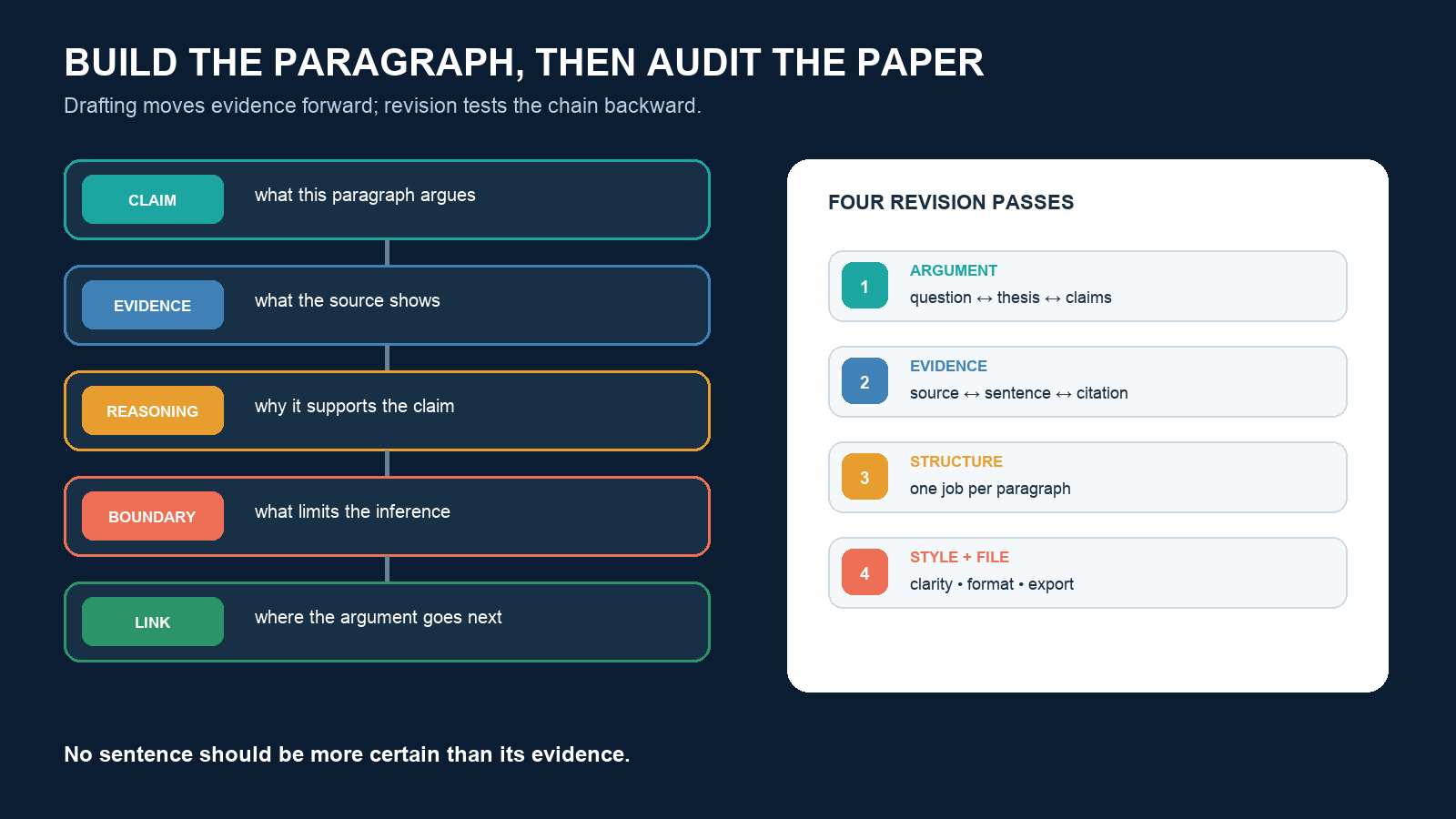
Use a claim-evidence-reasoning sequence:
- Claim: state the paragraph’s contribution in your own words.
- Evidence: present a precise finding, example, or source position with a citation.
- Reasoning: explain how and why the evidence supports, limits, or complicates the claim.
- Boundary: note a relevant limitation or counterpoint when it changes interpretation.
- Link: connect the result to the next claim or the thesis.
Draft the body while the evidence ledger is open. Write the introduction after the argument stabilizes: establish the problem, define the scope, state the research question, explain significance, and give the thesis. The conclusion should answer the question at the paper’s actual level of certainty, synthesize the implications, and avoid introducing unsupported evidence.
Cite the claim at the point of use
Cite quotations, paraphrases, distinctive ideas, data, visuals, methods, and claims that readers need to verify. Put the citation where its scope is clear; a single citation at the end of a long paragraph may not identify which sentences it supports.
Use the style assigned by the instructor—APA, MLA, Chicago, IEEE, or another system—and follow its current manual or course guide. Check that every in-text citation has a matching reference and that every reference is actually cited. Prefer a DOI or stable permalink where the style calls for one. Page or paragraph locations are especially important for quotations and useful during your own audit even when the final style does not require them for every paraphrase.
Follow the course’s generative-AI policy. Do not submit generated prose, analysis, citations, or summaries as your own when prohibited. Never trust a generated reference without opening the source and verifying its authors, title, publication, identifier, and support for the claim.
Revise in four passes
- Argument pass: does every major section answer the research question, and does the thesis match the evidence actually presented?
- Evidence and citation pass: open every source; verify quotation wording, numbers, context, page, citation scope, and reference match.
- Structure pass: reverse-outline each paragraph in five words. Move, merge, or cut paragraphs that duplicate or interrupt the argument.
- Sentence and format pass: improve clarity, define terms, remove filler, check tables and figures, apply the required style, and proofread the exported file.
Do not mix all passes. Fixing commas while the thesis is unstable wastes time; changing evidence after formatting can break citations and numbering.
Use a seven-session plan when time is short
| Session | Deliverable | Stop condition |
|---|---|---|
| 1 | Constraint sheet and two candidate questions | One question passes all five feasibility tests |
| 2 | Search map and orientation sources | Vocabulary and debate are visible |
| 3 | Core sources and evidence ledger | Each planned claim has evidence and a limitation |
| 4 | Provisional thesis and claim outline | Outline answers the question rather than lists topics |
| 5 | Body draft with citations | No evidence placeholder remains |
| 6 | Introduction, conclusion, argument and evidence passes | Thesis and body agree; every citation is verified |
| 7 | Structure, sentence, format, and export checks | Final file opens correctly and meets the rubric |
Save a submission copy and an editable source file. The final decision rule is simple: no sentence should be more certain than its evidence, and no citation should enter the paper unless you have opened and verified the source. That rule produces a paper a reader can follow backward from conclusion to claim, evidence, and original source.