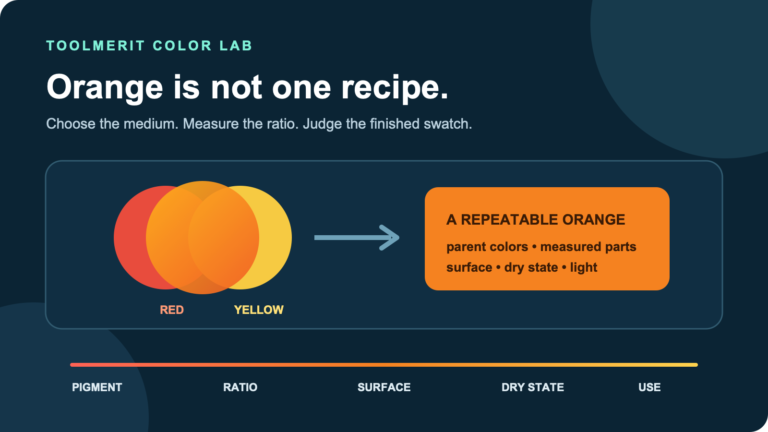
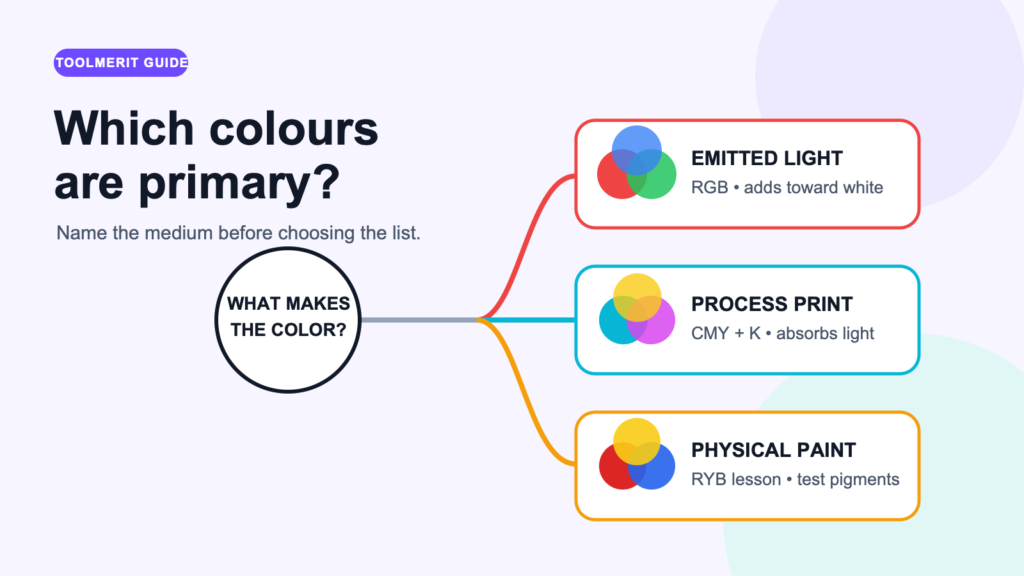
A medium-first decision route for choosing and verifying the right primary-color system.
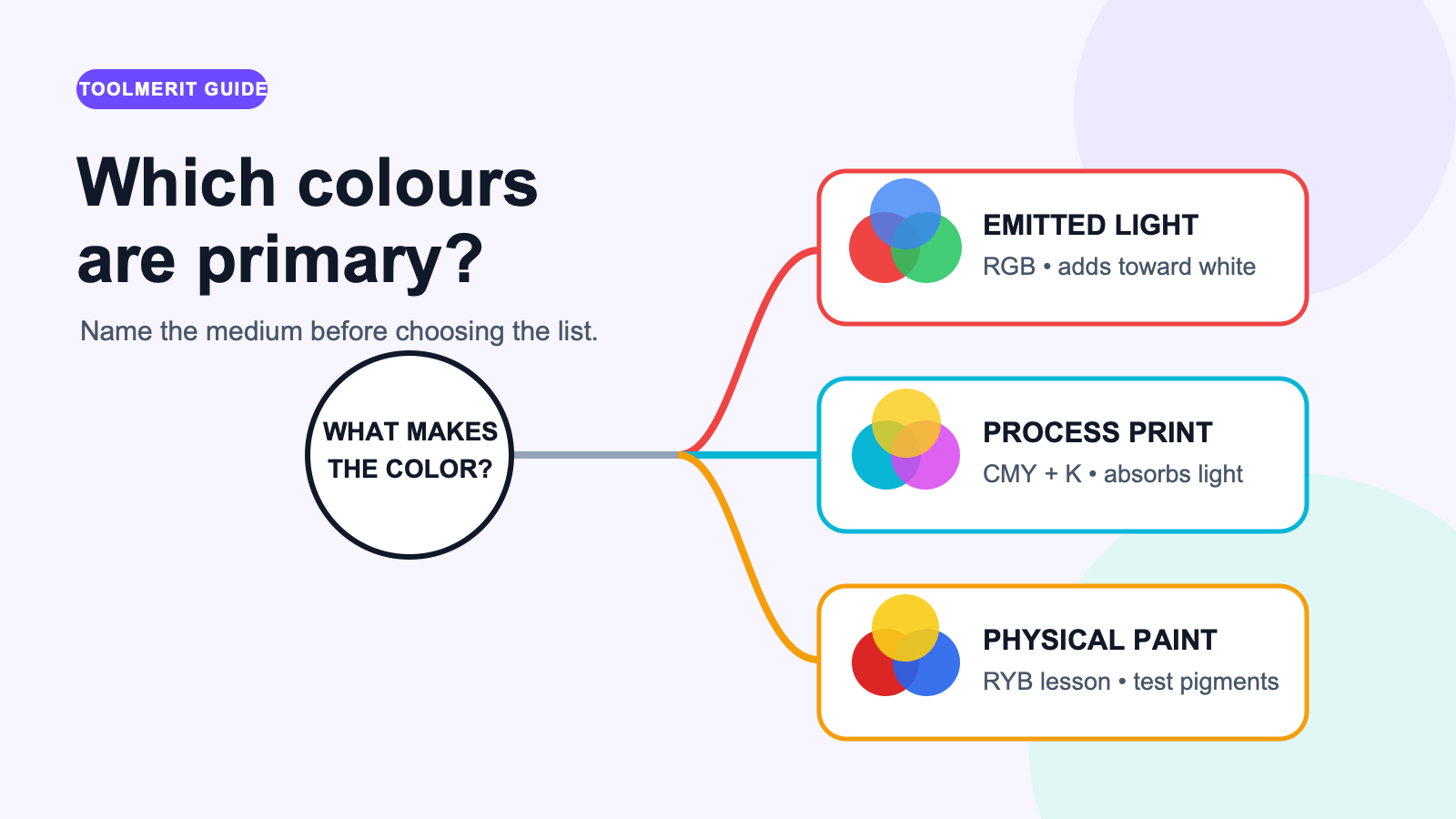
A color picker says red, green, and blue. A printer asks for cyan, magenta, yellow, and black. An art worksheet expects red, yellow, and blue. Copying one list into all three tasks is the common error.
The primary colors depend on the medium: red, green, and blue (RGB) for emitted light and screens; cyan, magenta, and yellow (CMY) for idealized subtractive mixing, with black added in practical CMYK printing; and red, yellow, and blue (RYB) in the traditional classroom paint model. Choose among them by naming what is being mixed, then check whether the observed behavior matches the model.
This page is a field test, not another catalog of color systems. The outcome is a defensible answer for the task in front of you: identify the medium, predict what adding a component should do, run a small check, and record the boundary.
Start with the medium, not the color wheel
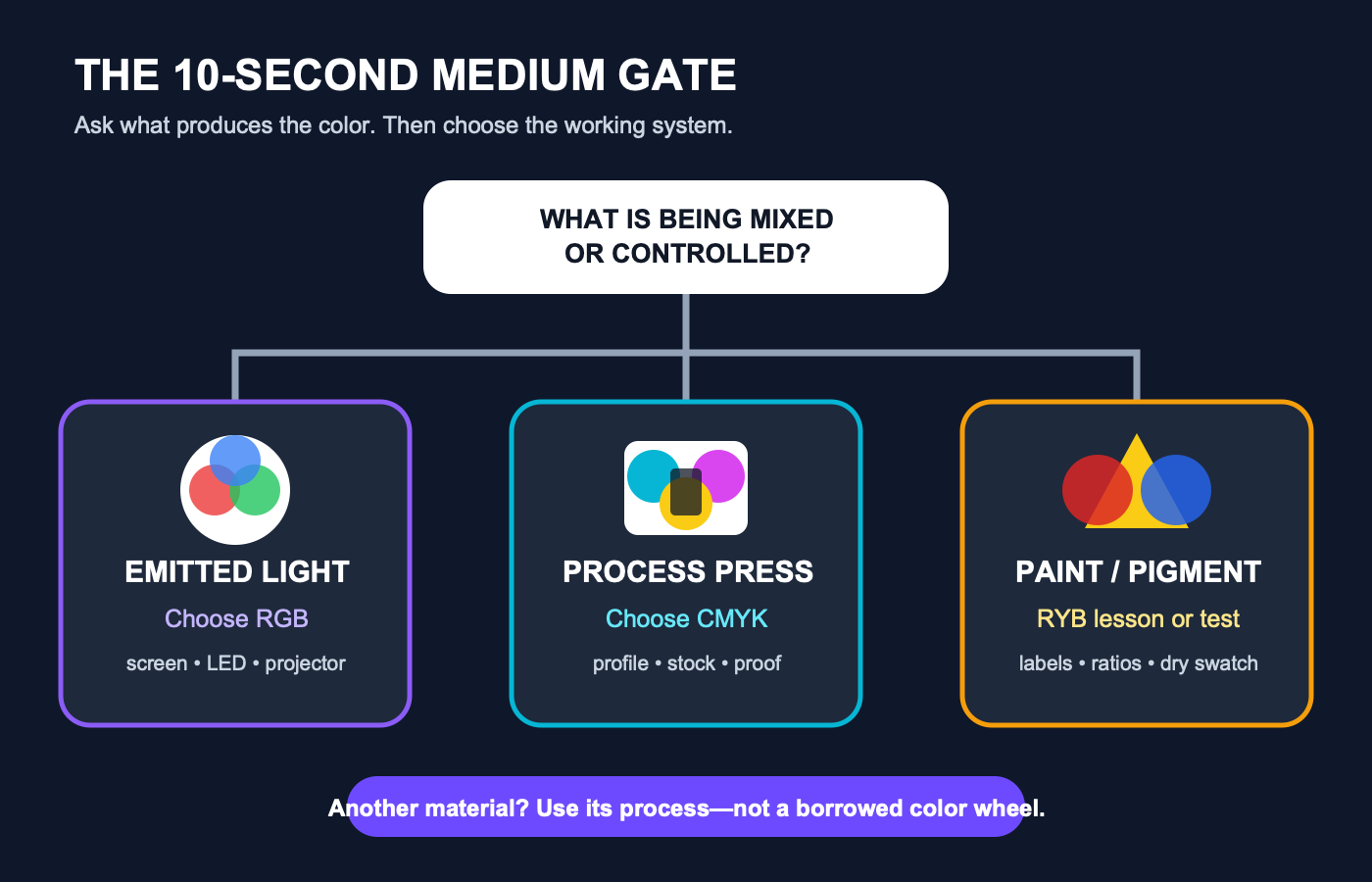
Use this four-question gate:
- Does the source emit colored light? A display, projector, LED fixture, or three-channel digital color value belongs to an RGB workflow.
- Will the file be separated for a four-color process press? The production channels are CMYK. CMY describes the subtractive colorants; K is the practical black channel.
- Are actual paints or pigments being mixed? If it is a traditional classroom exercise, RYB may be the expected model. If the result matters, test the named tubes or pans instead of assuming an ideal wheel.
- Is it another material? Food coloring, textile dye, ceramic glaze, and colored resin each have material and safety constraints. Do not assign a screen or print recipe by analogy.
When the distinction still feels abstract, the explanation of how light, material, and vision create blue separates the source, the object, and the observer. Once the output is known, use design and graphics tools for the chosen output rather than letting an application’s default color mode make the decision silently.
| Object in front of you | Working set | What “more” usually does | Useful check |
|---|---|---|---|
| Screen, LED, projector | RGB | Adds emitted light | Equal full channels produce the space’s reference white |
| Four-color process file and press | CMYK | Adds light-absorbing ink | Inspect separations, profile, stock, and proof |
| Traditional introductory art wheel | RYB | Combines physical colorants | Confirm the curriculum and make dried pair swatches |
| Specific paint palette | Named pigments | Depends on pigment and medium | Record products, ratios, surface, drying, and light |
Verify the system by what the mixture does
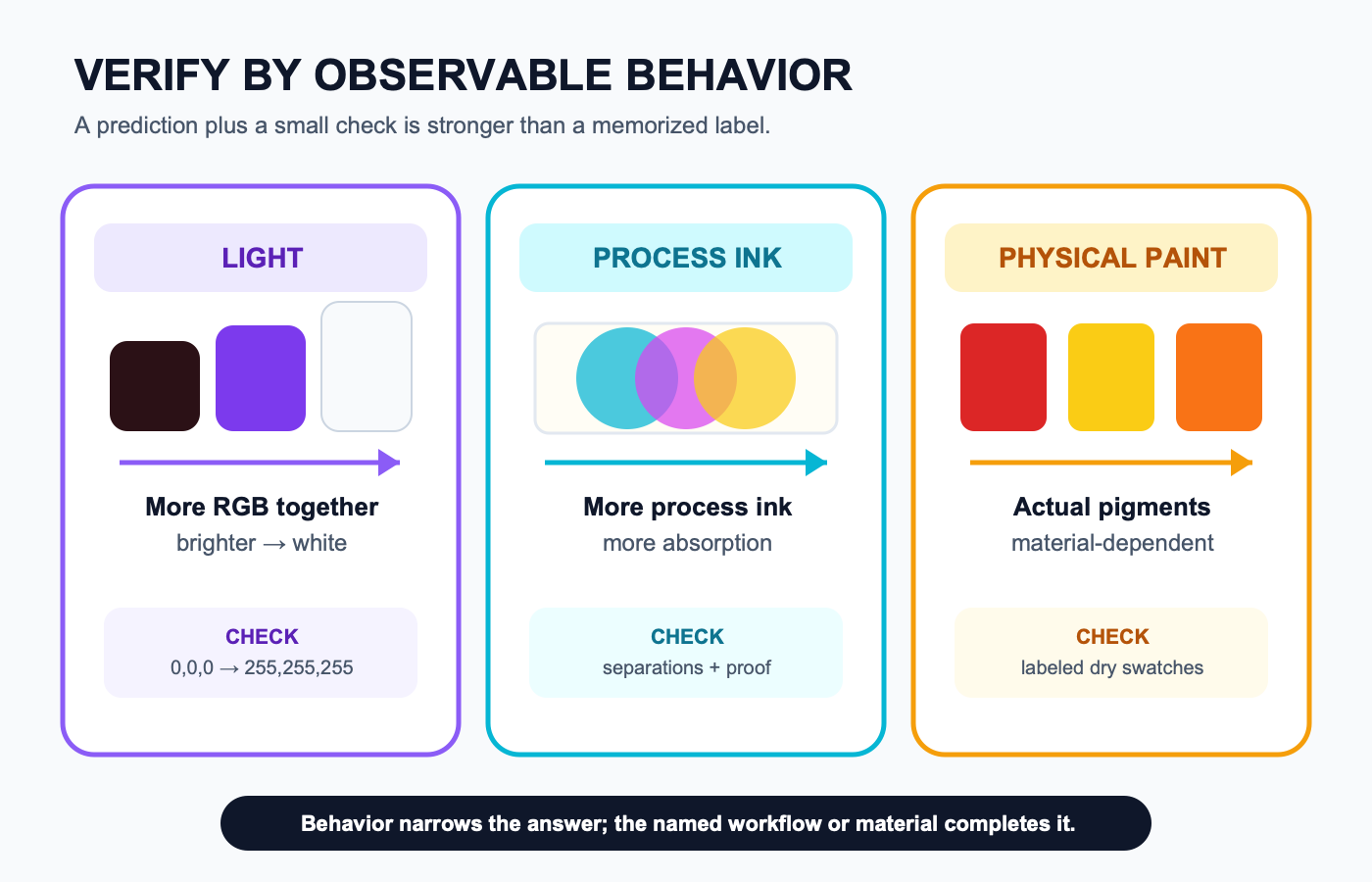
A label is only the first clue. Use an observable prediction:
- Additive-light prediction: raising red, green, and blue together increases emitted light toward the RGB space’s white. Lowering all three toward zero approaches black.
- Subtractive-print prediction: adding process ink generally removes more wavelengths from the light reflected by paper. Zero process ink leaves the paper as the white reference; heavy combinations trend darker.
- Physical-paint prediction: pair mixtures depend on the actual pigments, concentration, opacity, binder, surface, and lighting. A wheel predicts direction, but a dried swatch is the evidence.
These observations are not interchangeable proofs. Paint is also subtractive in a broad optical sense, but a jar of paint is not automatically a characterized CMYK press. Likewise, an RGB number is not a physical emitter until a named color space and device render it. The diagnostic tells you which question to ask next; it does not erase the output condition.
Run the RGB channel check on a screen
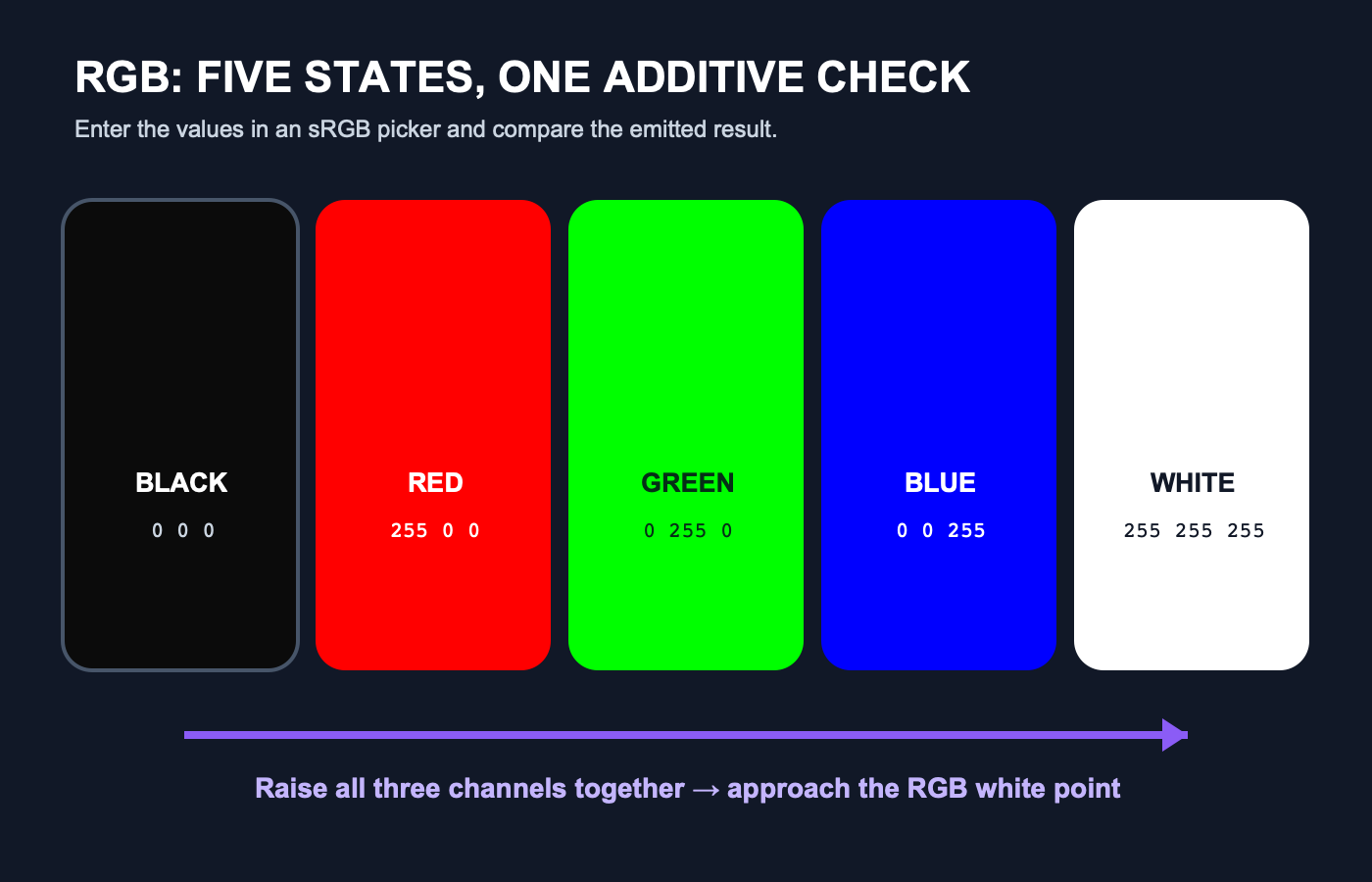
The W3C CSS Color specification describes RGB spaces as additive after linearization and defines an RGB gamut from its three primaries and white point. In an ordinary sRGB picker, enter these values:
rgb(0 0 0)— no channel contribution, black;rgb(255 0 0)— red channel only;rgb(0 255 0)— green channel only;rgb(0 0 255)— blue channel only;rgb(255 255 255)— all three at full encoded value, white.
This is enough to reject the claim that yellow is a screen primary: in sRGB, yellow is produced by high red and green with low blue. For a concrete blue coordinate, palette roles, and CSS formats, build blue from RGB channel values. If the test is part of a worksheet or handoff, capture the three channel states and label the app, color space, and display date.
The check verifies the channel logic, not perfect color accuracy. Display brightness, calibration, profile handling, ambient light, and gamut still affect appearance. Two RGB devices can use the same three channel names yet reproduce different ranges.
Treat CMYK as a production condition
Adobe’s current color-model guidance describes RGB as additive light and CMYK as subtractive process color: cyan, magenta, and yellow absorb parts of white light, while practical printing adds black ink for shadow depth and detail. That makes K a production channel, not a claim that black is a fourth theoretical chromatic primary.
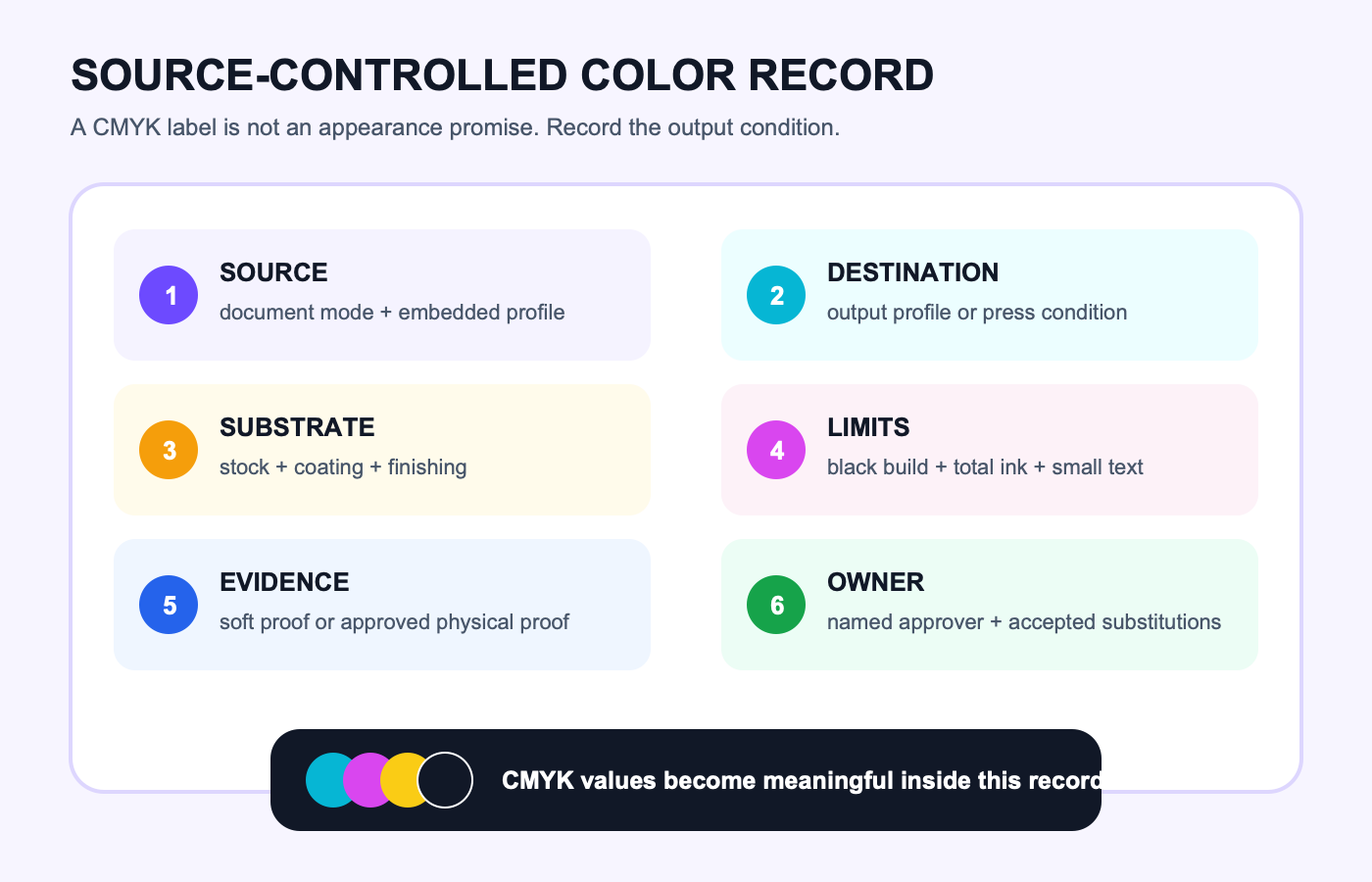
A bare statement such as “the primaries are cyan, magenta, and yellow” is not yet a print instruction. Record this source-controlled print card:
- Source
- Document mode and embedded RGB or CMYK profile.
- Destination
- Printer-supplied output profile or named press condition.
- Substrate
- Paper or other stock, including coating and relevant finishing.
- Limits
- Black construction, total ink guidance, and small-text rules supplied by production.
- Evidence
- Soft proof, contract proof, or approved physical sample under stated lighting.
- Owner
- The person who approves the proof and any out-of-gamut substitutions.
The International Color Consortium supports RGB- and CMY-family device spaces in its profile framework so color-management systems can transform between encodings. The profile does not make every device identical; it makes the conversion condition explicit.
When blue is the production target, take cyan-plus-magenta blue through a print proof instead of copying an unqualified percentage recipe. For logos and illustrations that may need both screen and print versions, keep a true vector master for later output changes; preserve editable geometry and assign color for each deliverable rather than repeatedly converting a flattened export.
Test the paint you actually have
“Red, yellow, and blue” is a model label. “This red, this yellow, and this blue on this paper under this light” is a reproducible paint claim. Build a paint evidence card before deciding whether the palette works:
- Record the brand, color name, and pigment code when available.
- Choose one surface and one application method.
- Make full-strength swatches of each candidate primary.
- Mix each pair at 2:1, 1:1, and 1:2 by the same measuring method.
- Add the same amount of white to a small part of each mixture to expose undertones.
- Let the samples dry, then judge hue, lightness, and chroma under the intended light.
- Keep the labels next to the swatches so a successful mix can be repeated.
This card answers a more useful question than “Are these universally primary?” It shows what the actual palette can produce. If the task is a clean blue-family mixture, test a cyan-and-magenta route to blue paint. If the goal is controlled neutralization, compare three complementary routes to brown. Both are pigment tasks; neither result should be inferred from RGB channel arithmetic.
Use RYB when the lesson actually uses RYB
The National Gallery of Art’s introductory lesson teaches red, blue, and yellow as paint primaries and explicitly contrasts them with the red, blue, and green light used by a computer screen. That is a legitimate classroom scope. It becomes misleading only when the scope disappears.
For an RYB worksheet, give the expected set, predict red plus yellow as orange, yellow plus blue as green, and blue plus red as violet or purple, then compare those predictions with the actual materials. A child-safe classroom activity does not need a lecture about chromaticity coordinates, but it benefits from the sentence “This is the traditional paint wheel; screens use RGB.” After confirming the palette, choose a subject and constraint for the color exercise so the colors are applied to a concrete composition rather than left as an isolated wheel.
Do not force three primaries onto every material
“Primary” is useful inside a defined model, not a universal recipe for every colored substance. A food-safe dye behaves in icing with acidity, fat, water, rest time, and dose constraints that a monitor model cannot describe. If frosting is the real task, use the food-coloring route for blue frosting rather than mixing unidentified art pigments or borrowing CMYK percentages.
The same boundary applies to textile dye, ceramic glaze, lighting gels, fluorescent materials, and proprietary printer ink sets with extra channels. Start with the manufacturer’s compatible materials and process. Then use a sample, proof, or test piece that represents the final substrate and viewing conditions.
Write an answer that cannot be misread
Use this scope-safe sentence:
For [medium or workflow], the working primary set is [set]. It behaves by [adding emitted light / subtracting reflected light / mixing these named materials]. For this task, the result is bounded by [color space, output profile, curriculum, or tested palette].
Three filled examples show why the boundary matters:
- Screen: For an sRGB screen, the working primaries are red, green, and blue. Their emitted light is additive; the result is bounded by the sRGB space and the display.
- Print: For four-color process printing, the chromatic colorants are cyan, magenta, and yellow, with black added as the K channel. The result is bounded by the destination profile, ink, stock, press, and proof.
- Classroom paint: For this traditional art lesson, the expected primaries are red, yellow, and blue. The wheel predicts pair mixtures, while the dried swatches show what the supplied paints actually make.
If the medium cannot be named, do not choose a list yet. Ask for the screen space, printer condition, curriculum, or material labels. That alternative route is the accurate answer when the original question lacks the one fact that determines which primaries apply.