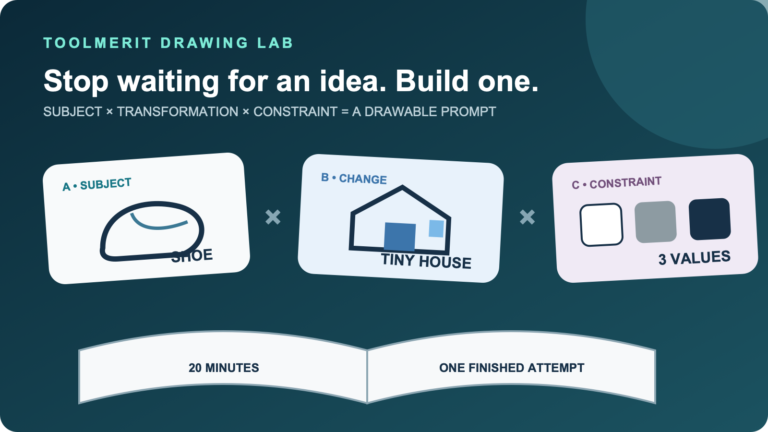
Choose a subject, transformation, and constraint to generate a drawing prompt that is specific enough to begin and open enough to make your own.
If you do not know what to draw, pick one subject you can observe now, add one transformation, and impose one constraint. Example: draw your mug as a tiny house using only two values. If blankness is emotional rather than conceptual, use a three-minute blind contour or six thumbnail sketches. The goal of the first drawing is not a portfolio piece; it is to create momentum and reveal the next idea.
You need paper and any tool that makes a mark. A pencil is enough. Do not search for the most original subject before you begin; originality can emerge from what you ask the subject to do.
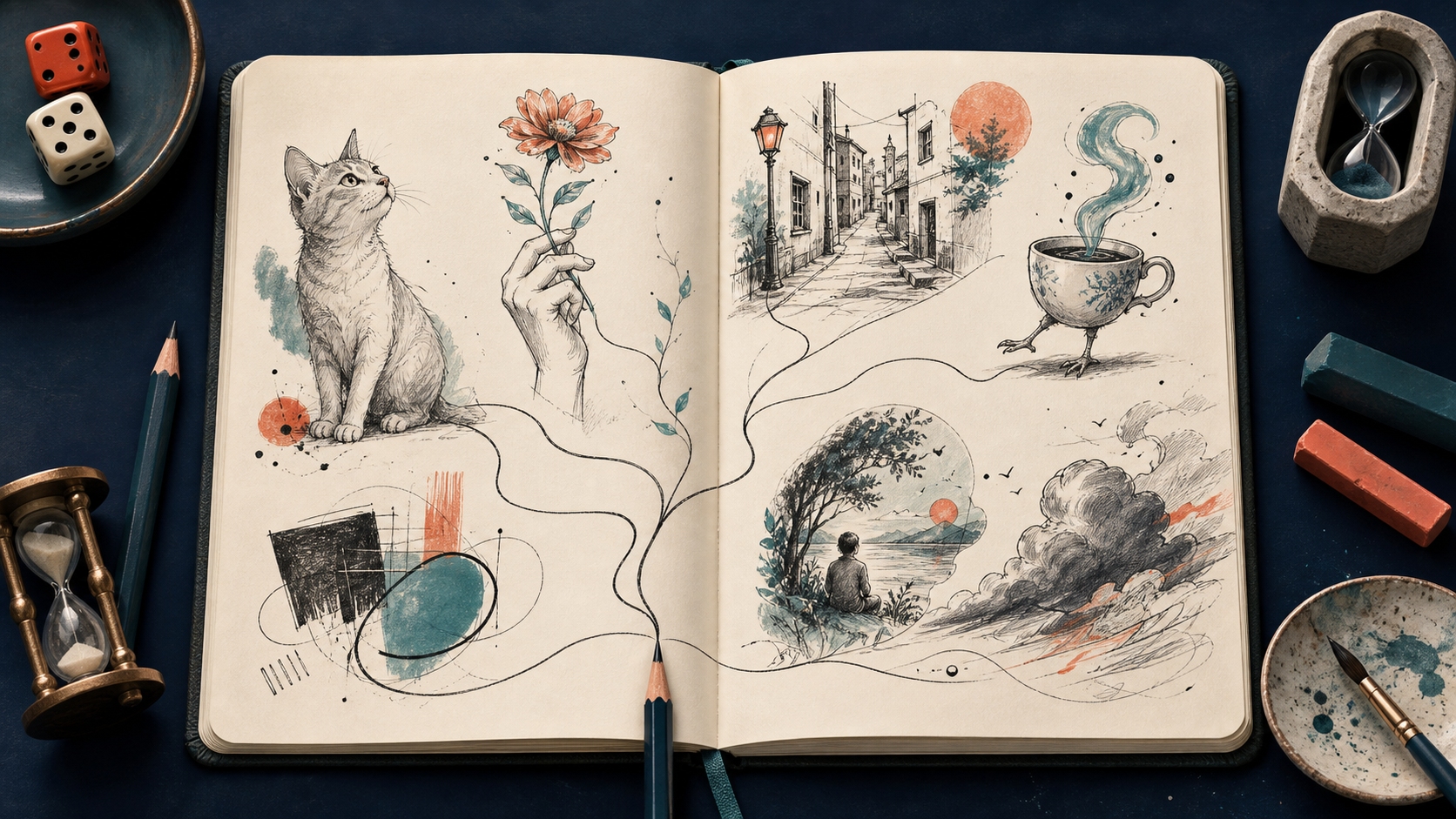
Generate a prompt instead of waiting for one
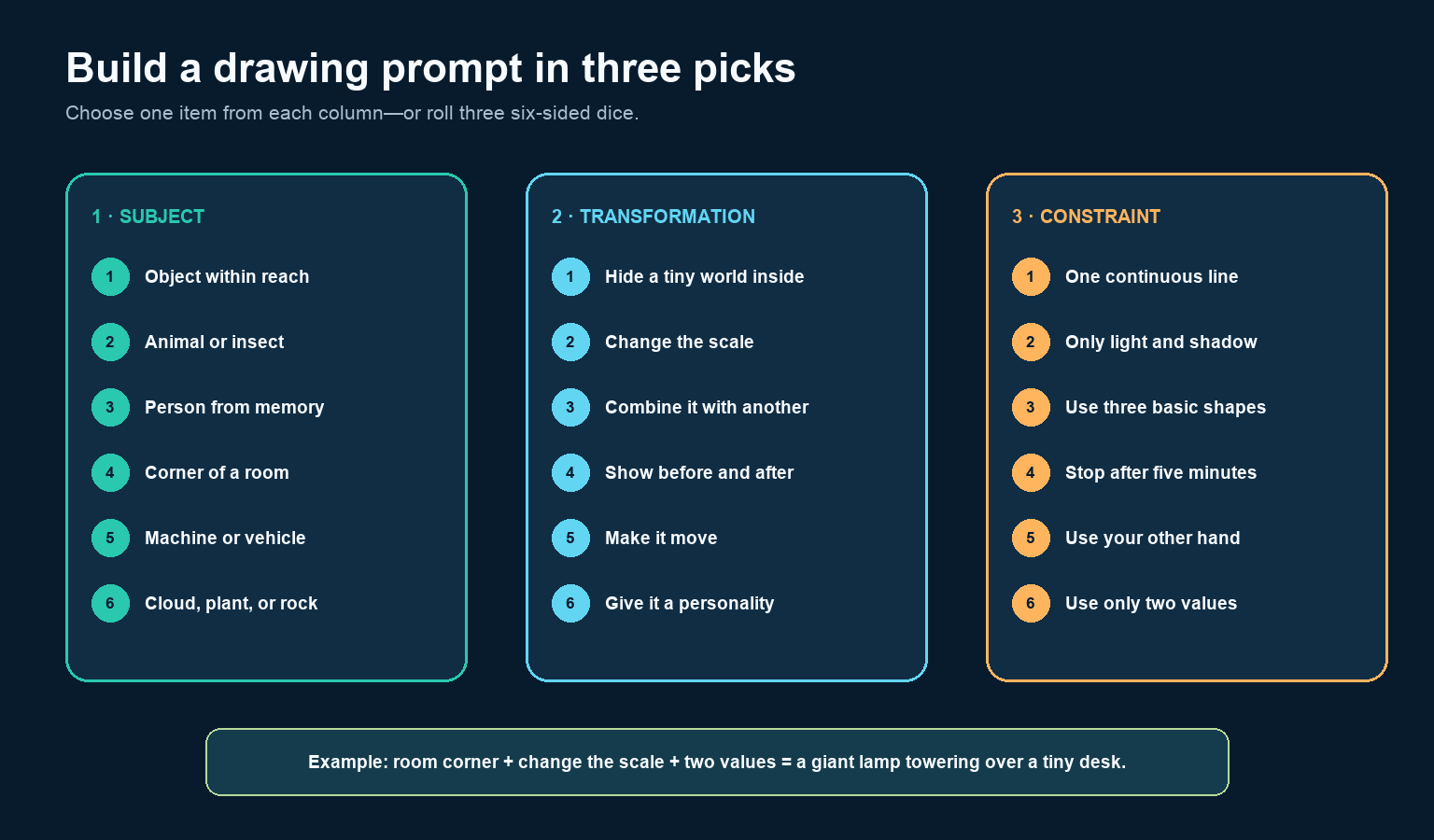
A subject alone often leaves too many decisions open. “Draw a chair” does not say why this chair is worth looking at or when to stop. Add a transformation and a constraint: draw the chair as a walking machine in one continuous line. Now the page has a problem to solve.
The generator contains six entries in each column, so it creates 216 combinations. Pick deliberately, roll three dice, or close your eyes and point. Reject only combinations that are unsafe, unavailable, or genuinely impossible with your materials. Give a merely awkward result five minutes before choosing again.
Keep the three parts visible in a corner of the page. When you stall, return to them. The subject tells you what to inspect, the transformation supplies the idea, and the constraint defines the game.
Choose one of 24 drawing starts
If you prefer a ready-made prompt, choose one item from one of these four modes.
Draw from observation
- Your shoe from floor level, including the shadow.
- The contents of one kitchen drawer without arranging them.
- Your hand holding a small object, drawn as five large shapes first.
- A plant leaf with every torn edge, vein, and curl you can see.
- The view through a doorway, using only straight lines.
- A reflective spoon, but draw only dark and light shapes—not the object’s outline.
Draw from memory
- The route from your bed to the front door as an illustrated map.
- A childhood room with one deliberately exaggerated object.
- The face of someone you spoke to today, then compare it with a reference later.
- A meal you remember because of where you ate it.
- The weather during an important day, represented as marks and shapes.
- A familiar place from two viewpoints on the same page.
Draw from invention
- A tiny repair shop operating inside a broken watch.
- An animal adapted to live in a library.
- A storm cloud kept as a household pet.
- A vehicle designed for a city with no flat ground.
- A teacup that grows legs when nobody is watching.
- The moment immediately before a mysterious door opens.
Draw as a designer
- Six silhouettes for the same creature before adding details.
- Three versions of a desk lamp for different personalities.
- A package for a fictional snack, including shape and opening method.
- A room for a person whose main hobby determines every object.
- An everyday tool redesigned for one-handed use.
- A symbol system for three imaginary warnings.
These modes train different decisions. Observation asks you to notice; memory asks you to select; invention asks you to connect; design asks you to serve a purpose. Rotate modes instead of judging them by the same standard.
Diagnose why the page feels blocked
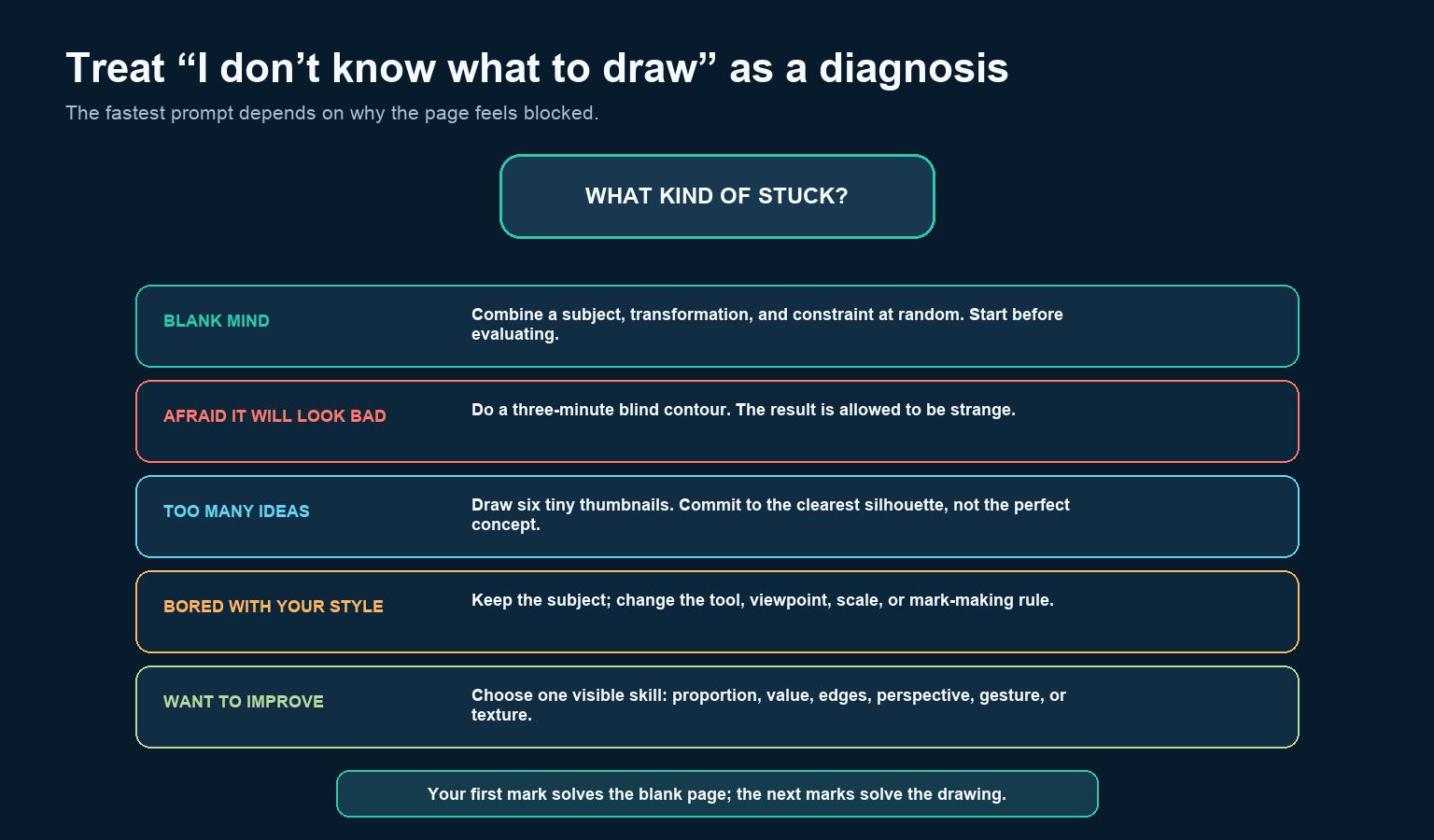
A blank mind benefits from randomness because choice is the problem. Use the generator. Fear of a bad drawing needs an exercise whose outcome is not supposed to look polished. Try a blind contour: look at the subject, keep your eyes off the page, and let the pencil follow its edges for three minutes.
The National Gallery of Art includes blind contour, emotional mark-making, simple-shape landscapes, and silhouettes among its experimentation activities. The blind contour works here because success is attention, not resemblance.
Too many ideas need compression. Divide a page into six rectangles and spend one minute on each composition. Choose the thumbnail with the clearest large shapes. Style boredom needs a changed variable, not necessarily a new subject: switch from line to value, close-up to distant view, smooth to broken marks, or pencil to brush pen.
If your real goal is improvement, name one visible skill. “Get better at drawing” is not a session plan; “separate the light and shadow sides of three objects” is.
Choose a skill and let it choose the subject
| Skill | Good subject | Working rule |
|---|---|---|
| Gesture | People walking, pets, birds, athletes on video | Thirty to ninety seconds per pose; capture direction before anatomy. |
| Proportion | Shoes, tools, faces, furniture | Compare lengths and angles before drawing details. |
| Value | Eggs, folded cloth, cups under one lamp | Use three or five tones and squint to group shapes. |
| Perspective | Room corners, stairs, boxes, street views | Find eye level and large converging directions first. |
| Edges | Portraits, glass, leaves, clouds | Include hard, soft, and lost edges; do not outline everything equally. |
| Texture | Bark, fabric, metal, hair, stone | Draw a few representative marks and let value carry the form. |
The National Gallery’s drawing basics distinguish scribbling, gesture, contour, pressure, hatching, and crosshatching. Those are not decorative labels; each is a different way to translate what you notice. Pick one technique to lead the session and let the others support it.
Match the idea to the time available
- Five minutes: one blind contour, ten gestures, or a two-value silhouette. Stop when the timer ends.
- Fifteen minutes: one object, one light source, three values. Spend three minutes measuring, ten drawing, and two noting what changed.
- Thirty minutes: a small scene or transformed subject. Make three thumbnails, choose one, block large shapes, then add one focal area.
- Sixty minutes: an observational study, designed object, or illustration with reference gathering, thumbnails, construction, values, and selective detail.
A short session is not an incomplete long session. It has a smaller promise. The National Gallery’s Sketchbook Club demonstrates the principle with focused 30-minute prompts that require only pencil and paper, with color optional.
Use references without outsourcing the idea
Drawing from reference is ordinary and useful. Use an object in front of you, your own photo, a public-domain museum image, or a reference you have permission to use. Ask what the reference is answering: anatomy, lighting, texture, clothing, architecture, or mood. One image rarely answers every question well.
Do not trace or closely reproduce another living artist’s distinctive finished work and present it as an original concept. If you study a work, label the page as a study and record the source. Museum collections can be especially useful because they pair images with creator, date, medium, and rights information. The Metropolitan Museum’s Make Your Mark guide treats a sketch as a place to look closely, test line, shape, and value, and work out ideas rather than prove perfection.
Turn one idea into a series
When a prompt works, do not discard it after one page. Make three related drawings:
- Observe: draw the subject accurately enough to understand its proportions and structure.
- Transform: change scale, purpose, environment, movement, or personality.
- Constrain: redraw it with one line, two values, three shapes, the other hand, or a strict timer.
That sequence produces continuity without forcing every page into the same template. Date the drawings and write one sentence about what you would keep or change. Then begin the next page with the unresolved part. Your first mark solves the blank page; the marks after it tell you what to draw next.