
A role-first explanation of the merchant, supplier, seller-of-record obligation, customer exception path, and evidence a real dropshipping arrangement needs.
Does drop shipper mean the store that sold the item or the warehouse that mailed it? The answer depends on the document. Amazon’s public guide calls the online seller a dropshipper, while the FTC uses “drop-shipper” for a fulfillment agent in one of its compliance examples. Treating the label as self-explanatory can therefore send a complaint, contract clause, or refund decision to the wrong party.
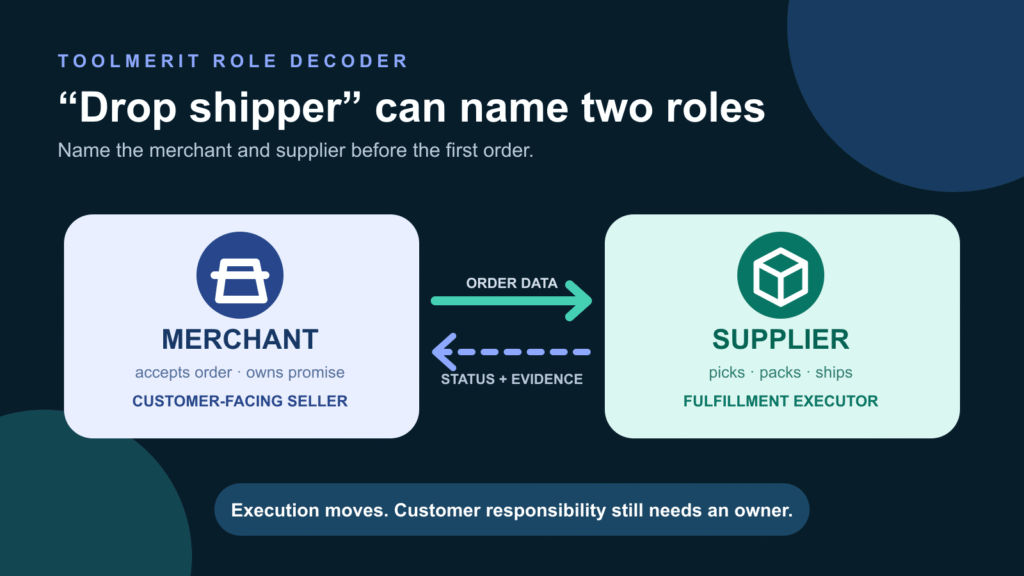
A drop shipper usually means the merchant that accepts a customer’s order and coordinates fulfillment by a third-party supplier. People also use the phrase for the supplier that stores, packs, and ships the product. The safe method is to name both parties explicitly: merchant or seller for the customer-facing business, and dropshipping supplier or fulfillment supplier for the party handling the parcel.
The physical work may move to the supplier. The storefront’s promises do not automatically move with it.
Decode which party someone means by drop shipper
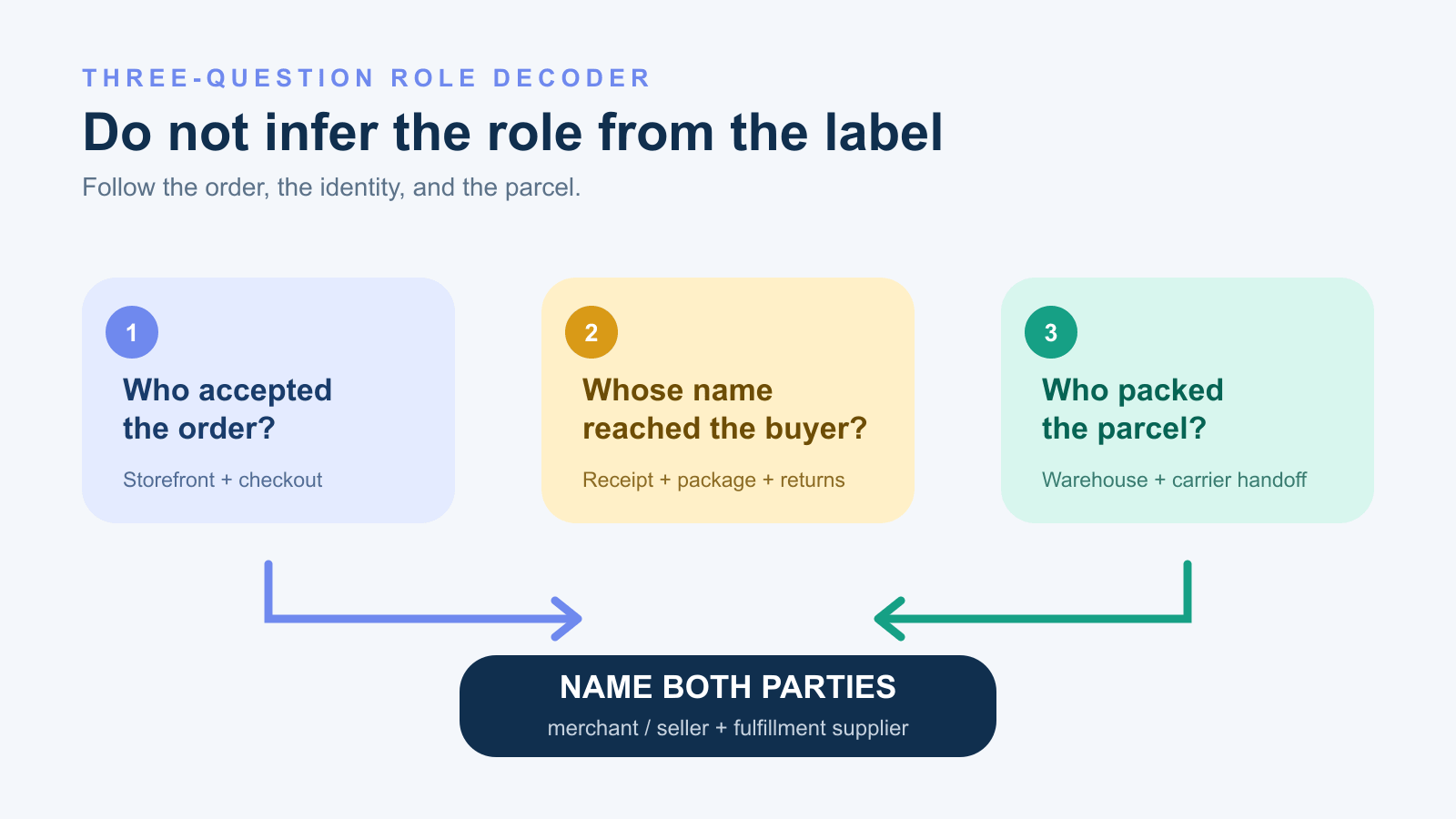
Ask three questions before interpreting the phrase:
- Who accepted the order? The business whose storefront, checkout, or marketplace listing took the customer’s order is the merchant.
- Whose identity reached the customer? The name on the listing, confirmation, receipt, packing material, return instructions, and support reply reveals the customer-facing seller.
- Who touched the parcel? The party that stored, picked, packed, labeled, and handed the item to the carrier is the fulfillment supplier.
| Sentence you encounter | Likely meaning | What to verify |
|---|---|---|
| “The dropshipper lists products online.” | Merchant or seller | Storefront and checkout identity |
| “The drop-shipper caused the delay.” | Fulfillment supplier | Supplier agreement and carrier handoff |
| “We need a drop shipper for our catalog.” | Ambiguous | Whether the need is a sales channel or a supplier |
This page resolves the role label. Use the full dropshipping model when you also need the money flow, unit economics, supplier-vetting process, and fit decision.
Follow an order through three roles
A normal dropshipped order has three actors: the customer, the merchant, and the supplier. Shopify describes the model as selling without storing or shipping the inventory yourself; a supplier ships to the customer on the merchant’s behalf. Amazon’s public explanation gives the same practical sequence: the seller receives the order, sends it to a supplier, and the supplier packs and ships it.
- The customer orders from the merchant and receives the merchant’s promise about the product, price, and delivery.
- The merchant validates payment and sends an authorized order to the supplier.
- The supplier confirms stock, packs the correct item, and transfers it to the carrier.
- Tracking and exceptions return to the merchant, which communicates with the customer and decides the remedy.
The storefront can be an independent shop or a marketplace listing. You can compare online-store tools after defining the roles, but a platform choice does not change who made the customer promise. If the merchant already owns the stock and merely stores it in another company’s warehouse, the arrangement is usually closer to third-party logistics than classic dropshipping.
Separate execution from ownership
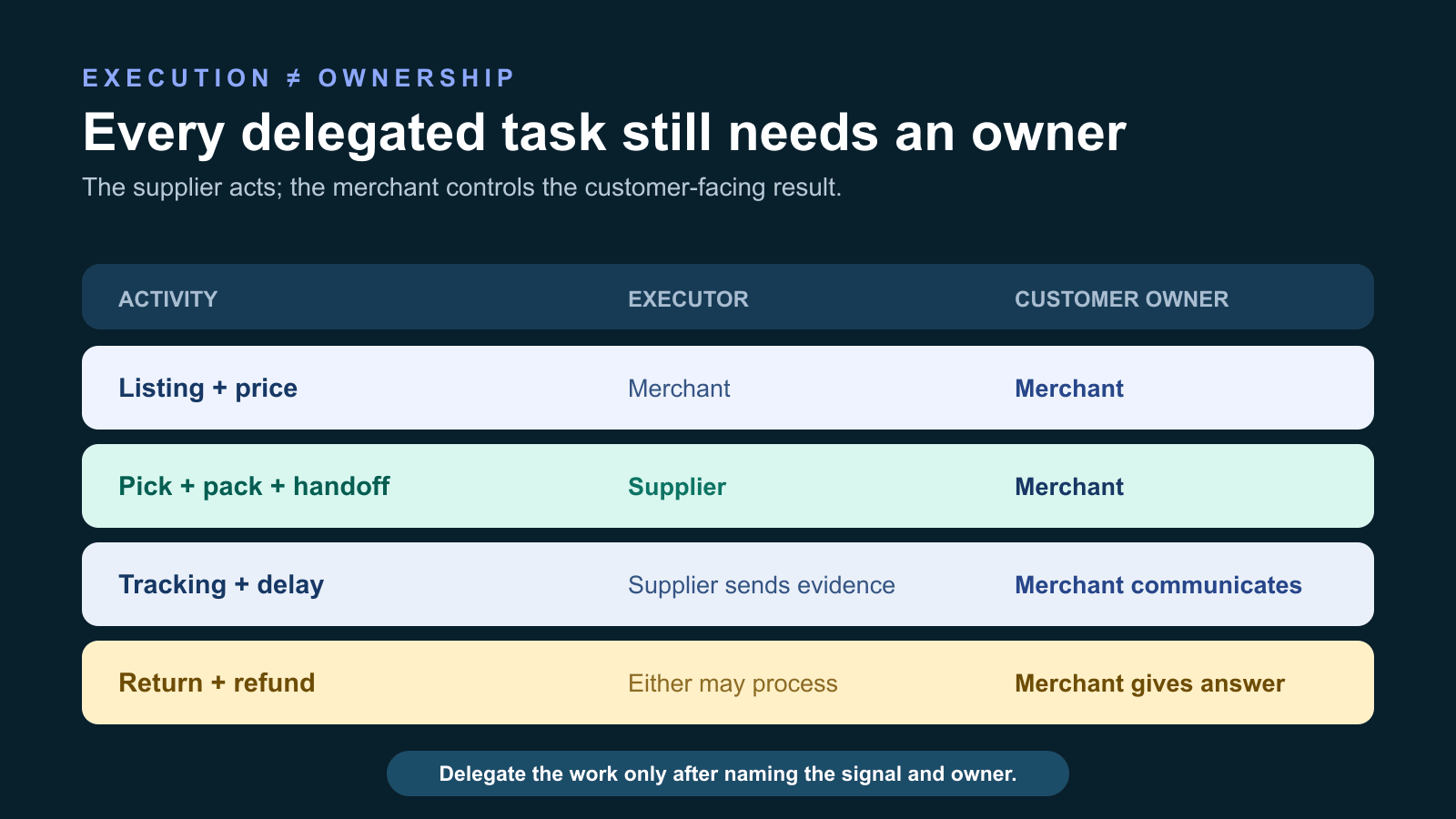
The cleanest operating rule is: delegate a task only after naming who owns its result. A supplier may execute the warehouse work, yet the merchant still needs a reliable control for every promise shown to the buyer.
| Activity | Typical executor | Customer-facing owner | Required signal |
|---|---|---|---|
| Listing accuracy and price | Merchant | Merchant | Approved product record |
| Stock availability | Supplier | Merchant controls order acceptance | Timestamped inventory status |
| Payment and confirmation | Merchant and processor | Merchant | Order and payment IDs |
| Picking, packing, and carrier handoff | Supplier | Merchant owns the stated delivery promise | Correct-item check and acceptance scan |
| Tracking and delay communication | Supplier provides data | Merchant communicates | Event time and revised expectation |
| Return, replacement, or refund | Either party may process | Merchant gives the customer an answer | Authorization, destination, and refund status |
Supplier billing records should show enough identity and line-item detail to reconcile an order; the practical invoice guide explains what a usable invoice needs to contain. Then use a consistent process to reconcile supplier charges and credits, including shipping adjustments, cancellations, returns, and partial refunds.
Test the seller-of-record clues
Seller of record is more than a loose synonym for the person who found the product. Amazon explains that the seller of record sets the price, records the purchase as revenue, and assumes seller responsibilities; its dropshipping guidance requires the seller to remain identifiable to the customer. In practical terms, inspect five surfaces:
- the storefront or marketplace seller name;
- the checkout and order confirmation;
- the receipt or invoice supplied to the buyer;
- the packing slip and external package; and
- the return and customer-service instructions.
Those surfaces should tell one coherent story. A package that unexpectedly advertises another retailer is not merely untidy branding; it may conflict with marketplace rules. eBay currently allows fulfillment from a wholesale supplier but says sellers remain responsible for safe, timely delivery and buyer satisfaction. It prohibits listing an item and then buying it from another retailer or marketplace for direct shipment to the buyer. Rules differ by platform and can change, so verify the current policy for the exact sales channel before listing.
Route a delayed order without abandoning the customer
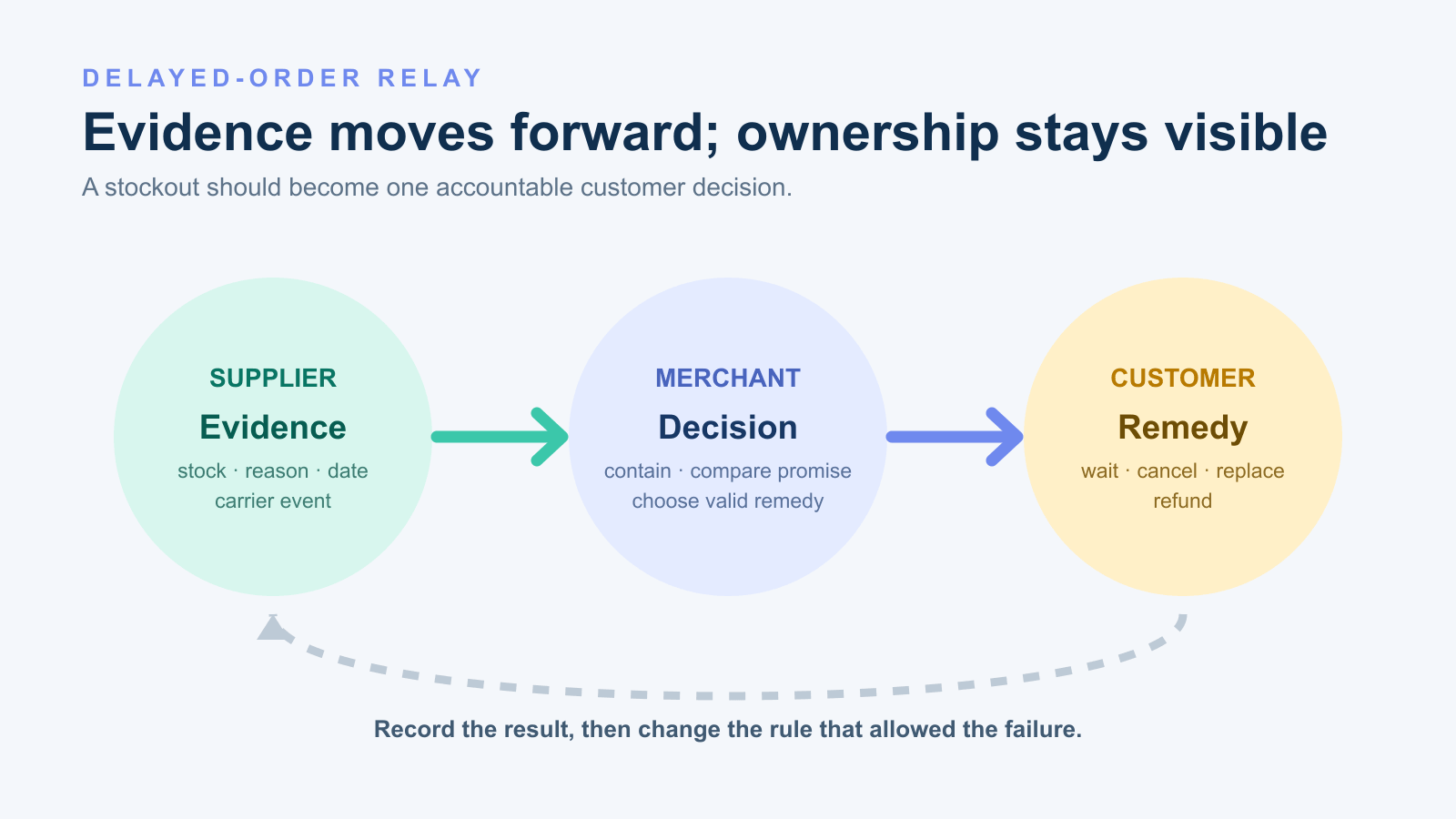
Suppose a merchant promises shipment within five business days. Two days after checkout, the supplier reports a stockout and cannot provide a carrier scan. The supplier discovered the problem, but it should not send the buyer into the supply chain to negotiate a remedy.
- Supplier signal: send the merchant the affected order, stock status, reason, evidence, and earliest defensible ship date.
- Merchant containment: stop accepting the affected offer or correct its availability before another order repeats the failure.
- Promise test: compare the new evidence with the shipping statement the customer saw.
- Customer decision: explain the delay and present the applicable wait, cancellation, replacement, or refund route.
- Close the loop: record the customer’s choice, the supplier action, the money movement, and the rule changed afterward.
For U.S. transactions covered by the FTC’s Mail, Internet, or Telephone Order Merchandise Rule, the seller needs a reasonable basis for the stated shipping time; when it cannot ship on time, it generally must offer the buyer the applicable delay-consent or cancellation-and-refund option. The FTC’s business guide specifically says the seller, not the fulfillment agent, is liable for violations caused by a fulfillment house or drop-shipper. This is a U.S. compliance example, not a substitute for advice about every jurisdiction.
Turn the sequence into owned support instructions rather than an improvised chat response. A small team can build a retrievable exception playbook for stockouts, late carrier scans, lost parcels, damaged goods, and refunds.
Demand five proofs before calling the arrangement ready
A catalog connection is not proof of an operational relationship. Keep a five-part evidence file before accepting live orders:
- Supplier agreement: legal identities, permitted products and territories, inventory updates, cutoff times, packaging identity, cancellation rules, returns, data use, and escalation contacts.
- Packaging sample: a real test parcel or documented sample showing the item, packing slip, external labels, inserts, return address, and any third-party branding.
- Inventory signal: a timestamped feed or confirmation method, including what happens when stock is reserved, stale, or unavailable.
- Shipping evidence: service level, handoff deadline, carrier acceptance event, tracking route, and the alert used when the promise is at risk.
- Return route: who authorizes the return, where the item goes, which evidence triggers a refund, and how the customer learns the outcome.
Run at least one sample order through the destination and return path you intend to use. FTC staff guidance names test or “seeding” orders, contractual controls, and complaint monitoring among the circumstances considered when evaluating merchant efforts. Once the exception owner and evidence fields are defined, compare customer-support tools by whether they preserve that handoff—not by the length of their feature lists.
Write both roles into the operating agreement
Replace every ambiguous use of drop shipper with a two-role card. This compact wording is suitable for an internal operating brief; a real contract should be reviewed for the markets and products involved.
Merchant / seller: [legal and store name]. Accepts customer orders, controls listings and prices, communicates delivery expectations, and owns the customer decision for cancellations, returns, replacements, and refunds.
Fulfillment supplier: [legal name]. Maintains the agreed inventory signal, picks and packs authorized orders, uses approved customer-facing identity, hands parcels to the specified carrier, and reports exceptions with evidence by [deadline].
Shared control: Every order carries a merchant order ID, supplier order ID, promised ship date, latest status, exception owner, and final remedy.
Attach the five proofs, the delayed-order path, and a named owner to each line. If the arrangement is part of a new venture, turn the arrangement into an operating plan that reconciles the customer promise, supplier capacity, costs, and fallback.
Choose the role you actually want
If you want to become the merchant, you are choosing the storefront, offer, price, customer relationship, policy disclosures, support decisions, and supplier monitoring—even though you may never touch the box. If you want to become the supplier, you are selling operational reliability: accurate inventory, correct packing, timely carrier handoff, traceable exceptions, compliant data handling, and a workable return path.
Do not buy software until that choice is explicit. First audit the connected tool stack so every storefront, catalog, payment, routing, tracking, and support system has an owner and a failure path. After a bounded pilot exposes the real support and exception workload, calculate ROI from full cost rather than treating the customer’s payment as the merchant’s gain.
The next action is small but decisive: write the merchant’s legal name and the supplier’s legal name on one page, place the five proofs beneath them, and walk one delayed order from warehouse signal to customer remedy. If either name or handoff is missing, the arrangement is not ready for a live order.