
The best place to sell a used item depends on whether shipping, specialist demand, speed, safety, or maximum net payout matters most.
Sell bulky or inexpensive used items through a local marketplace, classifieds site, consignment store, or pickup sale. Use a broad shipped marketplace for common items that benefit from a large buyer pool, and a specialist marketplace when category knowledge or verification can raise trust and price. For low-value items, bundle, trade in, donate, or recycle instead of creating dozens of weak listings. Compare expected net payout, time-to-sale, shipping effort, return risk, and safety before choosing—not just the advertised selling fee.
There is no universal best place to sell used items. A platform that is excellent for a phone can be inefficient for a sofa and unnecessary for a box of $3 kitchen tools. Decide what the item requires first; evaluate platform names second.

Choose the channel before the platform
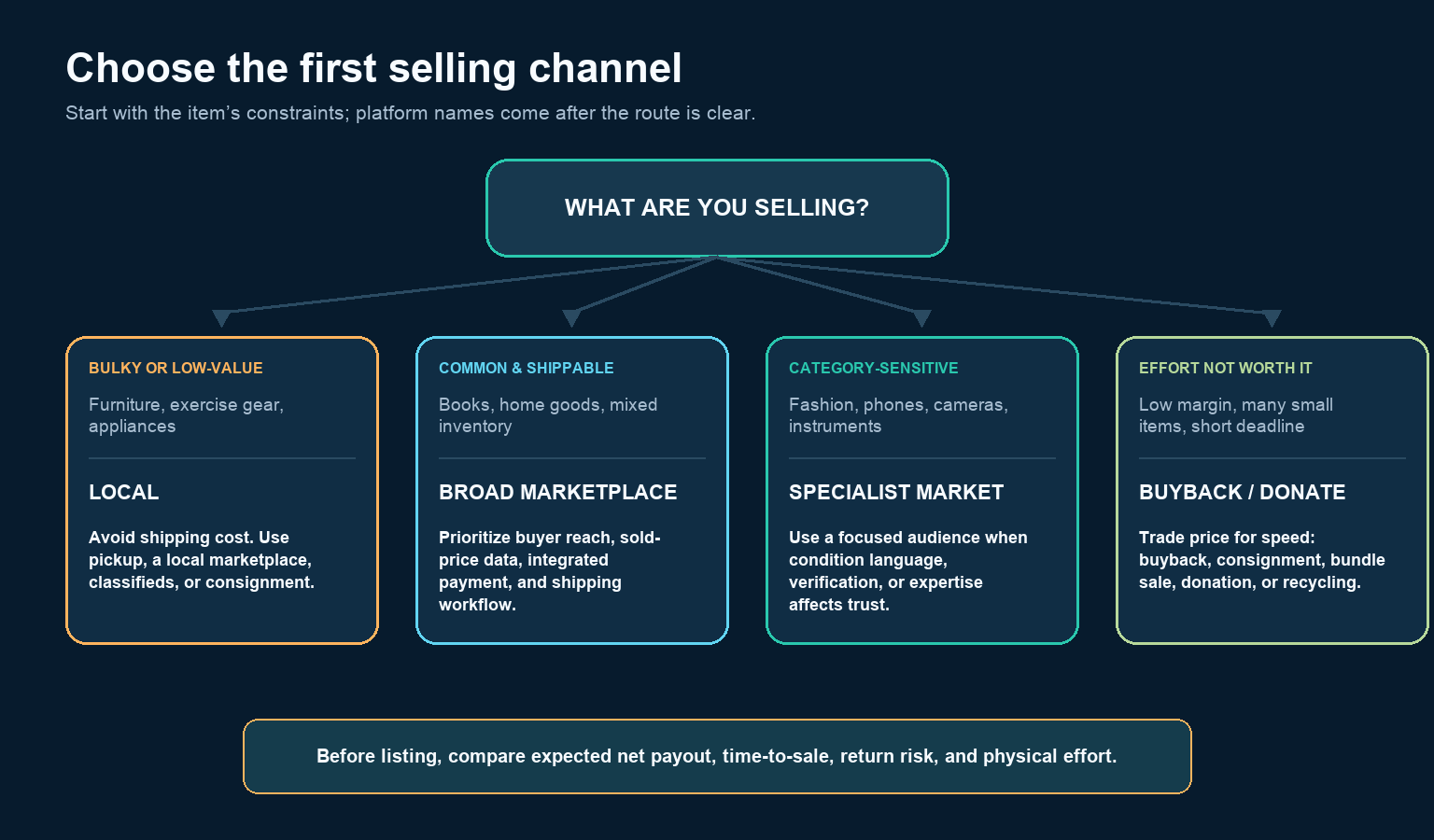
Four channel types cover most household resale decisions:
- Local direct sale: best when freight would erase the margin or the buyer should inspect the item. Facebook Marketplace, OfferUp, and Craigslist are common examples.
- Broad shipped marketplace: useful when many buyers can recognize the item and compare it remotely. eBay and Mercari are examples.
- Specialist marketplace: valuable when model details, condition vocabulary, authentication, or an enthusiast audience affect trust. Examples include Poshmark for fashion, Swappa for eligible technology, and Reverb for music gear.
- Low-effort exit: a buyback, consignment store, auction, yard sale, bundle, donation, or responsible recycling route. You give up some potential price to save time and handling.
Platform availability, eligibility, fees, and shipping programs can change by location and account. Confirm current terms before listing. The examples here were checked on August 16, 2026.
Best first place by item type
| Used item | Sensible first channel | Change course when… |
|---|---|---|
| Furniture and large appliances | Local marketplace, classifieds, consignment, or pickup auction | The piece is designer, antique, or valuable enough for specialist freight. |
| Everyday household goods | Local bundles, yard sale, or broad marketplace for higher-value pieces | Shipping and messages would consume most of the likely price. |
| Phones, tablets, laptops, and cameras | Specialist electronics market or broad shipped marketplace | The device is locked, damaged, financed, or cannot be safely wiped and described. |
| Clothing, shoes, and bags | Fashion marketplace for desirable brands; local bundle for basics | Cleaning, measurements, photos, fees, and individual shipping exceed the margin. |
| Guitars, pedals, and studio equipment | Music-gear specialist market | The item is too fragile to ship or local testing is essential. |
| Collectibles | Marketplace with sold-price history and the relevant collector audience | Authenticity or grading requires a qualified intermediary. |
| Books, media, and small toys | Lots or sets locally; broad marketplace for scarce editions | A single low-price item cannot absorb packing and postage. |
| Many mixed items under roughly $10 each | Bundle, yard sale, donation, or local consignment | A particular piece has clear specialist demand. |
This is a starting point, not a guarantee. Search completed sales for the exact model, size, edition, condition, and included parts. Active listings show what sellers hope to receive; completed sales provide better evidence of what buyers accepted.
Use local selling when shipping breaks the economics
Local selling removes packing and long-distance shipping, and it lets a buyer inspect size, condition, and function. It is usually the strongest first attempt for sofas, desks, weights, lawn equipment, ordinary bicycles, and working appliances. It can also be faster for an inexpensive object needed immediately.
The tradeoff is coordination and physical safety. Use in-platform messaging, limit personal information, and meet in a public, well-lit location when the item can be moved. Facebook’s official in-person Marketplace guidance recommends telling someone the location, bringing a charged phone, avoiding excessive cash, and not sharing a home address unnecessarily. For a large item that requires home pickup, screen the buyer first, avoid being alone, keep the item accessible without exposing the rest of the home, and arrange help for lifting.
Craigslist’s scam guidance centers its model on local, face-to-face dealing and warns against advance payments, wires, gift cards, cashier’s checks, financial information, and “verification code” requests. Cancel the transaction when a buyer invents a complicated courier, overpayment, refund, or account-upgrade story.
Use a broad marketplace when reach and price discovery matter
A broad shipped marketplace makes sense when the item is easy to identify, can survive shipping, and is worth exposing to more buyers. Search tools, category filters, sold-price records, integrated labels, payment processing, and dispute procedures can reduce friction. Those services have a cost.
eBay’s official fee overview says the exact charge depends on the item, listing setup, seller performance, and whether the seller has a Store; selling costs are deducted from proceeds. Mercari’s current fee FAQ likewise documents its prevailing structure. Do not rely on an old comparison chart or memory. Check the category-specific fee, what amount the percentage applies to, optional promotion costs, label charge, payout rules, return terms, and protection eligibility on the day you list.
Broad reach is not automatically better. More distant buyers mean packing, tracking, potential damage, and returns. Measure the item before you choose the channel, then price a real box and shipping service. If the packed dimensions trigger high postage or the item cannot tolerate a drop, local sale may produce a higher expected net even at a lower price.
Use a specialist market when expertise changes the result
Specialist buyers search with precise filters and understand condition details that look obscure elsewhere. That can help an accurate listing find the right audience. The benefit must outweigh the specialist platform’s rules and fees.
For example, Poshmark publishes its US fashion-marketplace commission in its current fee policy. Swappa’s official fee page describes a technology-focused marketplace with listing review, platform fees, payment processing, and buyer and seller protections. Reverb’s billing policy documents its music-gear selling fee. These services are not interchangeable: accepted items, condition standards, returns, verification, and shipping expectations differ.
A specialist channel is most useful when you can supply specialist evidence. A phone listing may need storage, carrier status, battery condition, account removal, and an accurate model identifier. A guitar listing benefits from serial details, modifications, fret condition, electronics tests, and a protective packing plan. If you cannot establish the facts, a conservative local sale, qualified consignment, buyback, repair, or recycling route may be safer.
Calculate expected net before you list
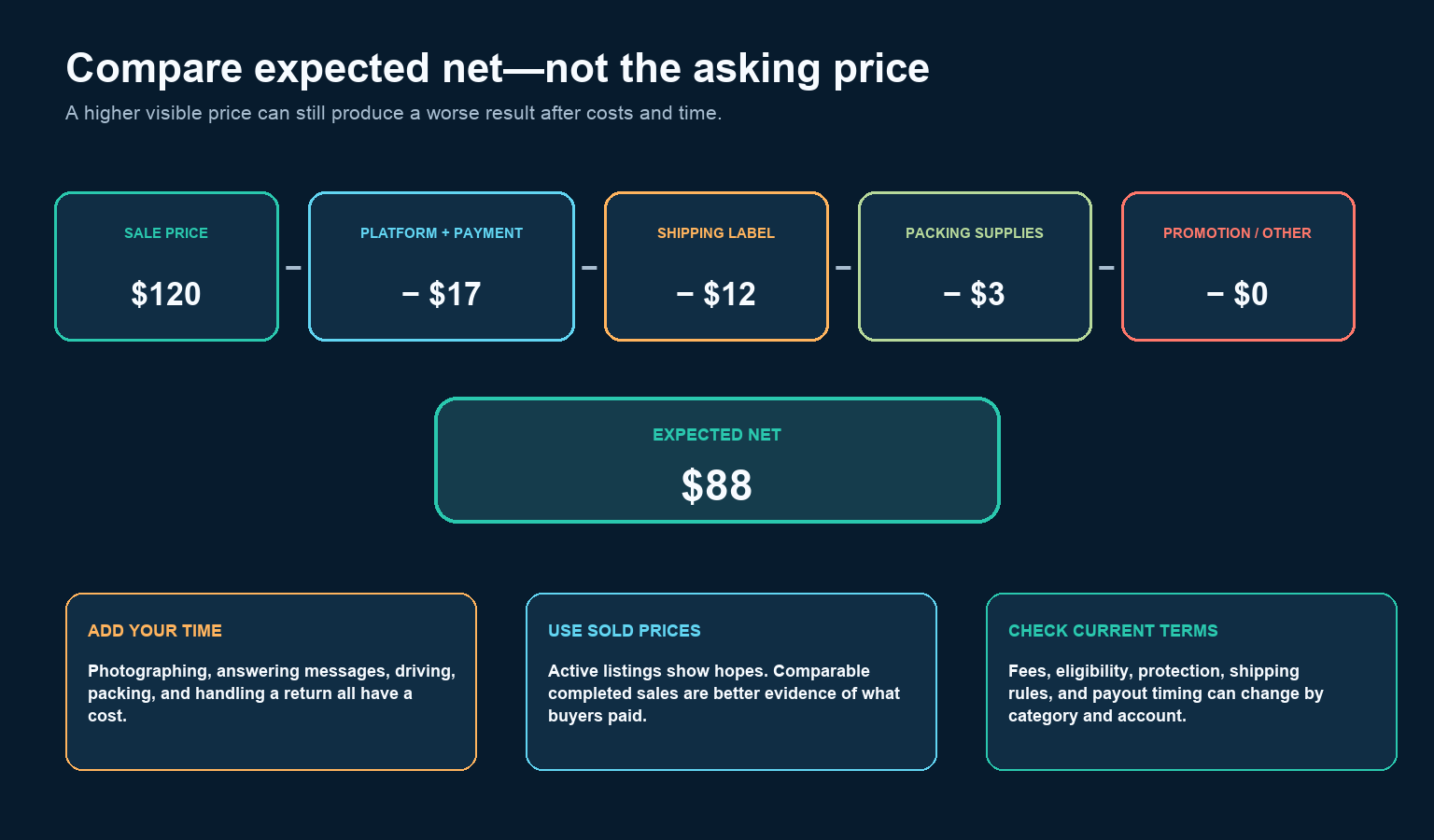
Use this equation for every serious comparison:
Expected net = likely sale price − platform and payment fees − seller-paid shipping − packing supplies − promotion − expected loss from returns or damage.
Then add a noncash line: your time. Photographing, measuring, researching, answering ten messages, driving to a meetup, packing, and handling a return may be worthwhile for a $600 item and irrational for a $6 item. A buyback offer that is 20% lower can still be the better decision when it removes hours of work and uncertainty.
Use the likely sale price, not your original purchase price or the highest active listing. For a fast sale, compare recent sold items in the same condition and price near the center of the realistic range. For a rare item, allow more time and document why it differs from the nearest comparables.
Build a listing that prevents disputes
A useful listing is evidence, not advertising. Include original photos of every side, identifiers that do not expose sensitive account data, dimensions, tested functions, included accessories, and close-ups of wear. State defects in plain language. “Good condition” is weak; “two-inch scratch on the left side, shown in photo six” is testable.
Before selling electronics, back up needed data, sign out, remove activation or account locks, and follow the manufacturer’s factory-reset process. Do not publish a full serial number when the platform does not require it publicly. For recalled, unsafe, counterfeit, stolen, financed, or prohibited goods, do not treat resale as a way to pass the problem to someone else; check the platform’s commerce policy and the relevant authority.
Photograph the item and packing process before shipment. Use tracking and any insurance or signature service appropriate to the value, and ship only to the address specified by the eligible platform transaction. Keep the listing, messages, receipt, tracking record, and payout statement until the return and dispute windows have closed.
Protect the transaction and keep basic records
Stay inside the platform’s communication and payment workflow when its protection depends on doing so. A screenshot or email saying “paid” is not payment; check the actual marketplace or financial account independently. The FTC warns online sellers about fake payment notifications and buyers who send a fraudulent overpayment and request money back.
For an in-person exchange, agree on the item, price, payment method, and meeting place before traveling. Do not surrender the item until the payment has been verified under the method you chose. Stop when the other person introduces gift cards, codes, unexpected links, excess payment, a third-party courier, or pressure to leave the platform.
Keep purchase evidence when available, plus a simple ledger of item, original cost, sale price, fees, shipping, and date. In the United States, the IRS’s current Form 1099-K guidance distinguishes personal items sold at a loss from items sold at a gain: a personal loss is not deductible, while a gain may be taxable. A payment form reports gross transactions, not the full story of what you actually gained. For a business or a complex tax situation, use current IRS instructions or a qualified tax professional.
Run a two-listing test
Do not cross-post an entire home before learning what the work feels like. Pick two representative items: one bulky or inexpensive item for a local listing, and one shippable or category-sensitive item for a broad or specialist listing. Record the preparation time, views, serious inquiries, likely net, days to sale, and problems encountered.
After both close, choose a repeatable route for the rest of the pile. Group low-value items, reserve specialist work for items that justify it, and redirect unsold goods by a deadline. The best place to sell used items is the channel that converts your particular inventory into an acceptable net result with an amount of effort and risk you are willing to repeat.