A reusable drawing-choice system that turns a blank page into one concrete, time-bounded observation, story, design, or mindful practice.
What is blocking you: no subject, no idea, no skill goal, or too much pressure to make a good drawing? Those are different problems. A random object can solve the first; an imaginative change solves the second; a constraint creates practice; and a low-stakes process can quiet the fourth.
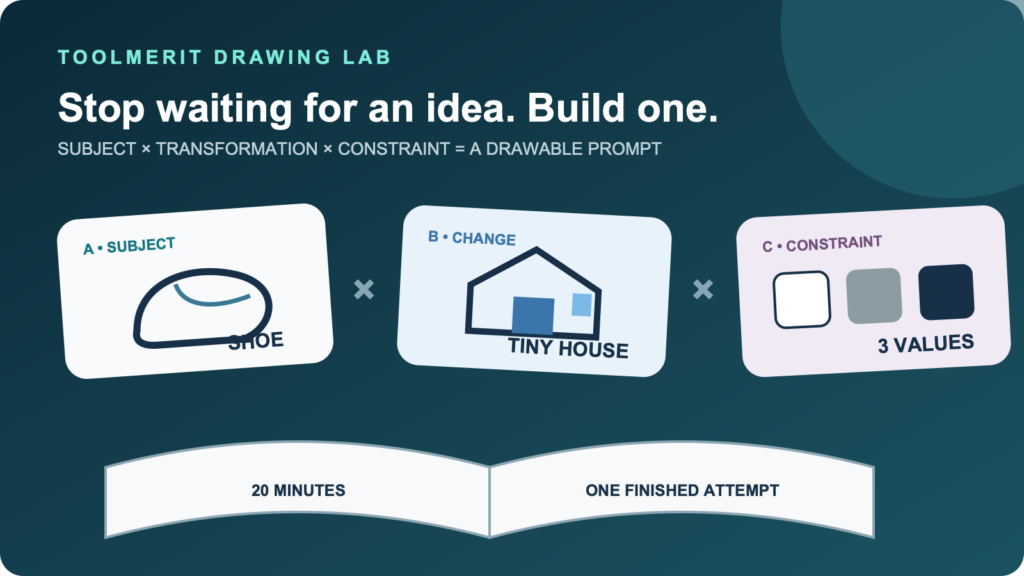
If you cannot decide what to draw, choose one subject you can see, one change that makes it unfamiliar, and one constraint that makes the session finite. For example: draw your shoe as a tiny house using only three values in 20 minutes. The subject gives you something concrete, the transformation supplies an idea, and the constraint prevents endless planning.
You do not need to feel inspired before starting. Use the purpose selector below, generate one prompt, and let the drawing itself produce the next question.
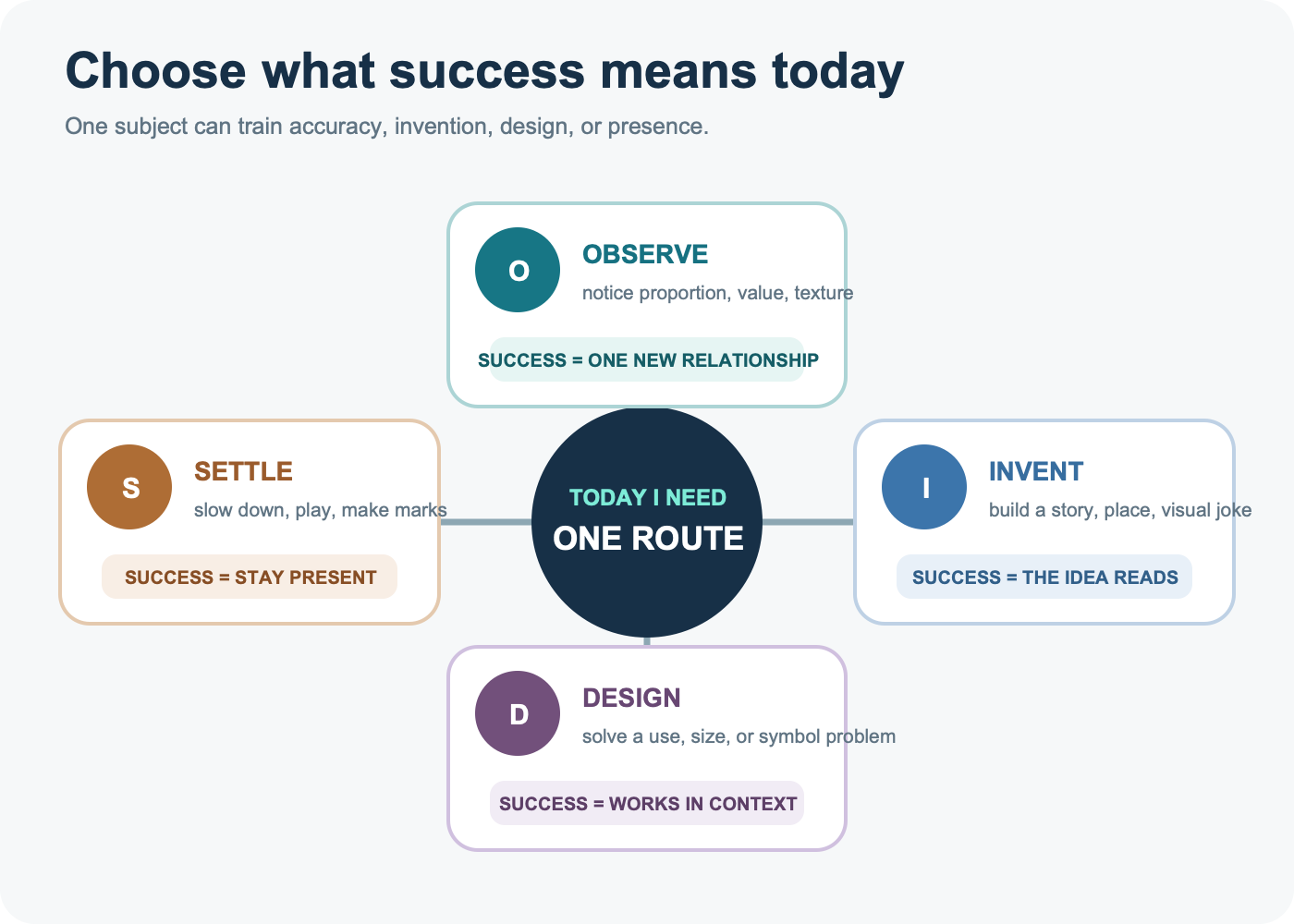
Choose the kind of drawing session you need today
Pick one route. Success means something different in each, so do not judge a mindful line exercise by portrait accuracy or an observation study by how original its story is.
| Route | Choose it when you want to… | Start with | Success test |
|---|---|---|---|
| Observe | See shape, proportion, value, or texture more accurately | An ordinary object in front of you | You notice and record one relationship you missed at first |
| Invent | Build a story, character, place, or visual joke | A familiar thing plus an impossible change | The viewer can infer the central idea without an explanation paragraph |
| Design | Create an icon, prop, creature, cover, pattern, or other usable concept | The intended use and two restrictions | The result still works at its target size and context |
| Settle | Slow down, experiment, or draw without performance pressure | A line, sound, breath, shadow, or emotion | You stay present for the chosen time; resemblance is optional |
The National Gallery of Art’s everyday-object activity asks drawers to select a frequently handled object, rotate it, notice what appears from different angles, make exploratory sketches, and record why the chosen view matters. Its mindful drawing activities use emotional lines and blind contour drawing for a different outcome: attention and experimentation rather than polished resemblance.
If your real blockage is broader creative planning, browse ToolMerit’s idea development tools. If the goal is a finished digital asset rather than a sketching practice, the design and graphics tools are the more useful starting category.
If you want a subject immediately rather than a generated constraint set, use the quick subject-selection guide as the simpler branch.
Generate 216 prompts from three small choices
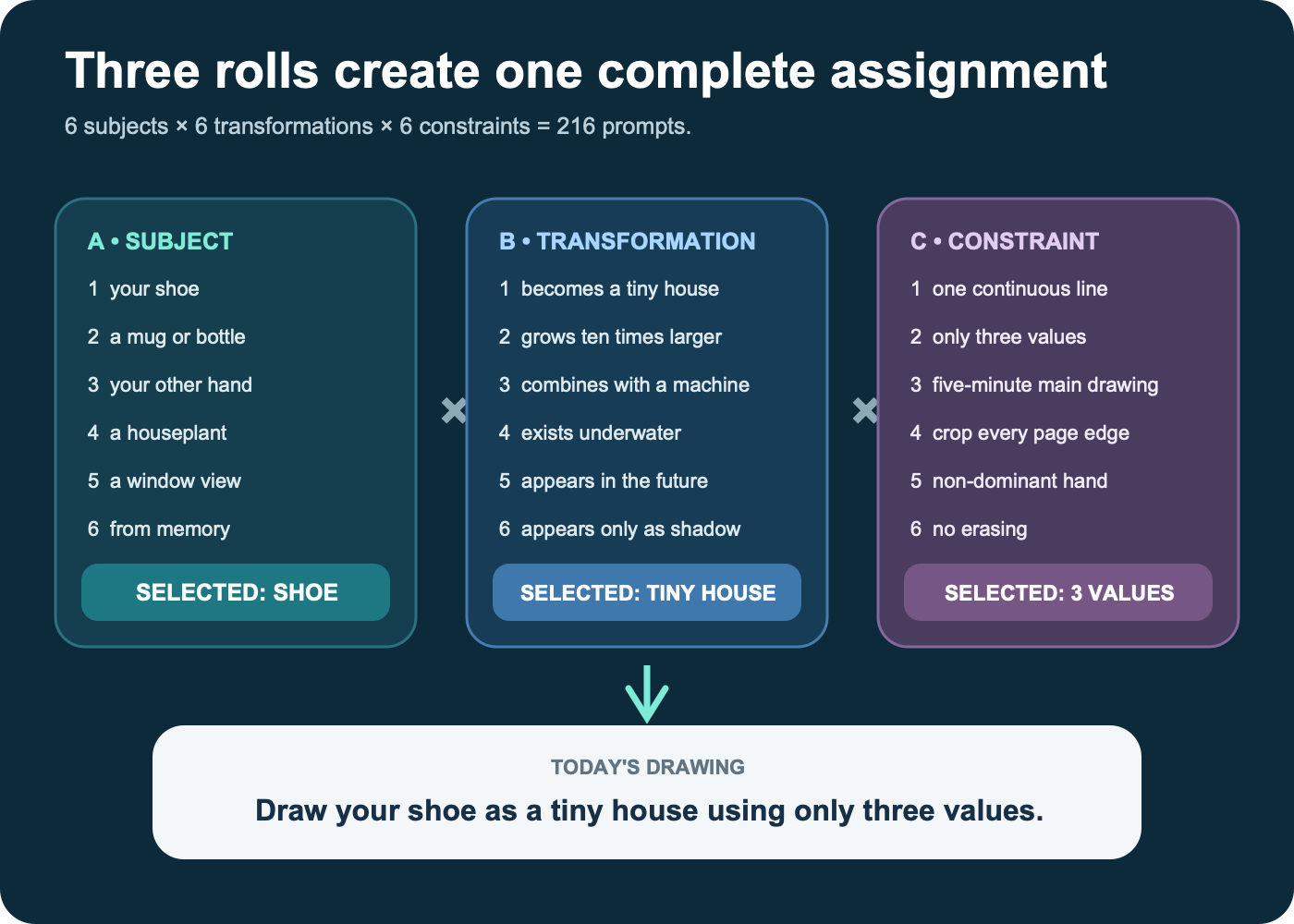
Use an ordinary six-sided die three times—or simply choose one item from each column. Six subjects × six transformations × six constraints produce 216 combinations.
| Roll | A — Subject | B — Transformation | C — Constraint |
|---|---|---|---|
| 1 | Your shoe | Becomes a tiny house | Use one continuous line |
| 2 | A mug or bottle | Is ten times larger than normal | Use only three values: light, middle, dark |
| 3 | Your non-drawing hand | Combines with a machine | Finish the main drawing in five minutes |
| 4 | A houseplant | Exists underwater | Crop part of it beyond every page edge |
| 5 | The view through a door or window | Appears 100 years in the future | Draw with your non-dominant hand |
| 6 | An animal or object from memory | Can be seen only through its shadow | Do not erase; convert errors into features |
Prompt formula: Draw [A: subject] that [B: transformation], while following [C: constraint].
A drawing prompt is a compact work specification, not merely a noun. It identifies the task, input, and boundary that will produce an observable result. ToolMerit’s guide to what a prompt contains explains the same underlying structure in a broader context.
The constraint is not a punishment. It removes decisions. “Draw a houseplant” leaves medium, viewpoint, finish, time, and purpose unresolved. “Draw a houseplant underwater, cropped off every edge, in 20 minutes” gives you a first mark.
Turn one generated prompt into a picture
Use the example from the direct answer: draw your shoe as a tiny house using only three values in 20 minutes.
- Keep two identities. List three shoe traits—sole, opening, laces—and three house traits—foundation, door, windows. The image must retain at least two from each list.
- Make three thumbnails. Try the shoe from the side, from above, and tilted toward the viewer. Spend about one minute on each; choose the silhouette that reads fastest.
- Map functions rather than decorating. The opening can become a courtyard, the sole a foundation, the tongue a roof, and the eyelets small windows. Do not paste a generic house on top.
- Assign three values. Let the page or lightest shape remain light, group most structure into a middle value, and reserve the darkest value for the opening, cast shadow, and focal edges.
- Test at a distance. The drawing passes when both “shoe” and “tiny dwelling” remain legible without counting details.
The Getty’s formal-analysis guide defines line, shape, space, color, texture, and value as separable building blocks. That makes them useful constraint knobs. If “three values” is easy, repeat the same prompt with contour only, negative space, or texture as the dominant problem.
For a design-route version, simplify the shoe-house until it works as a small symbol. If the final deliverable should scale cleanly for an interface or mark, the guide to real vector shapes and output formats explains what must change after the sketch.
Use ready-made prompts when you do not want to roll
Pick the first line under your chosen route. Do not browse for the “best” prompt.
| Observe | Invent | Design | Settle |
|---|---|---|---|
| Draw a kitchen tool from three angles. | Draw a bus behaving like a sea creature. | Design three icons that all mean “save.” | Fill the page with quiet, loud, and dancing lines. |
| Draw only the negative spaces between chair legs. | Draw two shoes arguing about where to go. | Turn a favorite tool into a mascot. | Make a three-minute blind contour portrait. |
| Draw crumpled paper using five shadow shapes. | Draw weather contained inside a glass jar. | Make a book cover from two shapes and one word. | Trace the changing shadow of a plant without outlining the plant. |
| Draw your hand holding a transparent object. | Draw a forgotten robot tending a garden. | Map an imaginary neighborhood using six symbols. | Repeat the first letter of your name as a changing pattern. |
These are starting structures, not claims of novelty. MoMA’s at-home drawing activities likewise use limits such as ten, five, or three portrait lines; views from a window; mood as color; shadow patterns; and one object from two viewpoints. The National Gallery’s everyday-object lesson changes technique—scribbling, gesture, pressure, contour, hatching, and crosshatching—while holding the still life steady. Repetition with a changed variable is a legitimate practice method, not a failure to find a new subject.
If you choose a limited-palette prompt and need a neutral color, the three paint-mixing routes to brown provide a practical color branch without turning this page into a paint formula guide.
Finish the drawing in 20 minutes
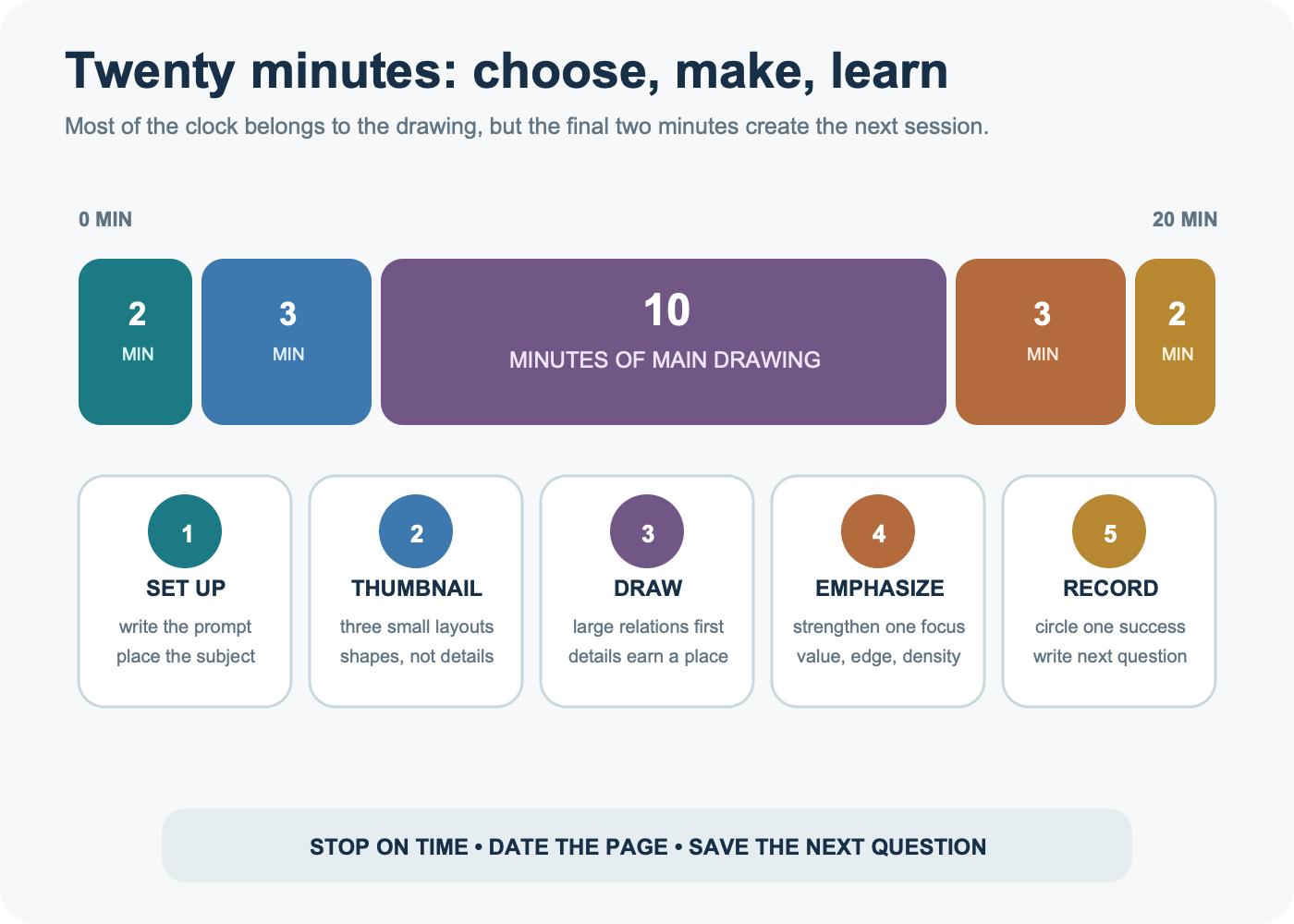
Use a timer so choosing ends and making begins:
- Minutes 0–2 — Set up: write the prompt at the top of the page, place the subject or reference, and choose the tool.
- Minutes 2–5 — Thumbnail: test three small arrangements. Use shapes, not details.
- Minutes 5–15 — Main drawing: build the largest relationships first, then add only details that support the prompt.
- Minutes 15–18 — Emphasize: strengthen one focal area through value, edge, density, scale, or color.
- Minutes 18–20 — Record: stop, date the page, circle one successful choice, and write the next question.
The final two minutes convert a finished attempt into practice. “Make the shadow direction clearer,” “try the mug from below,” or “repeat this with only curved lines” is more useful than “draw better next time.”
When the prompt fails, change only one axis
A failed start gives diagnostic information. Preserve two parts of the assignment and replace the third:
- The subject feels dead: keep “tiny house” and “three values,” but switch the shoe to a mug.
- The transformation feels forced: keep the shoe and three-value limit, but change “tiny house” to “seen only through its shadow.”
- The constraint blocks the idea: keep the shoe-house, but replace three values with continuous line.
- You finish too early: repeat the same prompt from a second viewpoint instead of filling the first drawing with unrelated detail.
- You avoid starting twice: change the session route. Move from invention to observation or from design to mindful marks.
Do not confuse a drawing prompt with an image-delivery request. If you need a finished generated asset rather than the experience or skill of drawing, review the AI images and design tools as a separate workflow. That route changes the task; it does not make the sketchbook session unsuccessful.
Drawing can also serve understanding rather than display. In seven free-recall experiments, Wammes, Meade, and Fernandes found that drawing presented words produced better later recall than writing them. The authors describe drawing as combining semantic, visual, and motor components. That finding is about a bounded memory task—not proof that every sketch improves every kind of learning—but it offers another valid answer to “what should I draw?”: draw the concept you are trying to remember.
Your next action is deliberately small: choose one of the four routes, roll or select A–B–C, write the full prompt, and start the two-minute setup timer. Save inspiration for later; the first mark only needs a subject, a change, and a boundary.
If the failed constraint is “make it readable as a tiny symbol,” the favicon size-testing workflow provides a concrete scale and silhouette test.