
A useful product roadmap connects strategy to prioritized outcomes, evidence, and changeable solution bets. This guide repairs a feature calendar and provides a reusable row template.
A slide says “Q3: SSO, Q4: AI summaries, January: mobile dashboard.” It looks like a product roadmap, but it cannot explain which user problem matters, what result should change, or what the team should do if the evidence changes.
A product roadmap is a living plan that connects product strategy to prioritized outcomes and the likely sequence of work used to reach them. It communicates direction, choices, and uncertainty. It is not a permanent promise that every named feature will ship on a precise date.
Why the feature calendar fails
A feature calendar starts with solutions. Once those solutions receive dates, sales, leadership, and customers can interpret them as commitments—even when the product team has not validated the problem or estimated the work. The team then measures success by whether an item shipped, not whether the product improved for its intended user.
Run three tests on any proposed roadmap item:
- Outcome test: What behavior, capability, risk, or business result should be different?
- Evidence test: What research, product data, support pattern, market constraint, or strategic requirement justifies attention now?
- Change test: If the first solution fails, can the team pursue the same outcome another way without “breaking” the roadmap?
If the item passes only the shipping test—“we will deliver feature X”—it belongs in a release plan or backlog until its strategic reason is clear.
What a product roadmap should connect
The UK Government Service Manual defines a roadmap as a plan showing how a product or service is likely to develop over time. Its roadmap guidance emphasizes user value, clear objectives, iterative updates, priority, and the ability to change as teams learn. That word likely matters: the roadmap expresses current intent, not certainty about an unknowable future.
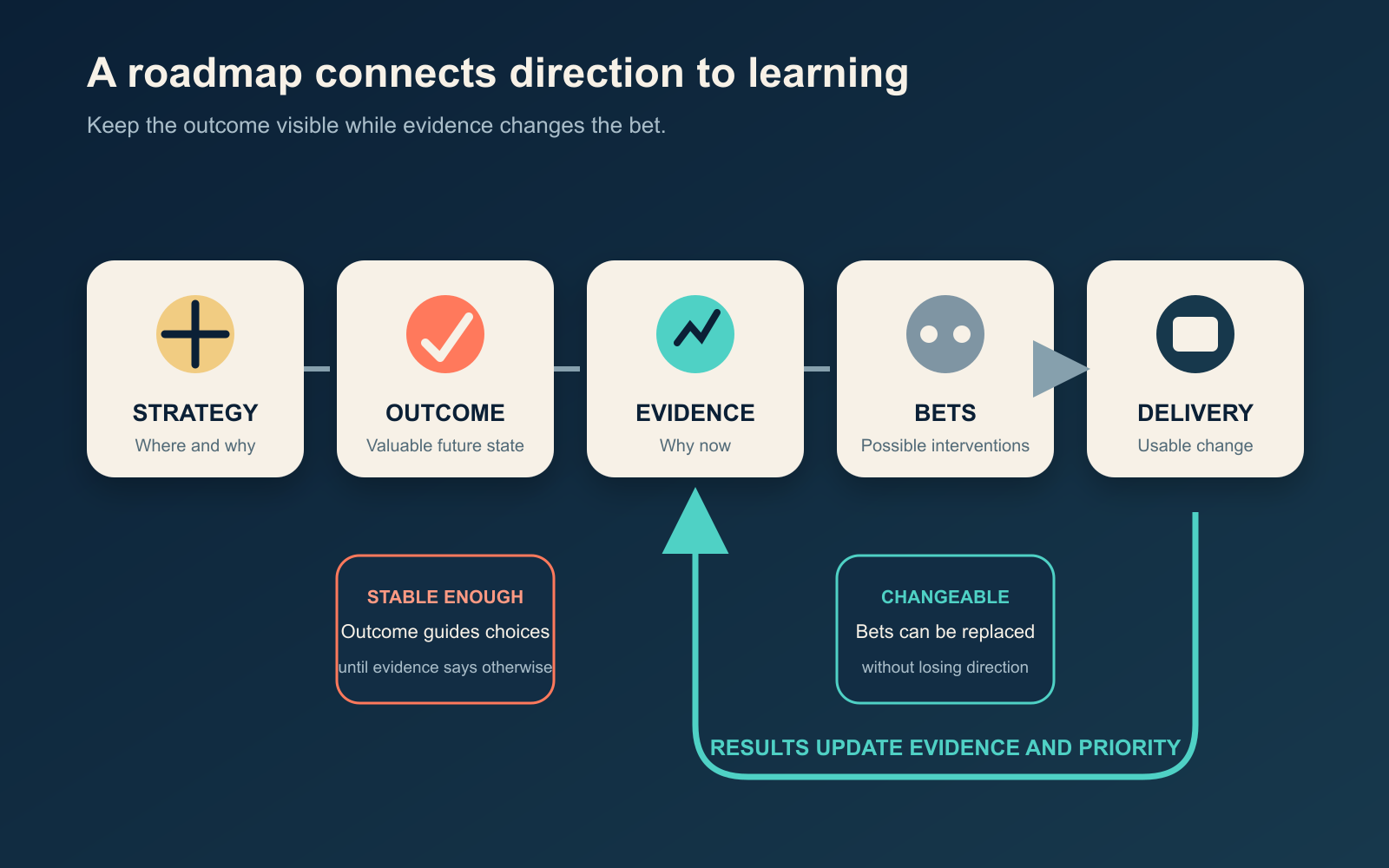
A useful chain has five links:
- Strategy: the market, users, capabilities, and advantage the organization chooses to pursue.
- Outcome: the valuable future state or measurable change the product should create.
- Evidence: the reason this outcome deserves priority now.
- Bet: a product intervention worth testing; it may be replaced if it does not work.
- Delivery link: the initiatives, releases, and backlog work that turn the selected bet into a usable change.
The official Scrum Guide makes a compatible distinction: a Product Goal describes a future product state, while the Product Backlog is the emergent, ordered list of work needed to improve the product. A roadmap can connect several strategic outcomes over a longer horizon; it should not duplicate every backlog item.
Roadmap vs. strategy, release plan, and backlog
| Artifact | Question it answers | Typical level | Change behavior |
|---|---|---|---|
| Product strategy | Where will we play, for whom, and how will we create advantage? | Choices, constraints, and positioning | Changes when strategic assumptions or conditions change |
| Product roadmap | Which outcomes come first, why, and what might move us toward them? | Outcomes, initiatives, horizons, evidence, and confidence | Reviewed as evidence, capacity, dependencies, and priorities change |
| Release plan | What approved scope is expected in a particular release? | Deliverables, readiness, sequence, owners, and target date | Managed against delivery dependencies and release criteria |
| Product backlog | What work could the team refine and undertake? | Ordered problems, experiments, features, defects, and technical work | Continuously refined and reordered |
These artifacts should link to one another, not collapse into one giant board. A roadmap row may link to discovery notes, a metric definition, an initiative, and a release plan. The backlog can then change without erasing the strategic outcome that justified the work.
Repair a feature list into an outcome roadmap
Consider a fictional self-serve reporting product. The original plan lists “guided connector,” “AI summaries,” and “mobile dashboard” in three quarters. It does not reveal that new users are abandoning setup before importing any data.
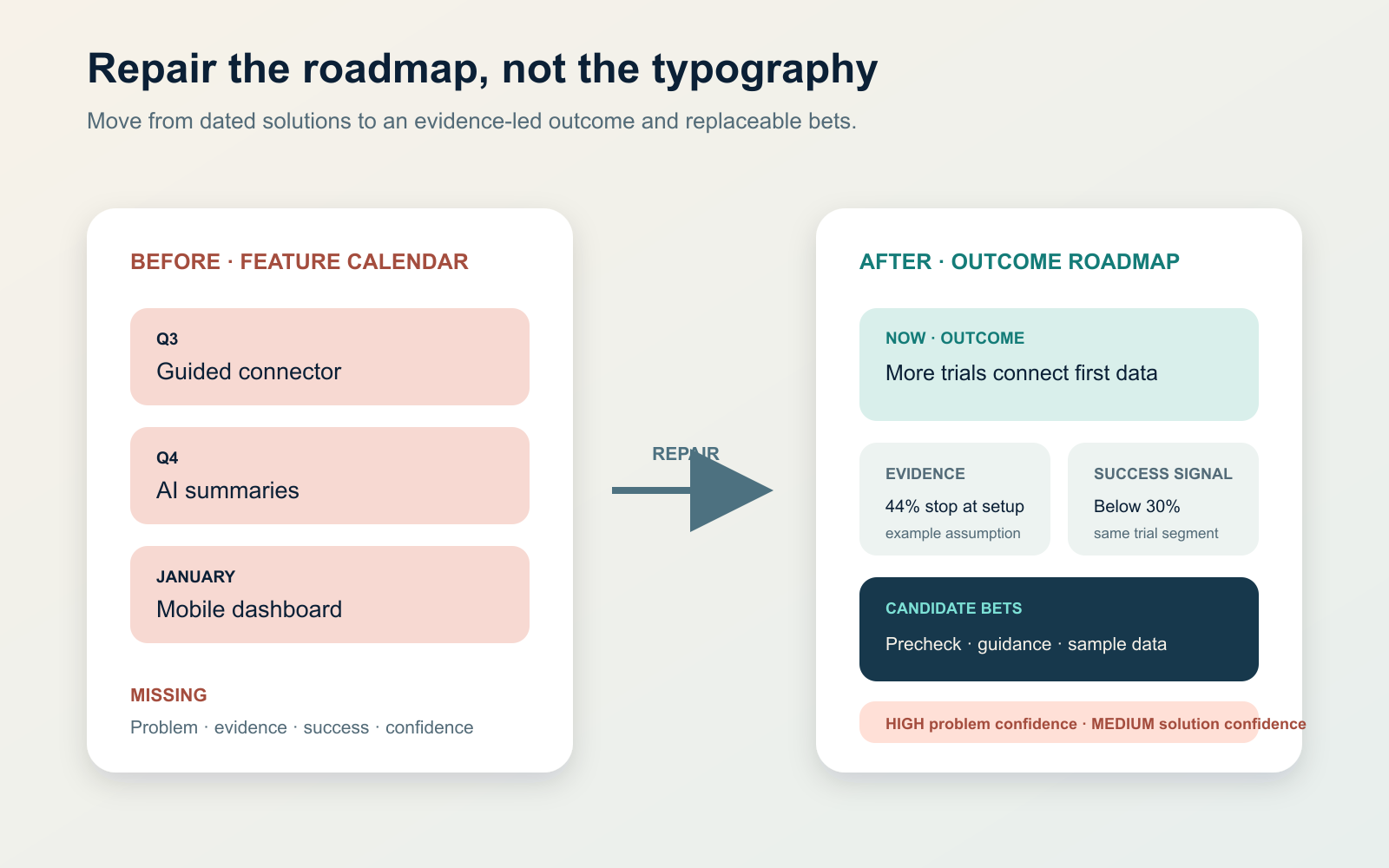
For the example, assume internal funnel analytics show that 44% of new trial accounts stop at the data-connection step, and five of eight recent setup interviews mention permissions or field mapping. Those numbers are stated assumptions for the example, not benchmark claims.
The repaired roadmap item becomes:
Outcome: More qualified trial accounts complete a first data connection without assisted support.
Baseline and target: Reduce connection-step abandonment from the assumed 44% baseline to below 30% for new self-serve trials.
Evidence: Funnel drop-off plus setup interviews pointing to permission and mapping confusion.
Candidate bets: Permission precheck, guided connector, sample-data mode, and clearer mapping feedback.
Horizon and confidence: Now; high confidence in the problem, medium confidence in the guided-connector bet.
Review: Compare activation, support contacts, and segment-level completion after the first experiment.
The guided connector remains visible, but the team can replace it with a permission precheck if testing shows that permissions—not guidance—drive most failures. The outcome remains stable while the solution learns.
A copyable product roadmap row
Use one row per outcome or mission. The format works in a spreadsheet, document, database, or roadmapping tool.
| Field | Write this | Reject this |
|---|---|---|
| Outcome | A valuable state or behavior that can be observed | A feature name alone |
| User and problem | The affected segment and the obstacle or unmet need | “All users need it” without evidence |
| Evidence and baseline | Source, date, segment, current measure, and important limits | An unattributed request count |
| Success signal | Metric, target direction, guardrail, and measurement window | “Launch completed” as the only success measure |
| Candidate bets | One or more plausible interventions or experiments | A solution presented as inevitable before discovery |
| Horizon and confidence | Now, next, or later plus confidence in problem and solution | A precise distant date with no confidence signal |
| Dependencies and owner | Critical external constraint, accountable owner, and decision authority | A list of everyone who attended the meeting |
| Review date | When evidence and priority will be reconsidered | A publication date that becomes a ceremonial deadline |
The Hackney Council product playbook uses a Now, Next, Later roadmap built from product goals and informed by analytics, research, and feedback. Atlassian’s current agile-roadmap guidance similarly recommends broader time chunks or Now, Next, Later instead of unnecessary precise-date commitments. Those horizons are useful only when the team defines what they mean.
Define time and confidence before sharing
“Now” might mean the current six-week cycle for one team and the current quarter for another. Put the definitions on the roadmap. A practical legend is:
- Now
- The team is actively discovering or delivering the outcome. Capacity is allocated, but scope can still adapt.
- Next
- The outcome is prioritized after current work, subject to evidence, dependency, and capacity checks.
- Later
- The problem is strategically relevant but sequence, solution, and timing remain exploratory.
Do not let horizon names carry all the risk communication. Label confidence separately: confidence in the problem, confidence in the proposed solution, and confidence in timing are different things. A regulatory deadline can create high timing confidence while the best implementation remains uncertain. A strong user problem can be real even when no solution has passed testing.
One source of truth, several audience views
Executives need strategic outcomes, investment choices, risks, and dependencies. Delivery teams need links to evidence, discovery, and executable work. Sales and customer success need language that separates committed releases from directional intent. Customers may need a deliberately limited public view that excludes security-sensitive or commercially sensitive detail.
Maintain one canonical data set and generate audience views from it. The GOV.UK guidance recommends a master version when multiple versions are necessary and says the roadmap should explain who maintains it, how it is updated, and how people contribute. Duplicated slide decks without an owner turn stale quietly.
Every shared view should carry:
- the owner and last review date;
- the horizon definitions;
- the meaning of confidence or commitment labels;
- a link to supporting evidence or the relevant delivery artifact;
- a short change log for additions, removals, and reordered outcomes.
Review the roadmap as a decision system
A roadmap meeting should not be a status reading. Review whether the evidence still supports each outcome, whether the success signal remains valid, what delivery taught the team, and which constraint changed. Productboard’s outcome-driven roadmap guide treats customer insight, market context, company goals, capacity, and business conditions as inputs to prioritization rather than as decorations added after the list is chosen.
For the fictional reporting product, the repaired roadmap now produces a clear decision. If the permission precheck lifts completed connections while the guided connector does not, keep the outcome, promote the effective bet, retire the weak one, and record why. If the baseline was measured incorrectly, fix the metric before claiming progress. If another outcome becomes more urgent, show the tradeoff rather than quietly moving cards.
The finished roadmap is no longer a prettier feature calendar. It tells the team which result matters, why it matters, what might change it, how uncertainty is represented, and when the decision will be revisited.