A practical explanation of dropshipping order flow, unit economics, supplier control, seller responsibility, platform rules, and fit.
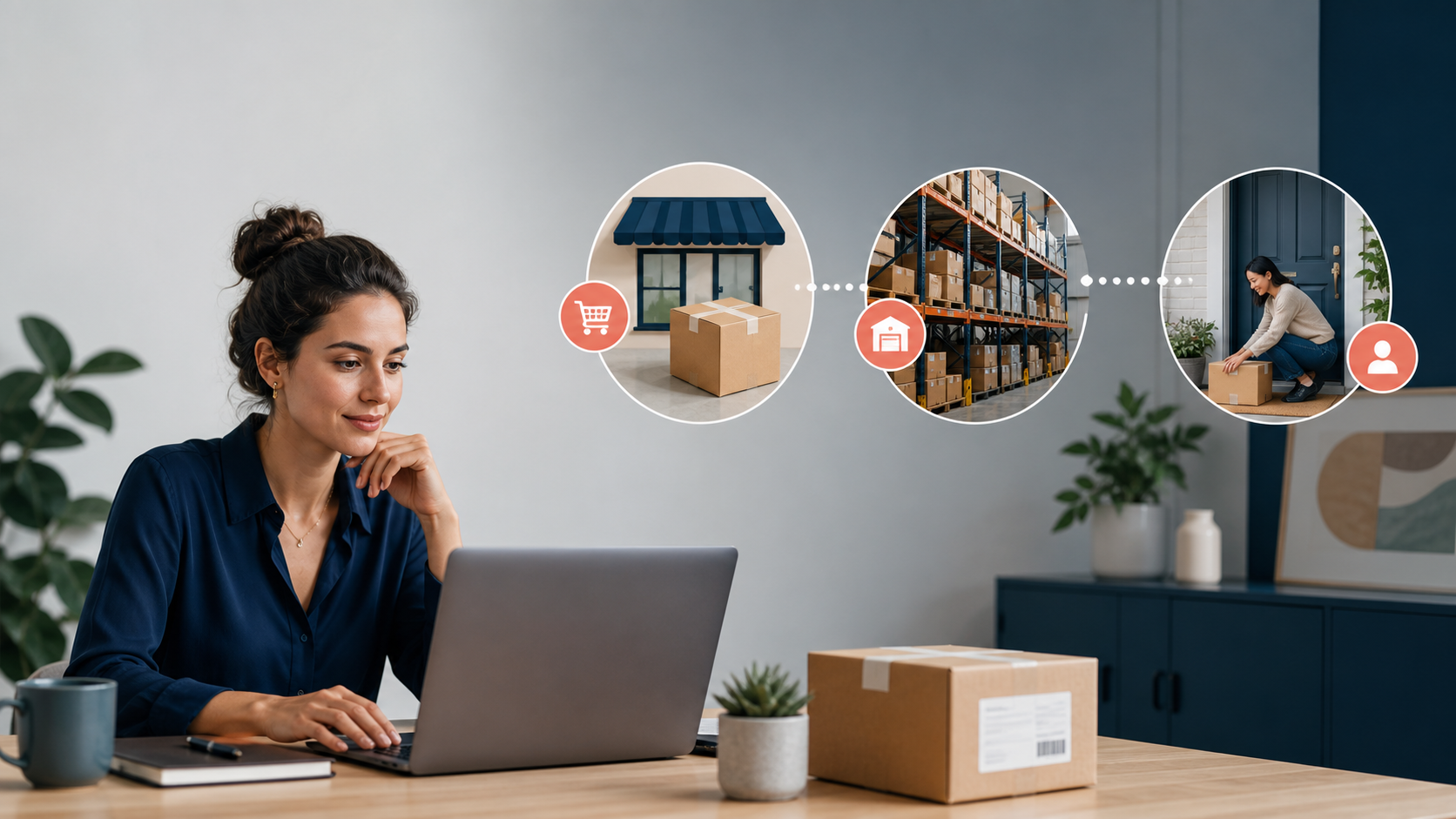
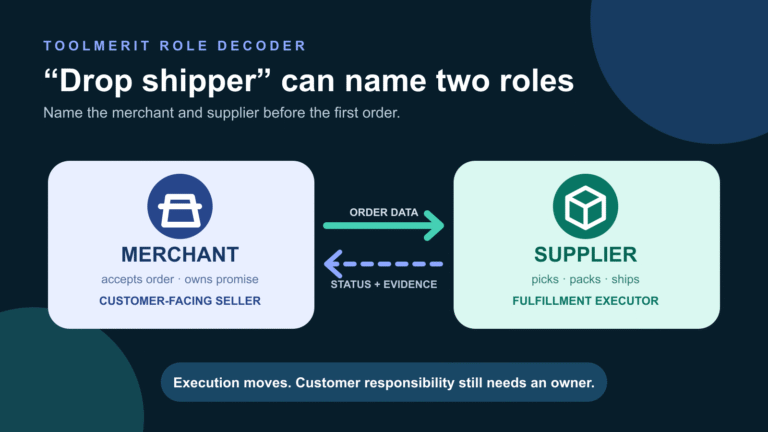
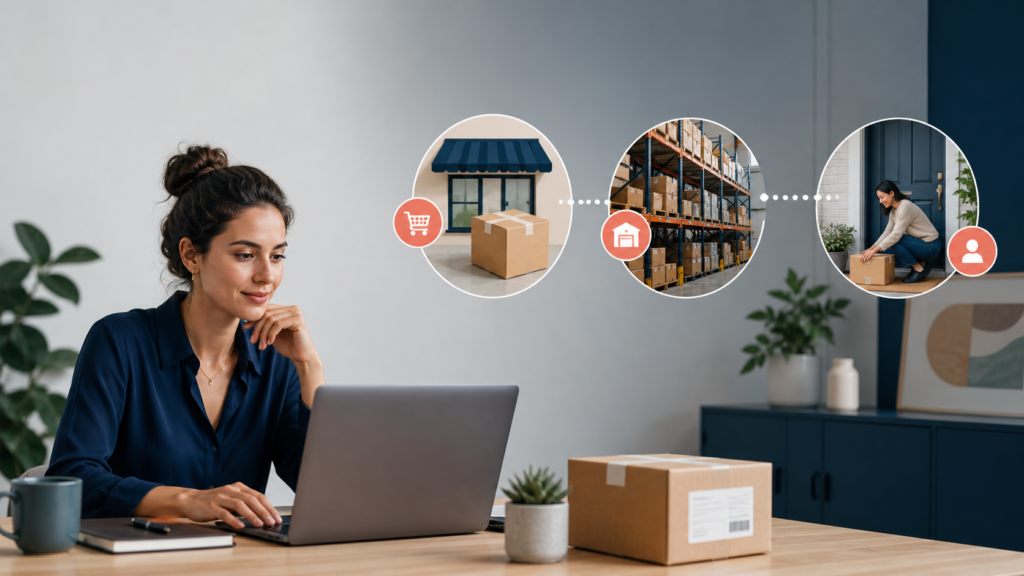
Dropshipping is a retail fulfillment method in which a store sells a product it does not keep in stock; after a customer orders, the store buys the item from a third-party supplier, and that supplier ships it directly to the customer. The customer pays the store, not the supplier. The store sets the offer and remains responsible for the customer experience even though it does not pack the parcel.
That last distinction matters. Dropshipping removes the need to pre-purchase and warehouse every unit, but it does not remove retail work or risk. Product selection, truthful listings, pricing, tax setup, payment disputes, shipping promises, support, returns, safety, and platform compliance still need an accountable owner.
What actually happens after a dropshipping order
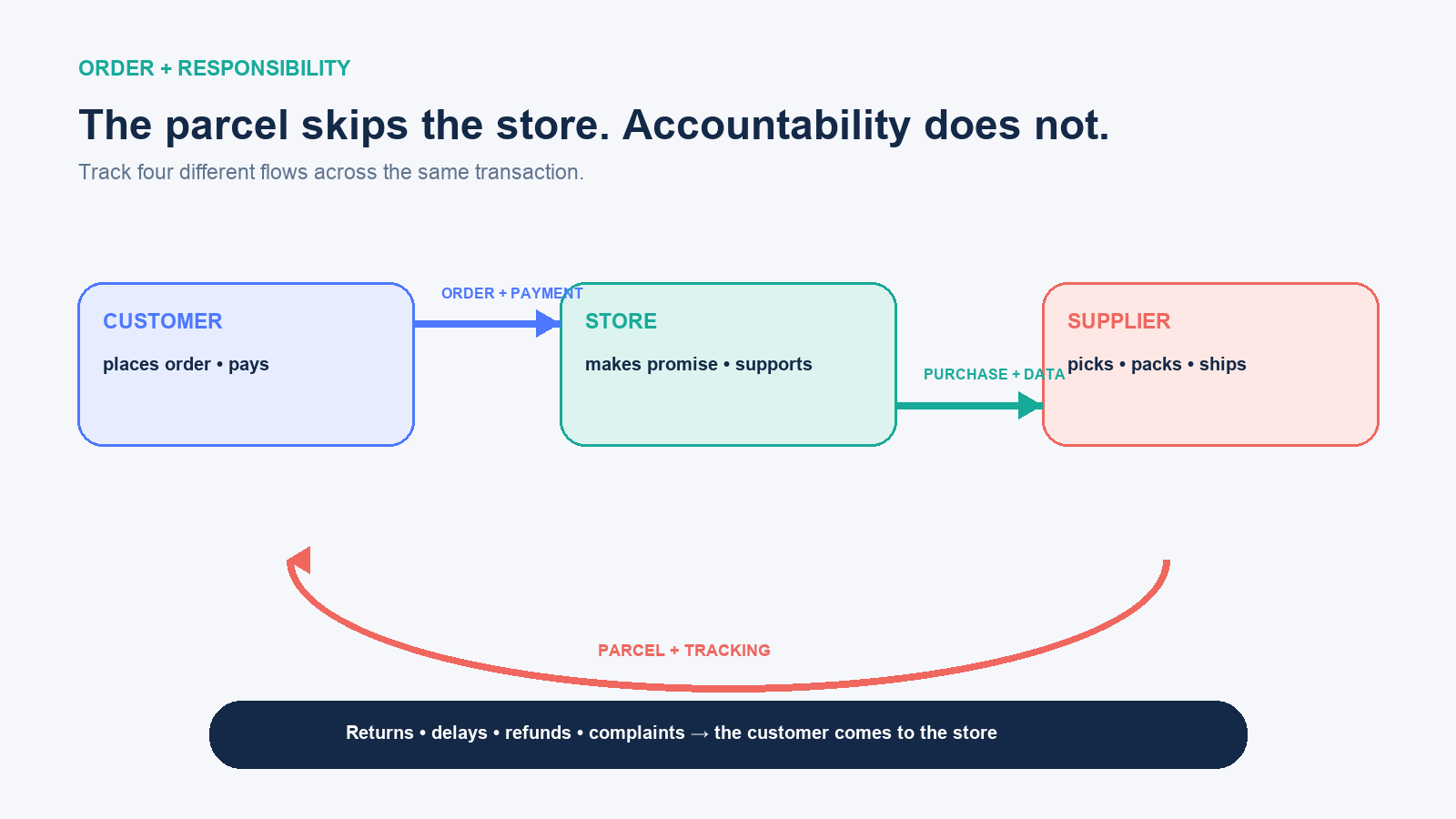
- The customer orders from the store. The product page, price, delivery claim, refund policy, and checkout belong to the seller’s offer.
- The store accepts payment. Payment processing fees and fraud or chargeback exposure arise at this layer.
- The order is transmitted to a supplier. This can be manual or automated. Only the data needed for fulfillment should be shared.
- The store pays the supplier. The supplier charges its product price and usually a shipping or fulfillment fee.
- The supplier picks, packs, and ships. Tracking must flow back to the store and then to the customer.
- The store handles the outcome. Questions, delays, damage, returns, refunds, and payment disputes reach the business that made the sale.
Shopify’s current help documentation describes the same sequence: order details move from the customer to the store and then to the supplier, which fulfills the parcel. It also states that the merchant remains responsible for customer service and order tracking. A supplier is therefore an operational partner, not a transfer of accountability.
Dropshipping is a fulfillment choice, not a store type
| Model | Who owns inventory before the sale? | Who ships? | How the operator earns |
|---|---|---|---|
| Dropshipping | Supplier | Supplier directly to customer | Retail revenue minus product, fulfillment, marketing, service, and overhead costs |
| Wholesale retail | Store | Store or contracted warehouse | Retail margin after buying inventory in advance |
| Third-party logistics (3PL) | Store | 3PL holds the store’s stock | The store earns retail margin and pays storage/fulfillment fees |
| Affiliate marketing | Merchant | Merchant | Publisher earns a referral commission and usually is not the seller |
| Marketplace selling | Depends on fulfillment model | Seller, supplier, or marketplace service | Seller margin after marketplace and fulfillment costs |
A store can mix models: hold proven products in a warehouse, dropship slower-moving variants, and use print-on-demand for customized items. “Selling on a marketplace” is not synonymous with dropshipping, and buying from another retailer only after making a marketplace sale can violate that marketplace’s rules.
The real unit economics of one order
Gross margin alone hides much of the business. Use a contribution calculation for each product:
contribution per order = collected revenue − product cost − supplier shipping − payment fees − acquisition cost − expected returns and support − other variable costs.
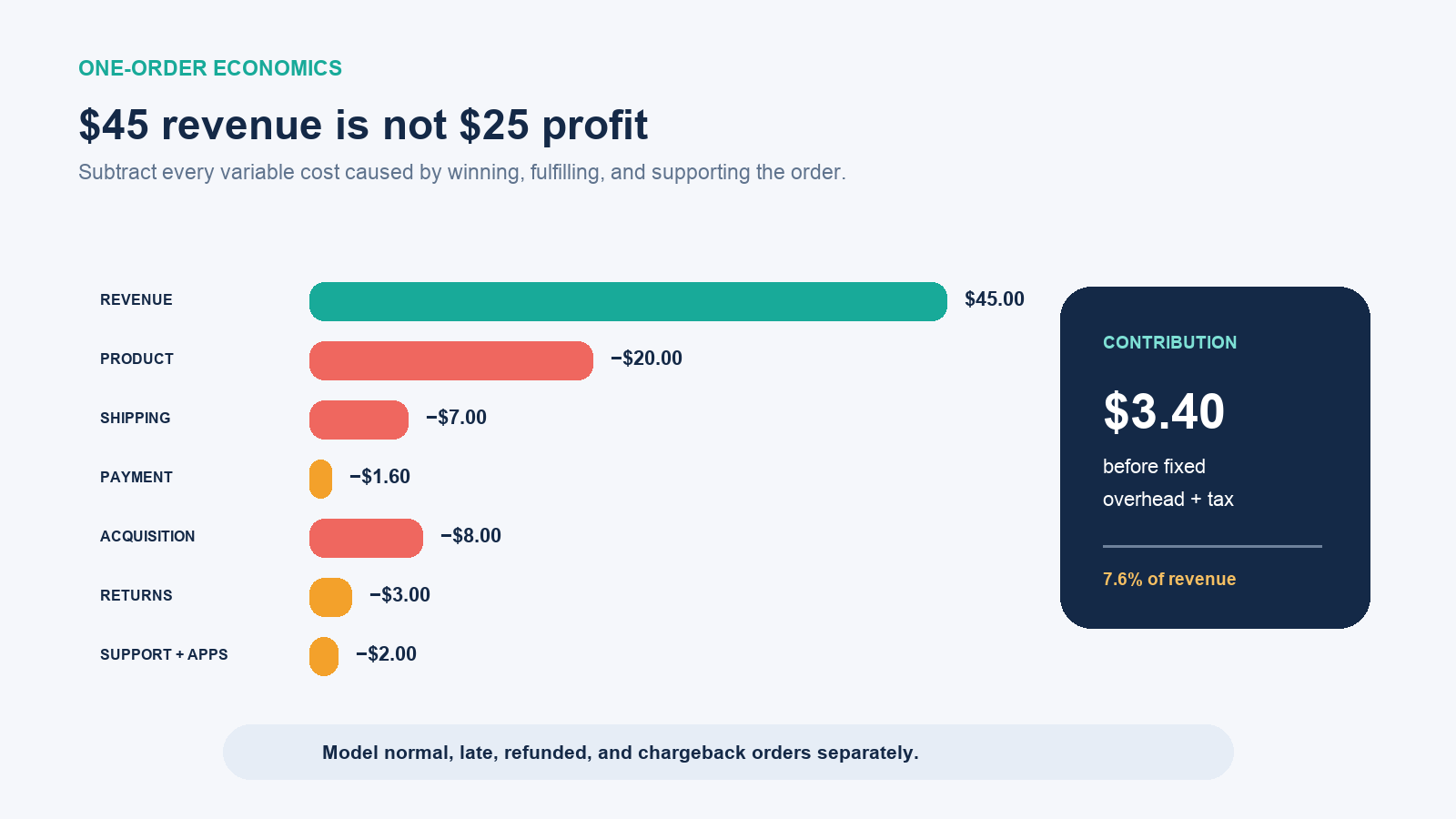
Suppose a store collects $45 before sales tax. The supplier charges $20 for the item and $7 to ship it. Payment fees are $1.60, attributed customer acquisition is $8, the expected returns/refund allowance is $3, and variable apps and support average $2. Contribution is:
$45 − $20 − $7 − $1.60 − $8 − $3 − $2 = $3.40 per order.
That $3.40 is not the owner’s take-home profit. It still has to cover fixed software, samples, accounting, insurance, contractors, and taxes. A refund may reverse revenue while leaving advertising, payment, or return-shipping costs behind. Model normal, late, refunded, and chargeback cases separately; an attractive normal order can coexist with a fragile portfolio.
What the supplier controls—and what the seller must control
| Operational area | Supplier usually executes | Seller must verify or own |
|---|---|---|
| Inventory | Stocks and picks units | Stock-feed accuracy, oversell response, substitutes |
| Product | Manufactures or sources it | Safety, authenticity, claims, documentation, target-market legality |
| Parcel | Packs and hands it to a carrier | Brand identity, forbidden inserts, tracking quality, damage rate |
| Delivery | Selects available service | Customer-facing promise, delay communication, refund decision |
| Returns | May receive or inspect items | Published policy, authorization, refund timing, customer contact |
| Data | Receives fulfillment details | Lawful disclosure, access control, retention, incident response |
Write these responsibilities into a supplier agreement or operating checklist. If an answer is “the app handles it,” identify which company actually receives the alert, who decides, and what happens when synchronization fails.
Why businesses use dropshipping
- Lower inventory commitment: the store does not buy a broad catalog before demand exists.
- Faster assortment tests: a product can be sampled and listed without placing a large opening order.
- Less warehouse work: the supplier performs storage, picking, packing, and carrier handoff.
- Location flexibility: the operating team can manage listings, suppliers, marketing, and support remotely.
- Long-tail availability: variants with intermittent demand need not occupy the seller’s shelves.
These are reductions in capital and physical handling, not free scale. A low barrier to listing the same catalog can intensify price competition. Less physical control also means less control over packaging, inspection, stock accuracy, and transit speed.
The tradeoffs that beginner explanations often omit
- Thin and volatile margins: supplier prices, advertising costs, refunds, and carrier surcharges can move independently.
- Split shipments: products from different suppliers may arrive separately and create multiple fees or confusing tracking.
- Inventory drift: a supplier can run out after the store has accepted payment.
- Harder quality control: the seller may never see the exact unit sent to a buyer.
- Longer support loops: the store asks the supplier for evidence while the customer waits.
- Brand leakage: supplier invoices, marketplace packaging, or promotional inserts can contradict the storefront.
- Cross-border complexity: duties, import roles, product rules, tax, and return addresses vary by route and jurisdiction.
Platform permission is specific, not universal. For example, eBay permits fulfillment from a wholesale supplier but says purchasing from another retailer or marketplace after the sale for direct shipment is not allowed. Its policy also keeps the seller responsible for safe, timely delivery and buyer satisfaction. Amazon’s policy likewise requires the marketplace seller to be identified as seller of record and to handle returns. Always read the policy for the exact sales channel and region before building a workflow.
How to vet a supplier before accepting real orders
- Verify the business. Confirm legal identity, address, contact route, product authority, and a person who can resolve exceptions.
- Request documentation. Match certifications, warnings, authenticity evidence, and recall procedures to the product and market.
- Place test orders. Use different destinations and observe processing time, packaging, tracking, delivered condition, and included paperwork.
- Test an exception. Ask how a lost, damaged, late, returned, or out-of-stock order is recorded and funded.
- Measure the feed. Check how quickly inventory, price, discontinuation, and tracking changes reach the store.
- Agree on data handling. Limit customer data to fulfillment needs and document subprocessors, retention, and incident notification.
- Keep a backup route. Know whether the listing pauses, a substitute is offered with consent, or the order is canceled when supply fails.
One successful sample proves only that one order worked. Track on-time dispatch, valid tracking, delivery time by destination, defect rate, cancellation rate, response time, and refund recovery across a controlled pilot.
Seller obligations do not disappear at the warehouse door
Rules depend on where the business and customer are located, so obtain jurisdiction-specific tax and legal advice when needed. In the United States, the FTC’s Mail, Internet, or Telephone Order Merchandise Rule requires a reasonable basis for the advertised shipping time—or for shipment within 30 days if no time is stated. If the seller cannot meet the applicable time, it generally must seek consent to the delay or provide a prompt refund. The FTC’s business guide specifically says the seller soliciting the order remains liable for rule violations caused by a fulfillment house or drop shipper.
Product claims and reviews also belong in the compliance plan. Shopify advises dropshipping merchants to check product-safety laws, licenses, certifications, markings, warnings, and documentation for the places where they sell. The FTC’s current reviews guidance prohibits deceptive practices such as fake or false reviews and requires material connections in endorsements to be handled transparently. Other work may include business registration, sales tax or VAT, customs, privacy notices, accessibility, intellectual property, product liability, recalls, and payment-network rules.
When dropshipping is a reasonable fit
| Signal | Promising fit | Warning sign |
|---|---|---|
| Customer value | Useful curation, guidance, bundle, service, or niche access | The only differentiator is a copied supplier listing |
| Economics | Positive contribution after realistic returns and acquisition costs | Profit exists only before marketing, support, and refunds |
| Supplier | Documented, tested, measurable, responsive | No samples, vague identity, unstable stock, no exception owner |
| Delivery | Trackable promise the supplier repeatedly meets | Unknown origin, variable transit, optimistic estimate |
| Product risk | Understandable, supportable product with required evidence | Safety-sensitive or branded product without documentation |
| Operations | Someone owns monitoring, support, returns, and reconciliation | Automation is expected to eliminate oversight |
A sensible pilot is narrow: one customer problem, a few sampled products, one dependable fulfillment region, conservative delivery copy, explicit policies, and a fixed loss limit. Review contribution and service metrics after enough delivered orders—not merely after clicks or gross sales.
The decision rule is simple: use dropshipping when supplier fulfillment creates real operational leverage and the store can still verify the product, keep a truthful promise, support the buyer, and earn positive contribution after failure costs. If those controls are unavailable, holding inventory, using a 3PL, affiliate publishing, or not selling the product may be the better model.