

One foot equals exactly 12 inches. Convert whole, mixed, decimal, and fractional measurements without confusing 5 ft 7 in with 5.7 ft.
There are exactly 12 inches in one foot. To convert feet to inches, multiply the number of feet by 12; to convert inches back to feet, divide by 12.
That rule is simple for whole feet. The part that causes errors is notation: 5 ft 7 in, 5.7 ft, and 5.5833 ft do not all describe the same length. Use the input format before choosing the calculation.
The 12-inch rule
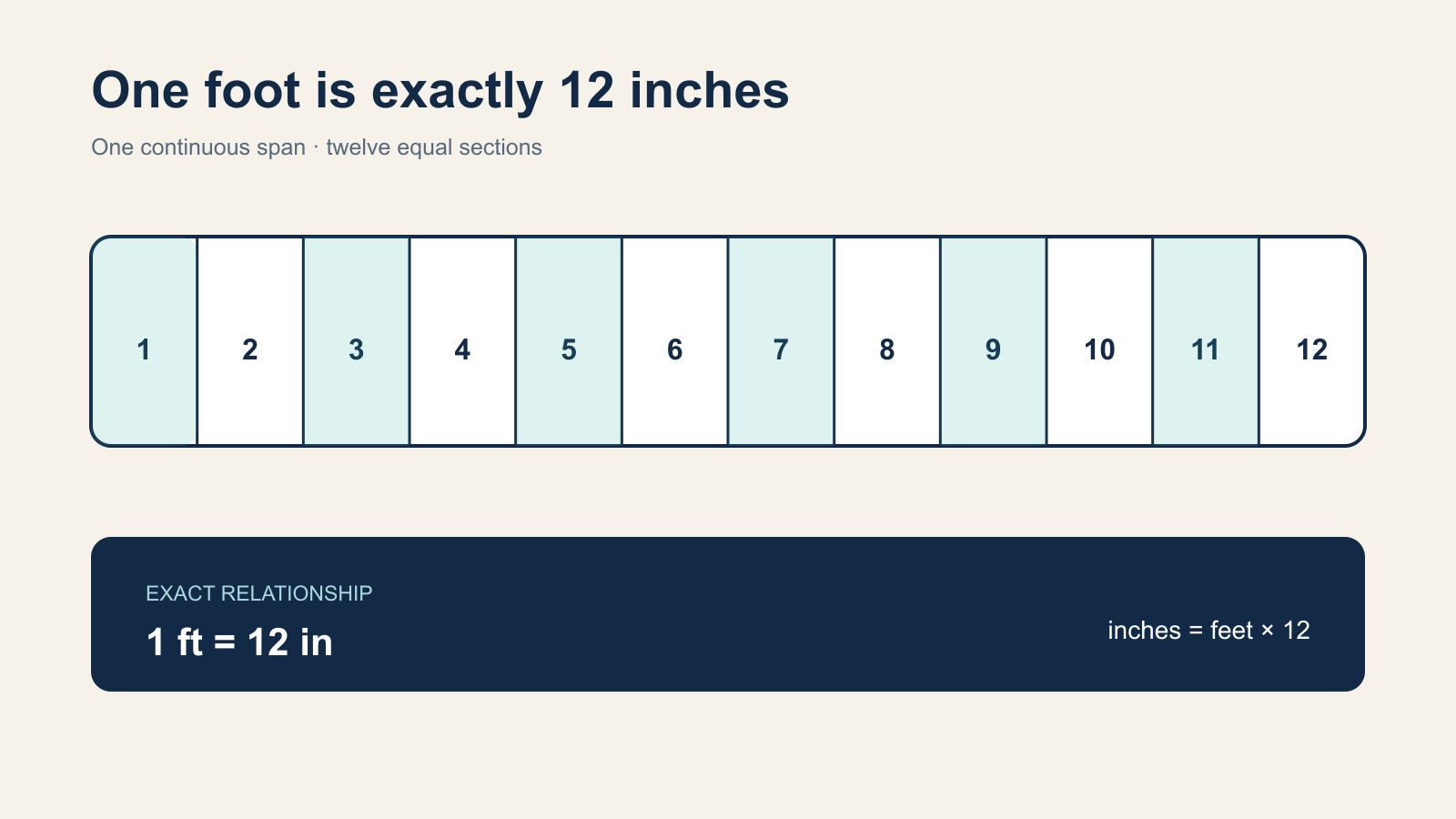
The relationship is exact, not an estimate. The NIST Guide to the SI gives the international foot as exactly 0.3048 meter and the inch as exactly 0.0254 meter. Dividing those definitions gives 12 inches per foot.
Feet to inches: inches = feet × 12
Inches to feet: feet = inches ÷ 12
Unit symbols are ft for foot or feet and in for inch or inches. A single prime and double prime—such as 5′ 7″—are also common, but 5 ft 7 in is clearer when a font or application may confuse those marks with apostrophes and quotation marks.
Convert whole feet to inches
Multiply the number of feet by 12. For example, 8 ft × 12 = 96 in.
| Feet | Inches | Calculation |
|---|---|---|
| 1 ft | 12 in | 1 × 12 |
| 2 ft | 24 in | 2 × 12 |
| 3 ft | 36 in | 3 × 12 |
| 4 ft | 48 in | 4 × 12 |
| 5 ft | 60 in | 5 × 12 |
| 6 ft | 72 in | 6 × 12 |
| 7 ft | 84 in | 7 × 12 |
| 8 ft | 96 in | 8 × 12 |
| 9 ft | 108 in | 9 × 12 |
| 10 ft | 120 in | 10 × 12 |
| 11 ft | 132 in | 11 × 12 |
| 12 ft | 144 in | 12 × 12 |
Add inches when the measurement is mixed
A measurement written with separate feet and inches needs two operations:
Total inches = (feet × 12) + remaining inches
For 5 ft 7 in, convert the feet first and then add the seven inches:
(5 × 12) + 7 = 60 + 7 = 67 in
The same rule works when the inch component contains a fraction or decimal:
3 ft 8½ in = (3 × 12) + 8.5 = 44.5 in6 ft 2 in = (6 × 12) + 2 = 74 in0 ft 9¼ in = 9.25 in
Do not read 5 ft 7 in as 5.7 ft
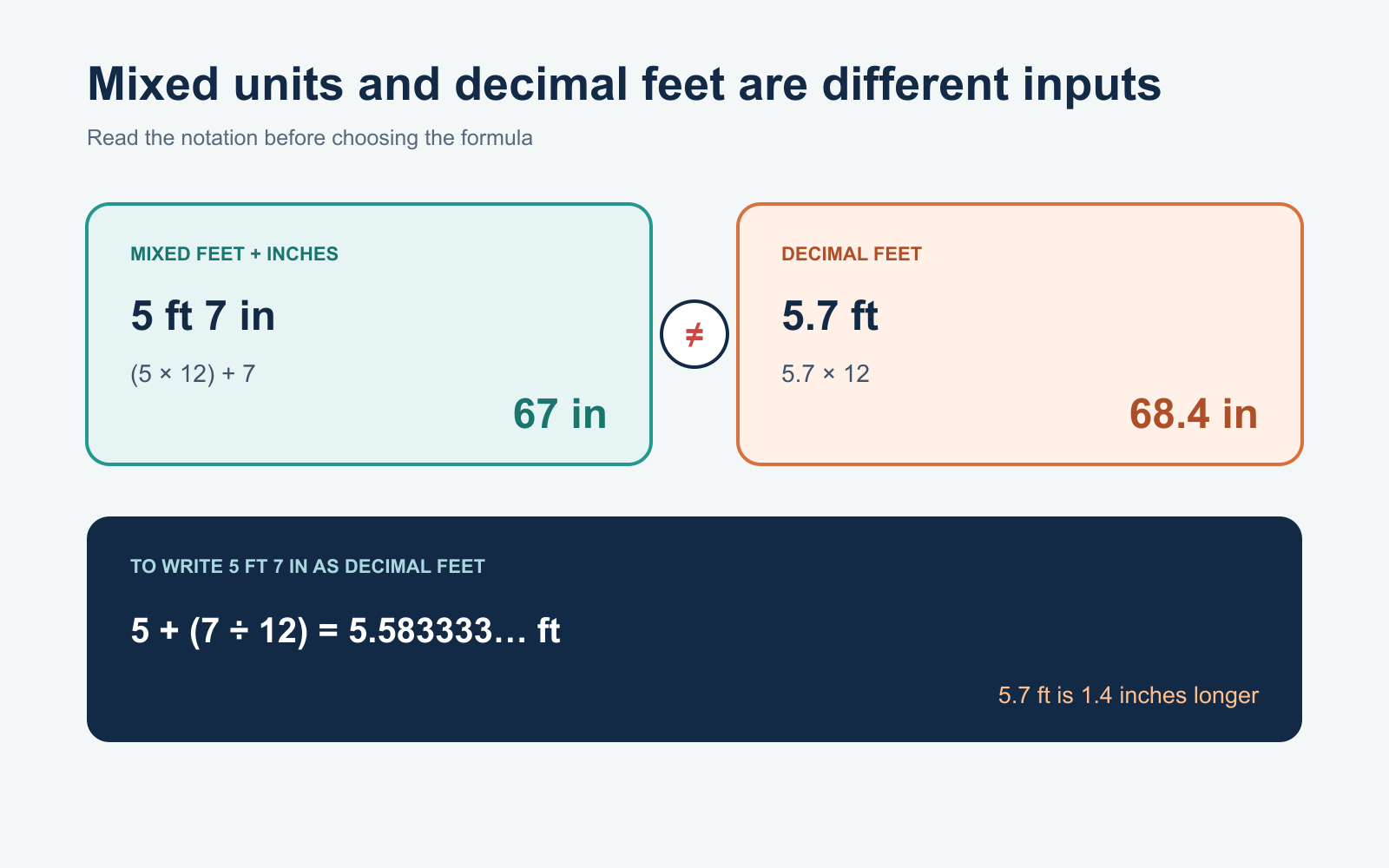
In mixed notation, the 7 means seven inches. In decimal notation, 0.7 ft means seven-tenths of a foot:
5 ft 7 in = 67 in5.7 ft × 12 = 68.4 in- The difference is
1.4 in.
To express 5 ft 7 in as decimal feet, divide the inch component by 12 and add it to the feet:
5 + (7 ÷ 12) = 5.583333… ft
This distinction matters when entering height, lumber length, drawing dimensions, or room measurements into software that accepts only decimal feet. Copying 5 ft 7 in as 5.7 changes the measurement.
Convert total inches back to feet and inches
Divide the total inches by 12. The whole-number quotient is the number of feet; the remainder is the number of inches.
For 74 inches:
74 ÷ 12 = 6with a remainder of2.- The result is
6 ft 2 in. - Verify it:
(6 × 12) + 2 = 74 in.
| Total inches | Whole feet | Remainder | Feet-and-inches result |
|---|---|---|---|
| 59 in | 4 | 11 in | 4 ft 11 in |
| 67 in | 5 | 7 in | 5 ft 7 in |
| 72 in | 6 | 0 in | 6 ft |
| 74 in | 6 | 2 in | 6 ft 2 in |
| 80.5 in | 6 | 8.5 in | 6 ft 8½ in |
If a calculator returns a decimal quotient, do not treat its decimal digits as inches. For example, 74 ÷ 12 = 6.1666… ft. Convert the fractional part back to inches: 0.1666… × 12 = 2 in.
Normalize an inch value of 12 or more
Conventional mixed notation keeps the inch component below 12. If a measurement is written as 4 ft 14 in, move one group of 12 inches into the feet:
4 ft 14 in = 4 ft + 1 ft + 2 in = 5 ft 2 in
For any oversized inch component, divide it by 12, add the quotient to the feet, and keep the remainder as inches. This normalization changes the notation, not the length.
Keep measured precision separate from the exact conversion
The conversion factor is exact, but a physical measurement may not be. If a tape measure supports sixteenths of an inch, preserve that fraction through the calculation rather than inventing more detail.
Example: 3 ft 8⅜ in becomes 36 + 8⅜ = 44⅜ in, or 44.375 in. The decimal does not make the measurement more precise than the original eighth-inch reading; it is only another representation.
When converting the final inch value to metric, use the exact relationship 1 in = 2.54 cm. Our inch-to-centimeter conversion guide includes fractional-inch values and rounding rules.
A note for historical survey files
For ordinary current measurements, “foot” means the international foot. NIST says the U.S. survey foot was superseded on January 1, 2023 and should now be avoided except in historical and legacy applications. If old coordinate or mapping data is involved, identify its foot definition before converting it to metric. That specialized issue does not change the everyday answer to how many inches are in a foot.
One conversion carried through every format
Start with 7 ft 3 in. In total inches, it is (7 × 12) + 3 = 87 in. In decimal feet, it is 7 + (3 ÷ 12) = 7.25 ft. Reverse the total by dividing 87 ÷ 12: the quotient is 7 and the remainder is 3, returning 7 ft 3 in. The three forms agree because each calculation keeps the 12-inch foot intact.