

One inch is exactly 2.54 centimeters. Use the formulas, tables, and precision rules here to convert whole, decimal, and fractional measurements correctly.
There are exactly 2.54 centimeters in one inch. To convert inches to centimeters, multiply by 2.54; to convert centimeters to inches, divide by 2.54.
This is an exact relationship, not a rounded shortcut. That makes the arithmetic simple. The judgment comes later: your answer should reflect how precisely the original object was measured.
Two-way rule
Inches × 2.54 = centimeters
Centimeters ÷ 2.54 = inches
The exact relationship
The international inch equals exactly 0.0254 meter, according to the NIST conversion-factor tables. The prefix centi means one hundredth, so one centimeter is 0.01 meter. Divide 0.0254 meter by 0.01 meter per centimeter and the result is exactly 2.54 centimeters.
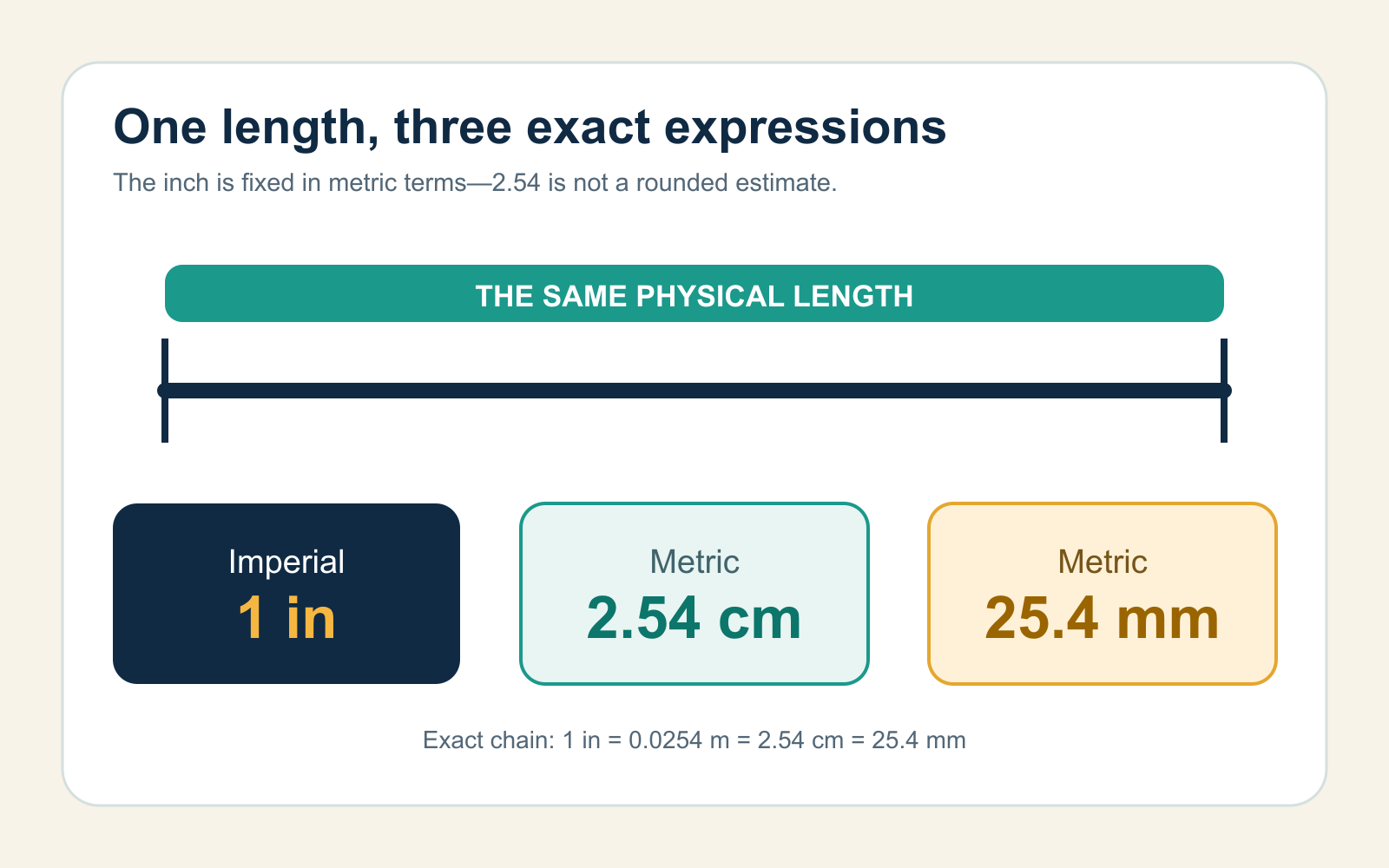
The word exactly matters. Writing “about 2.54 cm” incorrectly suggests that 2.54 is an estimate. The conversion factor has no rounding error. Any uncertainty comes from the measurement you put into the calculation.
Convert inches to centimeters
Multiply the number of inches by 2.54:
centimeters = inches × 2.54
Example: 5.5 inches
5.5 × 2.54 = 13.97 cm. This result terminates cleanly, so no further rounding is needed unless the task requests fewer decimal places.
Example: 12.75 inches
12.75 × 2.54 = 32.385 cm. If the input is a precisely specified dimension, keep 32.385 cm. If it came from a ruler that supports only rough readings, 32.4 cm may communicate the real precision more honestly.
Reverse example: 35 centimeters
For the opposite direction, divide: 35 ÷ 2.54 = 13.7795… inches. A practical result is 13.78 inches, or about 13 3/4 inches when working with a ruler marked in quarter inches.
Quick inch-to-centimeter table
These values all use the exact factor. Decimal digits shown here are part of the result, not alternative conversion factors.
| Inches | Centimeters |
|---|---|
| 0.5 in | 1.27 cm |
| 1 in | 2.54 cm |
| 2 in | 5.08 cm |
| 3 in | 7.62 cm |
| 4 in | 10.16 cm |
| 5 in | 12.7 cm |
| 6 in | 15.24 cm |
| 8 in | 20.32 cm |
| 10 in | 25.4 cm |
| 12 in | 30.48 cm |
| 24 in | 60.96 cm |
Fractional inch conversion table
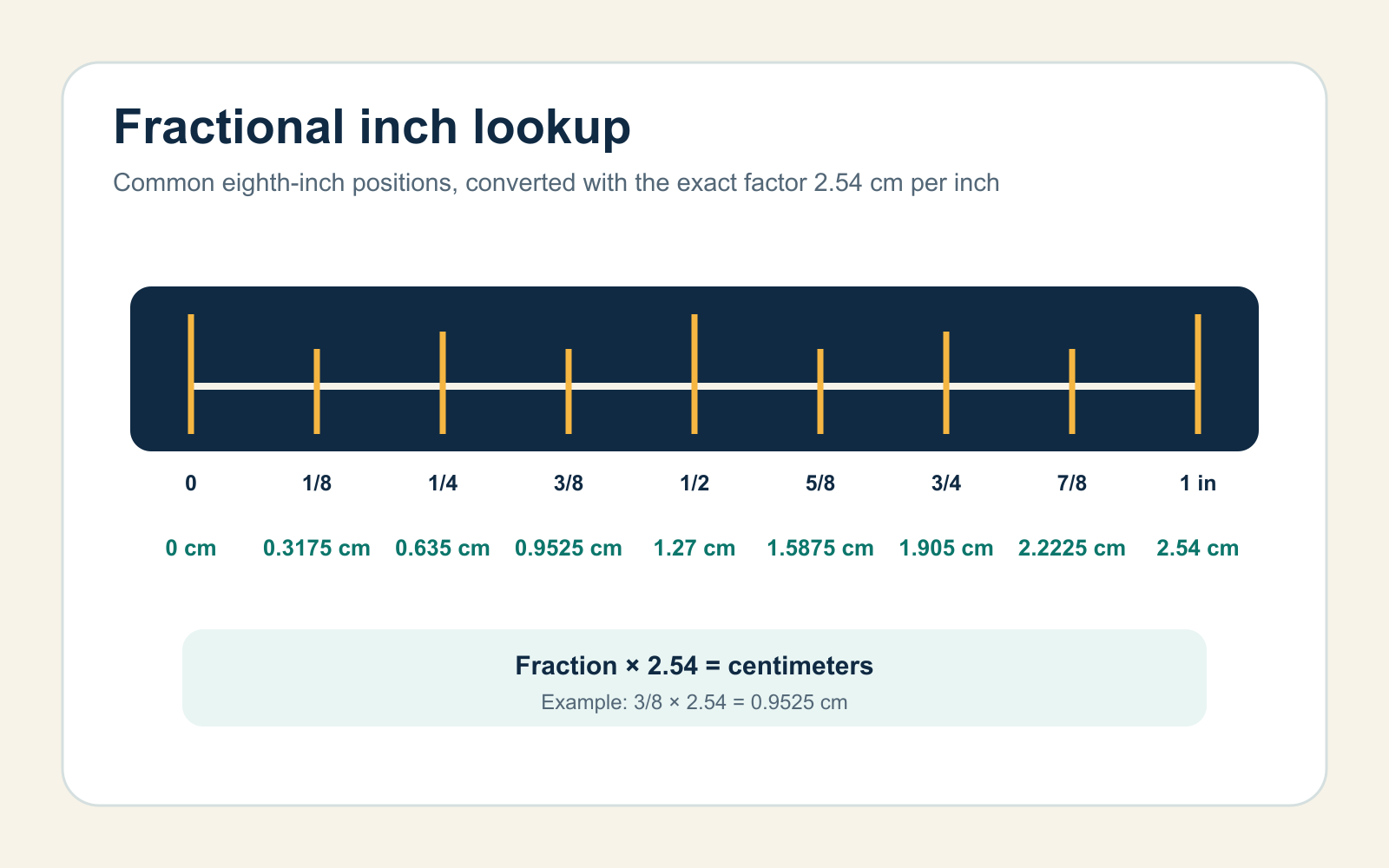
Fractions are common in woodworking, sewing, hardware, and home improvement. Convert a fraction by first treating it as part of one inch, then multiplying by 2.54. For example, 3/8 × 2.54 = 0.9525 cm.
| Fraction of an inch | Decimal inch | Centimeters |
|---|---|---|
| 1/16 in | 0.0625 in | 0.15875 cm |
| 1/8 in | 0.125 in | 0.3175 cm |
| 3/16 in | 0.1875 in | 0.47625 cm |
| 1/4 in | 0.25 in | 0.635 cm |
| 5/16 in | 0.3125 in | 0.79375 cm |
| 3/8 in | 0.375 in | 0.9525 cm |
| 7/16 in | 0.4375 in | 1.11125 cm |
| 1/2 in | 0.5 in | 1.27 cm |
| 9/16 in | 0.5625 in | 1.42875 cm |
| 5/8 in | 0.625 in | 1.5875 cm |
| 11/16 in | 0.6875 in | 1.74625 cm |
| 3/4 in | 0.75 in | 1.905 cm |
| 13/16 in | 0.8125 in | 2.06375 cm |
| 7/8 in | 0.875 in | 2.2225 cm |
| 15/16 in | 0.9375 in | 2.38125 cm |
| 1 in | 1 in | 2.54 cm |
Round the result, not the conversion factor
Keep 2.54 unchanged in the calculation. Then decide how many digits the output deserves based on the input and the job.
- Defined or specified dimensions: If a drawing specifies 12.75 in exactly, the converted value is exactly 32.385 cm.
- Everyday ruler measurements: If you can read only to the nearest 1/8 in, reporting six decimal places in centimeters creates false precision.
- Shopping and fit checks: Round only as much as the decision allows. A frame opening or machine part may need millimeters; a rough furniture footprint may need only tenths of a centimeter.
A useful workflow is to calculate with the full factor, retain extra digits while working, and round once at the end. Repeatedly rounding intermediate values can push a final measurement away from the correct result.
Avoid common measuring mistakes
- Align the real zero. Some rulers have a margin before the zero line. Measure from the line, not automatically from the physical edge.
- Check the dimension. Width, height, depth, circumference, and screen diagonal are different measurements even when they use the same unit.
- Do not convert area or volume with the length factor alone. Square inches require squaring 2.54; cubic inches require cubing it.
- Write unit symbols clearly. NIST style places a space between the value and symbol—such as 12.7 cm—and keeps the symbol unchanged in the plural. Write 12 cm, not 12 cms.
- Label both the input and answer. A bare “13.97” can be mistaken for inches, centimeters, or something else.
Where the simple conversion stops
For an ordinary length, 1 in = 2.54 cm is all the conversion you need. It does not decide manufacturing tolerance, garment ease, screen-size convention, saw kerf, or how tightly an object must fit. Preserve the exact factor, then apply the measurement rules of the actual task.