
A practical five-part template for turning your background, value, proof, relevance, and next step into a clear 30-second introduction.
Most elevator pitches fail because the speaker tries to squeeze an entire résumé into half a minute. The listener hears a title, a degree, four skills, and several goals—but never learns why this particular conversation should continue.
To write an elevator pitch, choose one audience and one next step, then compress your identity, useful value, one piece of proof, relevance to this listener, and an easy handoff into 60–80 spoken words. Treat it as the opening turn of a conversation, not a miniature keynote or a demand for a job.
Start with a conversation target, not your biography
Before drafting, finish this sentence: “After hearing me, I want this person to ______.” A useful answer might be “explain what the role actually handles,” “introduce me to the research lead,” or “agree to a 15-minute discovery call.” “Be impressed” is not a usable target because it gives you no way to end the pitch.
Then name the listener and the moment. A recruiter at a crowded career fair needs a different opening from a prospective client who already described a workflow problem. Harvard’s networking guidance recommends preparing 15-second, 30-second, and 60–90-second versions and adapting the basic introduction to the audience and situation. The core can remain stable; the proof, relevance, and handoff should change.
Write these three planning lines before the script:
- Listener: who this person is and what they plausibly care about.
- Useful point: the one capability, problem, or idea they should remember.
- Handoff: the question or small next step that lets them respond easily.
Use this five-part elevator pitch template
The following structure works for a job seeker, freelancer, operator, or founder because each part has a distinct job. Do not force every credential into it.
- Context: identify yourself in terms the listener can place quickly.
- Value: say what you help create, improve, explain, or solve.
- Proof: give one concrete project, responsibility, observation, or defensible result.
- Relevance: connect that proof to this organization, person, problem, or event.
- Handoff: ask one answerable question or propose one modest next step.
Copyable 30-second template
“Hi, I’m [name], a [specific identity or role]. I [useful work you do] for [audience or problem]. In [project, role, or situation], I [one concrete proof]. I’m interested in [relevant direction] because [connection to this listener]. [One easy question or request]?”
The template is a drafting scaffold, not a sentence you must recite mechanically. If your role is already obvious, remove it. If you have no formal work result yet, use a relevant course project, volunteer responsibility, customer observation, or portfolio artifact. Never invent a number merely to make the proof sound stronger.
Budget 30 seconds before polishing the words
Toastmasters’ speaking-voice manual places an effective speaking rate around 120–160 words per minute. At that rate, 30 seconds contains roughly 60–80 words. Aim near 65–75 words so a pause, greeting, or interruption does not force you to race.
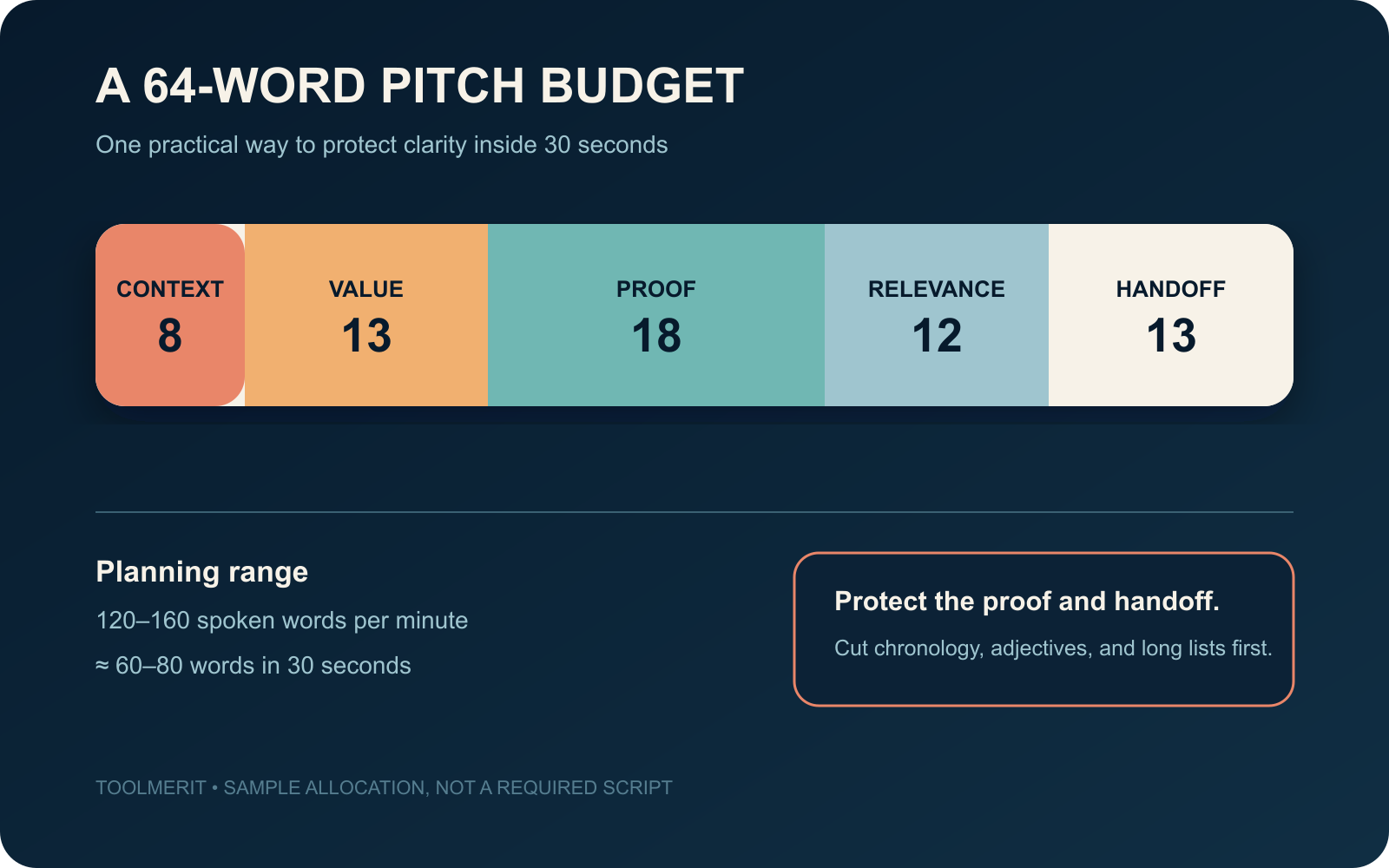
Use the calculation for other versions:
Word budget = speaking rate × seconds ÷ 60. At 120–160 words per minute, a 15-second version holds about 30–40 words, while a 60-second version holds about 120–160. These are planning ranges, not targets to fill. UC Berkeley’s career-fair guidance specifically recommends a pitch of 30 seconds or less in that busy setting.
When the draft is long, protect the value, proof, and handoff. Cut old chronology, stacked adjectives, software lists, and broad claims such as “I’m passionate about innovation.”
See a weak pitch become useful
The example below is fictional. Its purpose is to show the edit; replace every detail with experience you can actually defend.
Before: “Hi, I’m Maya. I’ve worked in operations for several years and have experience with data analysis, stakeholder management, project management, dashboards, automation, and process improvement. I’m a hardworking problem-solver and fast learner who is passionate about technology. I’m looking for an exciting role at a growing company where I can use all my skills and continue developing professionally.”
The draft tells the listener almost everything except what Maya is useful for. It includes no evidence, no connection to the listener, and no way to respond.
After: “Hi, I’m Maya, an operations analyst who turns recurring reporting work into simple, reliable workflows. In a recent project, I mapped a weekly handoff, removed two manual copy steps, and documented the checks so another teammate could run it. I’m exploring operations roles where process design matters, and your team’s expansion caught my attention. What workflow problems would this role tackle first?”
The 65-word revision makes one claim, supports it with one example, and ends with a question the recruiter can answer. It does not ask for a job on the spot. That fits Harvard’s advice for networking conversations: ask for information or guidance and let the contact decide what help they can offer.
Adapt the core for three different situations
| Situation | Lead with | Best proof | Useful handoff |
|---|---|---|---|
| Career fair | Role direction and relevant identity | One project, internship, or responsibility | A question about the team’s work or hiring need |
| Networking conversation | Shared field, transition, or reason for connecting | A relevant thread from your background | A request for perspective, not an immediate job |
| Client or business introduction | The customer and problem you serve | A method, credible result, or concrete example | A qualifying question or short follow-up conversation |
For a career-fair version, the University of Texas at Austin’s career-services template centers the speaker’s background, relevant experience, direction, and a question. For a business version, the U.S. Small Business Administration’s business-plan guidance emphasizes stating precisely what the business does, whom it serves, and what need distinguishes it. The same five-part structure works, but “value” shifts from your career capability to the customer problem.
Do not build one universal script. Build a stable two-sentence core, then keep two or three interchangeable proof and handoff modules. That makes tailoring faster without making you sound improvised or generic.
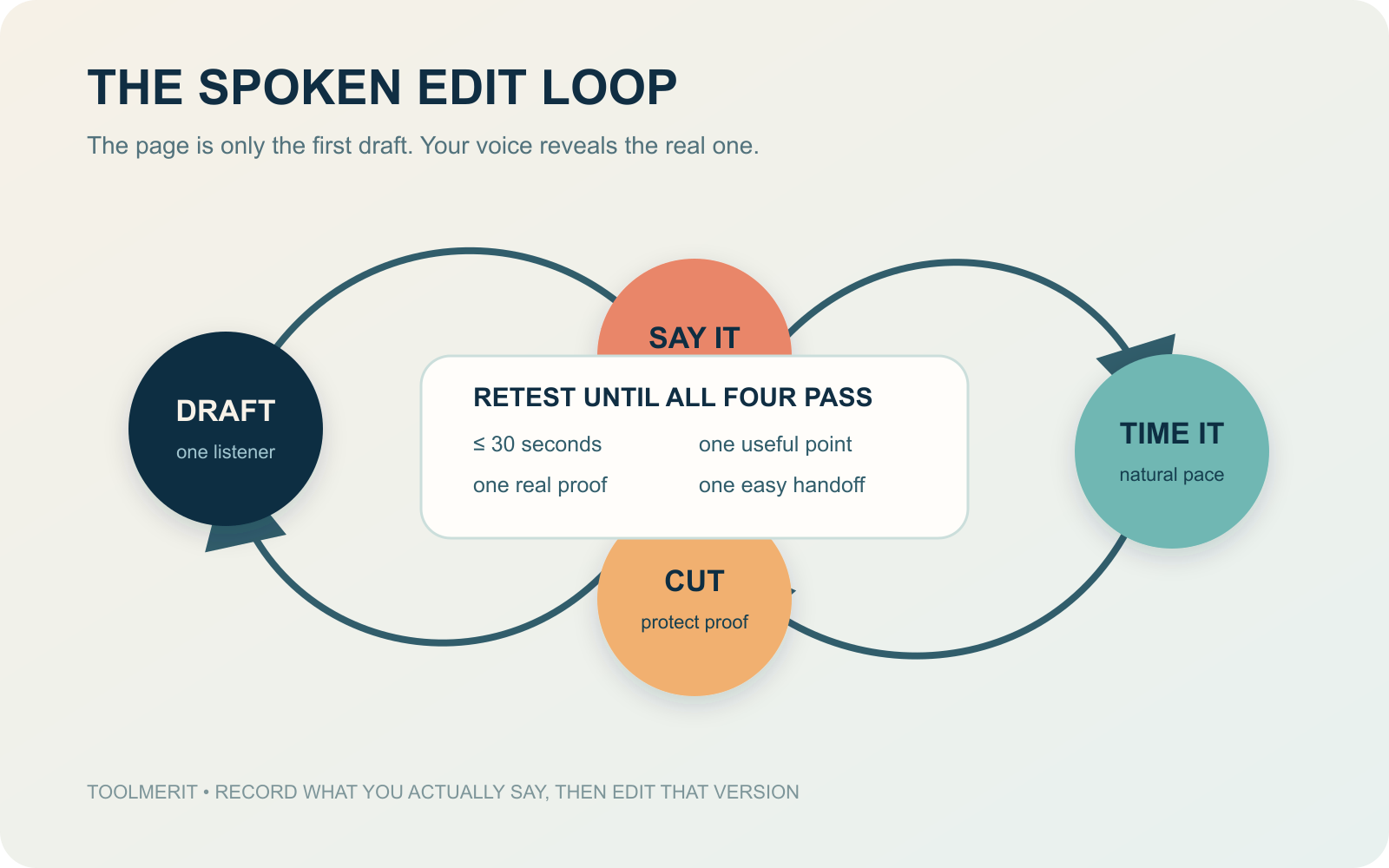
Edit with the one-listener test
Read the draft as if you knew nothing about the speaker. Then run four cuts:
- One-point test: can a listener repeat what you are useful for in one sentence?
- Proof test: does at least one detail show the claim rather than merely praise you?
- Audience test: is there a phrase that would change for a different listener?
- Handoff test: can the listener answer the final question without making a large commitment?
Replace résumé nouns with spoken verbs. “Experience in cross-functional stakeholder communication” becomes “I coordinate product and support teams when a launch changes.” Replace personality labels with observable evidence. “Detail-oriented” becomes “I built the preflight check another editor uses before every release.”
Rehearse without sounding memorized
Record the pitch once without looking at the page. Time it, transcribe what you actually said, and edit that version. The UT Austin guidance also recommends delivering it to a friend or recording it to check whether the message is clear. Spoken sentences usually need to be shorter than written ones.
Memorize the sequence—context, value, proof, relevance, handoff—not every syllable. Practice recovering after an interruption by jumping to the handoff. In a real conversation, the listener may ask about your proof before you reach the final line; that is success, not a failed performance.
Create the 30-second version first. Then cut it to a 15-second core and expand it with one additional proof for a 60-second conversation. Your next action is simple: choose one real listener, fill the five-part template, keep the draft under 80 words, and record it once today.