
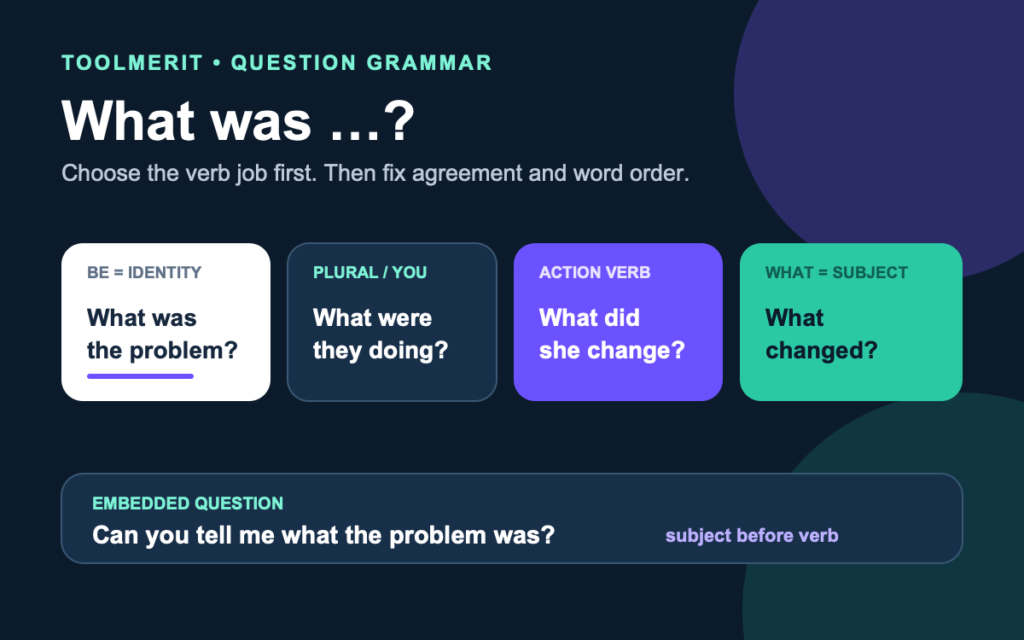
A practical grammar route for choosing what was, what were, or what did—and for changing a direct question into a correct embedded clause.
Three errors often get treated as one: What was happened?, What was you doing?, and Can you tell me what was the problem? Each contains familiar words, but each fails for a different reason. The repair depends on the verb’s job, the subject, and whether the words form a direct question or a clause inside another sentence.
Use “what was” when the past-tense form of be agrees with a singular subject or complement: “What was the problem?” Use “what were” with plural subjects and “you,” and use “what did” before another base-form action verb: “What did she change?”
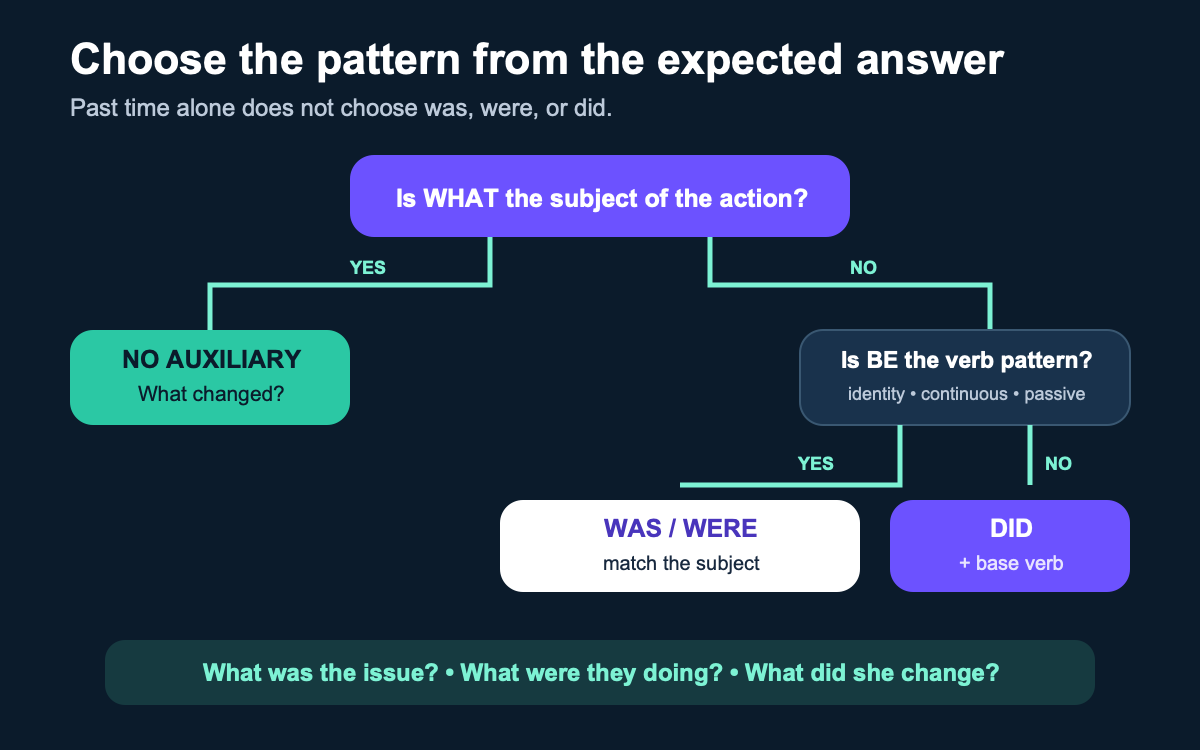
Do not memorize what was as a complete question. Build the question from the answer you expect. If the answer would use was, the question probably can too; if the answer contains a separate action verb, you will usually need did or a subject question instead.
Build the basic what was pattern
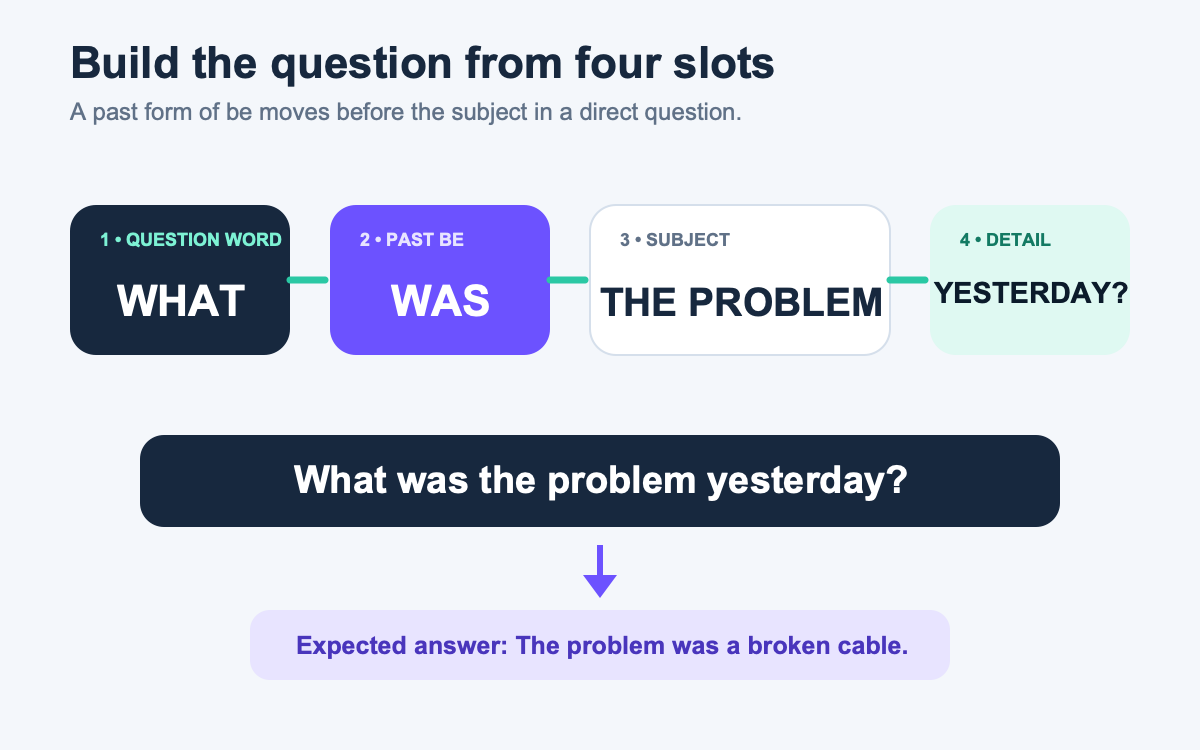
The most common pattern is:
what + was + singular subject or complement + optional detail?
For example, start with the answer The problem was a broken cable. Replace the unknown information with what, move was before the subject, and keep the question mark:
What was the problem?
The same frame can ask about identity, description, location, condition, or a past label:
- What was her role? — asks for an identity or function.
- What was the room like? — asks for a description.
- What was on the screen? — asks which thing occupied a position.
- What was the old filename? — asks for a past label.
In ordinary writing, What was? by itself is incomplete unless it is an echo question tied to an immediately preceding statement. Give the reader enough words to know which missing fact is being requested.
Choose was, were, did, or no auxiliary
The decisive question is not “Is this about the past?” All four choices can refer to the past. Ask what verb structure the answer requires. The British Council’s question-form reference distinguishes questions with be from past-simple questions built with did, while Cambridge’s wh-question guide also separates object questions from questions in which the wh-word is the subject.
| Verb job | Pattern | Example |
|---|---|---|
| be is the main verb | what + was/were + subject | What was the problem? |
| Another verb is a completed past action | what + did + subject + base verb | What did she change? |
| what is the subject of the action | what + past verb | What changed? |
| Past action was in progress | what + was/were + subject + -ing | What were they changing? |
| Past passive | what + was/were + past participle | What was changed? |
Compare What was GPT? with What did GPT stand for? The first asks for an identity or description; the second uses the lexical verb stand, so its past question needs did + stand. You can see the current stand for pattern in a real abbreviation question.
Existence questions form a separate branch: Was there a problem? and Were there delays? If that is the task, first build existence questions with is there or are there, then shift is/are to was/were for a completed past context.
Make was or were agree with the subject
Was and were are both past forms of be. The British Council’s verb be reference gives the standard agreement pattern:
| Subject | Past form | Question example |
|---|---|---|
| I | was | What was I supposed to bring? |
| he, she, it, singular noun | was | What was the original plan? |
| you | were | What were you doing? |
| we, they, plural noun | were | What were the warning signs? |
The article the does not determine the verb. The noun after it does: What was the question? is singular, while What were the questions? is plural. Likewise, What was you doing? is not standard agreement; use What were you doing?
When what itself represents the unknown subject, English often uses singular was before the answer is known: What was missing? If the set is already known to be plural, name that plurality more explicitly: Which files were missing?
Complete what was the without leaving a fragment
What was the is only the beginning of a question. The determiner the needs a noun phrase: the cause, the final result, the name of the file, or the URL in the old message. If that structure is unfamiliar, check how a noun heads a noun phrase.
Use this completion test:
- One known item: What was the deadline?
- One item plus detail: What was the cause of the outage?
- Several items: What were the causes of the outage?
- The noun performs an action: What did the report say?
A concrete noun makes the difference visible. You can use URL as a concrete question noun: What was the URL? asks for its past identity; What did the URL contain? asks what information appeared inside it.
Keep past time and current time separate
The past simple normally places a state or event in a finished past frame. Cambridge’s past-simple reference shows how definite past contexts establish that frame. Give the reader a date, prior version, former role, or finished event when the contrast matters.
| Current question | Past question | Difference |
|---|---|---|
| What is the address? | What was the address before the move? | Current location versus former location |
| What is this called? | What was this called in the old manual? | Current name versus historical label |
| What does the code mean? | What did the code mean in version 1? | Current interpretation versus earlier interpretation |
If the object still has the same name, ask what an unfamiliar thing is called now. If the missing information is the written form of a word rather than a past fact, verify the spelling of the word you need. Was is not automatically a more polite form of is; it should have a real past or hypothetical reason.
Remove inversion inside an embedded question
A direct question normally puts was before the subject. When the same question becomes a clause after tell me, I wonder, I asked, or do you know, restore statement order. Cambridge’s word-order guide for what and its reported-question reference both distinguish direct inversion from subject-before-verb order in the embedded clause.
| Direct question | Embedded version |
|---|---|
| What was the problem? | Can you tell me what the problem was? |
| What was she doing? | I asked what she was doing. |
| What did the report say? | Do you remember what the report said? |
| What were the options? | We discussed what the options were. |
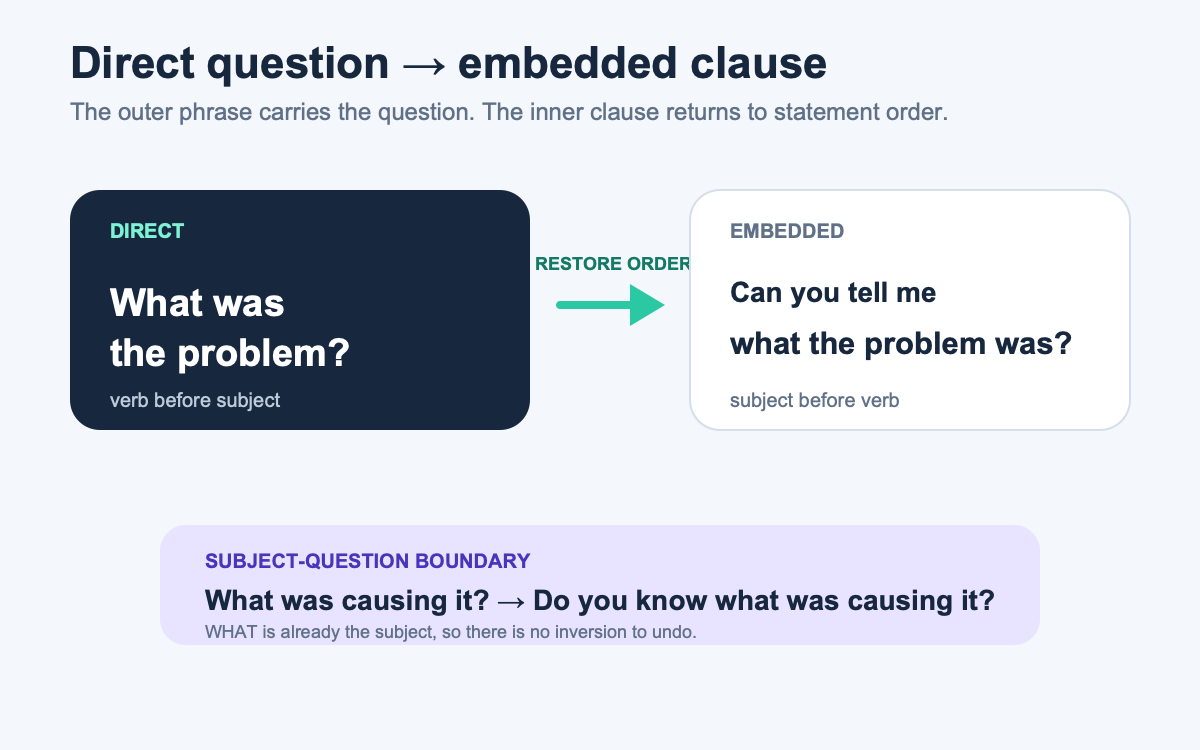
There is an important exception to the visual swap. In What was causing the problem?, what is already the subject of was causing. The embedded form remains Do you know what was causing the problem? Do not move was merely because the clause begins with what; identify the subject first.
Repair the errors that look almost right
| Problem form | Repair | Reason |
|---|---|---|
| What was happened? | What happened? | What is the subject; happened is already past |
| What was she say? | What did she say? | The action verb needs did + say |
| What did she was doing? | What was she doing? | The past continuous already uses was + doing |
| What was you doing? | What were you doing? | You agrees with were |
| What was the reasons? | What were the reasons? | The subject noun is plural |
| Can you tell me what was the reason? | Can you tell me what the reason was? | The embedded clause uses statement order |
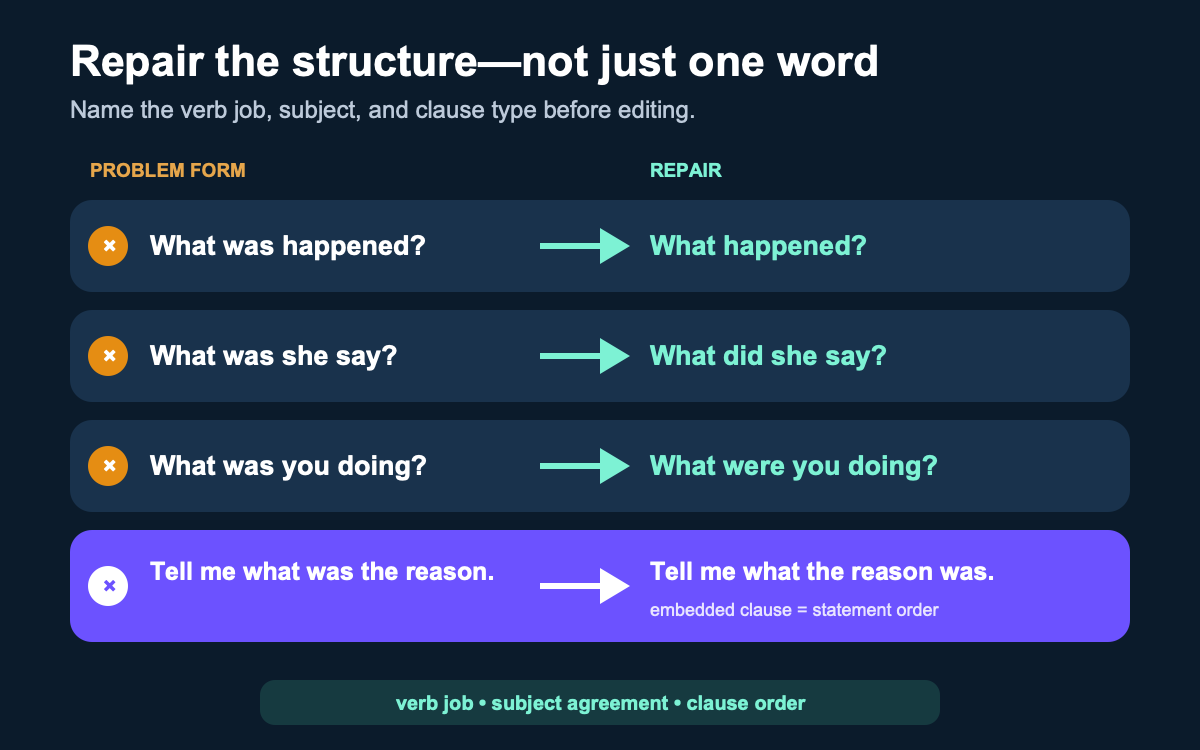
What was changed? is grammatical, but it is passive: someone changed something. What changed? is also grammatical, but it asks which thing or situation became different. The extra word changes the meaning, not just the style.
If you use an AI assistant to repair similar sentences, write a compact prompt that names the answer type and tense, such as “Repair these six past-time what-questions: identify the verb job, subject, and clause type; then explain each change in one sentence.” Check every output against the expected answer structure rather than accepting a fluent rewrite automatically.
Practice by reconstructing the answer
For each sentence, hide the bold information and rebuild the question. This keeps the expected answer—not a memorized fragment—in control.
- The problem was a broken cable. → What was the problem?
- The original colors were blue and white. → What were the original colors?
- She changed the deadline. → What did she change?
- A power failure stopped the server. → What stopped the server?
- He was checking the logs. → What was he doing?
- I cannot remember: What was the old name? → I cannot remember what the old name was.
For an academic assignment, correct grammar is only the first gate. After repairing the sentence, develop the question into a researchable paper topic with a defined subject, period, evidence base, and scope. “What was the main cause?” becomes useful only when the reader can tell the main cause of what, where, and when.