
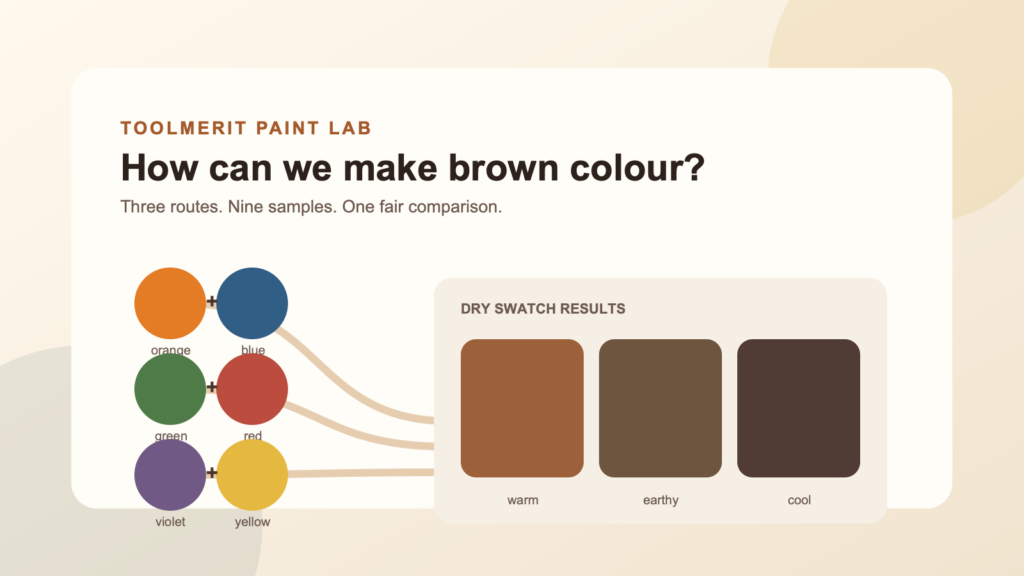
Make nine labeled brown samples from three complementary-color routes, compare them after drying, and learn how to correct each mixture deliberately.
If several people mix red, yellow, and blue paint, will everyone get the same brown? Probably not. That is exactly what makes this a useful experiment rather than a recipe to memorize.
We can make brown colour by mixing a secondary color with the primary color opposite it: orange with blue, green with red, or violet with yellow. For a fair experiment, make each secondary color first, split it into three labeled wells, and add one or two small measured amounts of its opposite color. These are starting routes, not universal ratios: real paints vary in pigment and strength, so compare dry swatches and adjust only one sample at a time.
This activity uses paint, not light from a screen. It is designed for washable tempera or poster paint and works best when one person measures, one mixes, one labels, and one records. The goal is not to produce nine identical browns. The goal is to learn what each route contributes and to use the differences as evidence.
Set up a fair paint experiment
Use the same paint line and the same measuring method throughout the activity. If one group measures with full spoonfuls and another uses tiny brush touches, their results cannot be compared meaningfully. Drops from squeeze bottles, level craft-spoon scoops, or repeatable brush loads can all work; choose one unit and write it down.
Materials for one group
- washable red, yellow, and blue tempera or poster paint;
- nine small cups, palette wells, or spaces on a coated plate;
- three clean measuring tools, one reserved for each primary color;
- nine mixing sticks or a way to clean one thoroughly between samples;
- white card or heavy white paper for swatches;
- labels, pencil, water, and paper towels; and
- the observation sheet shown later in this guide.
For children’s activities, an adult should read the product label and supervise use. The U.S. Consumer Product Safety Commission advises selecting children’s art materials labeled Conforms to ASTM D-4236 and without cautionary warnings. “Non-toxic” does not turn paint into food: keep it away from mouths and eyes, protect clothing and surfaces, and follow the manufacturer’s cleanup instructions.
White paint is optional. Keep it away from the first nine wells because it changes lightness and opacity as well as color. Introduce it only after the group has compared the original samples and wants to create a lighter brown or tan.
Use the primary-color systems guide to confirm that this experiment is testing physical paint relationships rather than RGB light or CMY ink.
Start with three complementary-color routes
Red, yellow, and blue are a familiar classroom primary set. Red plus yellow makes an orange family, yellow plus blue makes a green family, and blue plus red makes a violet family. On a traditional classroom color wheel, each secondary sits opposite the remaining primary. Bringing those opposites together reduces vividness and can move the mixture toward a neutral brown.
| Route | Make this base first | Add this neutralizer gradually | Likely starting bias |
|---|---|---|---|
| A | Orange from red + yellow | Blue | Warm, rusty, or golden |
| B | Green from yellow + blue | Red | Cool, earthy, or olive |
| C | Violet from blue + red | Yellow | Cool, deep, or muted |
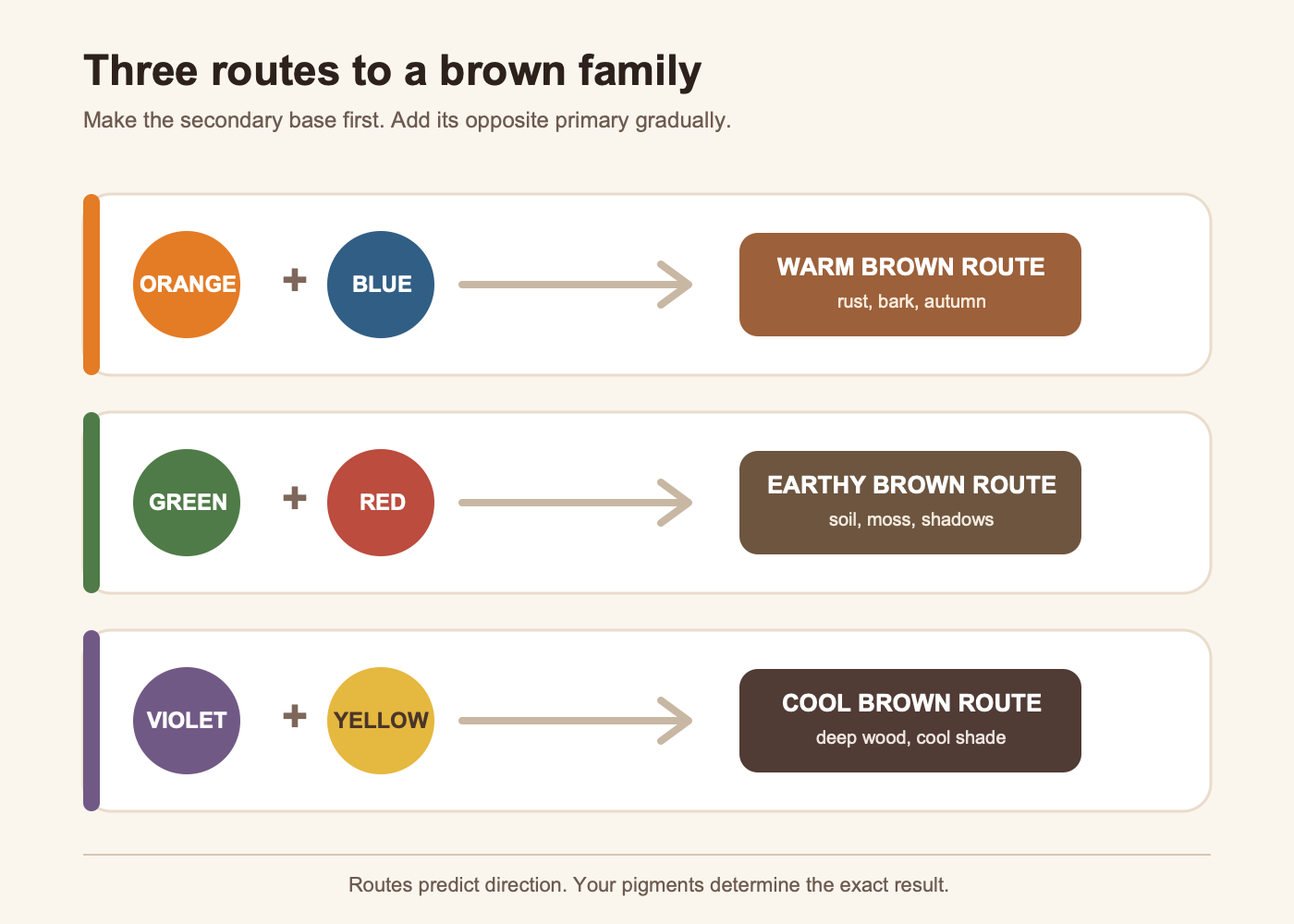
The route describes a relationship, not a guaranteed formula. Golden Artist Colors notes that masstone, undertone, tinting strength, opacity, and the actual pigments all affect a mixture. A strong blue can overtake a weak orange in a much smaller amount. Two jars both labeled “red” may also lean toward different parts of the spectrum.
If you want a broader studio method after this activity, ToolMerit’s guide to three reliable brown-mixing routes shows how to make controlled adjustment swatches. For projects that move from paint into layouts or digital artwork, the design and graphics tools directory is the relevant hub.
Build a nine-well brown test
The nine-well design changes only one variable within each route: the amount of neutralizing color. It gives the group a visible sequence rather than one muddy cup whose history nobody can reconstruct.
- Label the wells. Mark them A0, A1, A2; B0, B1, B2; and C0, C1, C2. Also label nine matching spaces on the swatch card.
- Make one orange base. Begin with measured red and yellow. Adjust until the mixture reads as orange, then record the actual amounts. Do not assume the two colors must be equal.
- Divide that base evenly. Place the same measured amount into A0, A1, and A2.
- Create the orange-to-brown sequence. Leave A0 unchanged. Add one small measured unit of blue to A1 and two to A2. Mix fully after each addition.
- Repeat with green. Make a recorded yellow-and-blue green base, divide it among B0, B1, and B2, then add zero, one, and two small units of red.
- Repeat with violet. Make a recorded blue-and-red violet base, divide it among C0, C1, and C2, then add zero, one, and two small units of yellow.
- Swatch every well. Use the same brush size and roughly the same paint thickness. Write the code beside the swatch immediately.
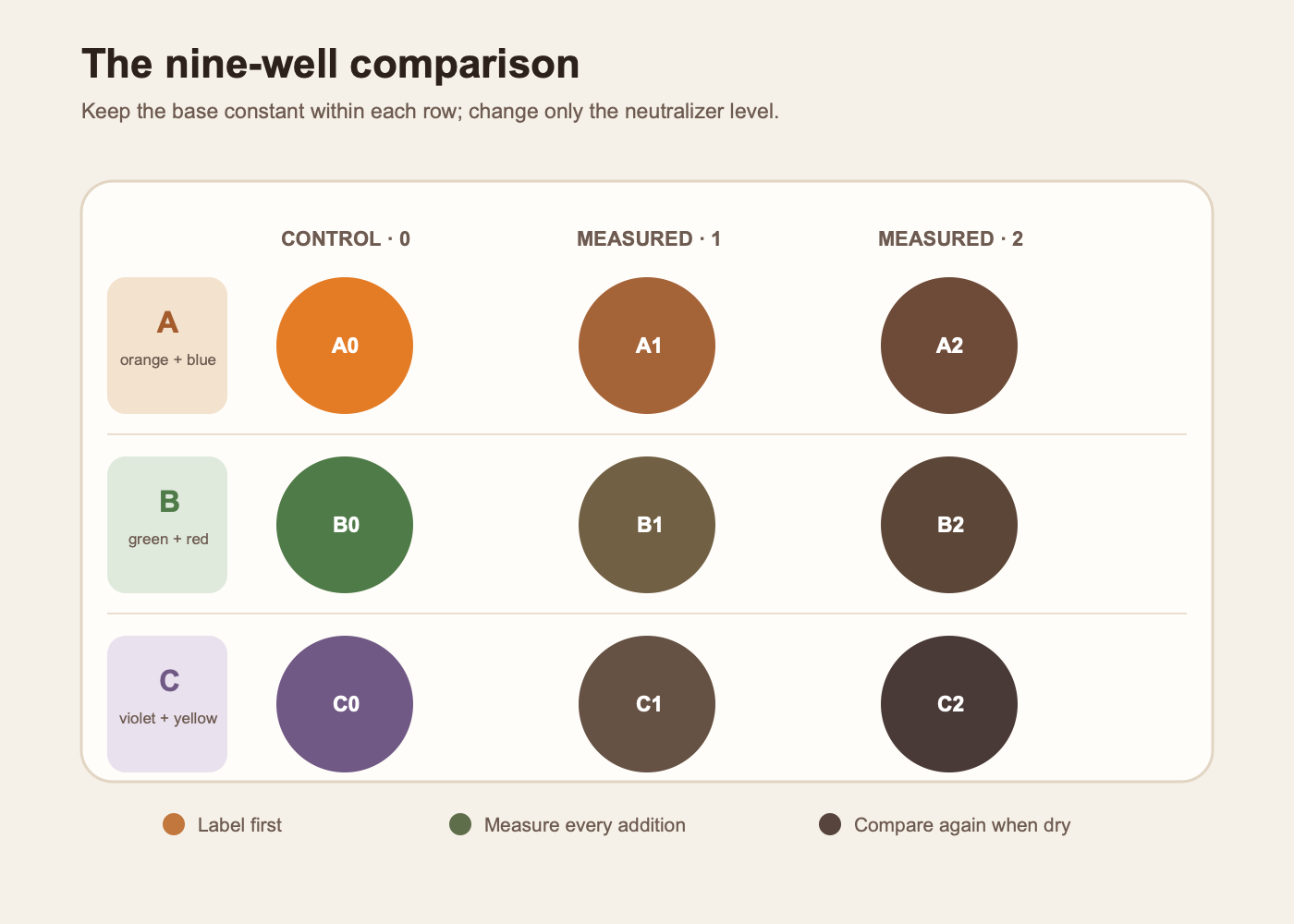
A0, B0, and C0 are controls. They show what each secondary base looked like before neutralization. Without them, a group may remember the base incorrectly and cannot tell how much the opposite color changed it. The “one” and “two” additions are deliberately relative: a class using craft-spoon scoops will need different quantities from a class using squeeze-bottle drops.
If the first addition overwhelms the base, stop. For the next trial, make the unit smaller or make a larger quantity of base. A failed sample is still useful evidence when its inputs are labeled.
Record the result instead of guessing
Paint looks different while glossy-wet than it does after drying. Make an immediate observation, then return after the manufacturer’s drying time and record a dry observation in ordinary room light. Do not rename the sample from memory.
| Sample | Recorded inputs | Bias | Lightness | Vivid or muted? | Wet-to-dry note |
|---|---|---|---|---|---|
| A1 | Orange base: ___ red + ___ yellow; then ___ blue | Warm / neutral / cool | Light / middle / dark | Vivid / muted / gray | ________________ |
| B1 | Green base: ___ yellow + ___ blue; then ___ red | Warm / neutral / cool | Light / middle / dark | Vivid / muted / gray | ________________ |
| C1 | Violet base: ___ blue + ___ red; then ___ yellow | Warm / neutral / cool | Light / middle / dark | Vivid / muted / gray | ________________ |
Complete the same fields for all nine codes. Young learners can replace the words with simple scales: an arrow from warm to cool, a three-step sun-to-moon scale for lightness, and a bright-to-gray scale for intensity. The labels matter more than sophisticated vocabulary.
For several groups or repeated lessons, you can build the observation table in Excel, using one row per sample and one column per observation. That makes it easy to sort by route or compare brands without pretending that unlike materials are one experiment. The creative production tools directory can help when the record needs to become a worksheet, handout, or documented project.
Compare the dry swatches before choosing a winner
Place all dry swatches together on a neutral surface. First compare within a row: what changed from A0 to A1 to A2? Then compare between routes: how does the best orange-plus-blue brown differ from the best green-plus-red brown?
Use four questions:
- Does it still reveal its base? An orange-looking A1 probably needs a little more blue; a blue-black A2 may have gone too far.
- Is it warm or cool? Warm and cool are descriptions, not grades. A warm brown may suit wood or autumn leaves; a cool brown may suit soil or shadows.
- Is it light enough for the job? Complementary mixtures can darken quickly. If a light opaque brown is the goal, make the hue first and test white in a separate sample.
- Did it become neutral or merely dull? A useful brown retains a readable hue bias. Mixing all remaining paint together often produces an unplanned gray-brown with no clear way to correct it.
There does not have to be one class winner. A better conclusion might be: “A1 made the warmest usable brown, B2 made the coolest, and C2 became too dark with this paint set.” That statement connects a visible result to the actual materials and remains honest about its limits.
After one dry swatch wins, the repeatable brown batch workflow shows how to preserve its ratio when the activity becomes a production task.
Repair one sample at a time
Move a teaspoon or brush-load of the chosen sample into a clean correction well. Never repair the whole batch first. A small correction preserves the original evidence and prevents one overcorrection from consuming all the paint.
| What the sample looks like | Next controlled move | Why |
|---|---|---|
| Too orange or rusty | Add a tiny measured touch of blue | Blue reduces the orange bias. |
| Too green or olive | Add a tiny measured touch of red | Red reduces the green bias. |
| Too violet | Add a tiny measured touch of yellow | Yellow reduces the violet bias. |
| Too gray, black, or dull | Add fresh secondary base that matches the route | More of every color usually deepens the neutralization instead of restoring a readable brown. |
| Right hue but too dark | Test a small amount of white in a separate well | White raises lightness but may also reduce saturation and change coverage. |
| Right color but not enough paint | Rebuild a larger batch from the recorded ratio | Eyeballing an extension changes the color and destroys repeatability. |
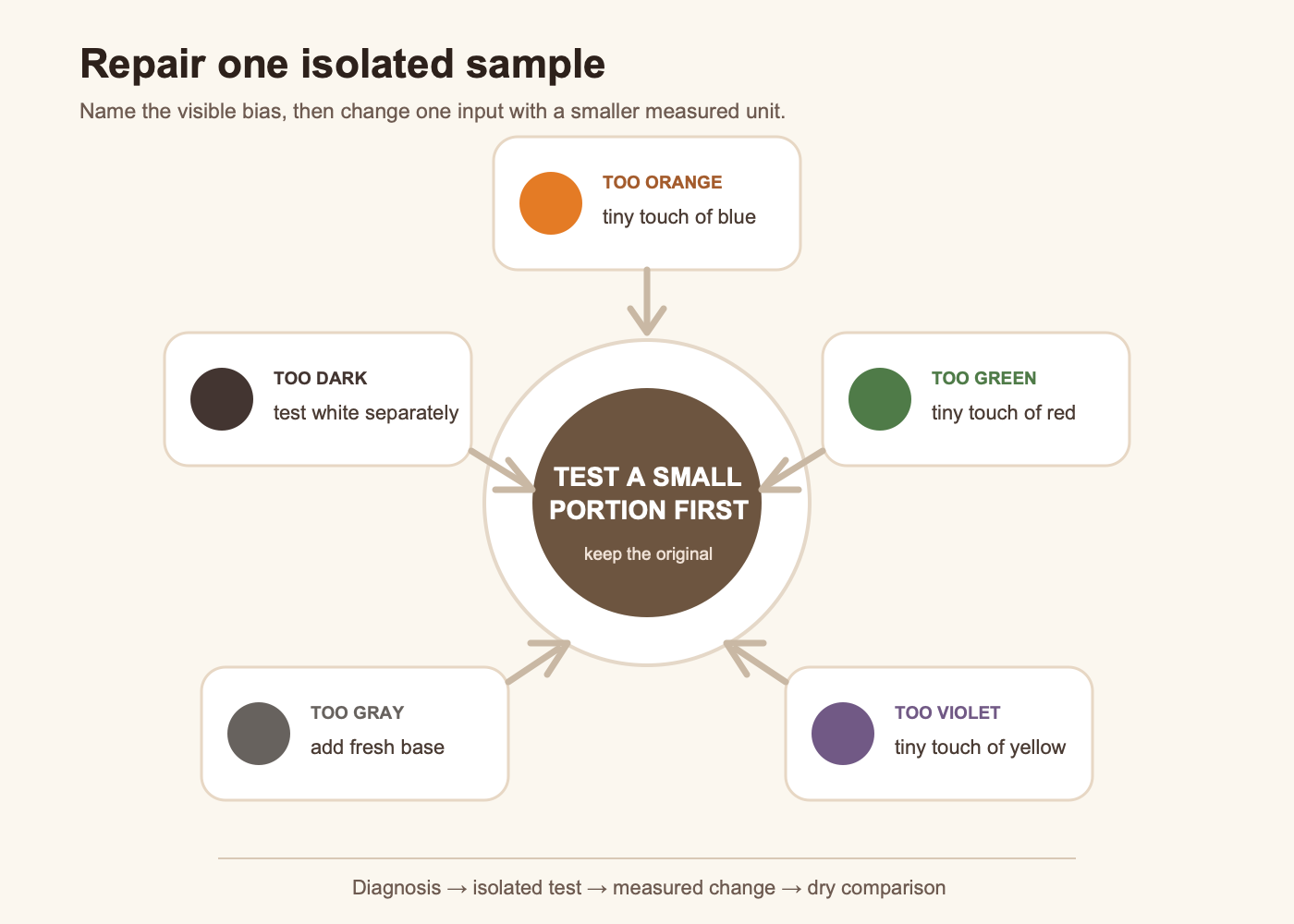
Keep the increments smaller as the mixture approaches the target. The strongest paint in the set determines how cautious the additions need to be. If a single drop of blue is too much, put a little blue on a spare palette, touch only the tip of a clean stick into it, and transfer that smaller amount to the test well. Record “one stick-tip touch” rather than calling it a drop.
Explain why the three routes do not match
Paint mixing is subtractive. The Smithsonian Libraries’ overview of color science explains that materials appear colored because they absorb some wavelengths and reflect others. When pigments are combined, the mixture generally absorbs a broader range of light. Less intense reflected light reaches the eye, so complementary mixtures move toward muted neutrals.
The tidy classroom wheel describes color relationships, but jars contain physical pigments rather than perfect theoretical primaries. The label “blue” may refer to a green-leaning or violet-leaning blue. One pigment may be transparent, another opaque; one may have far greater tinting strength. The white paper underneath, paint thickness, lighting, and dry surface also affect what the observer sees.
That is why “mix equal parts of every primary” is a weak universal instruction. Equal amounts are useful only as a controlled starting condition. If the result differs from a picture in a book, the learner has not failed. The paints have supplied data about their own behavior.
A screen is a different system. It emits red, green, and blue light and can display a specified brown without physically mixing pigment. If the actual task is a website, use a defined value and learn how CSS applies a digital color value. A paint ratio cannot be translated directly into a dependable hex code, and a hex code cannot tell a child how many drops to mix.
Run the activity in 20 minutes
This compact schedule works when materials and labels are prepared before the group starts. Drying continues after the session, so reserve a short follow-up for the final comparison.
| Time | Group action | Evidence produced |
|---|---|---|
| 0–3 min | Predict which route will make the warmest, coolest, and darkest brown. | Three written predictions |
| 3–8 min | Make and record the orange, green, and violet bases. | Three control formulas |
| 8–13 min | Divide the bases and add the measured neutralizers. | Nine labeled wells |
| 13–17 min | Paint nine swatches and complete wet observations. | One labeled comparison card |
| 17–20 min | Choose one sample to repair and state the reason. | One controlled correction |
Assign four roles: the mixer combines paint thoroughly; the counter confirms each addition; the recorder writes actual inputs; and the swatcher applies and labels the samples. Rotate roles in a second round. This keeps “we made brown” from meaning that one learner did all the work while everyone else watched.
End with a claim-evidence sentence: “We think sample ___ is the best brown for ___ because it is ___, and we made it with ___.” A learner might choose different evidence for bark, chocolate packaging, soil, or a shadow. The decision should match the intended use, not an imagined single correct brown.
Use the experiment after the lesson
Suppose a group records this result: A1 dries warm and medium-dark, B1 stays visibly green, B2 becomes a cool neutral brown, and C2 turns nearly black. The group chooses A1 for painted autumn leaves and B2 for damp soil. It does not “fix” C2 back into the same color; it records that its two-unit yellow addition was not enough to overcome the violet base or that the base was too blue-heavy, then designs a smaller second trial.
That outcome is more valuable than one unexplained cup of brown. It gives the group two fit-for-purpose colors, a rejected sample with a reason, and a specific next experiment. The record also lets the class repeat a selected mixture at a larger scale, provided the same paints and measuring unit are used.
For a logo or illustrated badge, first choose the physical swatch, then sample or match it in a digital application and prepare a scalable vector graphic. For a science or art report, photograph the labeled dry card under consistent lighting and build a short PowerPoint evidence deck with the question, method, results, and conclusion. The broader Creator Guides connect that work to image, audio, video, and publishing workflows.
The answer to “How can we make brown colour?” is therefore both simple and experimental: combine complementary paint families, but measure what you actually use. Make the base, add its opposite gradually, preserve a control, label the sample, and wait for it to dry. The best brown is not the one that matches a universal ratio; it is the one whose recorded behavior fits the job in front of you.