
A memorable domain can still be a bad asset. Use a naming brief, collision search, TLD check, six-test stress board, and registration-control plan.
Choose the shortest domain that is clear when spoken, distinct from existing brands, affordable to renew, broad enough for future growth, and registered under an account your organization controls. Do not choose mainly for keywords or a first-year discount. A memorable name is valuable only if people can find it, trust it, and keep using it.
The safest method is elimination. Start with several candidates, test each against the same hard questions, and remove any name with a serious brand, trademark, renewal, or ownership risk. This guide gives you that process without pretending a weighted score can make a legal conflict disappear.

Write a naming brief before checking availability
Availability is not a naming strategy. If you begin in a registrar search box, the first unregistered string can look better than it is. Write a one-paragraph brief first:
- Identity: What should the name signal—expertise, speed, playfulness, place, community, product, or a broader brand?
- Audience: Who must understand and trust it? A local customer, a global buyer, a technical team, and a student may interpret the same word differently.
- Scope: Is this one product, a company, a publication, or a platform that may add products and services?
- Geography and language: Which countries, scripts, pronunciations, and unintended meanings need checking?
- Channels: Will people see the address in search, hear it in a podcast, type it from a sign, or receive email from it?
- Time horizon: Must it survive a rebrand, expansion, acquisition, or a move beyond one city or technology?
A useful constraint is “specific enough to signal identity, broad enough to survive the plan.” A domain tied to one product feature, year, neighborhood, or trend may become misleading when the business changes. A completely generic phrase may be hard to distinguish from competitors. Google’s current site-name guidance similarly recommends a unique, concise, non-generic name that is used consistently.
Generate a shortlist, not one favorite
Create 10 to 20 candidates before you fall in love with one. Use several naming patterns:
- Distinctive coined or suggestive brand: a pronounceable name that evokes the benefit without describing every feature.
- Brand plus category: a unique brand paired with a familiar category word when the brand alone is unclear.
- Benefit or outcome phrase: a short expression of the result the audience wants, provided it is not generic or misleading.
- Founder or place-based name: useful when reputation or geography is central and likely to remain central.
Do not treat hyphens, numbers, unusual spellings, or longer names as automatic failures. They are friction multipliers. A hyphen can make a two-word address available, but people must remember to say and type it. A number can be distinctive, but listeners may not know whether to use a digit or spell the word. An invented spelling can be protectable and memorable, but it may require years of correction. Keep a candidate only when its benefit justifies its explanation cost.
Run the say, hear, and type test
A domain is used in conversation as well as on screen. Test it before buying:
- Show the name to five people for five seconds, hide it, and ask them to type it.
- Say the domain once without spelling it, then ask listeners to repeat and type it.
- Read it over a noisy call. Check whether word boundaries, doubled letters, or similar sounds cause errors.
- Put it before an email address—such as
support@…—and listen for awkward repetition or confusion. - Ask what product, audience, or promise they expect from the name. Record the answers instead of explaining the intended meaning first.
The test is diagnostic, not a popularity vote. If one participant dislikes the style, that is subjective. If most participants type the same wrong spelling, that is a repeatable delivery problem. Prefer evidence of how the name travels over opinions about whether it “sounds cool.”
Eliminate collisions before shopping for an extension
A domain can be technically available and still be a poor or risky brand. Search the name before comparing .com, country-code, or newer extensions:
- Search the exact words in quotation marks. Look for companies, products, publications, apps, creators, and organizations using the same wording.
- Search close spellings and sounds. Swap common vowels, remove spaces, add or remove plurals, and test phonetic equivalents.
- Search the relevant market and category. The same word can coexist in unrelated fields but create confusion among similar goods or services.
- Check company, app-store, and social-profile use. A matching social handle is not mandatory, but a strong existing identity across channels can make the domain expensive to explain.
- Run preliminary trademark searches. WIPO’s availability guidance recommends checking identical and similar marks by spelling, sound, meaning, goods, services, country, and class.
- Check national or regional registers. WIPO’s Global Brand Database combines many collections, but WIPO explicitly notes that coverage is not universal and recommends consulting relevant national or regional offices as well.
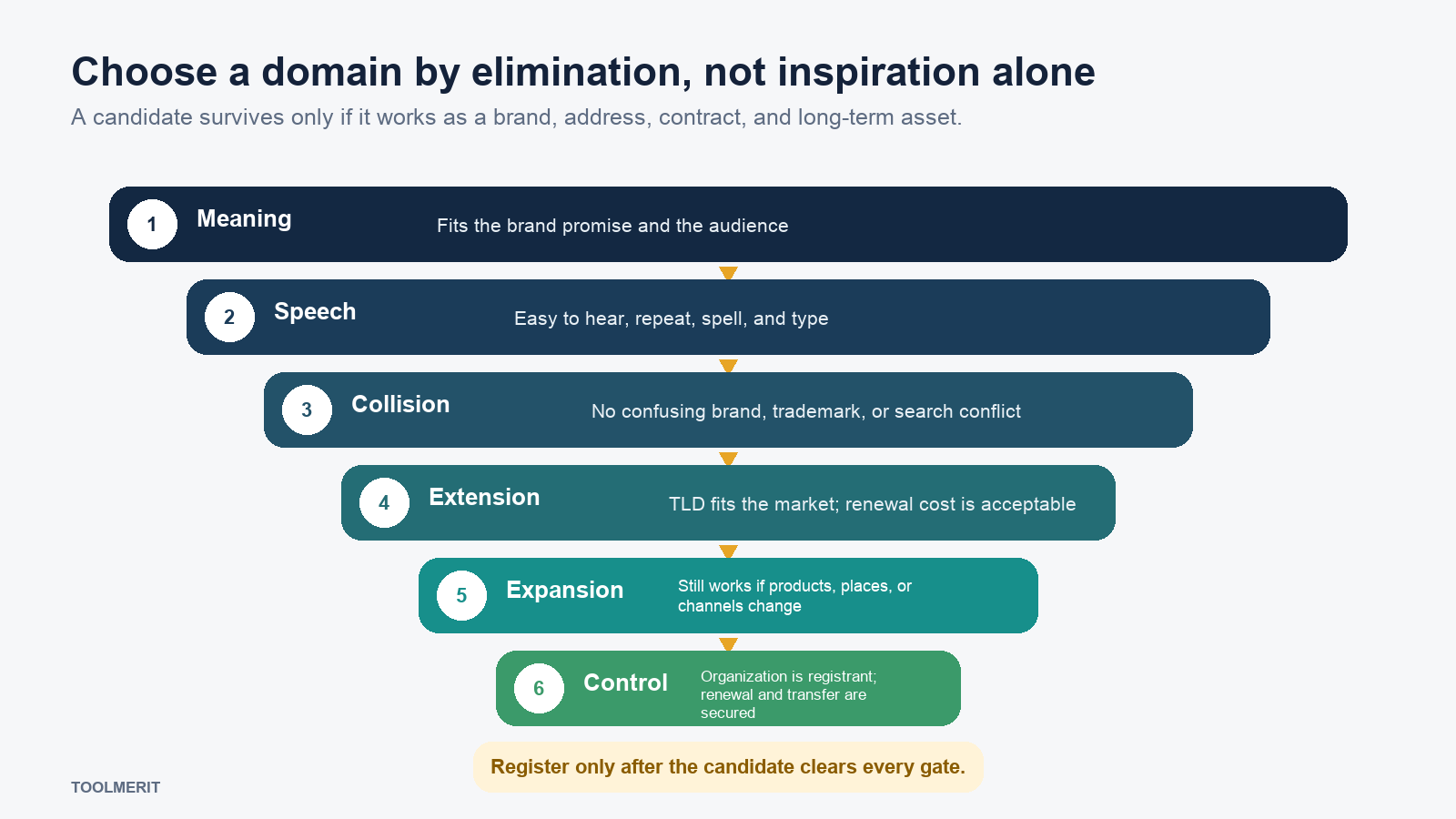
A preliminary search is not a legal clearance opinion. Database results can be incomplete, rights can arise in different ways, and similarity analysis depends on jurisdiction and goods or services. If the name matters to a business launch, investment, or rebrand, ask qualified trademark counsel to evaluate the target markets before committing.
This is also why “add a different extension” is not a complete fix. ICANN’s domain-dispute materials explain that trademark owners can challenge domain names that are identical or confusingly similar in abusive-registration disputes. A different suffix does not automatically remove confusion in the name itself.
Choose the extension without SEO myths
The top-level domain (TLD) is the ending, such as .com, .org, a country code, or a newer generic extension. Choose it for audience expectation, policy, availability, email clarity, and long-term cost—not for a promised ranking boost.
| Question | What matters | What not to assume |
|---|---|---|
| Will the audience recognize it? | A familiar extension can reduce explanation. A relevant newer extension can work when the full address remains clear. | Unfamiliar does not automatically mean untrustworthy; trust also comes from the brand, site, email practices, and context. |
| Is the business country-specific? | A country-code TLD may signal a local market and may have local eligibility or policy rules. | A country-code choice is not merely cosmetic; verify the registry’s requirements and the business’s future geography. |
| Will the TLD improve rankings? | Google says ordinary generic TLDs do not receive a ranking advantage, and domain keywords alone have hardly any ranking effect. | A long exact-match domain or fashionable extension is not an SEO shortcut. |
| What will it cost after year one? | Check normal renewal, transfer, redemption, privacy, and premium-name terms in the registration agreement. | The promotional first-year price is not the ownership cost. |
| Can people use it in email? | Say the complete address aloud and test spam-filter and form acceptance in the services your organization uses. | Website availability alone does not prove every legacy form or partner workflow handles the extension well. |
Google’s SEO Starter Guide is unusually direct: keywords in the domain or URL path alone have hardly any ranking effect, and Google generally does not care whether a generic TLD is .com, .org, .asia, or another generic choice. Country targeting can make a country-code TLD relevant, but it should fit the actual audience and business plan.
Stress-test every finalist the same way
Put three to five finalists through the same six tests. A candidate does not need to be perfect, but it must not hide a hard stop.
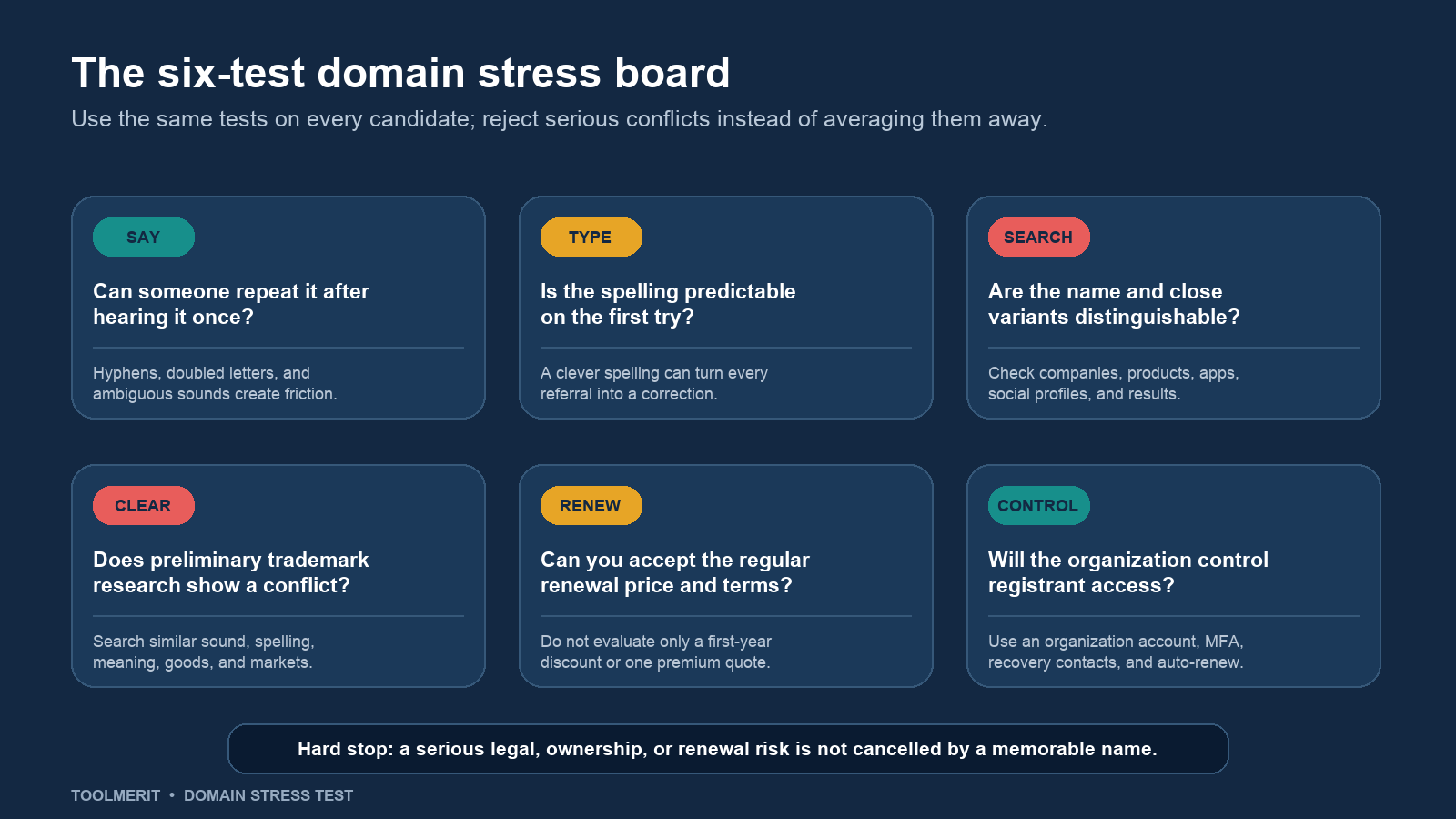
- Say: Can a listener repeat the domain after hearing it once?
- Type: Is the first-attempt spelling predictable?
- Search: Is the name distinguishable from existing companies, products, apps, and sites?
- Clear: Does preliminary trademark research reveal identical or similar marks in relevant markets and categories?
- Renew: Are the regular price, premium status, transfer rules, and restoration costs acceptable?
- Control: Will the organization—not a contractor’s personal account—control registrant access, renewal, recovery, and transfer authorization?
Social handles and alternate extensions are secondary. Buying a few defensive variants can prevent predictable confusion, but owning dozens of endings creates renewal and monitoring work. Register variants only when there is a clear risk or campaign need, then redirect them to one canonical domain. That canonical address becomes part of the site’s URL system; our URL guide explains the distinction between the domain, path, query, and fragment. If a campaign needs a shorter memorable route, treat it as a vanity URL that redirects to the canonical destination rather than creating a second competing site identity.
Register the domain as an organizational asset
ICANN defines the registrant as the individual or entity that registers the domain and enters into the registrar agreement. That agreement governs registration, management, transfer, renewal, and restoration. Treat registration as a control decision, not just a checkout step.
- Use a reputable registrar relationship. For a generic TLD, verify the ICANN-accredited registrar behind the seller or reseller. Compare support, transfer tools, security, and contract terms—not only price.
- Make the correct entity the registrant. Use the organization’s legal details and an organization-controlled account. Do not let an agency, employee, or founder’s personal inbox become the only control point.
- Use a durable recovery address. The recovery email should not depend only on the domain it protects. Otherwise a domain or email outage can block recovery.
- Enable strong account security. Use a unique password, multifactor authentication, registry or transfer locks when appropriate, and tightly limited administrator access.
- Record renewal terms. Enable auto-renew when suitable, maintain a valid payment method, and calendar an independent review before expiration. Keep registrar notices out of one person’s spam folder.
- Document DNS and transfer ownership. Record who can change name servers, DNS records, contact data, and transfer authorization. Test the offboarding process before a vendor relationship ends.
ICANN’s registrant resources emphasize access to information about managing, transferring, renewing, and restoring a registration. Its registration FAQ also recommends reading the agreement for fees, personal-data handling, and switching providers. The “free domain” bundled with hosting is still governed by these controls; confirm who the registrant is and what happens when the hosting plan ends.
Choose the domain before configuring your content management system, email, analytics, and marketing stack, but do not rush the legal and control checks merely to begin site design. Renaming those systems later is far more expensive than spending another day on clearance.
Make the final decision without hiding a hard stop
Create one row per candidate and one column for each test: meaning, speech, spelling, search distinctiveness, preliminary trademark findings, TLD fit, regular renewal cost, expansion fit, and registrant control. Record Pass, Unknown, or Stop with evidence and an owner for every unknown.
Do not total the columns. A domain with eight passes and one serious trademark conflict is not an eight-out-of-nine winner. A domain with a low launch price and an unacceptable renewal is not “mostly affordable.” Resolve every unknown and discard every hard stop.
When one candidate survives, register it under the correct organization account, secure recovery and renewal, and capture the registrar agreement and renewal terms. Then use the chosen site name consistently across the home page, email, profiles, and structured data. That is the next action that turns a good name into an asset the organization can actually keep.