
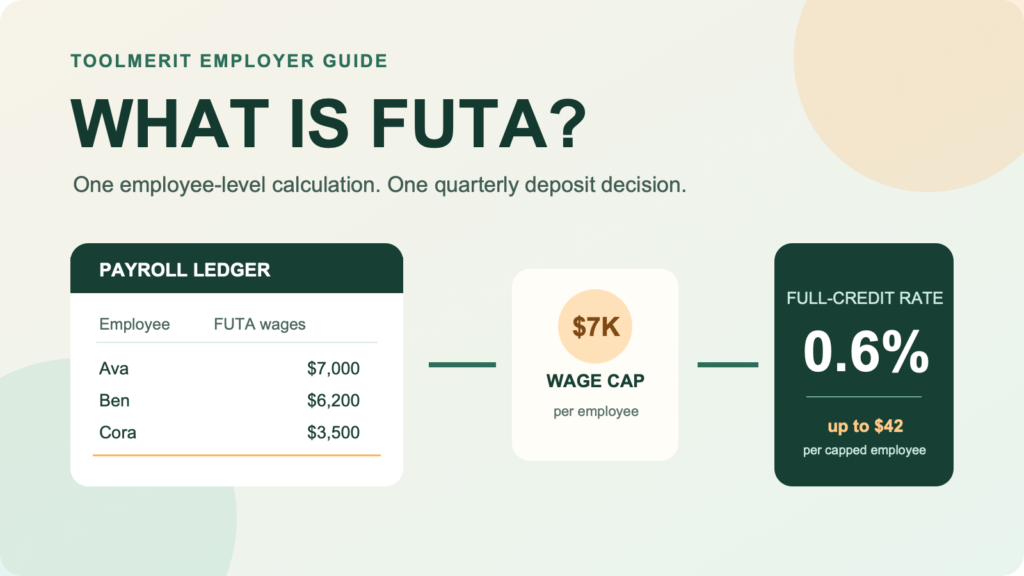
A practical employer guide to FUTA coverage, the $7,000 wage base, the usual 0.6% net rate, quarterly deposit timing, and Form 940.
FUTA is the federal unemployment tax paid by employers. For 2026, the statutory rate is 6.0% on the first $7,000 of FUTA-taxable wages paid to each employee. An employer that qualifies for the full 5.4% state unemployment tax credit usually reaches a 0.6% net rate. That makes the familiar estimate $42 per employee who earns at least $7,000—but only when the full credit applies.
This guide explains the federal rule for a typical U.S. business employer. Household work, farmwork, nonprofit or government employment, family employment, successor-employer situations, and wages in a credit reduction state can follow additional rules. Use the current IRS instructions or a qualified payroll professional when one of those cases applies.
What FUTA means and who pays it
FUTA stands for the Federal Unemployment Tax Act. The federal tax works alongside state unemployment systems to support unemployment compensation. The IRS Employer’s Tax Guide states that only the employer pays FUTA; it is not withheld from an employee’s paycheck.
That last point is operationally important. If an employee sees a line labeled FUTA deducted from take-home pay, the payroll setup needs review. FUTA is an employer liability. A small company may calculate and remit it through payroll software, a service provider, or its own tax workflow, but the legal payer does not change. Employers choosing or tightening that workflow can start with finance and administration tools that support payroll.
Decide whether FUTA applies to your business
For ordinary employees who are not household or agricultural workers, the IRS general test has two independent triggers. For 2026, a business is generally subject to FUTA if either of these is true in 2025 or 2026:
- It paid employees $1,500 or more in wages in any calendar quarter; or
- It had one or more employees for at least part of a day in 20 or more different weeks.
Count full-time, part-time, and temporary employees for the weeks test. Partners in a partnership are not counted as employees for this purpose. The current thresholds and counting rules appear in IRS Topic 759 and section 14 of Publication 15.
Do not use the general test for every worker by default. The IRS provides separate tests for household employees and farmworkers. Worker classification also comes before the FUTA calculation: paying an independent contractor is not the same as paying an employee, and a label in an accounting system does not settle the legal classification.
The payroll record should make it possible to identify the worker, dates worked, gross pay, employee status, and year-to-date FUTA wages. A controlled timesheet workflow can support the hours and approval trail, but the wage ledger—not the timesheet alone—must carry the tax calculation.
Keep FUTA separate from SUTA and FICA
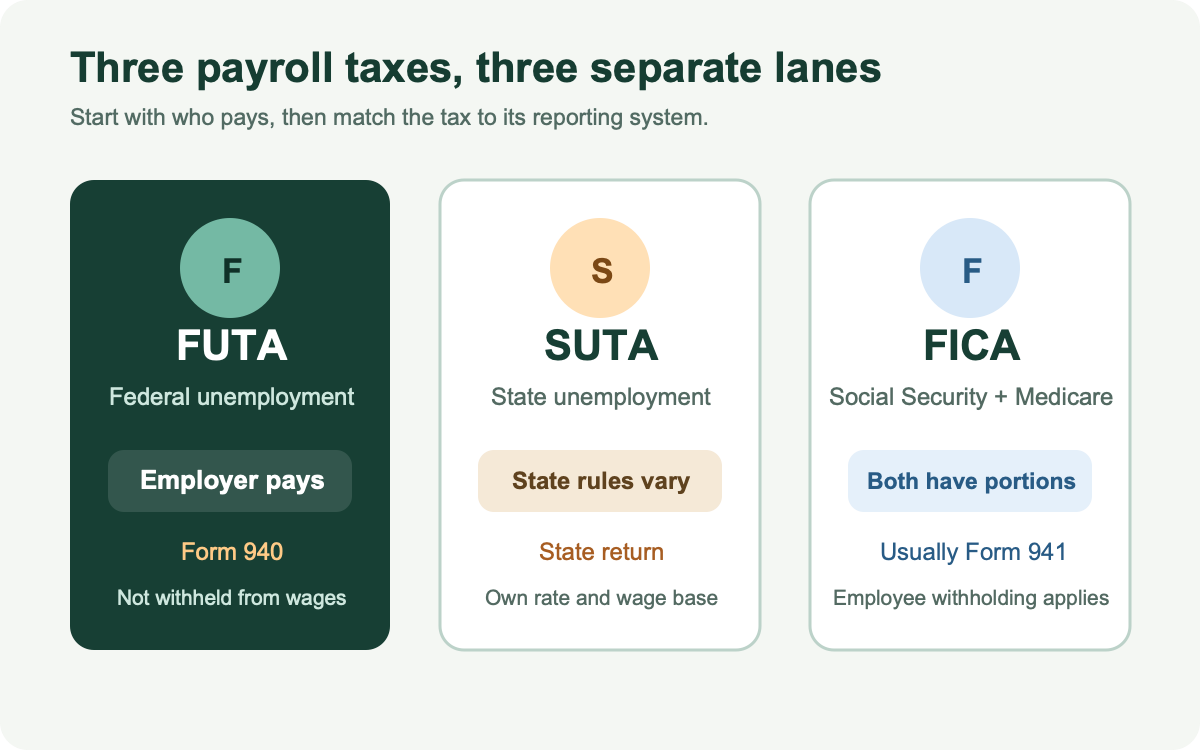
Three acronyms often appear together in payroll discussions, but they answer different questions:
| Tax | Who pays? | What it supports | Common federal reporting |
|---|---|---|---|
| FUTA | Employer | Federal-state unemployment system | Form 940 |
| SUTA or state UI tax | Usually employer; state rules vary | State unemployment program | State return |
| FICA | Employer and employee portions | Social Security and Medicare | Usually Form 941 or 944 |
FUTA’s state credit connects the federal and state unemployment systems, but it does not make them one tax. The state may use a different wage base and experience rate. Keep separate ledger accounts and source documents for federal unemployment, state unemployment, and withheld payroll taxes.
Calculate FUTA employee by employee
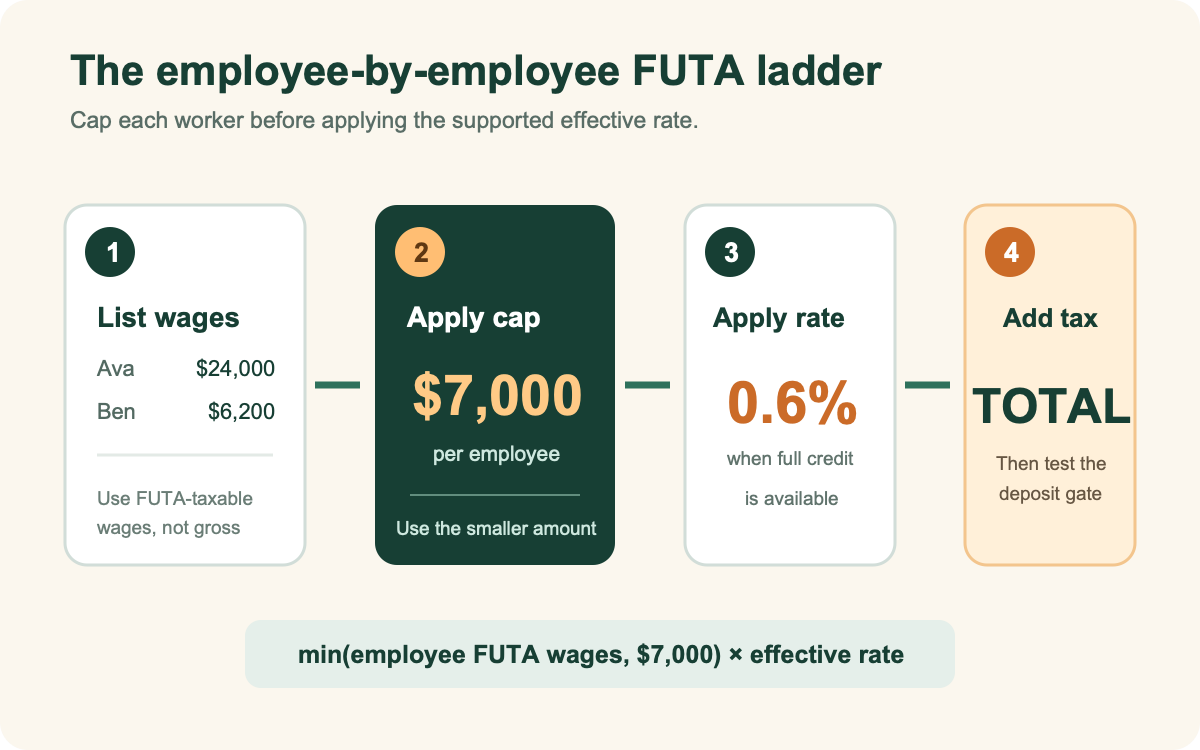
The wage base is a cap per employee, per calendar year. For 2026, stop adding FUTA-taxable wages for an employee after that employee reaches $7,000. A worker who earns $30,000 and a worker who earns $7,000 can therefore produce the same ordinary full-credit FUTA estimate: $42. A worker paid $4,000 produces an estimate of $24.
- List every covered employee.
- Determine each employee’s FUTA-taxable wages, excluding only payments the IRS rules exclude.
- Use the smaller of that amount or $7,000.
- Apply the effective rate supported by the employer’s state-credit situation.
- Add employee results to obtain the period or annual liability.
A useful worksheet has columns for employee, total wages, exempt payments, FUTA-taxable wages before the cap, capped wages, rate, and calculated tax. If payroll software does not expose that trail, build the worksheet in Excel and reconcile it to the payroll register rather than trusting a single summary total.
Worked example: four employees, one annual estimate
Assume a business is subject to FUTA, all listed pay is FUTA-taxable, and the business qualifies for the full 5.4% state credit. Its four employees receive the following wages during 2026:
| Employee | Annual wages | Wages after FUTA cap | Tax at 0.6% |
|---|---|---|---|
| Ava | $24,000 | $7,000 | $42.00 |
| Ben | $6,200 | $6,200 | $37.20 |
| Cora | $3,500 | $3,500 | $21.00 |
| Diego | $10,000 | $7,000 | $42.00 |
| Total | $43,700 | $23,700 | $142.20 |
The correct estimate is $23,700 × 0.006 = $142.20. Multiplying total payroll of $43,700 by 0.6% would produce $262.20 and overstate the estimate by $120. The difference comes from failing to cap Ava and Diego separately.
This is a planning example, not a completed Form 940. Real payroll may contain exempt payments, predecessor wages, state-credit adjustments, or multistate wages that change the result.
Use the $500 quarterly deposit gate
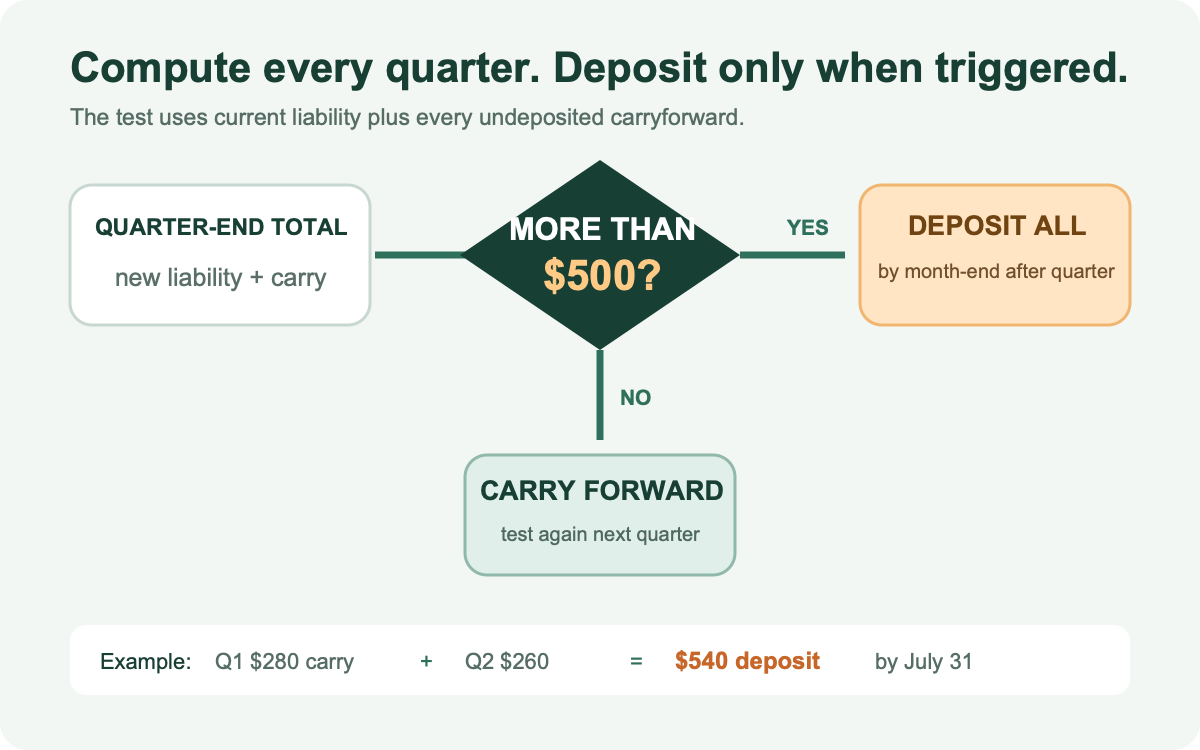
Form 940 is annual, but the deposit decision is tested quarterly. Compute the FUTA liability through the end of each quarter. If the current-quarter liability plus an undeposited carryforward is $500 or less, carry it forward. Once the cumulative undeposited amount is more than $500, deposit the full amount by electronic funds transfer by the last day of the month after the quarter ends.
For example, a $280 first-quarter liability carries forward. Add a $260 second-quarter liability and the undeposited total becomes $540, so the employer deposits $540 by July 31. If third- and fourth-quarter liabilities are $170 and $120, their combined $290 can generally be deposited or paid with a timely Form 940 because it remains $500 or less at year-end.
The IRS employment tax calendar lists April 30, July 31, October 31, and January 31 as the standard quarter-end deposit dates, shifted to the next business day when required. Federal tax deposits must be electronic. Record the liability when it arises and the payment when it clears; then reconcile the payment in an expense-tracking workflow so a carried amount is not booked or paid twice.
Plan for state credits and credit reduction
The 0.6% rate is not automatic. It assumes the employer receives the full 5.4% credit for eligible state unemployment contributions. Timeliness matters, the same wages must generally be covered, and the state must not be a credit reduction state.
A credit reduction state has outstanding federal loans that meet the statutory conditions for reducing employers’ normal FUTA credit. The Department of Labor determines affected states annually after the November 10 deadline. The IRS then publishes the applicable rates through its FUTA credit reduction guidance and the instructions for Schedule A (Form 940). A 0.3 percentage-point credit reduction, for example, would raise the effective FUTA rate from 0.6% to 0.9% on affected wages.
Do not hard-code last year’s state list into a permanent payroll rule. Check the current Schedule A instructions after the annual determination, preserve the source and date, and document who approved the update. For state-specific registration or rate questions, use the Department of Labor’s state UI agency directory. A small organization can turn the annual rate check into a maintained procedure rather than relying on someone’s memory.
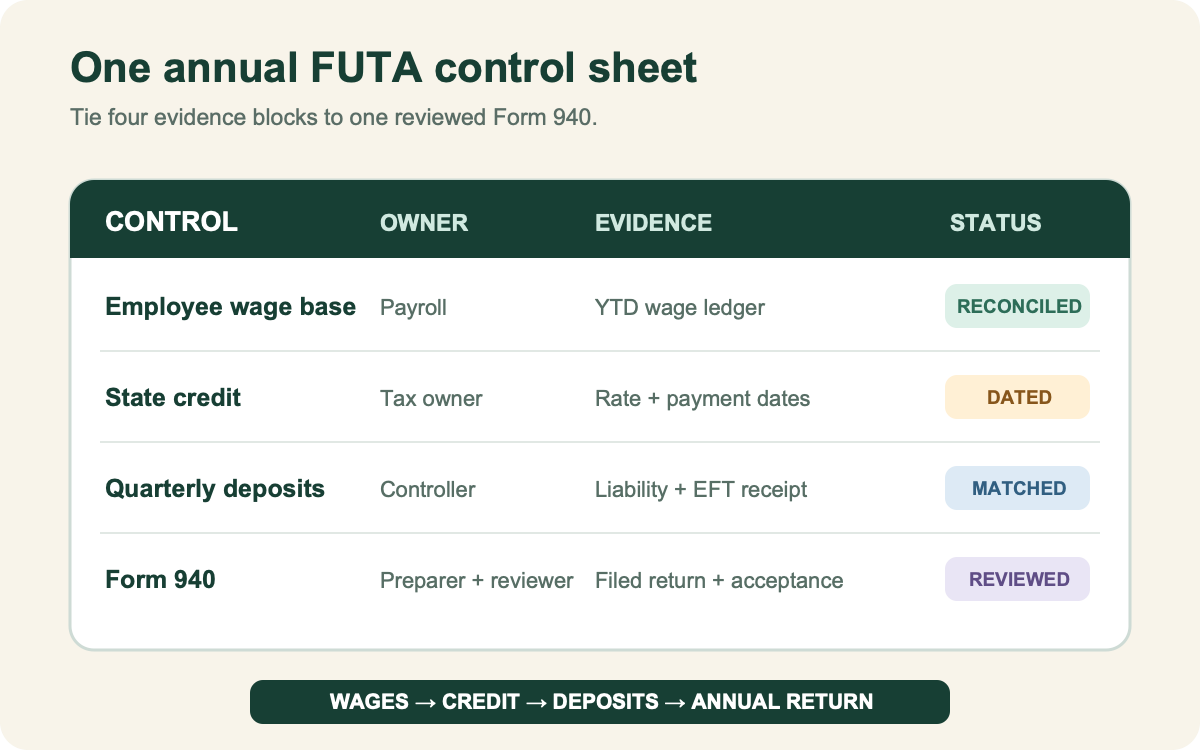
Build an annual FUTA control sheet
The most reliable small-business control is a one-page sheet that connects employee-level wages to quarter-level deposits and the annual return. Include:
- Each employee’s year-to-date FUTA-taxable wages and remaining wage base;
- The state unemployment account, rate, taxable wage base, and payment dates;
- The effective FUTA rate assumption and its official source date;
- Quarterly FUTA liability, carryforward, deposit required, payment confirmation, and ledger reference;
- Any multistate wages or credit reduction adjustment for Schedule A; and
- The Form 940 preparer, reviewer, filing date, and accepted copy.
Under the current Form 940 instructions, the return is generally due January 31 for the previous calendar year, with a 10-day extension when all FUTA tax was deposited on time; weekends and legal holidays can move the date. Filing does not replace a required deposit, and making deposits does not replace filing.
For planning, carry payroll-tax assumptions into the operating plan. Keep the statutory tax estimate distinct from software and service fees; the tool stack cost calculator separates payroll software cost from tax liability. As the company grows, use the broader team-operations guides to strengthen the surrounding team-operations process.
ToolMerit’s recommendation: calculate FUTA from an employee-level wage ledger, review the deposit gate at every quarter-end, and refresh the state-credit assumption before preparing Form 940. If payroll spans multiple states, a business acquisition, household or farm employment, disputed worker classification, or a credit reduction state, have a payroll tax professional review the calculation before filing.
This article provides general educational information, not tax or legal advice.