
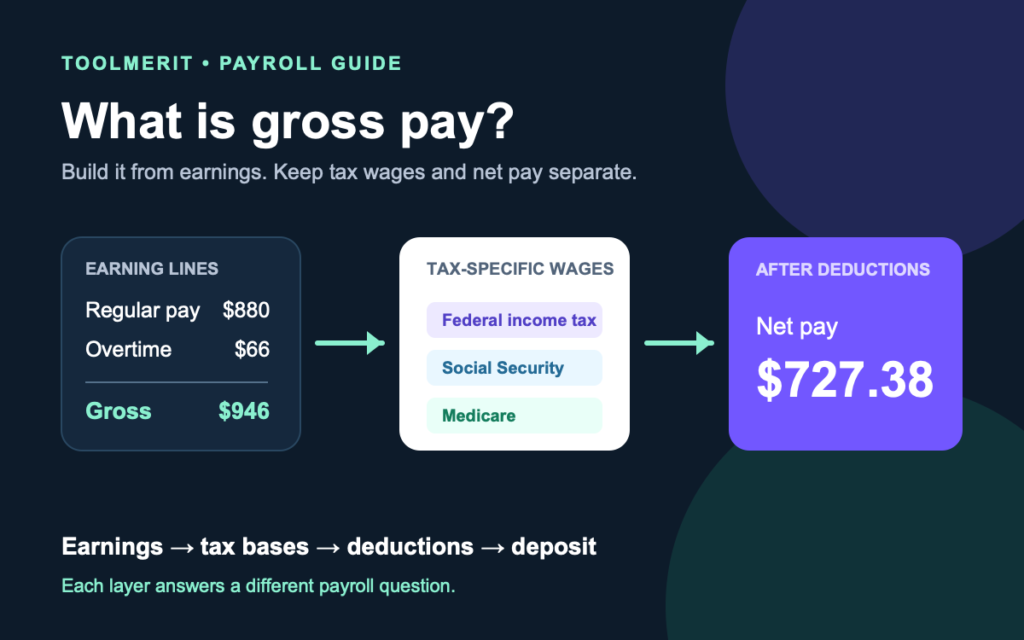
Build gross pay from the earning lines, then keep taxable wages and take-home pay in separate columns. Includes hourly and salary examples plus a pay-stub check.
Gross pay is the total compensation an employee earns for a pay period before employee taxes and other deductions are subtracted. It can include regular wages or salary, overtime, bonuses, commissions, tips, and taxable benefits, depending on the payroll arrangement.
Imagine that a pay stub shows $946 in gross pay and $727.38 deposited in the bank. Neither number is a mistake merely because they differ. The first describes earnings before employee deductions; the second is what remains after the payroll calculation. The useful question is not “Which number is my real pay?” It is “Can I reproduce each layer from the lines above it?”
This guide uses U.S. payroll examples and current federal sources. A collective bargaining agreement, employment contract, state or local wage rule, benefit plan, or employee classification can change the calculation. Treat the examples as a reconciliation method, not personal tax or legal advice.
Build gross pay from the earning lines
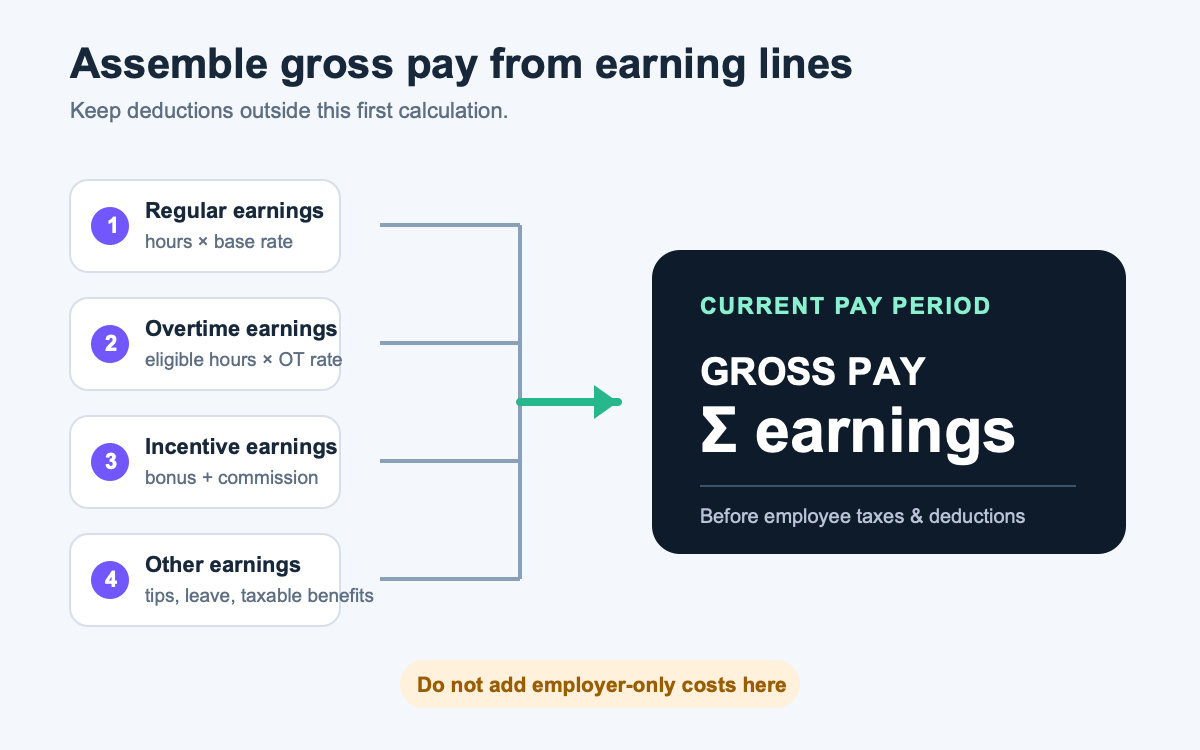
Gross pay begins with compensation earned in the period. For an hourly employee, that normally means approved hours multiplied by the applicable rates, plus any other current earnings. For a salaried employee paid evenly, it usually begins with the salary amount allocated to that pay period. The IRS Employer’s Tax Guide says wages subject to federal employment taxes generally include pay for services such as salaries, vacation allowances, bonuses, commissions, and taxable fringe benefits. That tax definition is useful evidence, but a payroll system may display a broader gross-earnings total before it derives tax-specific wage boxes.
Read the earning section line by line. Common labels include:
- regular hours or base salary;
- overtime, double time, or a shift differential;
- commission, nondiscretionary bonus, or piece-rate earnings;
- paid leave, holiday pay, or reported tips; and
- taxable noncash benefits or an adjustment from an earlier period.
Do not count a reimbursement, employer benefit cost, or payroll tax merely because it appears somewhere on the statement. First determine whether it is an employee earning, an informational employer contribution, or a deduction. If hours are the input, compare them with the approved record using a timesheet that preserves hours, dates, and approval. A payroll operator can place the resulting register inside a broader set of finance and administration controls.
Calculate hourly gross pay
For a simple hourly pay period with one rate and no overtime, multiply paid hours by the hourly rate. Forty hours at $22 per hour produces 40 × $22 = $880 in gross pay before any additional earnings.
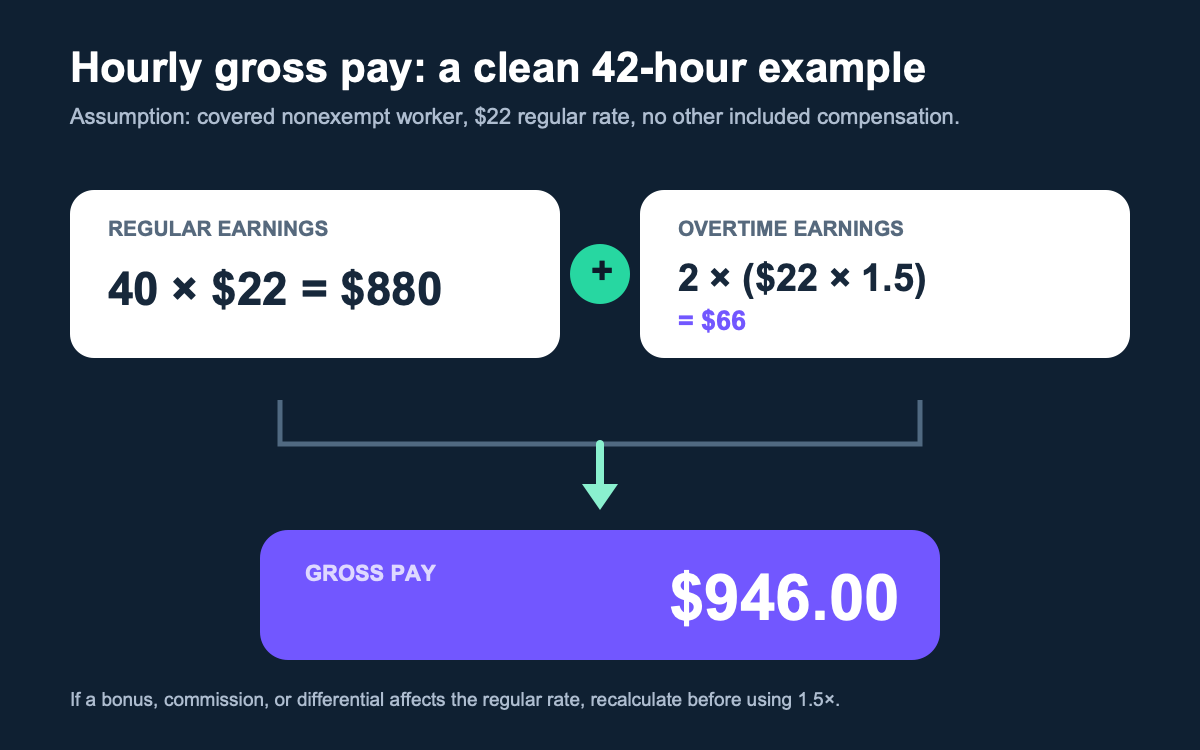
Now assume a covered, nonexempt employee works 42 hours in one workweek at $22 per hour, and no bonus, commission, shift differential, or other payment changes the regular rate. Under the federal Fair Labor Standards Act, most covered nonexempt employees must receive at least one and one-half times the regular rate for hours over 40 in a workweek:
| Earning line | Calculation | Amount |
|---|---|---|
| Regular earnings | 40 × $22.00 | $880.00 |
| Overtime rate | $22.00 × 1.5 | $33.00 |
| Overtime earnings | 2 × $33.00 | $66.00 |
| Gross pay | $946.00 | |
The arithmetic is deliberately simple; the boundary is not. The Department of Labor’s regular-rate guidance explains that the regular rate generally includes compensation for hours worked, services, or performance, and an includable bonus or commission can change the overtime calculation. State rules may also require daily overtime or a more protective standard. When additional pay exists, use the actual regular-rate method rather than automatically multiplying the stated hourly rate by 1.5.
For a repeatable check, create columns for date, regular hours, overtime hours, each rate, and every separate earning type. The formulas and total become easier to audit when you build the payroll check in Excel instead of typing a single gross number into a calculator.
Calculate salaried gross pay
If an annual salary is paid in equal installments, divide the annual salary by the employer’s actual number of pay periods. An employee with a $62,400 annual salary paid semimonthly has a base pay-period amount of $62,400 ÷ 24 = $2,600. If the employee also earns a $300 commission in that period, gross pay is $2,600 + $300 = $2,900.
Use the employer’s schedule rather than guessing from a calendar label. Weekly payroll is often 52 periods, biweekly payroll is commonly 26, semimonthly payroll is 24, and monthly payroll is 12, but an extra payroll run, partial period, unpaid leave, retroactive increase, or contract term can change the current amount. Also, receiving a salary does not by itself prove that an employee is exempt from overtime rules.
A first or final paycheck may need a documented proration method. Reproduce the method shown in the employer’s policy, agreement, or payroll setup; do not silently divide an annual salary by working days and assume that every employer or jurisdiction uses the same rule.
Keep gross, taxable, and net pay separate
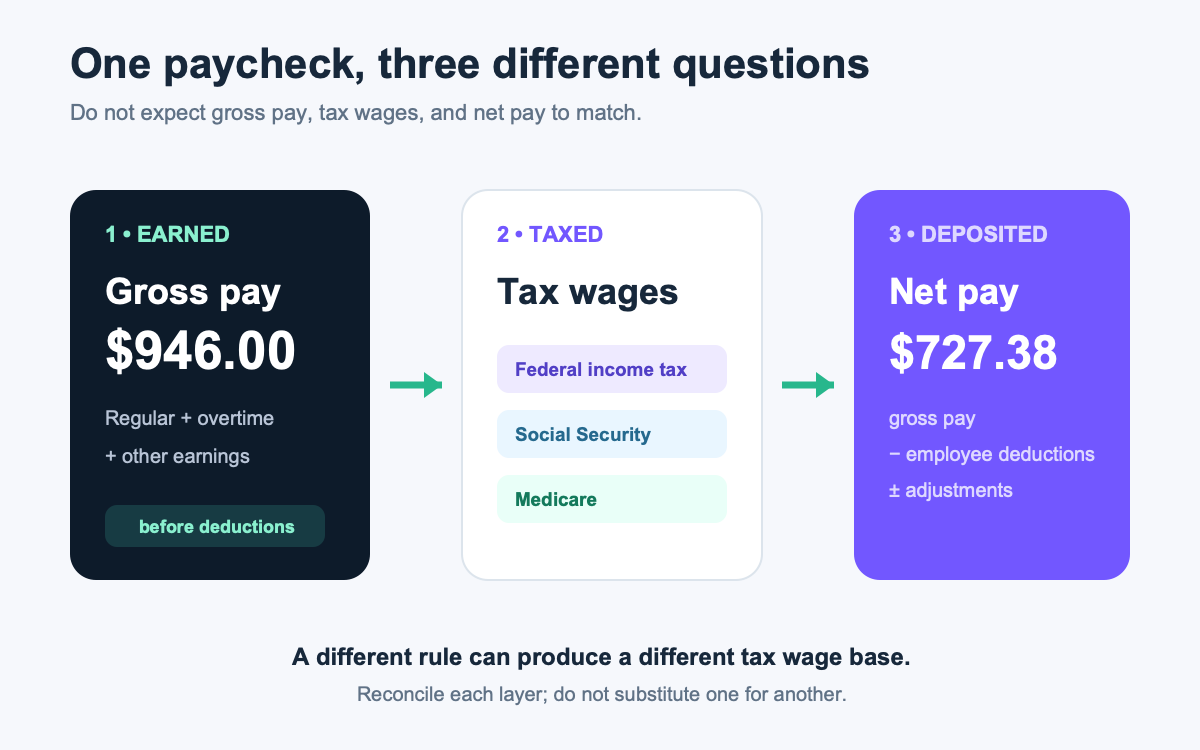
The most common repair is to stop treating three different values as synonyms:
| Value | What it answers | Typical starting point |
|---|---|---|
| Gross pay | What compensation was earned before employee deductions? | Current earning lines |
| Taxable wages | How much is subject to a particular tax? | Gross earnings adjusted under that tax’s rules |
| Net pay | What remains for the employee after deductions and adjustments? | Gross pay minus employee deductions, plus or minus authorized adjustments |
There is not one universal taxable-wage number. The current IRS Form W-2 instructions distinguish federal income-tax wages in box 1, Social Security wages in box 3, and Medicare wages in box 5. A traditional 401(k) elective deferral can generally reduce box 1 wages while remaining part of Social Security and Medicare wages. Other benefits can have different treatment. This is why gross pay, box 1, box 3, box 5, and net pay may all differ without any one of them being wrong.
Suppose the $946 hourly example has a $75 pre-tax retirement deferral, $143.62 in employee taxes, and no other deductions. A simplified illustration would show:
$946.00 gross − $75.00 retirement deferral − $143.62 taxes = $727.38 net pay
That equation explains the deposit but does not determine the tax treatment of the retirement contribution. Payroll must calculate each tax base under its own rules. IRS Topic 401 also notes that income-tax withholding is still income received by the employee even though the employer sends it to the government.
For employer books, employee gross pay is also not the full labor cost. Employer payroll taxes, benefit contributions, payroll service fees, and workers’ compensation costs can sit outside employee gross pay. Post those amounts through a controlled process and reconcile payroll cash and expenses by source rather than forcing every cost into the employee’s gross-pay field.
Reconcile a pay stub without guessing
The Department of Labor’s federal recordkeeping guidance lists the basis on which wages are paid, regular hourly rate, straight-time earnings, overtime earnings, additions or deductions, total wages, pay date, and covered period among the records an employer must maintain for covered nonexempt workers. Those fields also make a strong reconciliation checklist.
- Confirm identity and period. Make sure the employee, pay dates, and pay frequency match the expected payroll.
- Rebuild current earnings. Multiply approved hours by rates, verify salary allocation, and add each incentive or adjustment once.
- Reconcile gross pay. The earning lines should add exactly to the displayed current gross.
- Separate deduction types. Mark taxes, pre-tax elections, after-tax deductions, garnishments, reimbursements, and employer-only contributions separately.
- Recalculate net pay. Follow the statement’s signs; a reimbursement may add to the payment without becoming an earning.
- Check year-to-date continuity. Prior year-to-date gross plus current gross should normally equal current year-to-date gross, subject to a documented void or correction.
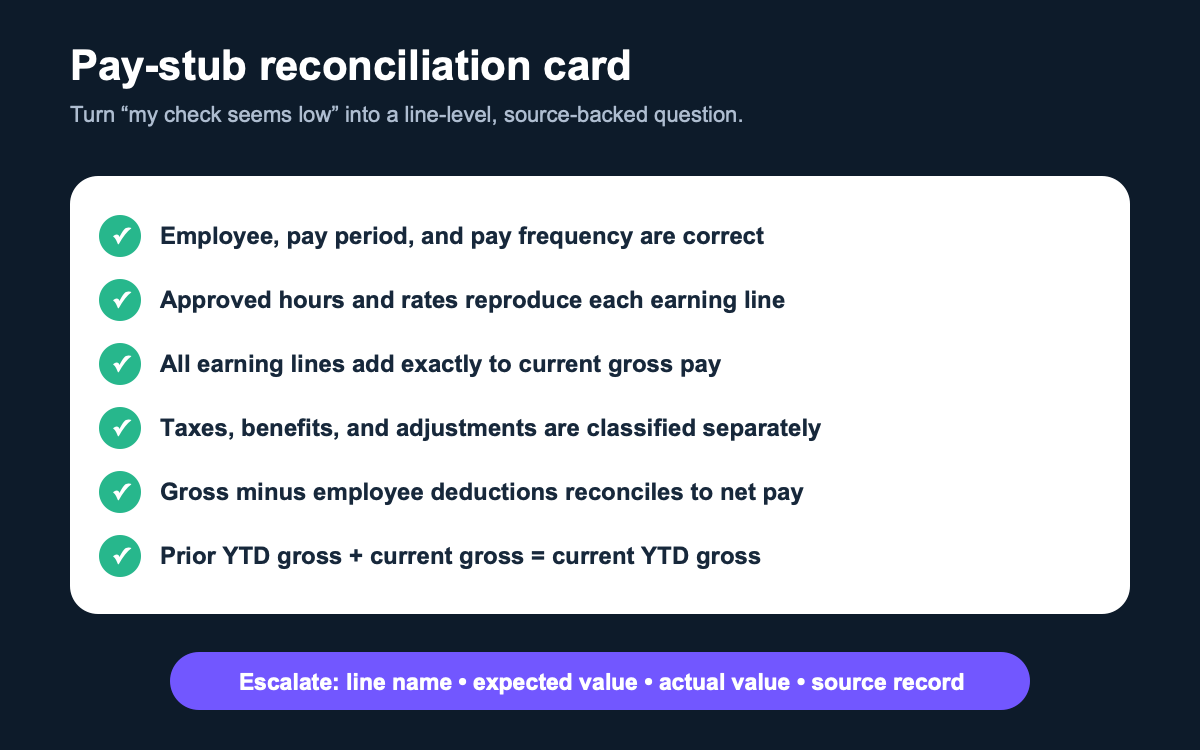
If something does not tie, preserve the pay stub and source record, then describe one discrepancy precisely: “42 approved hours appear, but only 40 regular hours and no overtime line were paid” is actionable; “my check seems low” is not. Teams can formalize ownership and review points with the team-operations guides, then choose appropriate team-operations tools for approvals and records.
Use gross pay in a budget without understating payroll cost
Gross pay is a useful compensation input, but it is not a complete employer cash forecast. Begin with employee gross wages, then add employer payroll taxes, benefits, insurance, service fees, and any jurisdiction-specific cost. Keep assumptions in separate rows so a rate or headcount change can be updated without rewriting the entire model.
When staffing affects a funding request or operating forecast, carry the documented payroll assumptions into the business plan. Keep payroll technology outside the employee compensation line; the tool stack cost calculator can model payroll software and related subscriptions separately.
Decision rule: if the question is “What did the employee earn before employee deductions?”, total the earning lines to get gross pay. If the question is “What amount is taxed?”, calculate the wage base for that specific tax. If the question is “What reaches the bank?”, continue through every deduction and adjustment to net pay. Do not substitute one layer for another.
This article provides general educational information, not tax, legal, accounting, or payroll advice. For an unresolved classification, overtime, withholding, benefit, garnishment, or multistate issue, use the current agency guidance and a qualified professional.