
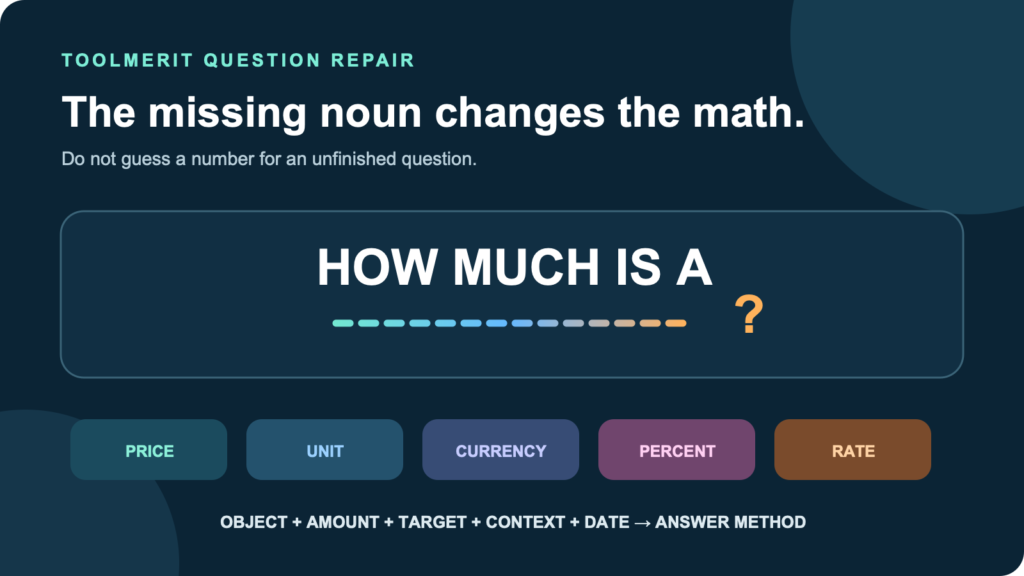
A practical router for repairing an incomplete quantity question before searching, converting, or calculating the wrong thing.
The search box contains “how much is a…” and then stops. A calculator cannot repair that gap with arithmetic. If it guesses that a means a foot, dollar, laptop, pint, percentage, or monthly subscription, it may produce a polished answer to a question nobody asked.
There is no single numerical answer to “how much is a” because the phrase omits the object and usually its amount, unit, currency, place, or date. Complete it as “How much is [amount] [thing or source unit] in [target unit or currency], for [context], on [date]?” Then use the matching method: current price research, unit conversion, exchange-rate conversion, percentage math, or a rate formula.
This is not merely a grammar issue. The BIPM’s SI Brochure describes a quantity value as a number multiplied by a unit and says the quantity must be adequately described before a result is reported. For shopping and currency questions, identity, market, condition, and time matter just as much as a unit.
Repair “How much is a…” with five missing fields
Fill the five slots below before opening a calculator. Not every question needs every slot, but a blank that can change the answer must be resolved or explicitly declared as an assumption.
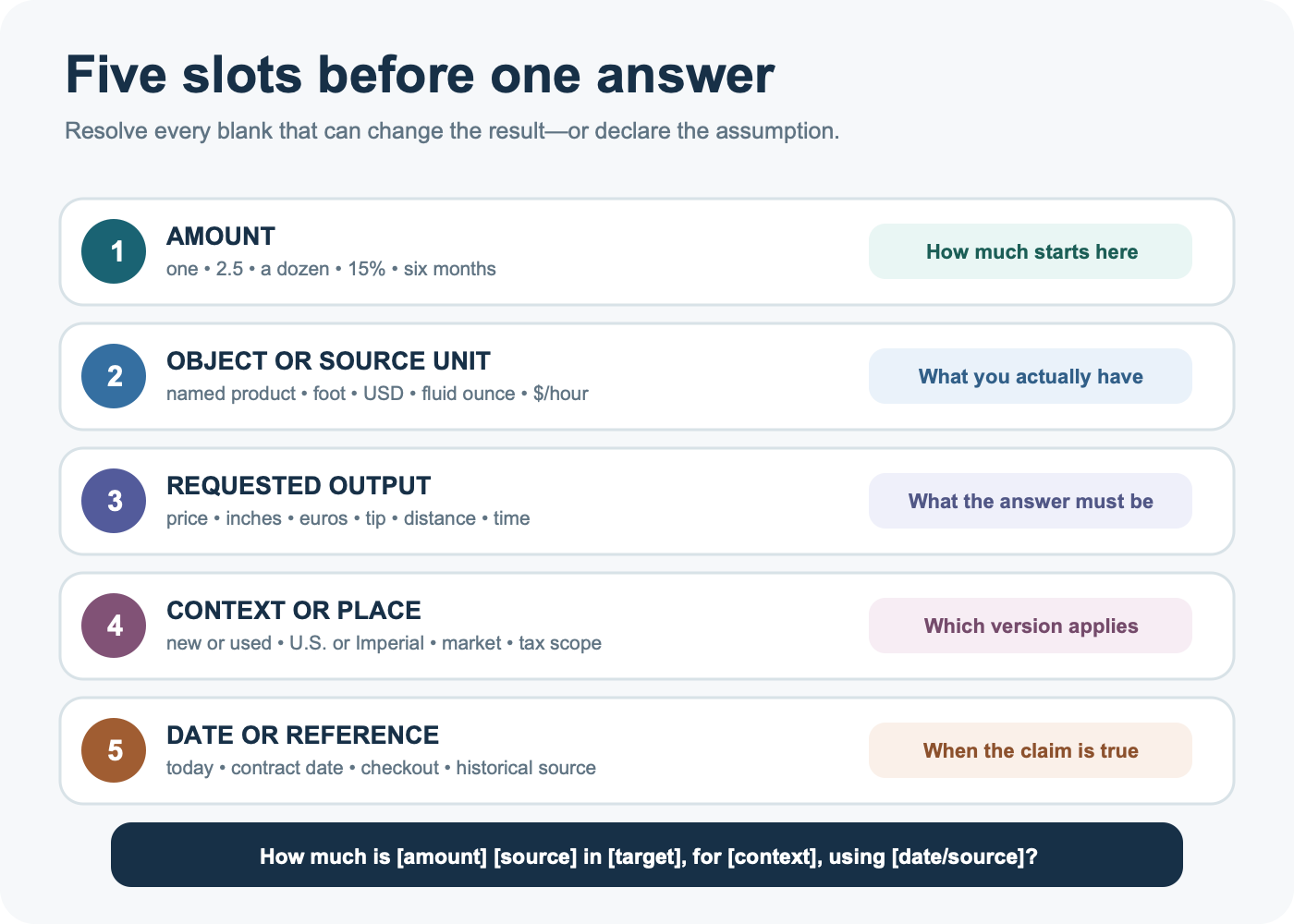
- Amount: one, 2.5, a dozen, 15%, six months, or another starting quantity.
- Object or source unit: a specific laptop, one international foot, 125 U.S. dollars, 3 U.S. fluid ounces, or a rate such as $40 per hour.
- Requested output: price, inches, centimeters, euros, tip amount, total after discount, distance, time, or another named quantity.
- Context or place: new or used, U.S. or Imperial measure, tax jurisdiction, retailer, recipe system, device configuration, or payment provider.
- Date or reference point: today, a historical date, contract date, checkout time, or a specific published standard.
Use this copy-ready form:
How much is [amount] [identified object or source quantity] in [requested unit, currency, or total], for [context or location], using information from [date or named source]?
“How much is a laptop?” becomes answerable only after it names a model, configuration, condition, market, seller scope, date, and whether the desired number is listed price or checkout total. “How much is a foot?” still needs a target unit: inches, centimeters, or meters.
Route the repaired question to the right answer method
The noun and requested output determine the method. The words “how much” do not.
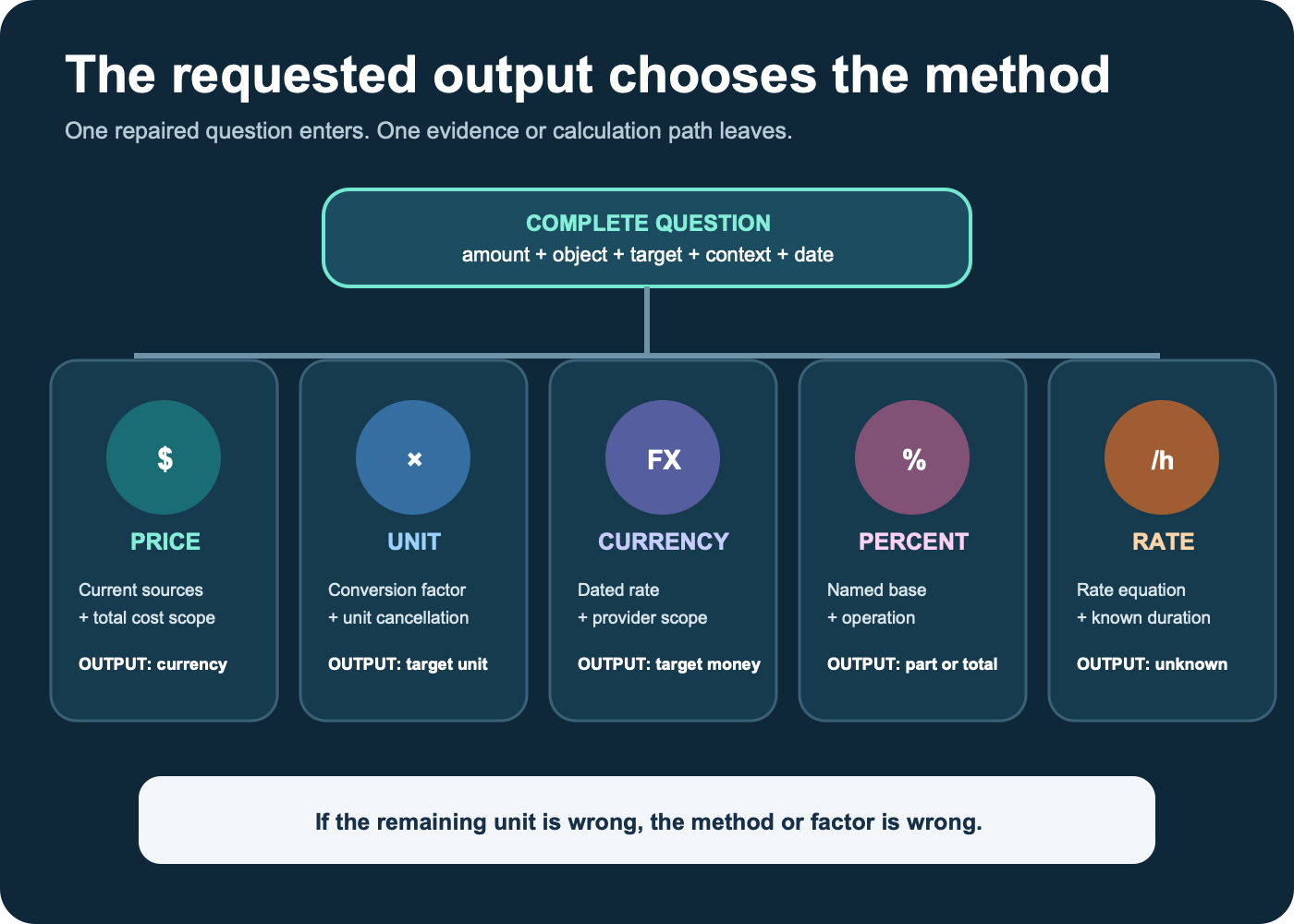
| Question is asking for | Required inputs | Method | Result must include |
|---|---|---|---|
| Current product or service price | Exact item, configuration, condition, quantity, market, seller scope, date | Current source comparison plus total-cost worksheet | Currency, tax/fee scope, seller, and checked date |
| Physical unit conversion | Starting amount and unit, target unit, measurement system | Conversion factor positioned for unit cancellation | Target unit, factor, and justified rounding |
| Currency conversion | Amount, source currency, target currency, rate convention, provider, date | Multiply or divide according to the quoted rate | Target currency, reference rate, date, and transaction caveat |
| Percentage amount or change | Base amount, percentage, and whether it is a part, increase, decrease, markup, margin, or return | Named percentage formula | Base, operation, and resulting unit |
| Rate, time, or quantity | Known rate, duration or quantity, and requested variable | Rate equation rearranged for the unknown | Units that agree with the requested result |
For shopping questions, the ToolMerit Prices & Deals section is a relevant discovery path after the exact product has been identified. For percentage-based business questions, first check whether the real task is a return calculation; the ROI formula and cost rules distinguish return from revenue, margin, and ad-spend ratios.
Use units as an error check, not decoration
NIST describes dimensional analysis as multiplying by a unit factor equal to one: the numerator and denominator express the same value in different units. Arrange that factor so the starting unit cancels and only the requested unit remains.
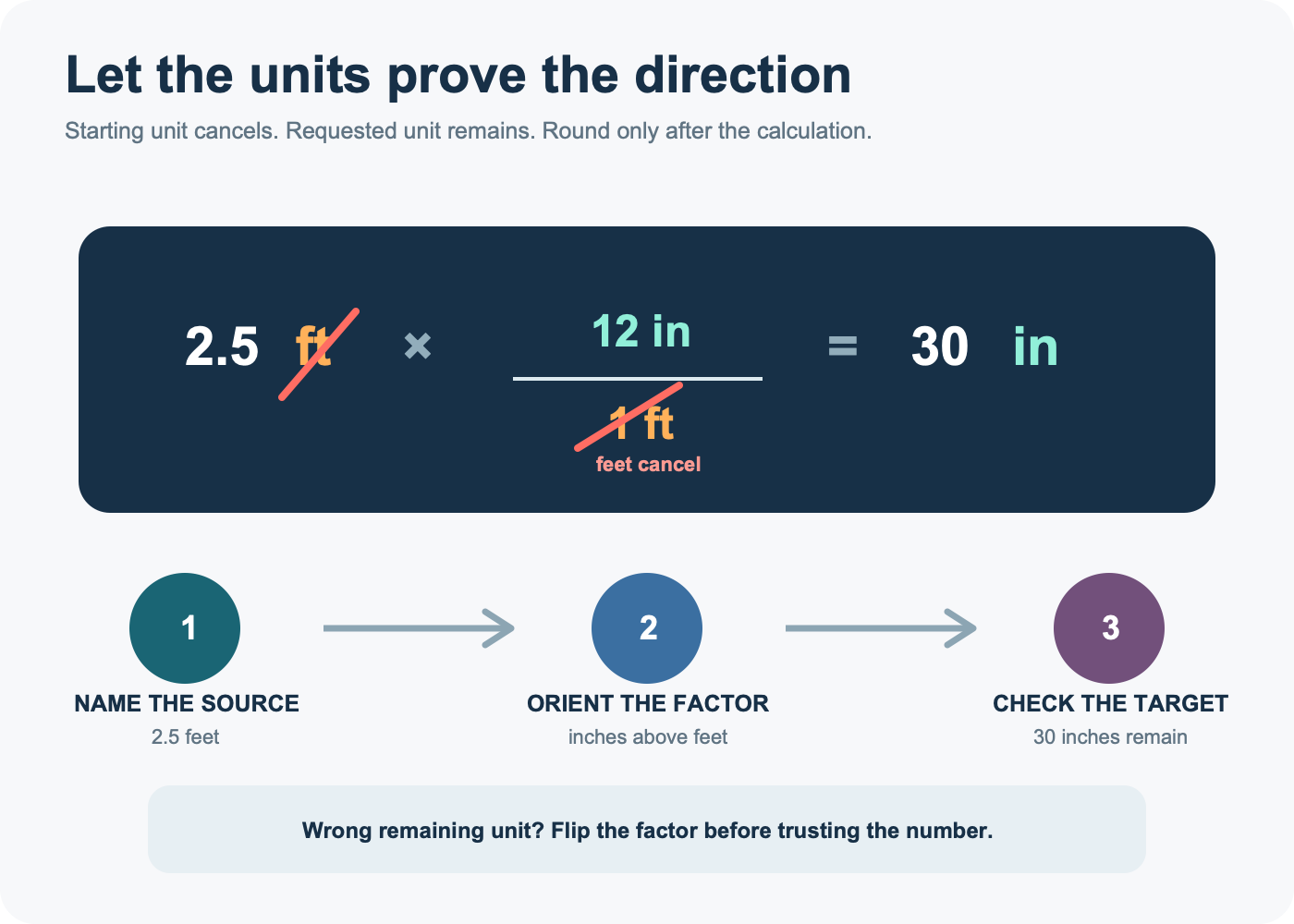
starting amount × (target unit / equivalent starting unit) = target amount
For example:
2.5 ft × (12 in / 1 ft) = 30 in
The feet cancel. The result is inches, which is what the repaired question requested. The relationship is exact; the guide to inches in a foot covers whole, decimal, fractional, and mixed measurements.
A metric example works the same way:
2.5 in × (2.54 cm / 1 in) = 6.35 cm
The inch-to-centimeter relationship is exact. The centimeters-per-inch guide shows how to carry the factor in both directions and choose useful precision.
Three traps require extra care:
- Area and volume: the length factor must be squared or cubed. Converting square feet with a simple feet-to-meters factor is dimensionally wrong.
- Temperature: Celsius and Fahrenheit require an offset and a scale factor. NIST gives °C = (°F − 32) / 1.8; a single multiplication is not enough.
- Measured inputs: an exact conversion factor does not make an uncertain measurement exact. Preserve appropriate significant digits and round once at the end.
Resolve context words that silently change the conversion
A complete unit symbol is sometimes still not a complete question. “Ounce” may mean mass or fluid volume. A fluid ounce may be U.S. or Imperial. A pint may be U.S. liquid, U.S. dry, or Imperial. Those are different quantities, not alternative spellings.
- If the question says “ounces to milliliters,” determine whether it means fluid ounces; then identify U.S. or Imperial. The mL-per-ounce guide keeps volume ounces separate from weight ounces.
- If it says “a pint in cups,” name the measurement system and whether the pint is liquid or dry. The pint-to-cups exception chart shows why the everyday two-cup answer is not universal.
- If it says “a gram in milligrams,” the factor is exact, but the use may carry different consequences. The gram-to-milligram conversion guide includes two-way checks and a high-consequence boundary.
The same rule applies outside measurement. “A room” needs a city, dates, occupancy, room type, cancellation policy, and fee scope. “A phone” needs the exact model, storage, condition, carrier status, market, and date. Context is part of the quantity being asked for.
For prices, calculate the amount you would actually pay
A listed price can answer “what does the page display?” while failing to answer “how much will this cost me?” The FTC advises online shoppers to learn the total cost, including applicable shipping, handling, delivery, taxes, or other fees, and to read the complete product description.
Use this worksheet:
| Field | Record | Why it changes the answer |
|---|---|---|
| Exact item | Brand, model, configuration, size, plan, term | Prevents comparing different products under one name |
| Condition and quantity | New, used, refurbished; units or seats | Changes both price and comparison scope |
| Listed price | Amount and currency | Creates the visible starting figure |
| Required charges | Mandatory fees, handling, required add-ons | Moves the number toward the payable total |
| Shipping and tax scope | Included, excluded, estimated, or location-dependent | Explains what the total does and does not contain |
| Discount conditions | Coupon, membership, financing, renewal, minimum quantity | Prevents presenting a conditional price as universal |
| Source and date | Seller URL, market, checked time | Makes a changing fact auditable |
payable total = listed price + applicable charges + shipping + tax − valid discounts
The formula is a scope statement, not a promise that every component is known before checkout. For recurring software, the Tool Stack Cost Calculator helps turn per-seat, monthly, and annual figures into a comparable operating cost.
Treat currency as a dated rate, not a permanent conversion factor
A repaired currency question names the source amount, source currency, target currency, rate convention, provider or reference source, and date. If the quote means “target currency units per one source-currency unit,” use:
target amount = source amount × quoted target-per-source rate
Suppose a purely illustrative rate is 0.92 EUR per USD. Then:
125 USD × (0.92 EUR / 1 USD) = 115 EUR
The arithmetic is valid for that stated hypothetical rate; it is not a current exchange quote. The European Central Bank publishes reference rates on working days and says they are for information, not necessarily the rates used in actual transactions. A bank, card issuer, cash exchange, or transfer service may apply its own rate, spread, or fee. Therefore, “How much is $125 in euros?” needs both a date and a purpose: reference estimate or expected transaction amount.
Name the base before doing percentage or rate math
A percentage is not an amount by itself. NIST treats the percent symbol as the number 0.01; the underlying base and operation still have to be named.
percentage amount = base × (percentage / 100)
total after a decrease = base × (1 − percentage / 100)
total after an increase = base × (1 + percentage / 100)
“How much is 20%?” is incomplete. “How much is a 20% tip on a $48 pre-tip bill?” has a base and an output:
$48 × 0.20 = $9.60 tip
Rates need the same discipline. At $40 per hour for 2.5 hours, the time units cancel:
2.5 h × ($40 / 1 h) = $100
If the question asks for time instead, rearrange the equation: time = amount ÷ rate. Never carry a formula forward if its remaining units do not match the requested result.
Once the part and whole are named, the percentage formula and examples guide provides the next calculation and a reverse check.
Work four complete examples
| Fragment | Repaired question | Answer route | Defensible answer |
|---|---|---|---|
| How much is a foot? | How many inches are in 1 international foot? | Exact unit conversion | 12 inches |
| How much is a laptop? | What is today’s checkout total for one named model and configuration, new, from three authorized U.S. sellers, before financing? | Current price research | No number until current seller, fee, shipping, and tax-scope evidence is collected |
| How much is a dollar? | How many euros is 125 USD at a named reference rate on a named date? | Dated currency conversion | Source amount × target-per-source rate, labeled as reference or transaction |
| How much is a 20% tip? | What is a 20% tip on a $48 pre-tip bill? | Percentage of a base | $9.60 |
The important move happens before the math: every repaired question names the object, requested quantity, and context that controls the answer.
Stop when the answer is specific enough to verify
Use this final gate:
- The object or quantity is unambiguous.
- The starting amount and all source and target units or currencies are present.
- The measurement system, market, condition, location, or other decisive context is named.
- A changing fact has a source and checked date.
- The formula is visible and the unwanted units cancel.
- The magnitude makes sense: converting to a smaller unit usually increases the numerical value, while a discount should not increase the total.
- Rounding matches the input quality and the practical use; exact factors are not rounded mid-calculation.
- The answer states its boundary, such as tax excluded, reference exchange rate, U.S. liquid measure, or approximate measured input.
Once those conditions are met, the fragment has become an auditable question, the method matches the question, and the resulting number has a meaning another person can reproduce.
If the missing noun is an object, icon, symbol, or sound you cannot name, use the identification workflow before returning to the amount question.