
The everyday U.S. answer is two cups, but dry pints and imperial pints use different volumes and need an explicit system check.
There are exactly 2 U.S. cups in 1 U.S. liquid pint: 1 pint = 2 cups = 16 U.S. fluid ounces = 473.176473 milliliters.
That is the answer for a typical U.S. recipe using liquid volume. Check the recipe’s country and ingredient before applying it: a U.S. dry pint is larger, an imperial pint is larger again, and some international recipes define a cup as 250 mL.
Use the two-cup rule for U.S. liquid measure
The U.S. liquid-volume chain makes the conversion easy:
- 1 cup = 8 U.S. fluid ounces
- 1 pint = 16 U.S. fluid ounces
- 16 ÷ 8 = 2 cups per pint
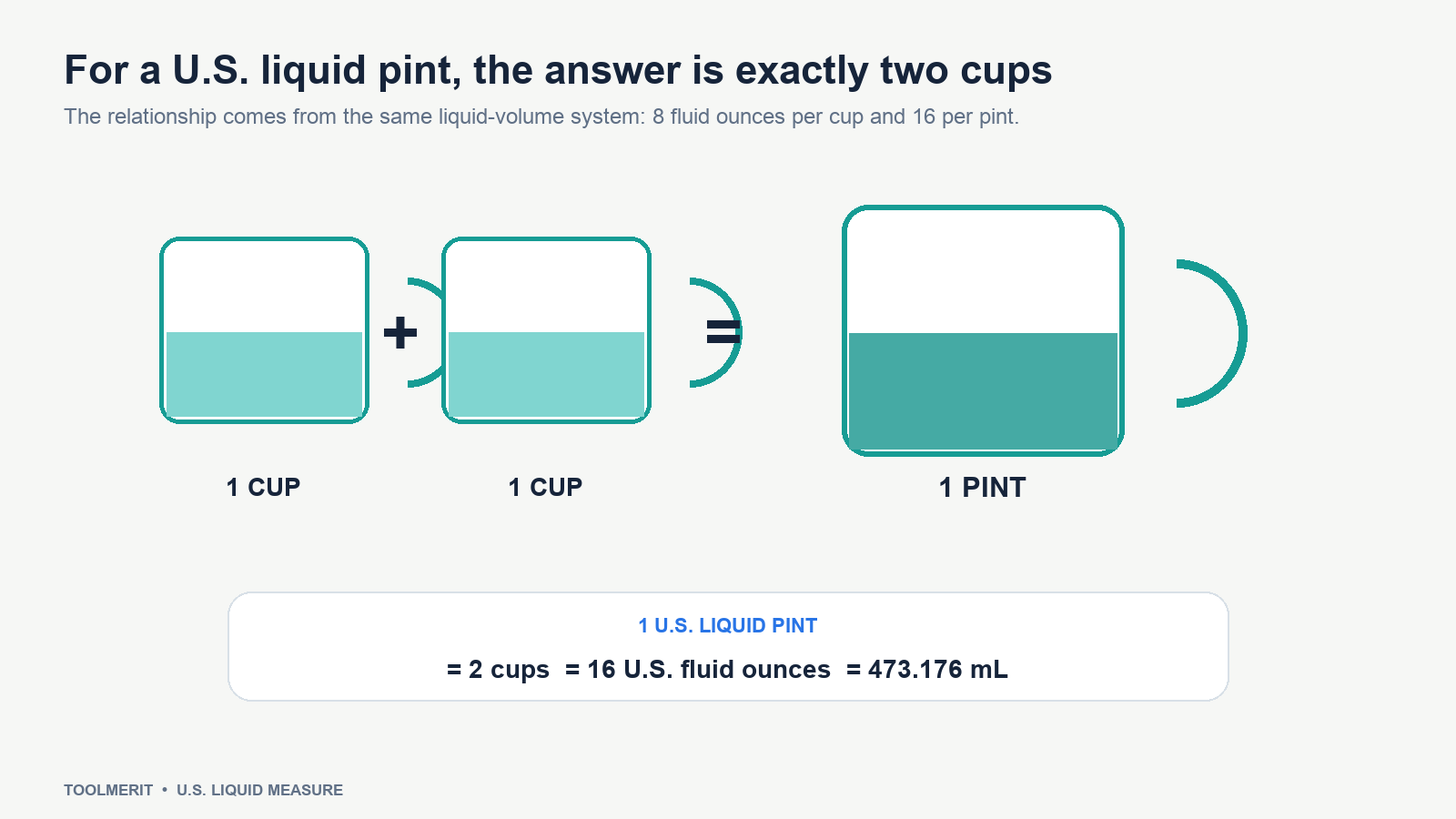
NIST’s cooking measurement equivalencies list 16 fluid ounces as one pint and two cups. Its kitchen table rounds that amount to 480 mL for convenient cooking, while the precise U.S. customary conversion is 473.176473 mL. Use the rounded value for an ordinary recipe only when that level of precision is appropriate; use the exact factor for a calculator, scale-up, or technical record.
Convert any number of pints to cups
For U.S. liquid pints, multiply by two:
cups = liquid pints × 2
To go the other direction, divide cups by two:
liquid pints = cups ÷ 2
Examples:
- 1.5 pints × 2 = 3 cups
- 2.25 pints × 2 = 4.5 cups
- 5 cups ÷ 2 = 2.5 pints
Keep fractions until the last step when accuracy matters. Converting one-third pint to a rounded decimal, then scaling the result again, can accumulate unnecessary error.
Convert common pint fractions
| U.S. liquid pints | Cups | U.S. fluid ounces | Approximate milliliters |
|---|---|---|---|
| 1/8 pint | 1/4 cup | 2 fl oz | 59.1 mL |
| 1/4 pint | 1/2 cup | 4 fl oz | 118.3 mL |
| 1/2 pint | 1 cup | 8 fl oz | 236.6 mL |
| 3/4 pint | 1 1/2 cups | 12 fl oz | 354.9 mL |
| 1 pint | 2 cups | 16 fl oz | 473.2 mL |
| 1 1/2 pints | 3 cups | 24 fl oz | 709.8 mL |
| 2 pints | 4 cups | 32 fl oz | 946.4 mL |
A U.S. liquid quart is two pints, so it is four cups. A U.S. liquid gallon is eight pints, so it is sixteen cups. Those relationships stay exact because all units remain inside the same volume system.
Check the measurement system before using the answer
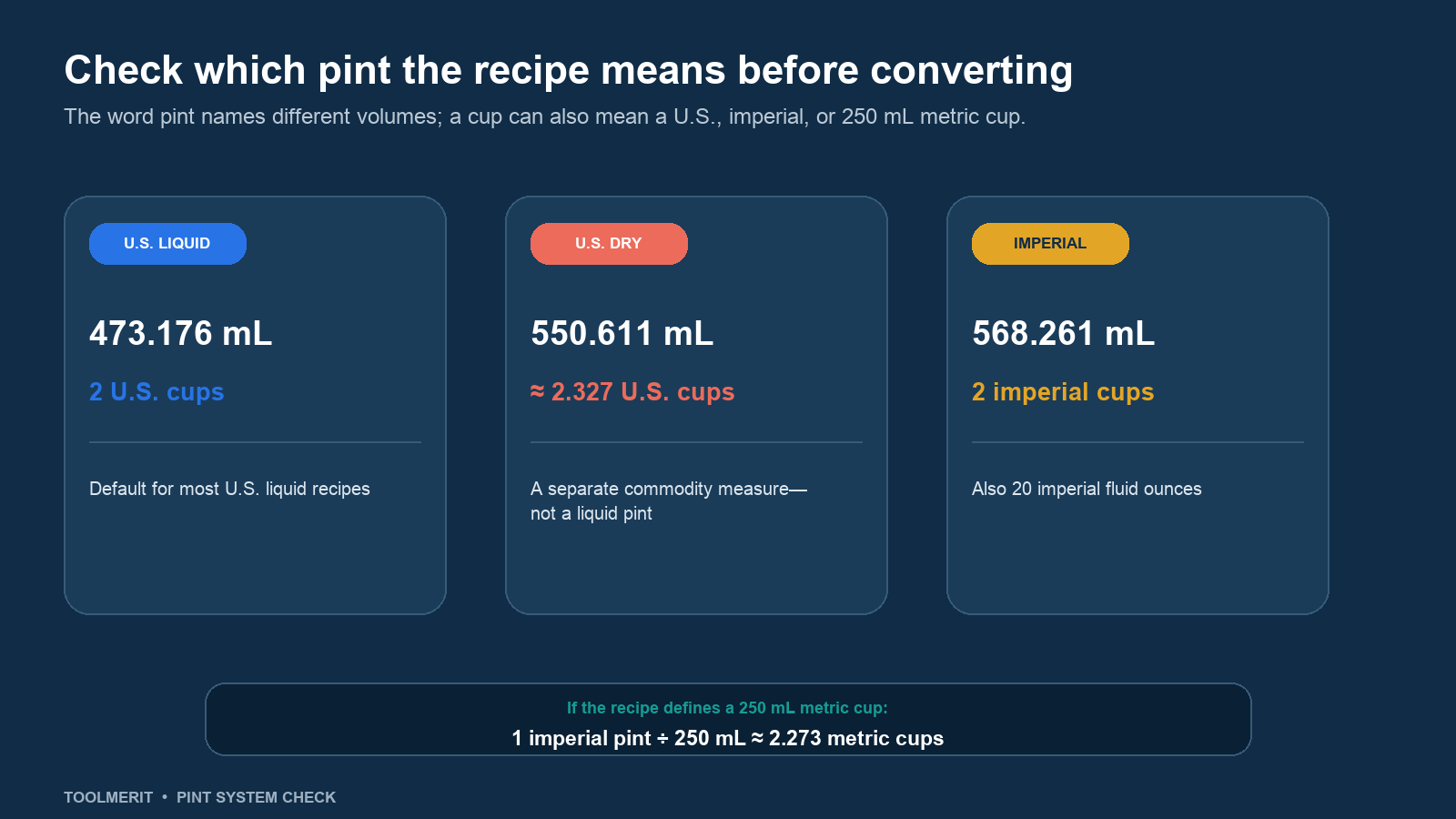
“Pint” does not name one worldwide volume. NIST’s precise conversion factors distinguish the U.S. liquid pint from the U.S. dry pint. Current UK legislation defines its pint as 0.56826125 cubic decimeters, or 568.26125 mL.
| Measure | Volume | Cup result | Practical meaning |
|---|---|---|---|
| U.S. liquid pint | 473.176473 mL | Exactly 2 U.S. cups | Default for most U.S. liquid recipes |
| U.S. dry pint | 550.610471 mL | About 2.327 U.S. cups by volume | A separate dry commodity measure, familiar from produce containers |
| Imperial pint | 568.26125 mL | 2 imperial cups, if a 284.130625 mL imperial cup is intended | Equal to 20 imperial fluid ounces; not equal to a U.S. pint |
| Imperial pint expressed in 250 mL metric cups | 568.26125 mL | About 2.273 metric cups | Use only when the recipe explicitly defines a 250 mL cup |
Do not infer the system only from English-language wording. Check the publisher’s country, unit glossary, neighboring measurements, and whether milliliters appear alongside cups. A British recipe using a pint may mean the 568 mL imperial quantity, while a modern recipe may avoid cups entirely or define a metric cup.
Do not confuse fluid ounces with ounces by weight
A fluid ounce measures volume. An ounce without “fluid” usually measures mass or weight in recipe contexts. One cup of water and one cup of flour occupy the same nominal volume but do not weigh the same amount. Therefore:
- 16 U.S. fluid ounces = 1 U.S. liquid pint;
- 16 ounces by weight = 1 pound;
- 16 ounces by weight of an ingredient does not generally equal one pint.
If a package lists ounces, look for fl oz before treating the value as volume. Ice cream and berries can also be sold in pint containers, but the net weight depends on density, air, packing, and product standards.
Measure the ingredient, not just the conversion
For a liquid, place a clear liquid measuring cup on a level surface, pour to the target line, and read at eye level. For a dry ingredient measured by volume, use a dry cup that can be filled and leveled according to the recipe’s method. NIST’s culinary measurement tips identify using the wrong style of cup as a common source of error.
Technique affects ingredients differently. Flour can compact when scooped; brown sugar may be specified as packed; chopped produce contains air spaces; and sticky ingredients cling to the vessel. When a baking formula provides grams, use a kitchen scale. Mass avoids ambiguity about cup size and packing method and is easier to scale accurately.
Use the right alternative when the units are ambiguous
For an ordinary U.S. liquid recipe, the answer is simply 2 cups per pint. If the recipe mentions a dry pint, uses imperial units, defines a 250 mL cup, or gives an ingredient by weight, stop using the shortcut.
The reliable alternative is to convert the stated pint to milliliters, then divide by the recipe’s stated cup size—or skip volume and follow the ingredient’s gram weight. That extra system check is more accurate than forcing every pint into two cups.