
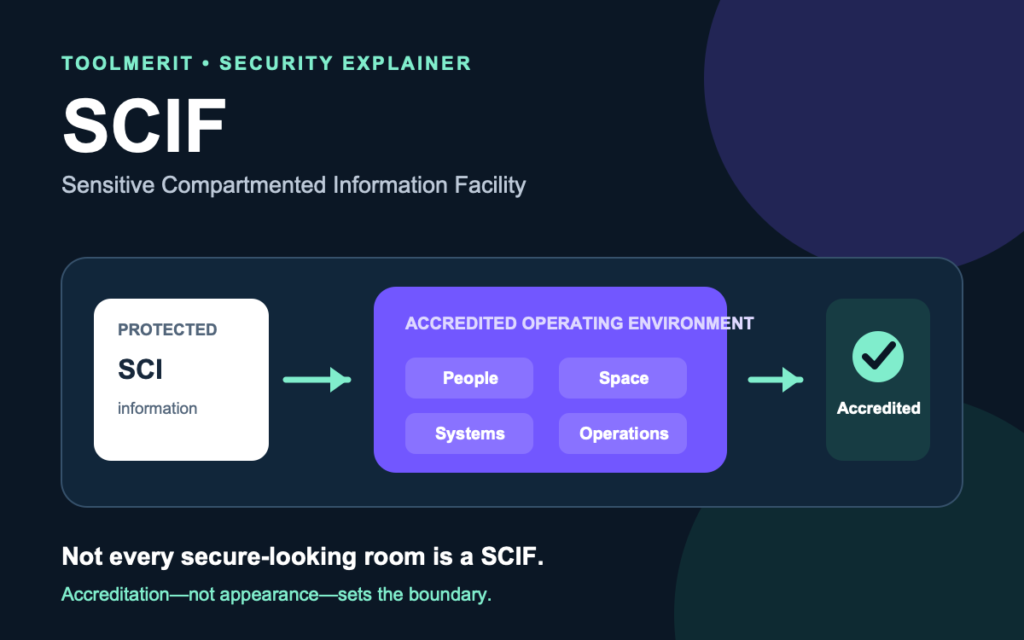
A practical explanation of the SCIF acronym, the information it protects, the access layers visitors need, and why a secure-looking room is not automatically accredited.
SCIF stands for Sensitive Compartmented Information Facility. It is an area, room, group of rooms, building, or installation that has been accredited to the applicable U.S. intelligence-community standards so sensitive compartmented information can be stored, used, discussed, or processed there.
The word is usually pronounced “skiff.” It is often expanded incorrectly as “secure compartmented information facility.” A SCIF is certainly designed to be secure, but Sensitive is the official first word—and accreditation, not appearance, is what makes the space a SCIF.
This article explains the public, high-level framework. It does not provide construction specifications, countermeasure details, or instructions for bypassing local controls. Visitors and organizations must follow the directions of their sponsor, Special Security Officer, Cognizant Security Authority, Accrediting Official, or other responsible security office.
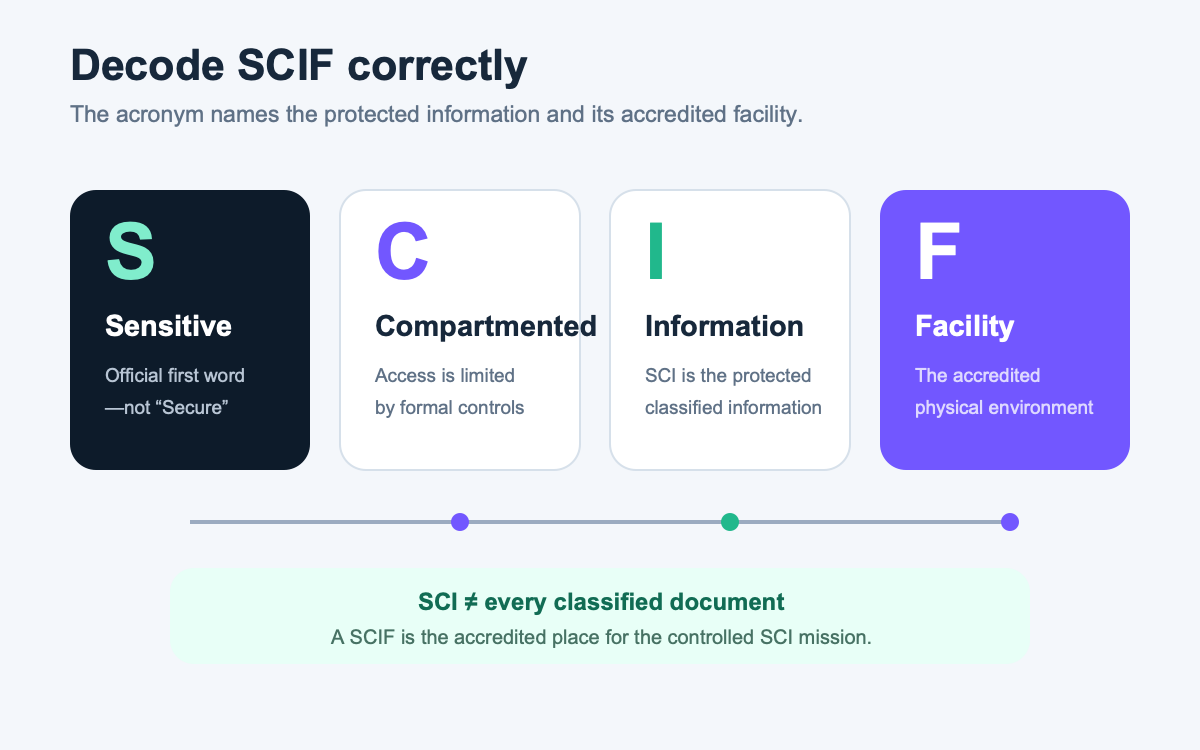
Decode the four letters correctly
The acronym describes both the information and the place that protects it:
- S — Sensitive: the formal word in the acronym, not a generic claim that the room is “secure.”
- C — Compartmented: access is divided into formally controlled compartments; a broad clearance does not automatically provide access to every compartment.
- I — Information: the protected subject is sensitive compartmented information, or SCI.
- F — Facility: the accredited physical area in which that information may be handled under the governing rules.
The NIST definition of SCI describes it as classified information concerning or derived from intelligence sources, methods, or analytical processes and handled within formal access-control systems established by the Director of National Intelligence. SCI is therefore not a synonym for every secret government document, and “SCI” is not simply a higher label placed above Top Secret. It is a controlled category with additional access rules.
SCIF also has less common meanings in insurance, computing, research, and nonprofit names. If the search was intended to find Scifocus or a similar scientific assistant, use ToolMerit’s AI research tools collection; that is a different subject from the government acronym explained here.
A SCIF is not just a secure conference room
NIST defines a SCIF as an area or installation that is certified and accredited against Director of National Intelligence standards for processing, storing, or discussing SCI. Two parts matter: the space has defined protective requirements, and an authorized official has accepted it for a stated use.
| Workspace | What the label proves | Can SCI be handled there? |
|---|---|---|
| Ordinary office or conference room | Only the organization’s normal workplace controls | No, not merely because the door locks or the meeting is private |
| Controlled or restricted area | Access is limited under a particular organization’s rules | Not unless it is separately accredited for SCI |
| Accredited SCIF | The facility has been approved for the scope recorded in its accreditation | Yes, within that scope and only for authorized people and operations |
The Department of Commerce explicitly notes that SCIF accreditation is separate from accreditation for its Controlled Areas. The distinction prevents a dangerous shortcut: copying visible features from a SCIF does not reproduce the security assessment, documentation, inspection, operational controls, or formal decision behind accreditation.
A video platform, encrypted chat, or closed-door meeting also does not create a virtual SCIF. When the content has been confirmed unclassified and the organization approves the channel, a team can run an ordinary unclassified Zoom meeting. If SCI is involved, the sponsor and security office determine the authorized venue and systems.
What the facility is designed to protect
At a high level, a SCIF protects SCI against unauthorized access, observation, disclosure, and relevant technical threats. The public Intelligence Community Directive 705 requires SCI to be processed, stored, used, or discussed in an accredited SCIF and requires SCIFs to meet uniform security requirements.
The form can vary because the mission and risk can vary. The NIST definition allows an area, room, group of rooms, building, or installation. Accreditation records the approved scope; it does not turn every adjacent hallway, connected network, visitor, or conversation into an authorized part of the SCIF.
Protection is also more than physical construction. A functioning SCIF depends on personnel access, information handling, approved systems, visit coordination, training, inspections, operating procedures, and incident reporting. That is why “How thick are the walls?” is not a useful public test of whether a room is a SCIF. The decisive evidence is the current accreditation and the responsible security authority’s direction.
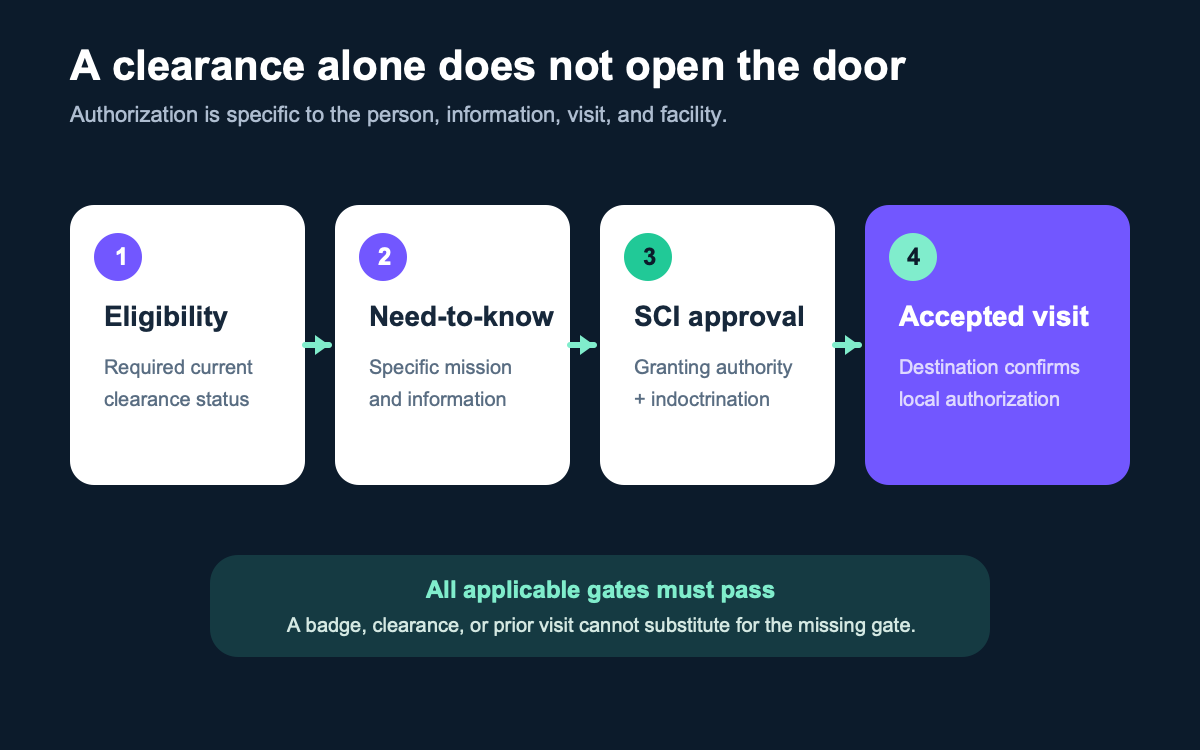
A clearance alone does not open the door
A person may have a security clearance and still lack authorization for a particular SCIF visit or SCI compartment. For its own program, the Department of Commerce describes several SCI access layers: a need-to-know, a Top Secret clearance, approval by the intelligence-community granting agency, and completion of the required nondisclosure agreement. Other organizations implement the governing policy through their own responsible offices and processes.
A useful mental model is a four-gate sequence:
- Eligibility: the person has the required current clearance status.
- Need-to-know: the mission requires access to the specific information.
- SCI access: the granting authority has approved and the person has completed the required indoctrination or agreements.
- Visit and local authorization: the destination has accepted the visit and the individual follows that facility’s access conditions.
Passing one gate does not silently satisfy the next. A building badge is not evidence of SCI access. SCI access does not authorize every compartment. A visit certification does not approve an unlisted device or a different meeting. The destination security office—not the visitor—confirms the final access decision.
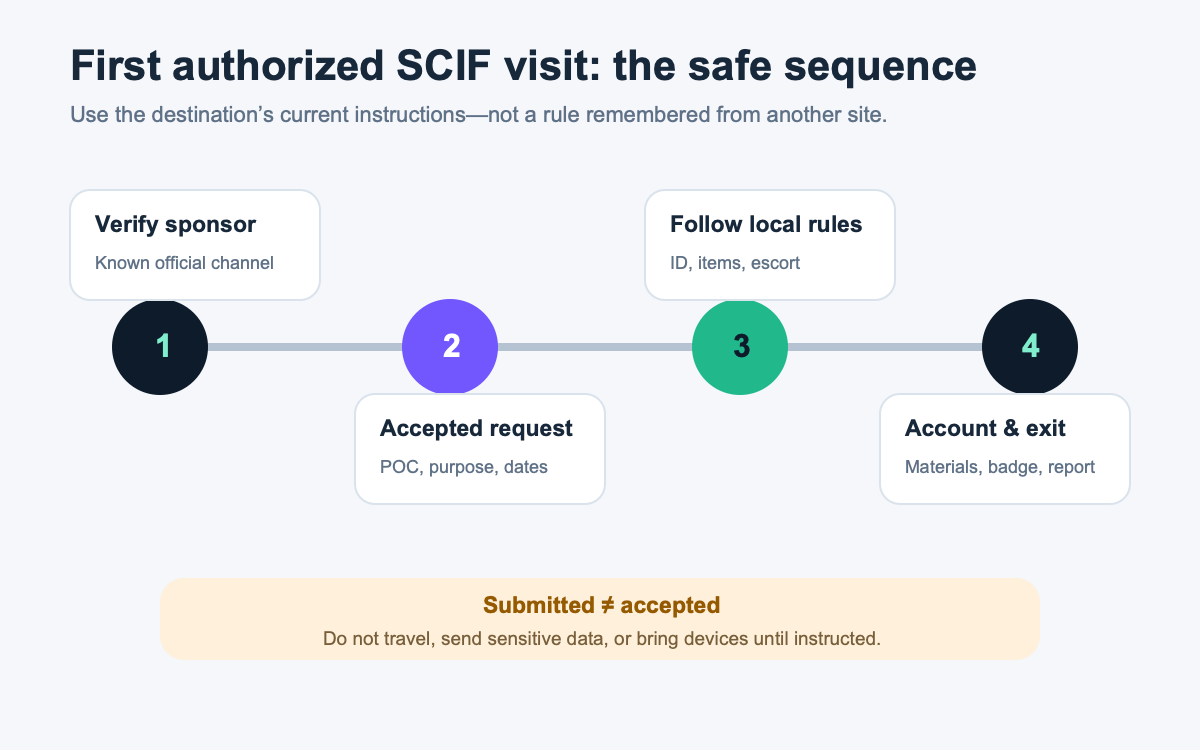
Prepare for a first authorized SCIF visit
Do not treat a SCIF visit like a normal office appointment. The exact process belongs to the sponsoring and destination organizations, but this high-level sequence reduces avoidable problems without guessing at local security procedures.
- Confirm the official sponsor and purpose. Use a known government, military, or cleared-contractor channel. If an unexpected email requests identity or clearance information, check the suspicious access message without using its links. If the sender is unfamiliar, verify the unfamiliar contact through an independent route.
- Let the responsible office transmit the visit request. The Commerce public visit-authorization example uses a Visit Access Request containing the visitor, current clearance information, point of contact, purpose, and approved dates. Do not improvise by emailing sensitive personal or clearance data to an address you found in a search result.
- Wait for acceptance and local instructions. A submitted request is not the same as an accepted visit. Confirm the date, arrival point, identification requirement, escort arrangement if any, and items that must remain outside.
- Bring only what is authorized. Follow the destination’s current instructions for phones, watches, removable media, cameras, medical electronics, bags, paper, and writing materials. Do not rely on a rule remembered from another facility.
- Stay within the approved purpose. Handle only information and systems for which access has been granted. Do not record, photograph, copy, connect equipment, or remove notes unless the responsible authority explicitly permits the action.
- Complete the exit process. Account for issued materials and badges, follow local sign-out directions, and report a suspected mistake immediately through the designated channel.
Meeting documentation requires the same separation. An ordinary notes template is not automatically approved for classified content or systems. Use a meeting-minutes workflow only for an approved unclassified record, kept outside the classified discussion and reviewed under the organization’s release rules.
Accreditation is a lifecycle, not a room upgrade
An organization cannot buy a collection of products, copy a public diagram, and self-declare a SCIF. ICD 705 assigns accreditation authority to intelligence-community element heads or their delegated Accrediting Officials. The separate ICS 705-02 accreditation standard describes accreditation as the beginning of continuing monitoring, evaluation, periodic re-evaluation, and documentation review.
The public lifecycle can be understood without turning it into a construction recipe:
- Mission need: the organization establishes why SCI must be handled at the location.
- Authority and scope: the responsible security authority and Accrediting Official define the applicable path, risk basis, and intended use.
- Design and documentation: qualified participants work to the current official standards and approved plans.
- Inspection and decision: the evidence is reviewed and the authorized official accredits, limits, or rejects the facility.
- Operation and oversight: trained personnel maintain controls, records, inspections, and incident response.
- Change, re-accreditation, or de-accreditation: material changes and end-of-use decisions return to the responsible authority.
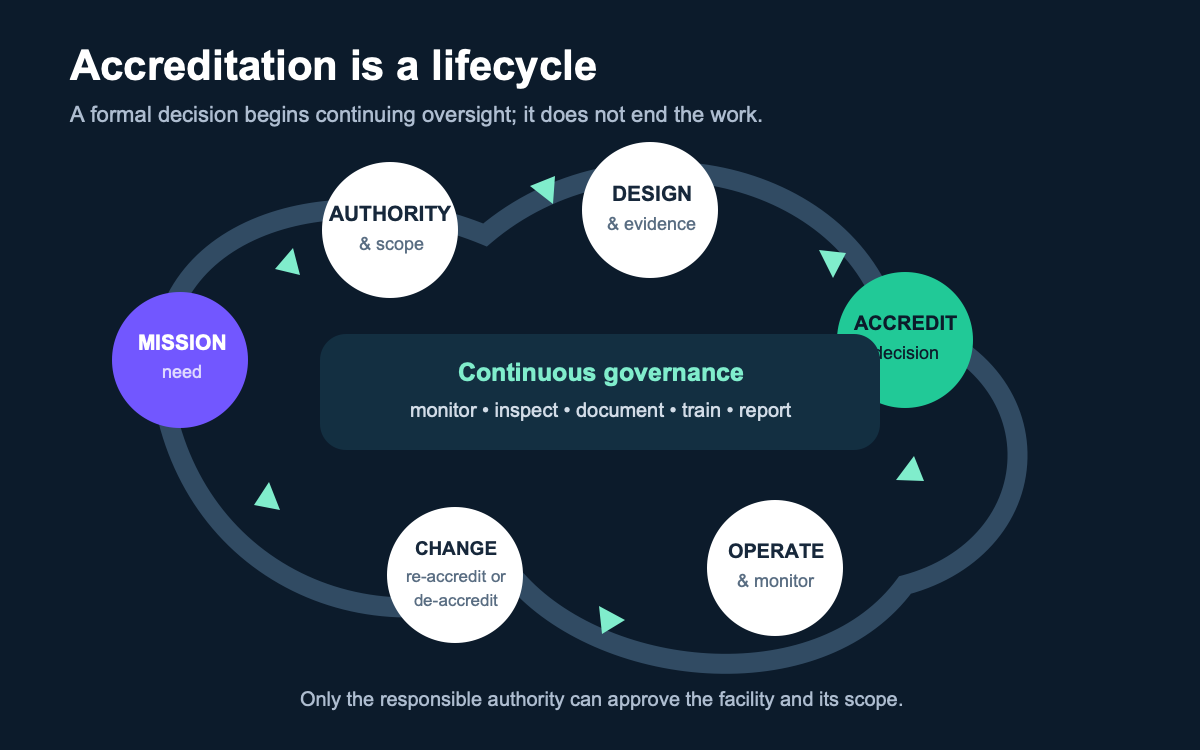
The Office of the Director of National Intelligence even frames its public SCIF course around the facility lifecycle from design and construction through operations. For the ordinary, unclassified project layer, teams may maintain the unclassified process layer in a controlled knowledge base and use team-operations guides for the surrounding unclassified workflow. Classified details, accreditation records, and SCI do not belong in a general-purpose public or commercial workspace unless that exact use is authorized.
Choose the next action by your role
If you saw “SCIF” in the news: read it as an accredited facility for SCI, not simply a secret bunker or a room where every classified topic can automatically be discussed.
If you are an invited visitor: work through the sponsoring security office, wait for destination acceptance, and follow the current local instructions. Do not post the location, schedule, access details, or visit documents publicly.
If you manage a government or contractor requirement: contact the responsible SSO, Cognizant Security Authority, contracting security office, or Accrediting Official before selecting space, vendors, systems, or a budget. A public article cannot determine the correct facility type or approve a design.
If your work is unclassified: keep it visibly separate and choose tools for the separate unclassified workstream. Never copy SCI into a consumer collaboration service simply because it is convenient or encrypted.
Risk boundary: the correct public takeaway is the model—SCI requires both properly authorized people and an accredited operating environment. The correct operational answer for a particular room, device, visitor, conversation, or change must come from the responsible security authority, not from visual inspection or an internet checklist.