
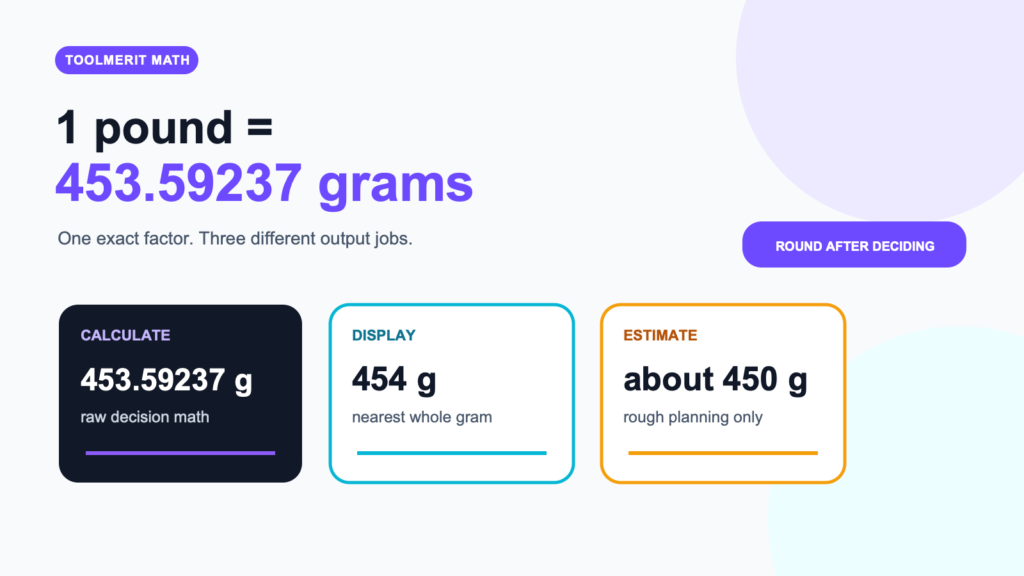
The exact pound-to-gram factor plus a decision-safe method for estimates, displays, and thresholds.
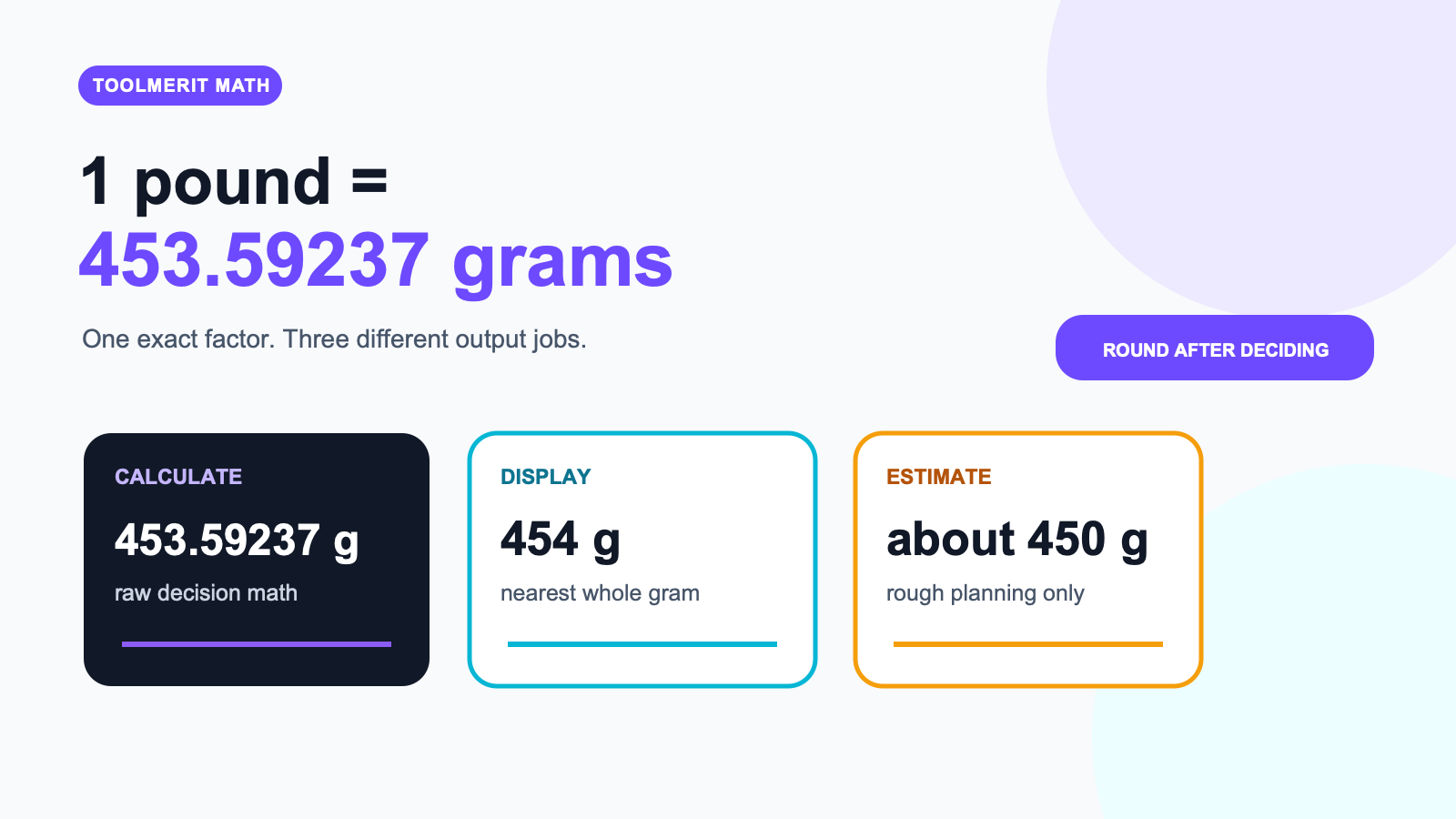
There are exactly 453.59237 grams in one ordinary avoirdupois pound. Multiply pounds by 453.59237 for decision math. Use 454 g only as a whole-gram display and about 450 g only as a clearly labeled estimate; never compare a rounded display with a limit when the unrounded result is available.
If your search used the wording “how many grams and in a pound,” the intended question is “how many grams are in a pound?” The arithmetic answer is short. The operational question is which version of that answer belongs in an estimate, a label, or a pass/fail decision.
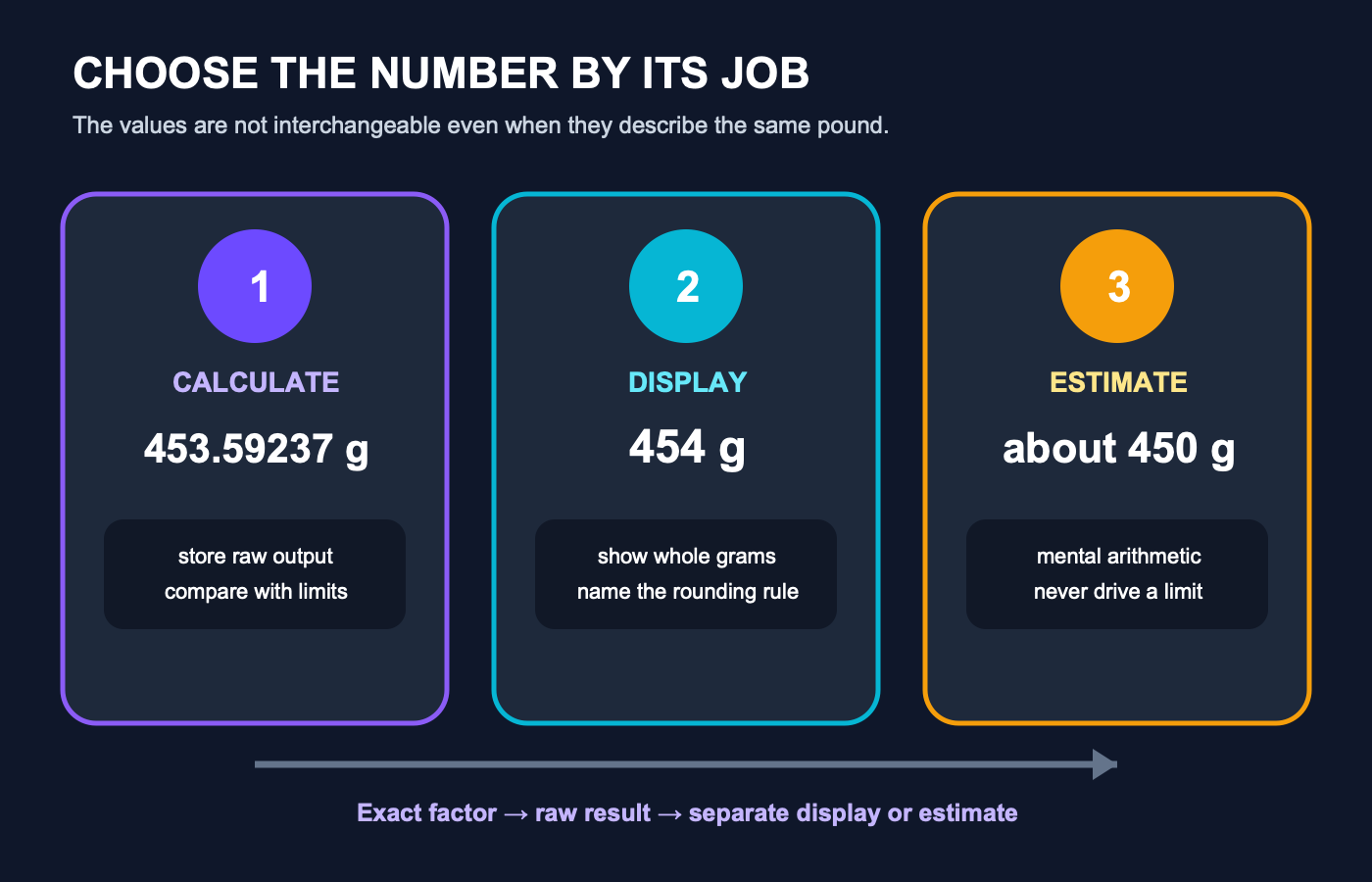
Choose 450, 454, or 453.59237 by the job
The 2026 NIST Handbook 44 conversion tables give one avoirdupois pound as exactly 0.45359237 kg, which is exactly 453.59237 g. Use that factor for the calculation:
raw grams = pounds × 453.59237
| Value for 1 lb | Role | Use it when | Do not use it when |
|---|---|---|---|
| 453.59237 g | Exact conversion factor | Calculating, storing raw output, comparing with a limit | The displayed digits would imply the item itself was measured that precisely |
| 454 g | Whole-gram display | A scale, label, or interface reports whole grams and the rule permits nearest-gram rounding | A decision is close enough that 0.40763 g can change the outcome |
| about 450 g | Mental estimate | Rough planning, quick comparisons, or a deliberately approximate conversation | A reusable record, recipe execution, shipment limit, inventory total, or compliance decision |
NIST’s approximate conversion card explicitly uses 0.45 kg per pound for estimation and points users to exact factors when needed. For ordinary lookup tables, reverse conversion, pound identity, and mixed pound-and-ounce examples, use the full pounds-to-grams reference for ordinary conversions. For a one-off calculation with no stored policy, you can also browse the free calculation tools.
Budget the shortcut error before it accumulates
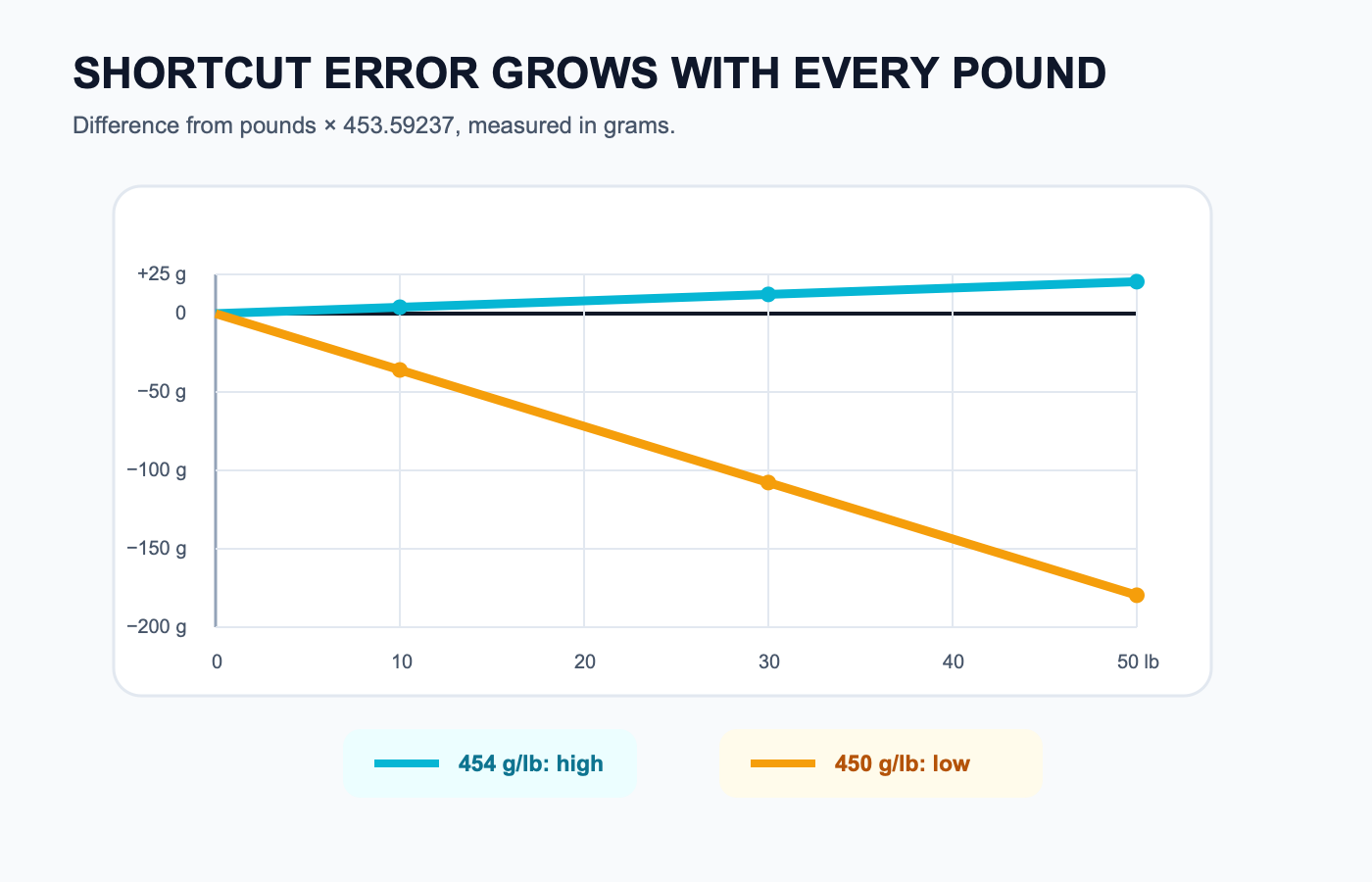
Replacing the exact factor creates a predictable signed difference:
450 g shortcut error per pound = 450 − 453.59237 = −3.59237 g
454 g shortcut error per pound = 454 − 453.59237 = +0.40763 g
| Source pounds | Exact raw grams | Error using 450 g/lb | Error using 454 g/lb |
|---|---|---|---|
| 1 lb | 453.59237 g | −3.59237 g | +0.40763 g |
| 5 lb | 2,267.96185 g | −17.96185 g | +2.03815 g |
| 10 lb | 4,535.9237 g | −35.9237 g | +4.0763 g |
| 25 lb | 11,339.80925 g | −89.80925 g | +10.19075 g |
| 50 lb | 22,679.6185 g | −179.6185 g | +20.3815 g |
The 450 g shortcut is about 0.792% low; the 454 g shortcut is about 0.0899% high. To express a different absolute difference relative to your source quantity, calculate the relative error as a percentage. The allowable error still comes from the real task, not from the conversion page.
An exact unit relationship does not make a physical item exactly one pound. A label reading 1 lb may be nominal or rounded, and a scale has finite resolution and uncertainty. The same distinction appears when you compare exact units with real measurement precision: keep the factor exact, but do not manufacture measurement certainty.
Compare the raw result with the limit
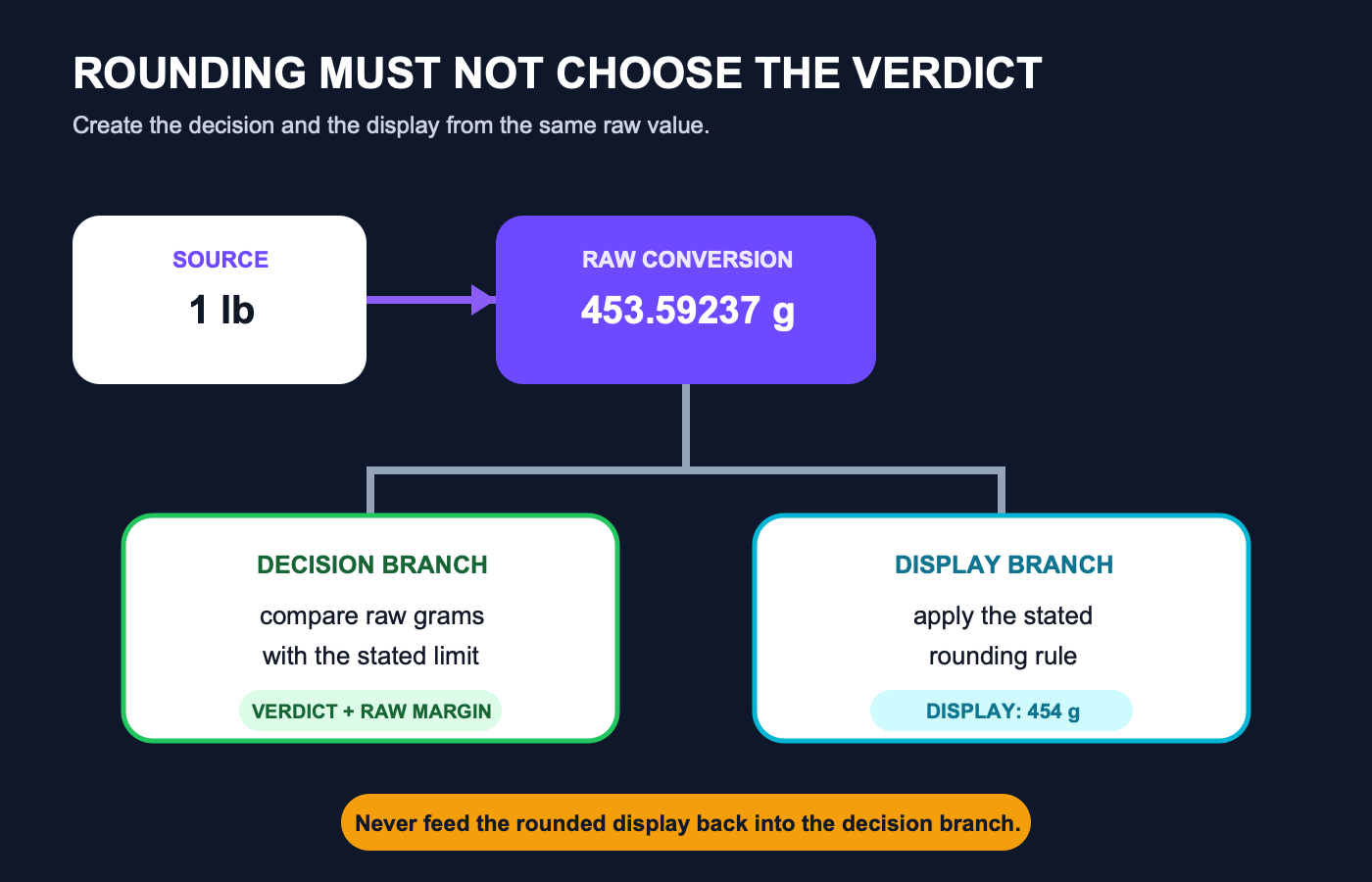
Use two branches after conversion:
raw grams = source pounds × 453.59237
decision = compare raw grams with the stated limit
display grams = round raw grams under the stated display rule
For a maximum limit, define the margin as:
margin = maximum allowed grams − raw grams
A positive margin is below the maximum; zero is exactly at it; a negative margin is above it. If the policy defines a minimum, reverse the subtraction or name the result clearly. Never mix both conventions in one column.
If the source is written as pounds plus ounces, normalize mixed pounds and ounces first instead of reading the ounce count as decimal pounds. If “oz” may mean a liquid quantity, separate fluid ounces from mass before converting; a fluid ounce cannot be turned into grams without the substance and density.
This arithmetic determines only what the stated source number converts to. It does not prove an actual package, batch, or shipment meets a legal, carrier, manufacturing, or recipe requirement. Use the specified measuring method, tolerance, and governing policy for that decision.
Keep one record for the number and the decision
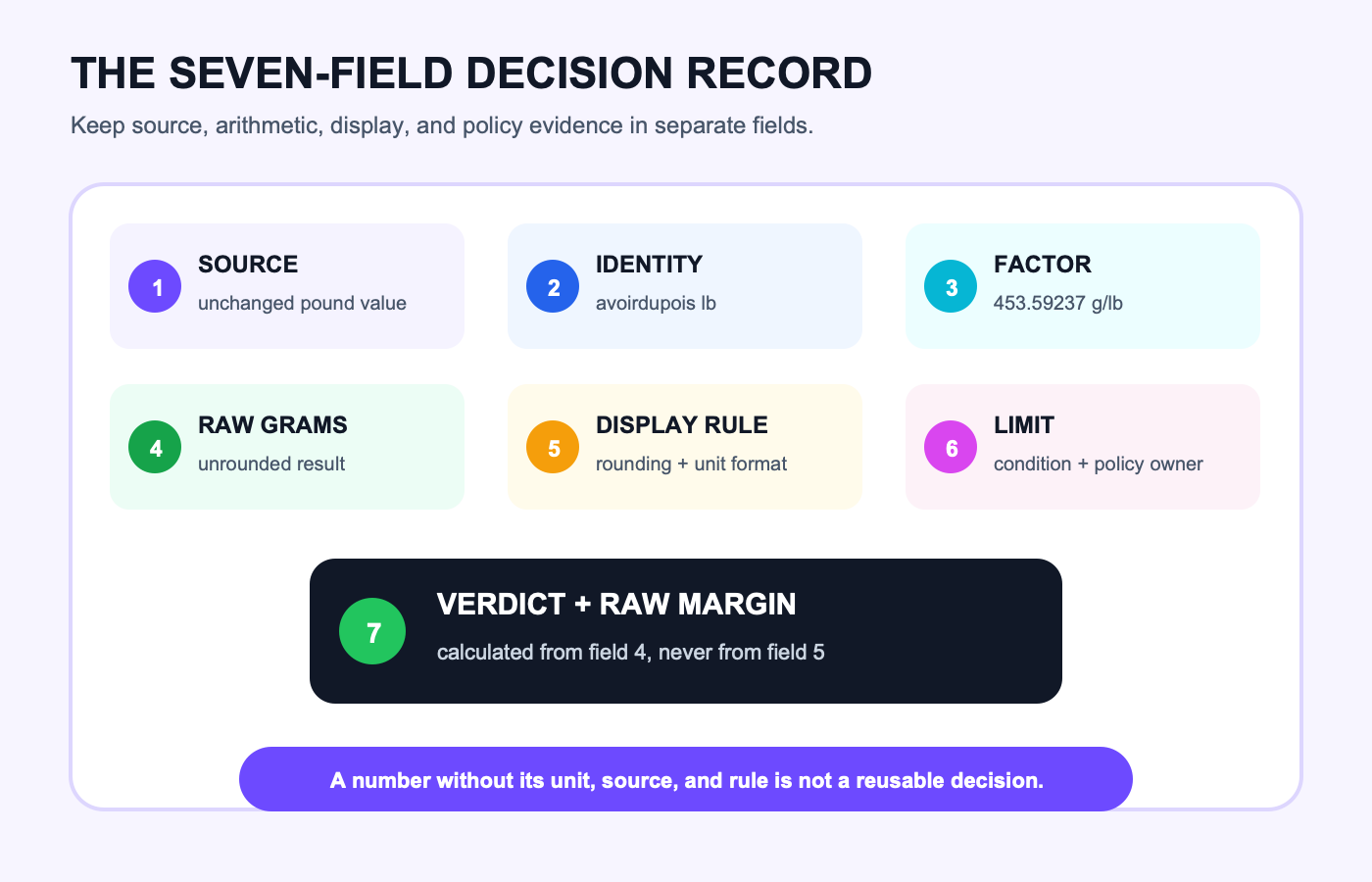
Do not overwrite the original pounds with a rounded gram result. Keep seven fields:
- Source value: the unchanged number as received.
- Unit identity: ordinary avoirdupois
lb, not troy pound or pound-force. - Factor: 453.59237 g/lb.
- Raw grams: the unrounded multiplication result.
- Display rule: for example, nearest whole gram.
- Decision condition: the named maximum or minimum, unit, and policy owner.
- Verdict and margin: produced from raw grams, with review required when the source or policy is ambiguous.
NIST Handbook 44 also distinguishes the troy pound, which equals 373.2417216 g. If a bullion, jewelry, or historical record explicitly says lb t, this page’s ordinary-pound factor is the wrong one. If a workflow begins with kilograms, switch to the kilogram-to-pound route for metric-first records rather than converting back and forth unnecessarily.
When several people use the record, store the approved rule in the team’s operating system with an owner, effective date, source, and change history. A correct formula can still produce inconsistent decisions if every person chooses a different display rule or threshold convention.
Build the decision in separate spreadsheet columns
Assume column A contains the source pounds and column D contains a maximum gram limit. Keep the intermediate and display columns visible:
| Column | Meaning | Example formula in row 2 |
|---|---|---|
| A | Source pounds | Entered value |
| B | Raw grams | =A2*453.59237 |
| C | Displayed whole grams | =ROUND(B2,0) |
| D | Maximum grams | Entered policy value |
| E | Raw margin | =D2-B2 |
| F | Arithmetic verdict | =IF(B2<=D2,"PASS","REVIEW") |
| G | Reverse check | =B2/453.59237 |
The reverse check in G should reconstruct A within the spreadsheet’s normal numeric precision. Protect the factor and formula columns, validate numeric input, and keep the display format from replacing raw values. If you are new to tables and structured data, build the record as an Excel table. When the team needs to see how shortcut error grows across many values, chart the accumulated shortcut error from raw comparison columns rather than from manually typed points.
Audit three near-limit cases
For an input of 1 lb, the raw result is 453.59237 g and the whole-gram display is 454 g. That pair produces three useful test cases:
| Decision condition | Raw-math result | What 454 g alone suggests | Correct handling |
|---|---|---|---|
| Maximum 453.8 g | Pass by 0.20763 g | Apparent failure | Use the raw result, then confirm the source measurement supports such a narrow margin |
| Minimum 453.7 g | Fail by 0.10763 g | Apparent pass | Use the raw result and send ambiguous real-world evidence for review |
| Maximum 454 g | Pass by 0.40763 g | Pass at the displayed boundary | Keep the raw margin even though both verdicts agree |
If a genuinely supported workflow requires the margin in smaller mass units, convert a supported subgram margin to milligrams. Changing units does not increase the quality of the original measurement, so preserve its stated resolution and uncertainty.
Use one decision rule
Calculate with 453.59237 g/lb, compare the unrounded result with the stated limit, and round a copy for display. Use 450 g only when “about” is part of the result. Use 454 g only when whole grams are the agreed output. If the source unit, measurement precision, limit, or governing rule is missing, the correct outcome is review—not a more elaborate decimal.
The NIST Guide to the SI ties converted digits to the possible rounding error of the source value and the end use. Its writing rules also place a space between the number and unit symbol, so write 454 g, not 454g. The result is defensible when the exact factor, source precision, output rule, and decision condition remain visible together.