

Convert kilograms and pounds in either direction, handle mixed pound–ounce readings, and distinguish rounded displays from exact limits.
One kilogram is approximately 2.20462262 pounds. In the other direction, one ordinary pound equals exactly 0.45359237 kilogram. Divide kilograms by 0.45359237 to get pounds; multiply pounds by 0.45359237 to get kilograms. Keep the original unit beside the number so you do not use the factor backward.
“Kilo” means kilogram in an everyday mass question. This reference covers both directions, decimal and mixed pound–ounce readings, mental estimates, ranges, and rounding. For many records, use the separate batch conversion workflow for Excel or Google Sheets.
Convert kilograms to pounds
pounds = kilograms ÷ 0.45359237
The NIST Handbook 44 mass tables give the ordinary international avoirdupois pound as 0.45359237 kg. Its reciprocal is 2.204622621848775… pounds per kilogram; any finite version of that reciprocal is rounded, not exact.
For 12.5 kg, 12.5 ÷ 0.45359237 ≈ 27.55778277 lb. The numerical result grows when positive kilograms become pounds, because a pound is the smaller unit. An answer of about 5.67 lb would mean you multiplied by the factor instead of dividing.
| Kilograms | Pounds, approximately |
|---|---|
| 0.25 | 0.551156 |
| 0.5 | 1.102311 |
| 1 | 2.204623 |
| 2 | 4.409245 |
| 2.5 | 5.511557 |
| 5 | 11.023113 |
| 10 | 22.046226 |
| 20 | 44.092452 |
| 25 | 55.115566 |
| 50 | 110.231131 |
| 100 | 220.462262 |
Convert pounds to kilograms
kilograms = pounds × 0.45359237
For example, 12 lb × 0.45359237 kg/lb = 5.44310844 kg. The pound units cancel, leaving kilograms. For a positive input, the kilogram number is slightly less than half the pound number; zero stays zero.
| Pounds | Kilograms |
|---|---|
| 0.25 | 0.1133980925 |
| 0.5 | 0.226796185 |
| 1 | 0.45359237 |
| 2 | 0.90718474 |
| 5 | 2.26796185 |
| 10 | 4.5359237 |
| 11 | 4.98951607 |
| 22 | 9.97903214 |
| 25 | 11.33980925 |
| 33 | 14.96854821 |
| 44 | 19.95806428 |
| 50 | 22.6796185 |
| 55 | 24.94758035 |
| 100 | 45.359237 |
One pound is also exactly 453.59237 g. If the destination needs grams, the pounds-to-grams reference covers that output directly.
Read decimal pounds and pounds plus ounces correctly
An ordinary pound contains 16 mass ounces. To change decimal pounds into mixed units, keep the whole pounds and multiply only the fractional part by 16.
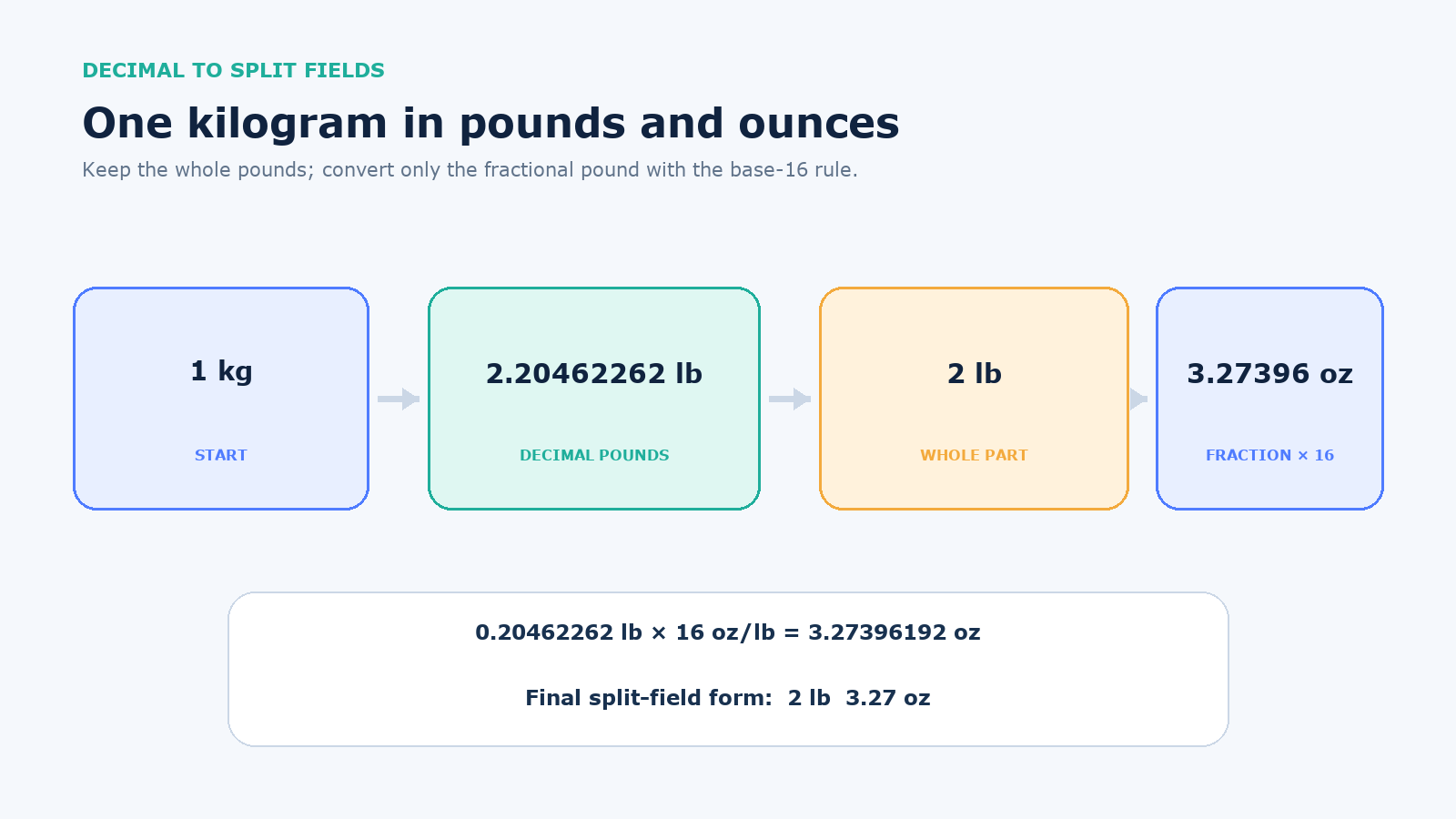
- Convert 1 kg: approximately 2.2046226218 lb.
- Keep 2 whole pounds.
- Multiply the remainder:
0.2046226218 × 16 ≈ 3.27396195 oz. - Report approximately 2 lb 3.274 oz, or 2 lb 3.3 oz if a tenth-ounce display is appropriate.
In reverse, combine the fields first: decimal pounds = whole pounds + ounces ÷ 16. Thus 7 lb 8 oz is 7.5 lb, which converts to 3.401942775 kg. It is not 7.8 lb; that would be 7 lb 12.8 oz.
Likewise, 2.20 lb means 2 lb 3.2 oz, while 2.3 lb means 2 lb 4.8 oz. An unlabeled display such as 2:3.2 is ambiguous: check the scale’s mode or manual. If rounding the ounce remainder produces 16 oz, carry that into one additional pound and reset the remainder to zero. See the pound–ounce formulas for fractions and remainders for other mixed inputs.
Estimate mentally without mistaking the estimate for the result
Kg to lb: double the kilograms, then add 10% of that doubled number. For 18 kg: 36 + 3.6 = 39.6 lb, compared with approximately 39.68320719 lb using the full factor. The ×2.2 shortcut is about 0.21% low for positive inputs; at 100 kg it is about 0.4623 lb low.
Lb to kg: multiply by 0.45 for a quick estimate, or halve the pounds and subtract 9% of that half. At 44 lb the first gives 19.8 kg, the second gives 20.02 kg, and the exact-factor result is 19.95806428 kg. Dividing by 2.2 gives 20 kg. All three are estimates. The 11, 22, 33, 44, and 55 lb rows above are useful landmarks near 5, 10, 15, 20, and 25 kg.
A pound is not half a kilogram. The difference is 0.5 − 0.45359237 = 0.04640763 kg, or 46.40763 g. That gap is 9.28% of the half-kilogram benchmark, but treating one pound as 0.5 kg overstates the pound by about 10.23%. The denominator explains the different percentages. At 100 lb the half-kilo shortcut adds 4.640763 kg.
Half a kilogram is approximately 1.10231131 lb—about 1 lb 1.637 oz. Use these shortcuts to understand size, not to decide a fee, allowance, portion, or equipment limit.
Keep ranges and limits in the controlling unit
Convert both endpoints of a range with the same positive factor. An inclusive 18–22 kg range corresponds to approximately 39.68320719–48.50169768 lb, displayed as about 39.7–48.5 lb. The endpoint order and inclusivity stay the same. Its 4 kg width becomes approximately 8.81849049 lb, and its 20 kg midpoint becomes approximately 44.09245244 lb.
Do not use the rounded display as a new pass/fail rule. “At least 10 kg” is not exactly “at least 22.0 lb”; 22.0 lb is below 10 kg. “At most 20 kg” is not exactly “at most 44.1 lb”; 44.1 lb is above 20 kg.
If a document requires a conservative one-decimal proxy, a minimum rounded upward (22.1 lb) or a maximum rounded downward (44.0 lb) tightens those particular conditions. It can exclude quantities the original rule would accept and is not an exact equivalent. Keep the governing kilogram condition visible.
A 44 lb limit corresponds to exactly 19.95806428 kg, not 20 kg. A scale displaying 19.9 kg is mathematically below the limit, but the measurement uncertainty may exceed that margin. Follow the rule owner’s measurement procedure; conversion arithmetic does not establish scale accuracy or a universal operating buffer.
Round the display without inventing measurement precision
Keep three things separate: the source measurement, the calculation using the full factor, and the displayed result. NIST’s conversion and rounding guidance distinguishes the arithmetic from the precision supported by the original data.
For the defined one-pound quantity, 0.4536 kg is 0.00763 g high, 0.454 kg is 0.40763 g high, and 0.45 kg is 3.59237 g low. These are display differences, not evidence of how precisely an item was weighed. Do not call 0.454 kg an exact definition.
For 1 kg, 2.20 lb converts back about 2.10 g low; 2.205 lb is about 0.17 g high. Choose the display from the source and receiving task, not the number of digits a calculator offers. A compact record can say: Source: 1 lb; factor: 0.45359237 kg/lb; raw: 0.45359237 kg; display: 0.454 kg, rounded to 0.001 kg.
Check the label before changing the number
Use kg for kilograms and lb for pounds, with a space after the number. “Kilo” is conversational shorthand here; formally it is a prefix. NIST’s unit-writing guidance explains the distinction. Write 0.454 kg, not 0.454kg, Kg, or kgs.
lbs is common shorthand; 1bs uses the numeral one instead of a lowercase L. In a kilogram-conversion question it likely means pounds, but an unknown code or imported record needs confirmation. Preserve the raw entry, check the source, and put the confirmed unit in a separate field. Never replace every “1” with “l” throughout a file.
These factors describe ordinary avoirdupois mass. A troy pound is a different unit, 0.3732417216 kg; lbf describes force; fl oz describes volume. Do not feed any of those into the ordinary lb-to-kg formula without resolving the actual quantity and system first.
Reverse-check the unrounded calculation
For a single validated numeric spreadsheet input in A2, use =A2/0.45359237 when A2 contains kilograms, or =A2*0.45359237 when it contains pounds. Keep the original value and unit in separate source fields; do not overwrite them with the output.
Multiply a raw pound result by 0.45359237 to recover the input kilograms. Divide a raw kilogram result by the same factor to recover the input pounds. For example, 3.401942775 kg ÷ 0.45359237 = 7.5 lb = 7 lb 8 oz.
Recombining the rounded one-kilogram display gives 2 + 3.274 ÷ 16 = 2.204625 lb, or about 1.0000010787 kg. The small difference is expected after rounding the ounces. For repeated inputs, preserve the unrounded result and validate every row instead of repeatedly converting a shortened display.