
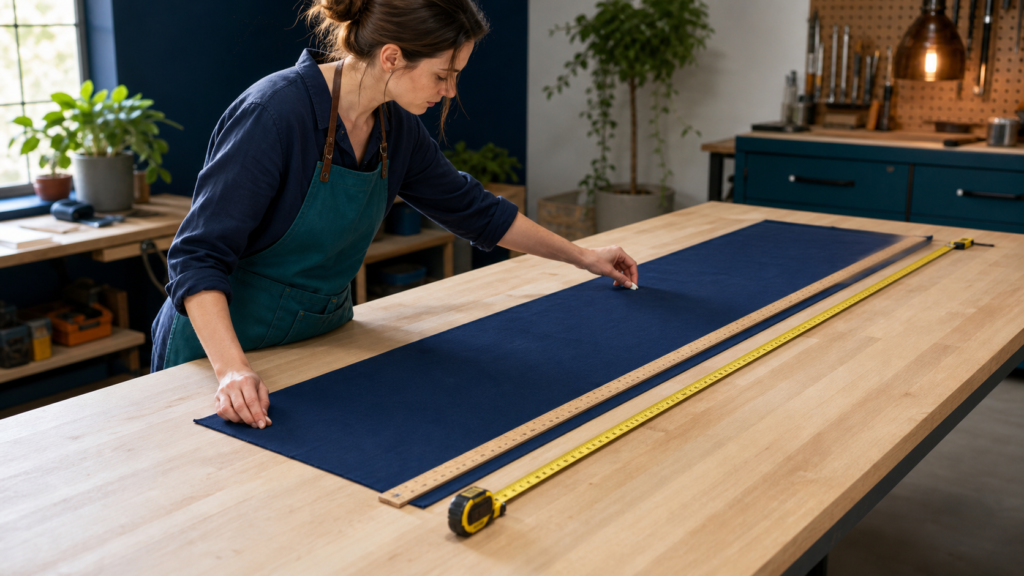
A precise visual guide to one metre, including metric and U.S. customary conversions, metre-versus-yard difference, formulas, examples and practical measurement checks.
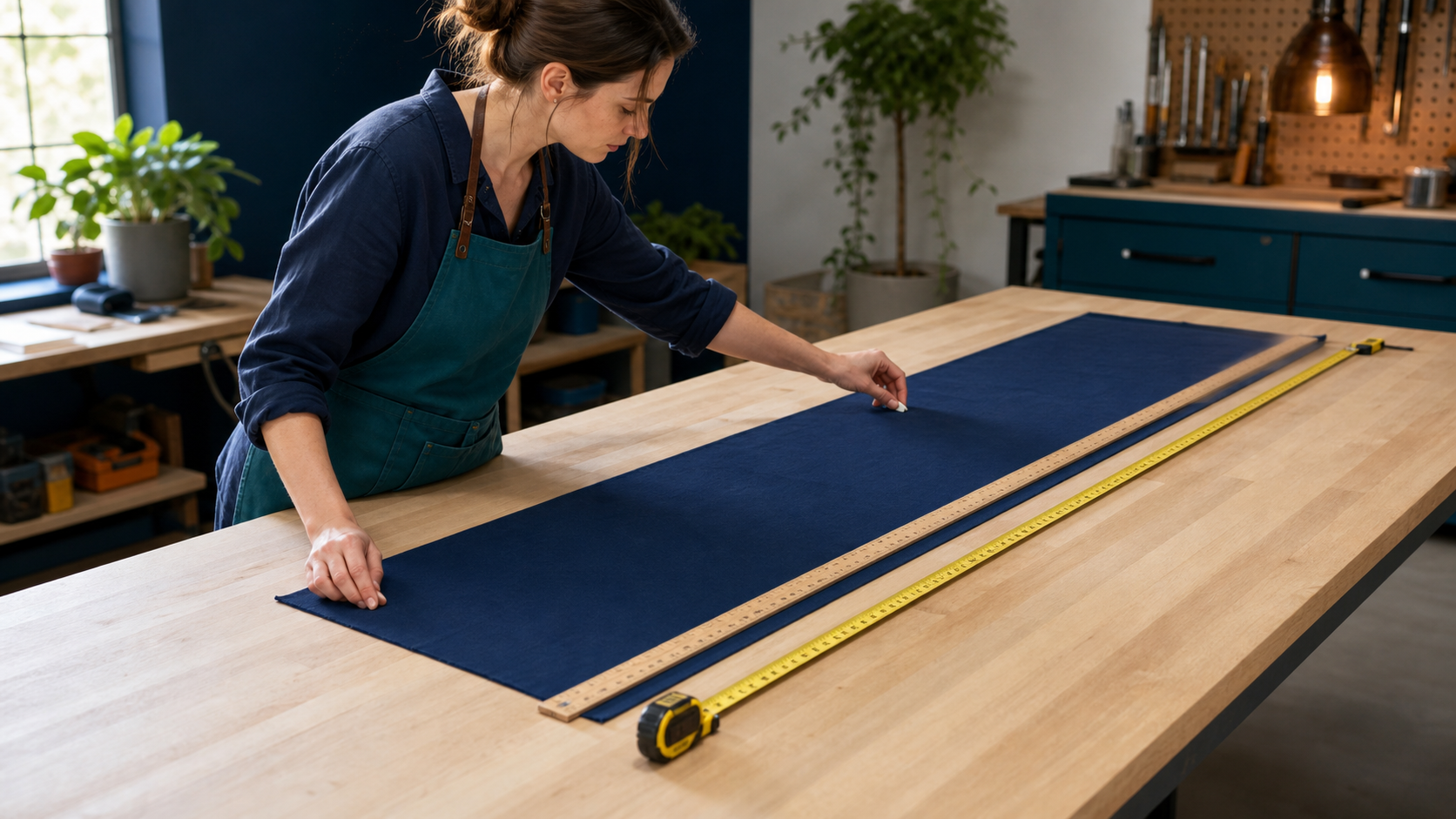
One meter is exactly 100 centimeters or 1,000 millimeters. Using the international inch and foot definitions, it is approximately 39.3701 inches, 3.28084 feet, or 1.09361 yards—equivalent to 3 feet 3.3701 inches. A meter is exactly 8.56 centimeters, or about 3.37 inches, longer than a yard.
The unit is spelled metre in the international SI documentation and meter in U.S. English. Both names refer to the same length and use the symbol m. If you need a physical picture, imagine a standard yardstick extended by another 3.37 inches—not an average stride, arm span, or piece of furniture, all of which vary.
The one-meter conversion table
| Unit | One meter equals | Status | Useful display |
|---|---|---|---|
| Millimeters | 1,000 mm | Exact | 1,000 mm |
| Centimeters | 100 cm | Exact | 100 cm |
| Decimeters | 10 dm | Exact | 10 dm |
| Inches | 39.370078740157… in | Derived from exact 1 in = 0.0254 m | 39.37 in |
| Feet | 3.280839895013… ft | Derived from exact 1 ft = 0.3048 m | 3.281 ft |
| Feet and inches | 3 ft + 3.370078740157… in | Derived from exact factors | 3 ft 3.37 in |
| Yards | 1.093613298338… yd | Derived from exact 1 yd = 0.9144 m | 1.094 yd |
The decimals for inches, feet, and yards continue because one metre is not a whole number of those units. The underlying factors can be exact even when the displayed decimal is rounded. Keep more digits during a calculation and round the final result to the precision your task supports.
The metric relationships follow the SI prefixes. Centi means one hundredth and milli means one thousandth, so 1 cm = 0.01 m and 1 mm = 0.001 m. Therefore, 100 cm and 1,000 mm both reconstruct exactly one metre.
A meter is not the same as a yard
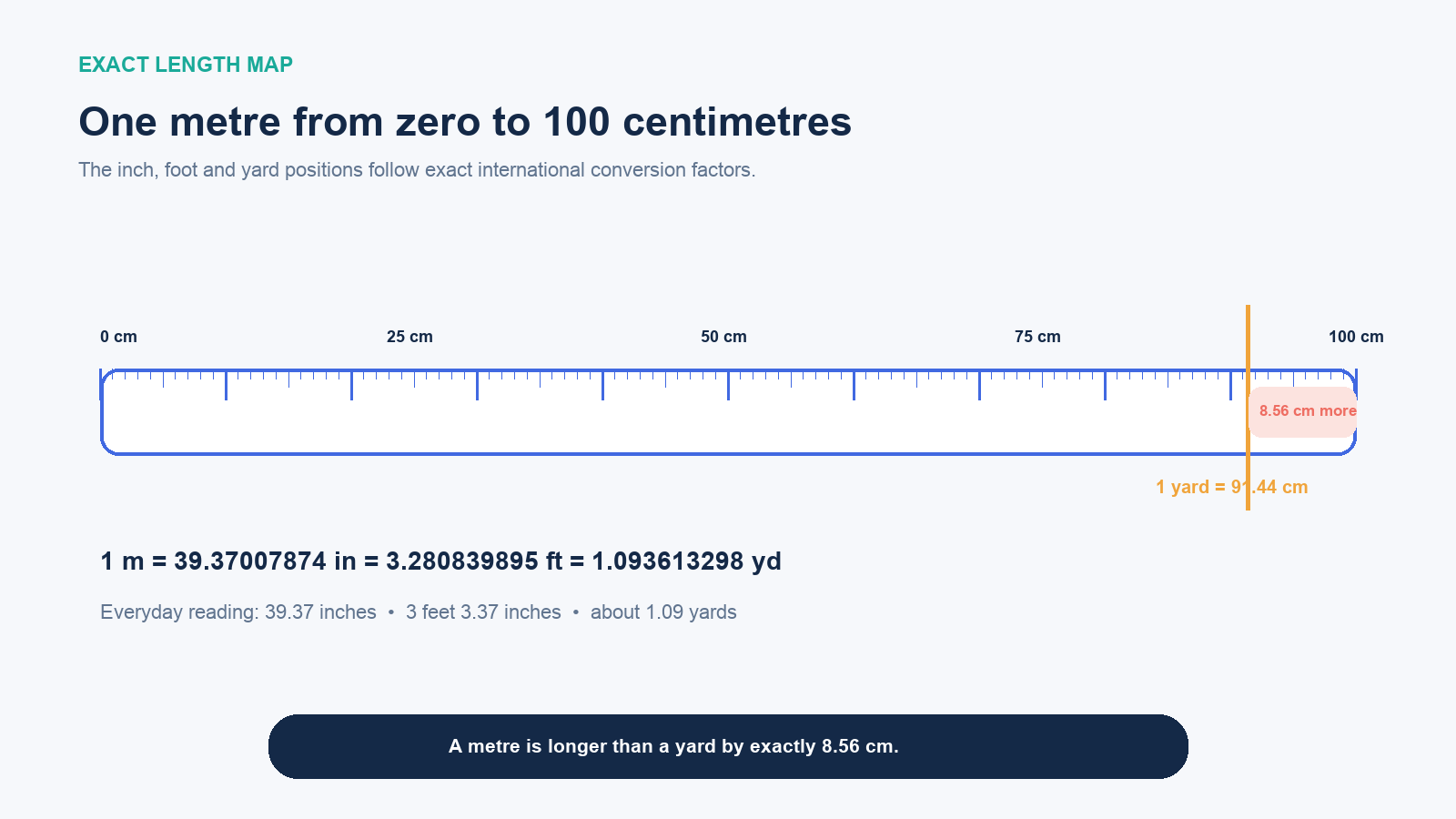
Treating a metre and a yard as equal creates a 9.36 percent difference relative to the yard. That may be harmless when estimating whether an object is roughly one unit long, but it is large for fabric, flooring, furniture clearance, construction, shipping limits, or repeated cuts.
The mismatch compounds. Ten yards equal 9.144 metres, not 10 metres. Conversely, 10 metres equal about 10.936 yards. If a plan lists one system and the material seller uses the other, convert the total before ordering; do not replace the unit name and keep the same number.
Use the exact factor, then round once
For a length (m) expressed in metres, the common formulas are:
- centimeters = meters × 100
- millimeters = meters × 1,000
- inches = meters ÷ 0.0254
- feet = meters ÷ 0.3048
- yards = meters ÷ 0.9144
To return to metres, reverse the operation: multiply inches by 0.0254, feet by 0.3048, or yards by 0.9144. NIST lists 1 inch = 0.0254 metre as an exact relationship. It also identifies the international foot as 0.3048 metre exactly. Since one yard is three international feet, it is 0.9144 metre exactly.
Avoid chaining rounded results. To convert 2.4 metres to inches, calculate 2.4 ÷ 0.0254 directly. Do not first round one metre to 39.37 inches and then multiply if the additional digits matter. The direct result is about 94.4882 inches; a practical tape reading might be reported more coarsely.
Worked examples
| Length | Metric view | Inches | Feet | Example use |
|---|---|---|---|---|
| 0.25 m | 25 cm / 250 mm | 9.8425 in | 0.8202 ft | Small shelf depth or craft material |
| 0.75 m | 75 cm / 750 mm | 29.5276 in | 2.4606 ft | Table component or fabric cut |
| 1.2 m | 120 cm / 1,200 mm | 47.2441 in | 3.9370 ft | Panel, opening, or package length |
| 2 m | 200 cm / 2,000 mm | 78.7402 in | 6.5617 ft | Long material or room-scale span |
The number of shown decimals is not a claim that an ordinary tape can reproduce that precision. It makes the conversion traceable. For a rough purchasing check, 47.24 inches may be enough for 1.2 metres; for a cut line, work in the original units on the drawing when possible and follow the tool’s graduations.
How to mark one meter accurately
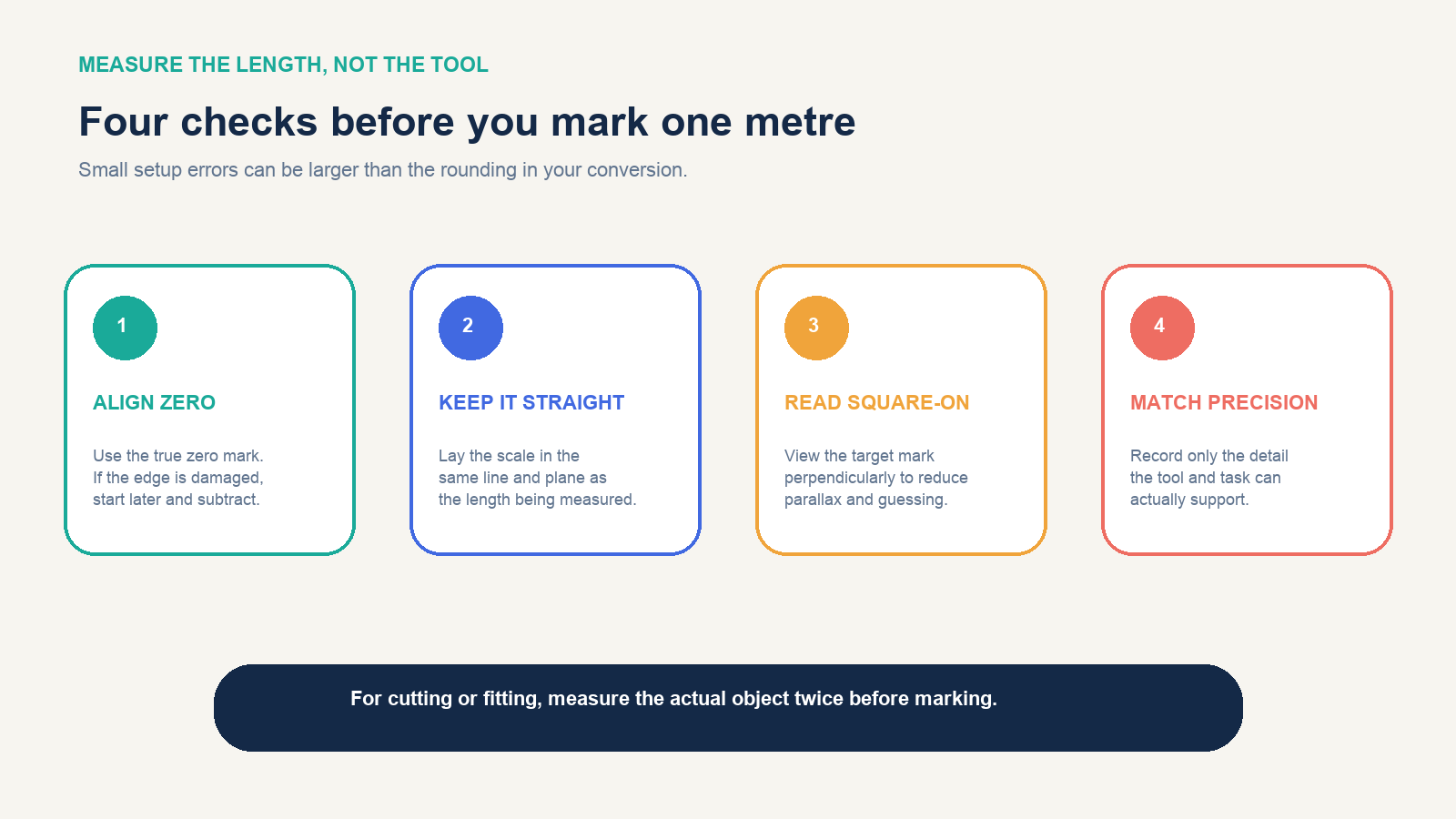
- Inspect the tool. Confirm that the scale includes metric units and that the zero end and relevant marks are undamaged. A printed paper ruler can change size if the document was scaled during printing.
- Align the true zero. Put the zero mark—not merely the edge of the casing or material—at the starting point. If a rigid rule has a damaged end, start at a known mark such as 10 cm, read the far point, and subtract 10 cm.
- Keep the scale straight and in plane. A tape running diagonally across a surface measures the diagonal, not the intended edge. Avoid sag, bow, and a path around an obstruction.
- Read square-on. Put your eye perpendicular to the graduation at the endpoint. This reduces parallax, where the apparent mark shifts because you view from the side.
- Mark and repeat. Make a fine mark at 100 cm or 1,000 mm, then measure again from the same zero. For a critical fit, check the actual mating part and account for blade, cut, seam, or clearance requirements.
NIST explains that manufacturers calibrate tape graduations against length standards and that real tapes have measurement uncertainty from their marks and repeatability. A conversion calculator cannot correct a stretched, bowed, worn, loosely held, or misread tape.
Use visual references only for estimation
A yard plus roughly 3⅜ inches is a defensible mental construction because both units are defined. A person’s stride, waist height, arm reach, countertop, guitar, broom, or door component is not a unit. Those objects vary by person, design, region, and product.
If you only need to decide whether a package is closer to half a metre or two metres, an object reference can be convenient. Label the result as an estimate. If the length controls price, fit, safety, eligibility, shipping, sport, or compliance, use a suitable measuring tool and record the unit.
Why a meter is exact even when your measurement is not
The International Bureau of Weights and Measures defines the metre by fixing the numerical value of the speed of light in vacuum at exactly 299,792,458 metres per second. Equivalently, one metre is the distance light travels in vacuum during 1/299,792,458 of a second.
This definition is not how someone normally measures cloth or a wall. National laboratories realize and transfer the unit through calibrated measurement systems, which manufacturers use to establish practical rulers, tapes, and instruments. Traceability connects the workbench tool to the unit; it does not make the tool or the operator error-free.
Choose precision by consequence. A rough room layout may tolerate centimeters. Cabinetry may require millimeters. A laboratory or industrial drawing may specify tighter tolerance, temperature, force, geometry, and calibrated equipment. Reporting 1.000000 m from a basic household tape adds digits, not justified accuracy.
Notation that prevents conversion mistakes
- Write the unit symbol as lowercase m, not M. SI symbols are case-sensitive.
- Leave a space between the number and symbol: 1 m, 100 cm, 1,000 mm.
- Do not use m for both metres and minutes in the same unqualified calculation.
- Keep length separate from area and volume: 1 m, 1 m², and 1 m³ are different quantities.
- Carry the original unit through the formula so a missing division or multiplication is visible.
The practical boundary is simple: use 1 m = 100 cm = 1,000 mm when working in metric; use the exact inch, foot, or yard factor for conversion; round only the final result; and use a real measuring tool whenever the physical length matters. “About a yard” is a memory aid, not the answer to a cut, fit, order, or safety decision.