A practical guide to AI deep search: what the term means, how multi-step research agents work, when they add value, and how to audit their citations and claims.
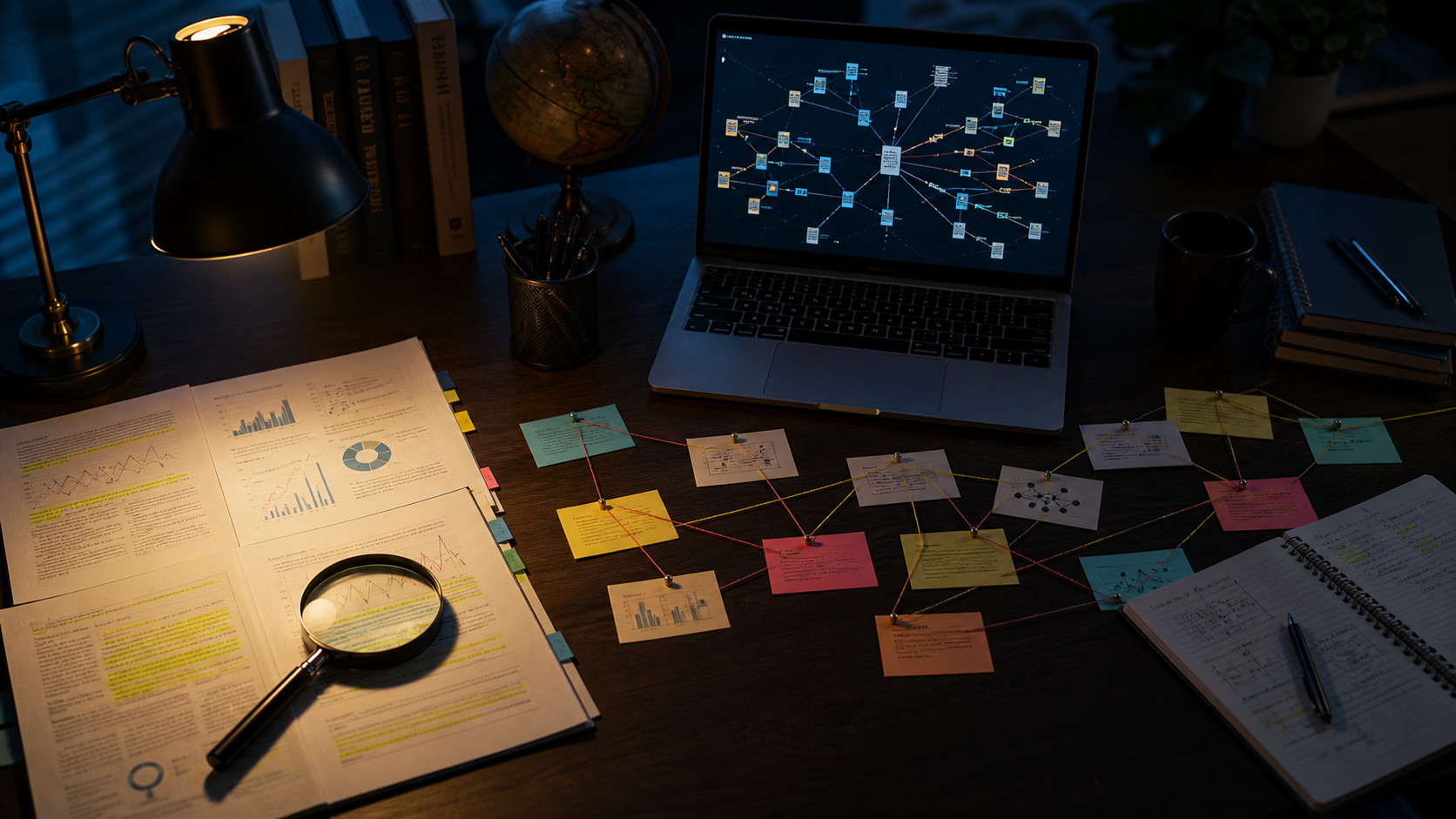
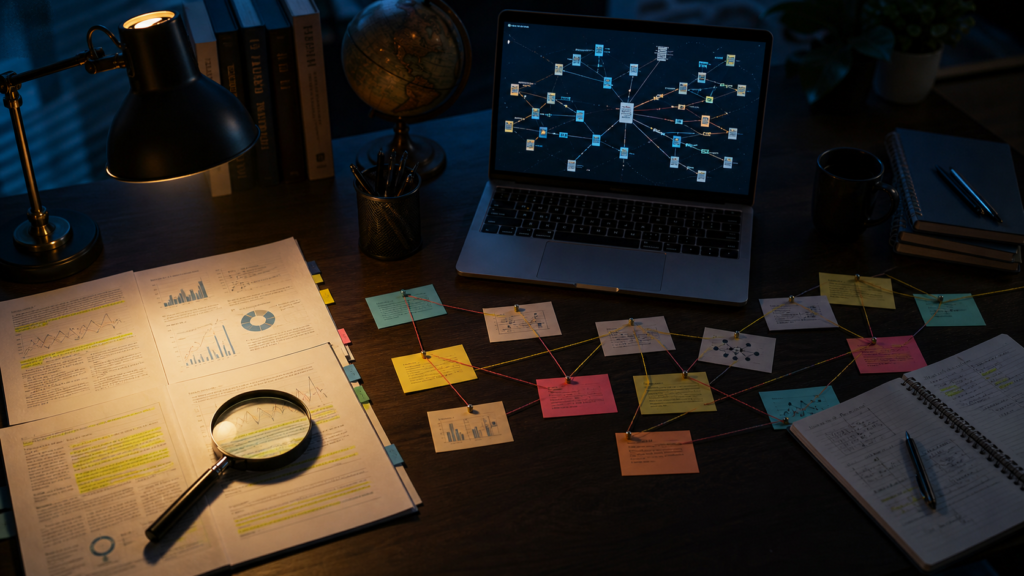
A long answer with twenty blue citation links can feel more trustworthy than a page of ordinary search results. That visual confidence is useful only if the links exist, the pages support the nearby claims, and the research covered the right question. Deep search automates more work than a conventional search engine; it does not automate away judgment.
Deep search is an AI-assisted research workflow that turns one complex question into multiple searches, reads and compares sources, revises its approach, and produces a synthesized answer with citations. It is more useful than ordinary search for multi-part questions, but the report is not automatically correct: important claims, quotations, dates, and recommendations still need to be checked against the cited sources.
Deep search is a workflow, not one universal product
The term is used in two ways. Lowercase deep search is a category label for multi-step AI research. Capitalized names such as Google Search’s Deep Search and xAI’s DeepSearch identify particular product modes. Other vendors call comparable workflows deep research, research mode, or something else. Features, data sources, limits, and controls can change even when the label remains the same.
| Method | What it usually returns | Best fit | Important boundary |
|---|---|---|---|
| Ordinary web search | Ranked links, snippets, and sometimes a quick answer | Finding a known page or checking one fact | You open and synthesize the sources |
| AI answer with web search | A conversational summary based on one or more searches | Orientation and follow-up questions | The search may be brief or opaque |
| Deep search or deep research | A longer, structured, cited synthesis built through many retrieval steps | Complex comparisons, landscape reviews, and evidence briefs | More work and more citations still do not guarantee correctness |
| Academic or specialist database search | Records selected from a defined collection | Systematic literature, legal, patent, or standards work | Coverage depends on the database and query method |
| Deep web access | Content not indexed by public search engines | Authenticated databases, portals, or private collections | This is not what “deep search” normally means |
Deep search does not inherently enter the “deep web,” bypass paywalls, or retrieve private records. A tool can use only the public pages, uploaded files, licensed databases, or connected services that it is permitted to access. OpenAI and Google, for example, document source controls that can combine the public web with selected files or connected services. Access and data handling must be checked for the specific account and product.
What a deep-search agent actually does
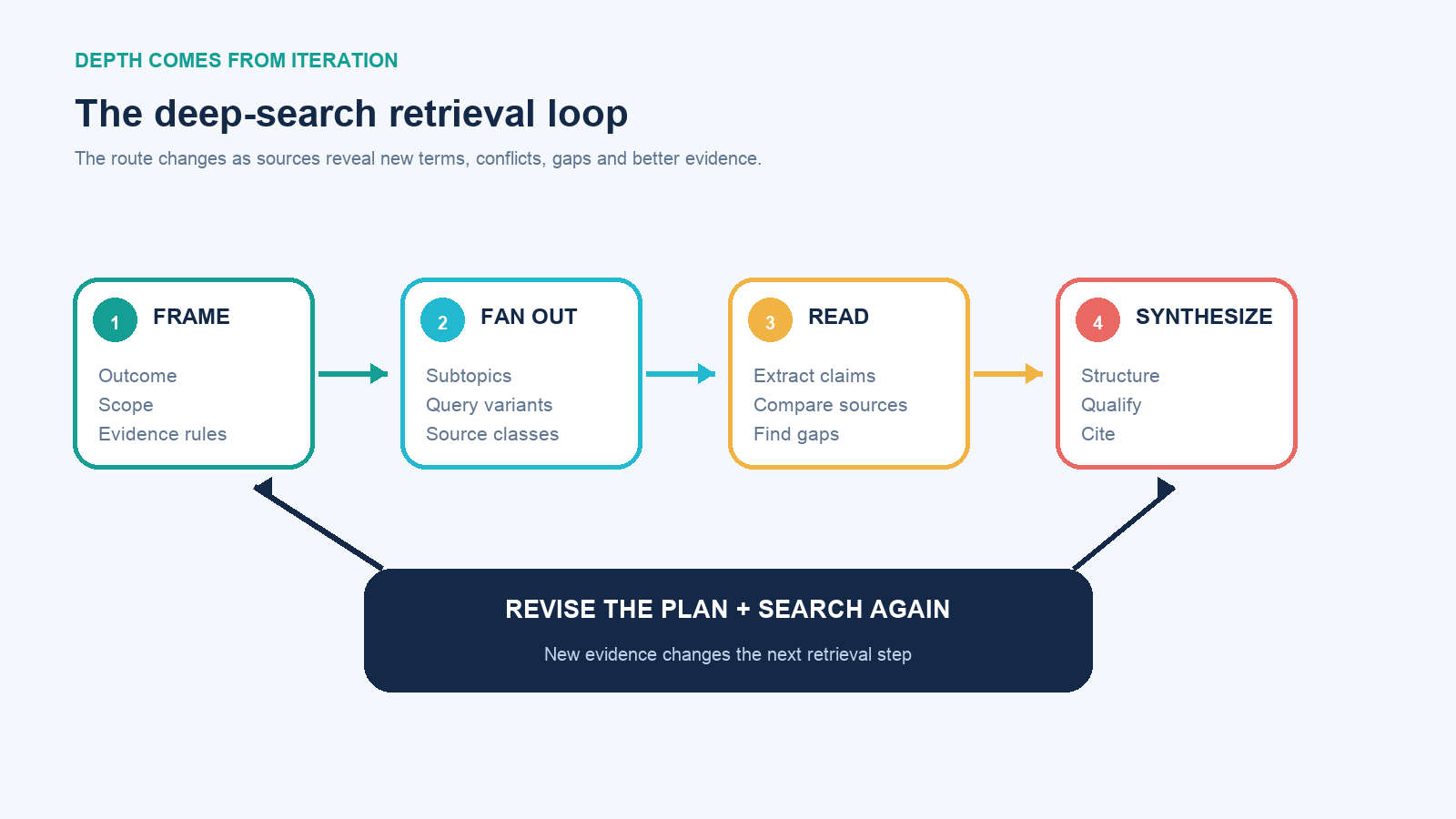
A normal search often maps one query to a result page. A deep-search agent can treat the request as a project. The exact implementation is proprietary, but official product descriptions reveal a common pattern:
- Frame the task. Interpret the requested outcome, constraints, time range, audience, and deliverable.
- Build a plan. Split the problem into subquestions, assumptions to test, and source categories to consult.
- Fan out queries. Search several formulations and subtopics instead of betting everything on the user’s original wording. Google publicly describes a query fan-out technique; other vendors describe repeated or iterative searching.
- Read and extract. Open results, locate relevant passages, record facts, and associate them with source URLs or files.
- Revise the route. Search again when evidence reveals a missing definition, disagreement, regional exception, later update, or better primary source.
- Synthesize and cite. Organize findings into an answer, distinguish agreement from conflict, and attach citations or source links.
The loop matters more than the number of searches. Issuing hundreds of near-duplicate queries can create volume without useful coverage. A good research path changes after reading: a product comparison may branch into privacy terms, regional availability, support documentation, independent testing, and a check of whether two differently named features are actually equivalent.
When deep search earns its extra time
Use research depth in proportion to question complexity and the cost of being wrong. Deep search is usually worthwhile when the answer must combine several source types, reconcile conflicting claims, compare options against explicit criteria, or reflect recent developments across a defined period.
- Good fit: compare five vendors under the same requirements; summarize how a regulation differs across jurisdictions; map a market and identify uncertainties; trace a technical failure across documentation and issue history; or assemble a cited reading brief.
- Usually excessive: find an official login page, check one stable conversion factor, locate a manual, or answer a question that one authoritative page resolves.
- Insufficient on its own: diagnose a medical condition, provide case-specific legal advice, approve an investment, verify a person’s identity, or make another consequential decision that requires a qualified professional or authenticated evidence.
Current facts do not automatically require deep search. “What is the current price on the vendor’s official page?” may need one live lookup. “Which pricing plan is lowest over three years after usage limits, regional tax, cancellation terms, and expected growth?” is a multi-source analysis. The second question benefits from a research agent because the work is decomposable and the assumptions can be stated.
Write a research brief, not a three-word prompt
“Research project-management tools” leaves the agent to invent the audience, comparison set, geography, date, and definition of “best.” A compact brief reduces that freedom. Include:
- Decision or outcome: what will the report help you decide or create?
- Scope: products, countries, industries, population, and time period.
- Criteria: the attributes that must be compared consistently.
- Source policy: required first-party, government, standards, scholarly, or independent sources; excluded source types.
- Evidence rules: cite each material factual claim, expose conflicting evidence, and label inference.
- Output: table, narrative, timeline, calculations, uncertainties, and a recommendation threshold.
Prepare a decision brief for a 20-person UK design agency choosing a project-management platform for 2027. Compare the four named candidates on guest access, approval workflows, time tracking, data export, published security documentation, UK pricing, and cancellation terms. Use current official documentation for product facts and at least two credible independent sources for implementation concerns. State the date and currency of each price, quote no source beyond a short necessary phrase, mark missing evidence as unknown, show conflicts, and finish with conditional recommendations rather than one universal winner.
Before the run, inspect the proposed plan if the product exposes one. Check that every criterion has a route to evidence, the date boundary is explicit, and the planned sources are capable of answering the question. A brilliant report built around the wrong comparison set is still a failed task.
Audit claims, not the report’s polish
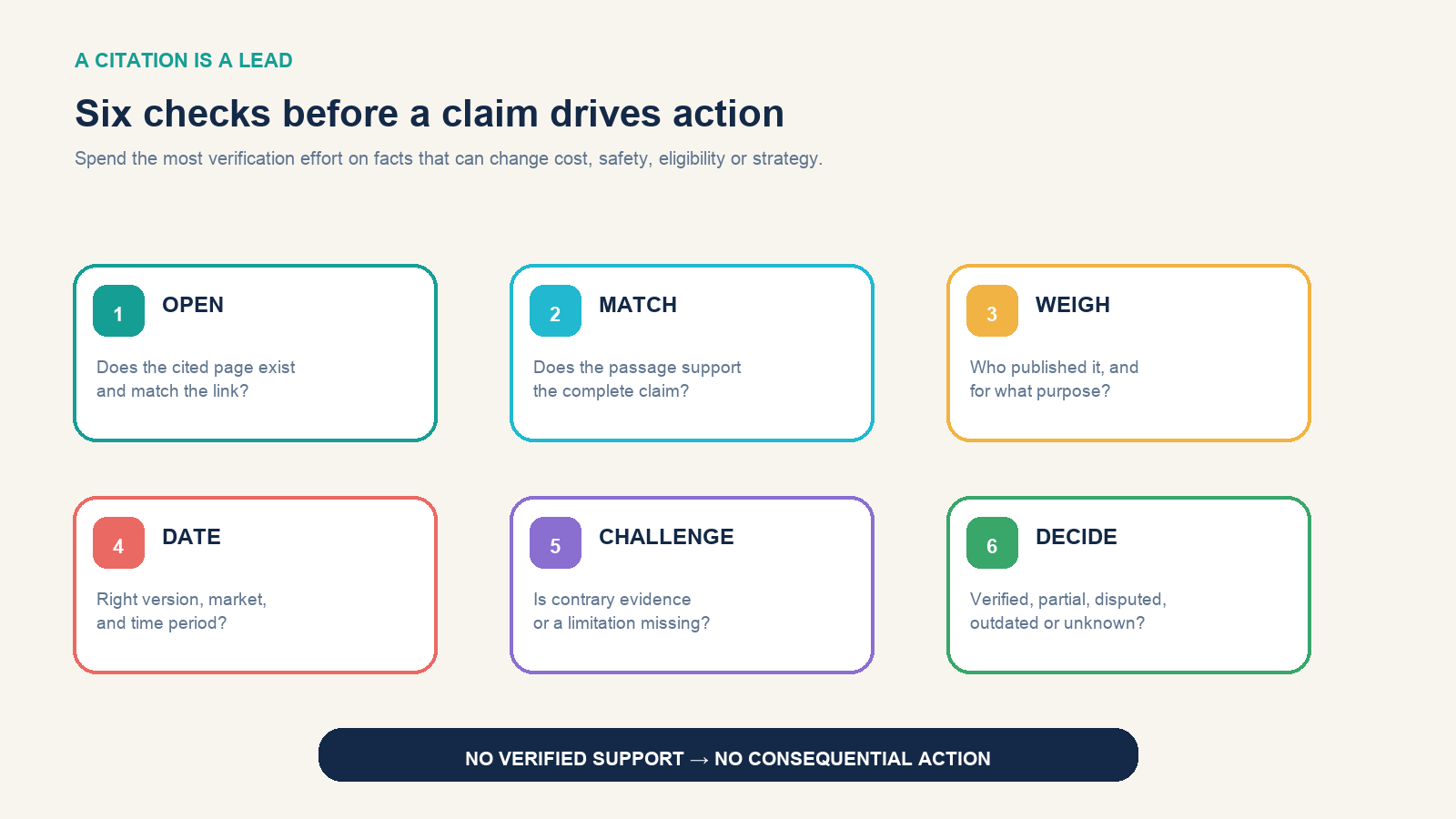
NIST identifies confabulation as a generative-AI risk and notes that false content can include fabricated logic or citations. Treat the report as a map to evidence, not as the evidence itself. Audit every high-impact claim and a sample of lower-impact claims:
- Open the link. Confirm that the page exists, is the cited item, and is accessible enough to inspect.
- Match claim to passage. The source must support the full nearby statement—not merely discuss the same topic.
- Check authority and purpose. A vendor can be authoritative about its documented features but interested in presenting them favorably. A reseller’s summary is not the governing contract.
- Check date, geography, and version. A 2024 US help page may not establish a 2026 EU feature or price.
- Look for missing conflict. Search independently for a primary source, correction, opposing result, or limitation the report may have omitted.
- Set confidence and action. Label the claim verified, partly supported, disputed, outdated, or unverified; do not let an unverified claim drive a costly action.
A fast spot check should not be random. Start with numbers, quotations, superlatives, safety statements, legal requirements, eligibility rules, prices, and the premises behind the recommendation. If two of the first five material citations fail, expand the audit rather than assuming the rest are sound.
Common failure patterns—and their repairs
- Citation presence is mistaken for citation support.
- Repair it by opening the source and locating the exact supporting passage. A citation attached to a paragraph may support only one sentence.
- Many outlets repeat one unsupported origin.
- Trace the claim backward. Ten derivative articles may still equal one weak source; prefer the original dataset, filing, documentation, or study.
- The report mixes dates and markets.
- Add an “as of” date and jurisdiction to every volatile fact, then separate global features from regional availability.
- Criteria change between candidates.
- Use one evidence table with identical fields. Record “not found” instead of silently substituting a favorable metric.
- A confident recommendation hides value judgments.
- Show weights and assumptions. A tool that wins on price may lose when export controls or workflow fit carry more weight.
- Private data is added before the boundary is understood.
- Remove secrets and personal data, read the applicable privacy and retention terms, and use an approved enterprise environment when the work requires confidential sources.
Choose a tool by controls, not by the word “deep”
Brand comparisons age quickly. A durable evaluation asks what the workflow lets you control and inspect. Run the same bounded test question through candidates, then score the process:
| Control | What to test | Why it matters |
|---|---|---|
| Source scope | Can you require, prioritize, exclude, or restrict domains and add files? | Prevents an attractive report from using the wrong evidence universe |
| Plan control | Can you inspect, edit, pause, or redirect the research plan? | Catches scope errors before they multiply |
| Traceability | Do citations resolve, and can you see which source supports which claim? | Makes verification feasible |
| Conflict handling | Does the report expose disagreement and missing evidence? | Reduces false consensus |
| Output reuse | Can you export a structured report and preserve source links? | Supports editing, archiving, and collaboration |
| Data controls | What happens to prompts, files, connected data, history, and training use? | Determines whether sensitive work belongs in the tool |
| Failure recovery | Can you resume, refine, rerun one section, or see why evidence is missing? | Avoids paying the full time cost again |
Official documentation checked in August 2026 shows meaningful differences in source selection, plan editing, connected data, progress views, exports, model choice, and usage limits across products. Do not memorize a static feature chart. Re-check the product’s own documentation immediately before purchase or a sensitive project, then run a representative test with claims you can independently verify.
A practical stopping rule
Deep search is finished when the evidence is sufficient for the decision—not when the report is long. Stop when the scoped questions are answered, material claims have direct support, conflicting evidence is represented, critical unknowns are visible, and another search is unlikely to change the action. Continue when a recommendation rests on an inaccessible citation, a single interested source, an unexamined date mismatch, or an undefined assumption.
The useful division of labor is simple: let the agent fan out queries, read widely, organize findings, and preserve links. Keep responsibility for the brief, evidence standard, privacy boundary, verification, and final decision. That is what turns deep search from an impressive answer generator into a defensible research workflow.