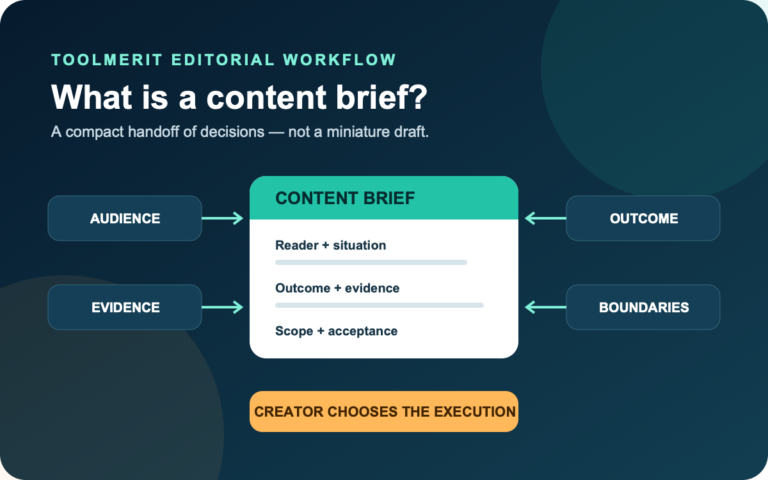

A practical, URL-level content audit system that joins crawl data, Search Console, analytics, quality, business value, risk, actions, owners, and post-change measurement.

A content audit is a structured review of every in-scope piece of website content against audience needs, business goals, quality, search performance, technical state, and risk. Its output is not a list of scores; it is an evidence-backed action for each canonical URL—keep, improve, merge, redirect, noindex, archive, or remove—plus an owner and measurement plan.
A crawl is one input to a content audit, not the audit itself. An SEO tool can report status codes, titles, canonicals, links, and duplicate patterns. It cannot decide whether a policy page meets a legal obligation, whether a quiet support article prevents tickets, whether a product comparison still reflects the market, or which overlapping page should become the canonical answer.
Begin with the decision the audit must support
“Improve the content” is too vague to define scope. Choose the decision and the time horizon first. Examples include:
- Consolidate an overgrown blog before a migration.
- Find pages with demand but weak answers before the next editorial quarter.
- Verify that product, pricing, legal, security, and support information is accurate.
- Reduce duplicate landing pages without losing backlinks, conversions, or required regional variants.
- Build a refresh backlog with owners and service-level dates.
Write the scope as a reproducible rule: hostname, protocol, subdomains, languages, folders, post types, publication states, date range, and exclusions. Define the analysis window and a comparison period that respects seasonality. Freeze the data-extraction timestamp so different reviewers do not compare moving numbers.
Build an inventory that can expose missing URLs
No single source is complete. A crawler finds linked and permitted URLs; a sitemap expresses preferred discoverable URLs; the CMS contains drafts, orphans, and historical records; Search Console contains URLs that appeared in Google; analytics contains tagged pages that received visits. Reconcile all of them.
- Export published and relevant unpublished records from the CMS, including IDs, post types, owners, dates, and status.
- Export XML sitemap URLs. Google recommends putting preferred canonical URLs in sitemaps, but a sitemap remains a discovery source, not proof that every listed page is indexed.
- Crawl the site with the same inclusion and rendering rules you record in the audit. Export internal URLs, status codes, canonicals, directives, titles, word counts, inlinks, outlinks, duplicate details, and crawl depth.
- Export Search Console page and page-query data for the fixed window. Preserve query-to-page relationships before aggregating.
- Export GA4 landing-page and relevant key-event data. Confirm that the tag and events were valid during the window.
- Add backlink, feed, paid-campaign, support, email, app, and manually known URLs where those systems matter.
- Normalize host, protocol, trailing slash, case, parameters, and fragments without overwriting the raw URL. Map every variant to an observed or declared canonical.
The differences are findings. A CMS URL missing from the crawl may be orphaned, blocked, unpublished, or outside scope. A Search Console URL absent from the sitemap may be a historical canonical, parameter variant, or stale result. Do not discard mismatches during cleanup.
Join six evidence layers to each canonical URL
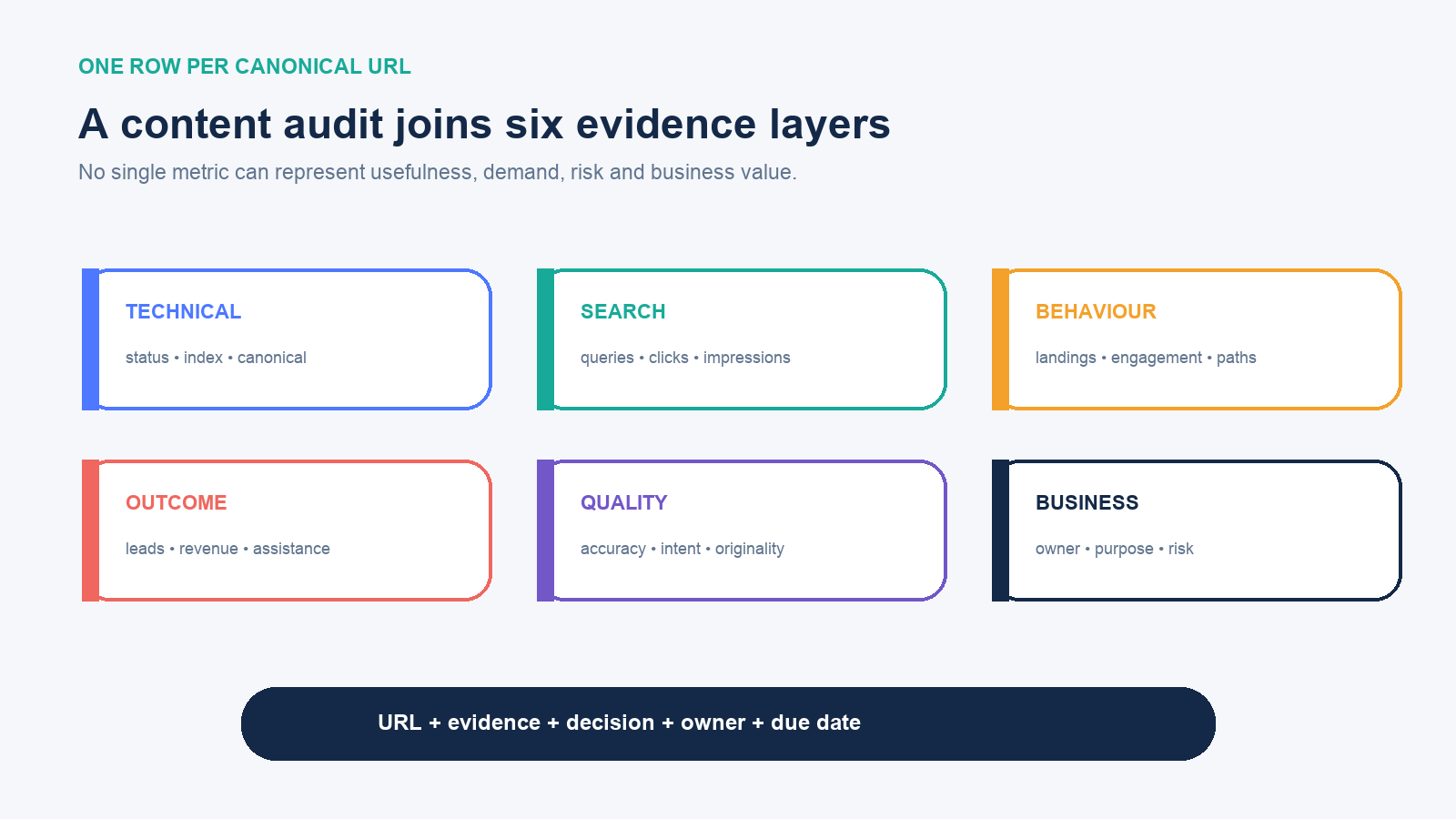
Technical evidence establishes whether the URL is accessible, indexable, canonical, internally linked, and rendered as intended. Search evidence shows queries, clicks, impressions, CTR, position trends, and competing pages. Behavior shows landings, engagement, paths, and exits. Outcome connects the page with key events, assisted conversion, revenue, leads, downloads, or ticket deflection. Quality requires editorial judgment. Business captures purpose, audience, owner, compliance, product dependency, brand risk, and maintenance cost.
Search Console’s page-level data should stay page-level. Google documents that property aggregation and page aggregation count impressions, clicks, and position differently. Avoid joining a property total to every URL or treating average position as a stable rank. Google recommends focusing on trends in clicks and impressions more than position alone.
Use one row per canonical URL
| Field group | Minimum useful columns | Why it exists |
|---|---|---|
| Identity | Raw URL, normalized URL, canonical URL, CMS ID, type, language, cluster | Prevents variants from becoming false “pages” |
| Technical | Status, indexability, canonical target, sitemap, depth, inlinks, last crawl | Separates content problems from discovery/indexing problems |
| Search | Clicks, impressions, CTR, position trend, top queries, competing URLs | Shows demand, visibility, and overlap |
| Behavior | Landings, active users, engagement, path role | Shows how people use the page after arrival |
| Outcome | Key events, leads, revenue, assisted role, support value | Prevents traffic from becoming the only value signal |
| Editorial | Intent fit, accuracy, completeness, originality, evidence, media, accessibility, freshness need | Captures what automated tools cannot judge |
| Governance | Purpose, owner, regulatory/brand risk, dependencies, review date | Protects required and high-risk content |
| Execution | Action, rationale, target URL, brief, owner, due date, status, QA, baseline | Turns the audit into work that can finish |
Keep raw metrics and reviewer judgments separate. A composite score can help sort work, but it should never erase the evidence. Use explicit gates for legal obligations, active campaigns, product dependencies, backlinks, conversions, and support value before any automated retirement rule.
Review quality against the reader’s job
For each page, write the intended audience, task, and successful outcome in one sentence. Then inspect whether the page answers that task completely, accurately, and efficiently. Google’s people-first self-assessment asks whether content offers original information or analysis, provides substantial value, demonstrates expertise, supports trust, uses a descriptive title, and leaves the reader feeling they learned enough to achieve the goal.
Flag, but do not mechanically fail, pages with these patterns:
- The title promises a different decision than the body supports.
- The direct answer is missing, buried, or overconfident.
- Facts, screenshots, prices, product states, laws, or dates are stale.
- The page summarizes competitors without original evidence, examples, tools, or judgment.
- Several URLs answer minor wording variants instead of distinct user outcomes.
- Media is decorative where a diagram, screenshot, calculator, template, or worked example is needed.
- Claims lack traceable sources, or the author/reviewer identity does not support trust.
Google explicitly says there is no preferred word count and warns against adding or removing older content merely to make a site seem fresh. Length and publication date are therefore diagnostic clues, not verdicts.
Choose the action in a safe order
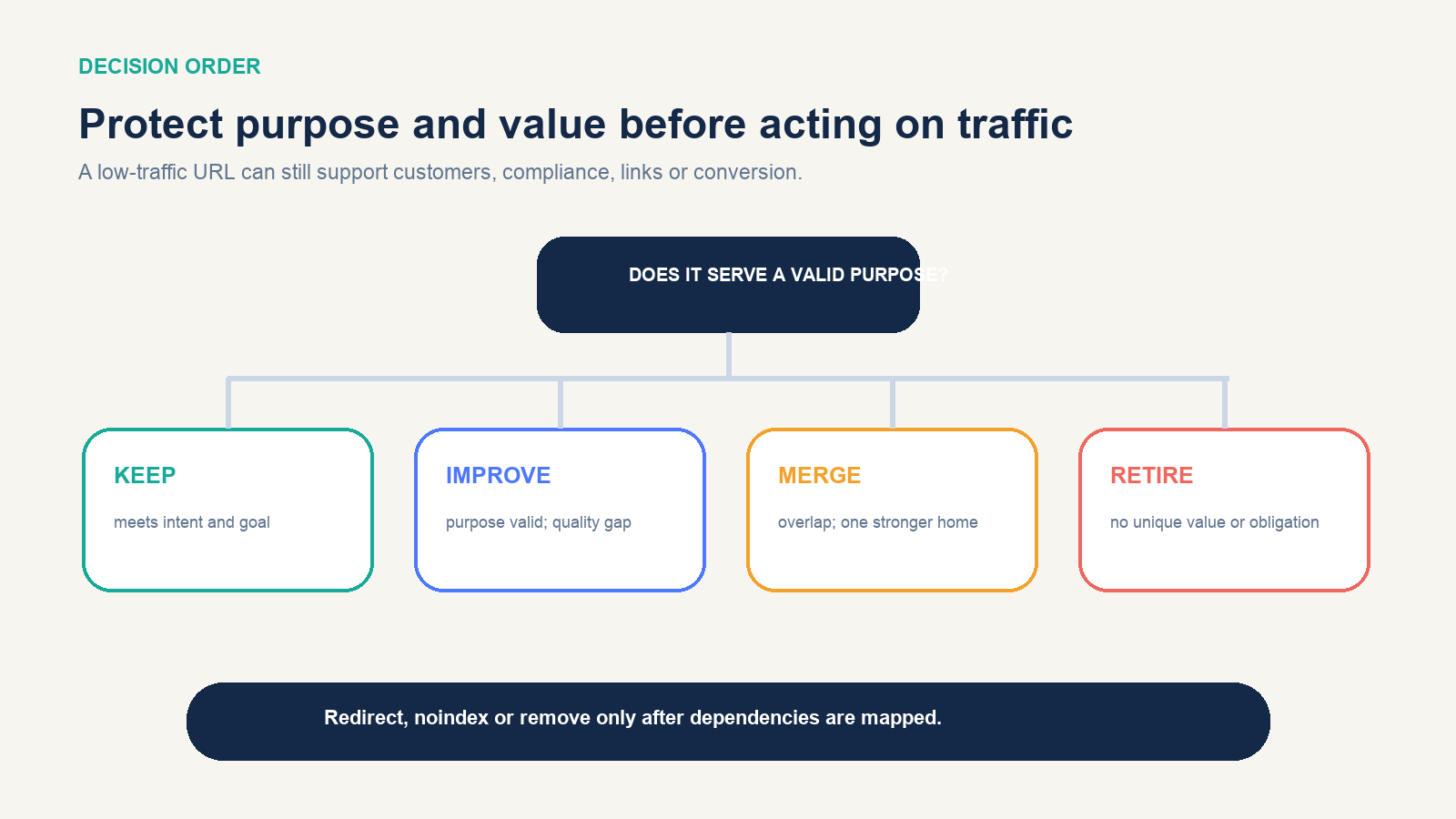
- Does the page serve a valid audience or business purpose? If yes, protect that purpose even when organic traffic is low.
- Is it accurate, complete, distinctive, trustworthy, and usable? If yes, keep it; if not, improve it.
- Does another page satisfy the same intent more completely? If yes, merge unique material into the strongest destination and map signals.
- Must the URL exist but stay out of search? Consider noindex only when that matches the product and discovery requirement.
- Does it have inbound links, conversions, campaigns, bookmarks, contracts, or external references? Preserve the best destination and map the handoff.
- Is there no unique value, obligation, dependency, or suitable replacement? Archive or remove under the site’s retention policy.
Low traffic appears late in this order. A privacy policy, compatibility note, error reference, investor document, or narrow troubleshooting page can be essential to a small audience. Conversely, a high-traffic page with a misleading answer may require urgent correction.
Make every verdict executable
| Action | Use when | Required follow-through |
|---|---|---|
| Keep | Purpose, quality, and experience are sound | Confirm owner and next review trigger; fix incidental defects |
| Improve | The purpose is valid but the answer, evidence, UX, media, or conversion path is weak | Create a brief with acceptance criteria; preserve proven intent and links |
| Merge | Multiple pages satisfy substantially the same intent | Choose one destination, preserve unique sections, update internal links, canonicalize or redirect old URLs |
| Redirect | A retired URL has a genuinely equivalent destination | Use a permanent server-side redirect, update links and sitemap, avoid chains |
| Noindex | The page must remain available but should not appear in search | Ensure crawlers can see the directive; remove from the canonical sitemap if inappropriate |
| Archive | The record has historical value but should not compete with current guidance | Label status/date, separate archive navigation, preserve citations and context |
| Remove | No valid value or obligation remains and no equivalent destination exists | Return the intended status, remove links/sitemap entries, monitor external demand and errors |
Google describes redirects and rel="canonical" as strong canonicalization signals and sitemap inclusion as a weaker signal. They are not interchangeable: redirect a deprecated duplicate when users should land elsewhere; use a canonical when multiple accessible variants legitimately remain; include preferred canonical URLs in the sitemap.
Measure the change as a cohort, not an anecdote
Before implementation, freeze page-level baselines and label cohorts: improved, merged destination, redirected source, noindexed, removed, and untouched comparison pages. Track leading checks immediately—status, canonical, indexability, internal links, sitemap, rendering, analytics events—and lagging outcomes over an appropriate period: clicks, impressions, relevant query coverage, landing engagement, key events, revenue, tickets, and user feedback.
Do not announce success from a single URL or a few days of data. Search Console notes that recent data can be preliminary, and recrawling can take days to weeks. Annotate release dates, watch for redirect chains and unexpected canonicals, and compare like-for-like seasonal periods.
Worked example: three overlapping pages
Imagine three URLs: a 2023 “content audit checklist,” a thin “how to audit blog posts” page, and a newer definition page. Search Console shows the same core queries distributed across all three; the checklist has the strongest backlinks, the blog-post page has one useful scoring worksheet, and the definition page has the best current explanation.
The evidence-backed action is not “delete the two low performers.” Choose the destination that best fits the stable intent and URL strategy; combine the checklist, worksheet, and current explanation into a single complete guide; preserve the strongest title and unique examples; permanently redirect the two deprecated URLs; update internal links and the sitemap; and monitor the combined query/page cohort. The audit ends only when the destination passes QA, the handoffs work, an owner is assigned, and the baseline is ready for comparison.
Your next action is simple: create the inventory with one row per canonical URL and add five columns before collecting any score—purpose, action, rationale, owner, and due date. Those fields force the audit to produce accountable decisions rather than another spreadsheet that describes the site and then goes stale.