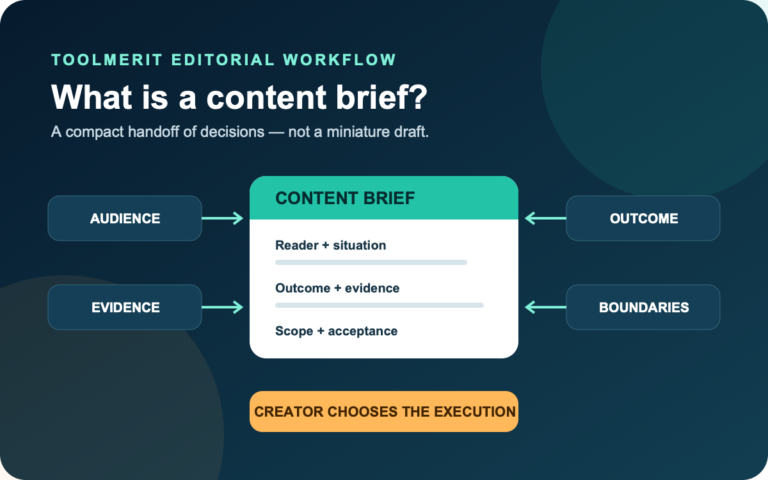

Content strategy is the set of choices that connects audience needs, useful content, delivery systems, ownership, and measurable outcomes.

A content strategy is a set of evidence-based choices for creating, structuring, delivering, governing, and measuring content so that a defined audience can achieve an outcome and the organization can achieve a compatible goal. It decides what content should exist, what should not exist, how people will find and use it, who owns it, and when it must be updated or retired.
A list of blog ideas is not a content strategy. Neither is a social posting schedule, a keyword spreadsheet, a style guide, or a campaign brief. Those can execute parts of a strategy, but they do not resolve the central choices: whom the content serves, which problem deserves attention, what distinct value it provides, where it belongs, and how it remains trustworthy after publication.
Content strategy is larger than a publishing calendar
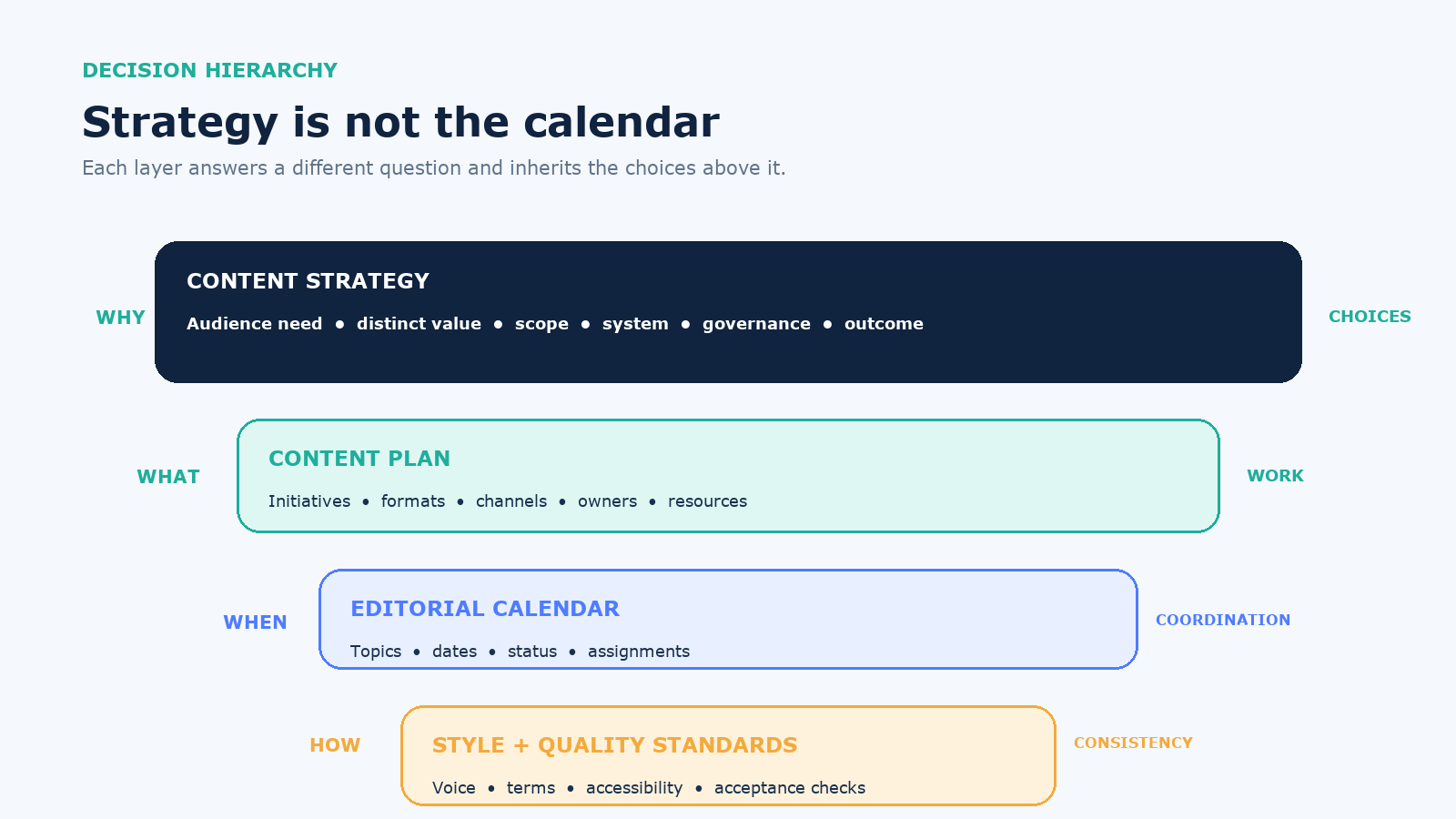
| Artifact | Question it answers | Typical contents |
|---|---|---|
| Content strategy | Why this content, for whom, and under which choices? | Audience need, value, scope, system, governance, outcome |
| Content marketing strategy | How will content attract, develop, or retain a market? | Market, positioning, journey, demand or relationship goals |
| Content plan | What work will execute the strategy? | Initiatives, formats, channels, owners, budget, dependencies |
| Editorial calendar | What is being produced and published when? | Titles, dates, statuses, campaigns, assignees |
| Style guide | How should content communicate consistently? | Voice, terminology, grammar, formatting, accessibility patterns |
Content strategy also reaches beyond marketing. Product instructions, onboarding screens, help articles, policies, emails, forms, support scripts, sales enablement, and in-product messages can all affect the same user outcome. A campaign may end; a password-reset article still needs an owner when the interface changes.
Content Marketing Institute’s explanation of strategy before editorial planning separates four connected concerns: substance, structure, workflow, and governance. The useful distinction is that topics and dates are only one visible layer of a managed content system.
A complete strategy makes six decisions
A practical content strategy should make these choices explicit:
- Outcome: what will be different for the audience and for the organization?
- Audience and context: who has the need, what triggers it, and what constrains them?
- Value and position: what can this organization contribute that is useful, credible, and distinct?
- Scope and system: which topics, formats, channels, journeys, and relationships belong—and which do not?
- Operations and governance: who decides, creates, reviews, publishes, updates, and retires content?
- Evidence and measurement: how will the team know whether the content changed the intended outcome?
These are choices, not headings to fill with vague language. “Increase engagement with helpful content across all channels” does not exclude any action and therefore cannot guide a disputed decision. A strategy becomes useful when two reasonable content ideas compete and the team can reject one.
Start with a user need, not a format
“We need a podcast” is a proposed solution. “New payroll administrators need to correct a rejected first submission before the pay deadline” is a need with a user, task, trigger, and consequence. The second statement permits research into whether the best response is an inline error, a diagnostic guide, a support intervention, a short video, or a product change.
The GOV.UK Service Manual recommends learning from actual or likely users and treating unsupported opinions as assumptions. Its user-needs guidance frames a need around what someone must do and why, while warning against embedding a preferred solution in the need itself.
Use at least three evidence streams:
- Behavior: search queries, navigation paths, successful tasks, exits, form errors, content usage, and repeat visits
- Voice: interviews, usability sessions, support conversations, sales objections, reviews, and on-site search wording
- Inventory: current pages, documents, messages, owners, age, duplication, accuracy, accessibility, traffic, and business risk
A high-traffic page may be popular because users cannot complete a task elsewhere. A low-traffic policy may still be mandatory and high-risk. Treat analytics as evidence of behavior, not an automatic verdict on value.
Write one statement that forces tradeoffs
Use this working template:
We will help [priority audience] accomplish [high-value task] in [important context] by providing [distinct content value] through [primary system or experience]. We will prioritize [scope] and will not [explicit exclusion]. We expect this to contribute to [organizational outcome], measured by [audience behavior or task result].
Here is a filled example for fictional payroll software:
We will help first-time payroll administrators submit an accurate first payroll before their deadline by providing task-based guidance linked directly from setup and validation errors. We will prioritize country-specific setup, error recovery, and deadline decisions; we will not publish general small-business news. We expect this to reduce failed first submissions and avoidable support contacts, measured by first-run completion and recovery without assisted support.
This statement does not prescribe every title. It creates a test: a proposed article about office productivity may be popular, but it does not serve the priority task or the chosen position. An error explanation with modest search volume may be strategically essential.
Turn the strategy into a connected content system
For each priority user task, map the content before, during, and after the moment of action. Include acquisition pages, product UI, documentation, email, and human support where they affect the same journey. Then decide which source should be authoritative.
| System decision | Example for rejected payroll | Failure prevented |
|---|---|---|
| Canonical source | One maintained error-reference entry | Five teams publishing conflicting explanations |
| Structure | Cause, affected submission, safe correction, resubmission check | Long prose that hides the action |
| Delivery | Error message links to the exact entry and preserves the error code | User searches a generic help center from scratch |
| Reuse | Support and email link to the canonical answer rather than copying it | Outdated fragments survive in other channels |
| Escalation | Named route for account-specific or statutory cases | Content pretending to resolve exceptions it cannot diagnose |
Information architecture is part of the strategy because labels, hierarchy, search, metadata, and content relationships determine whether a useful answer can be found. Format follows the task: comparison data may need a table; a physical procedure may need a diagram or video; a legal condition may need carefully structured text and a visible effective date.
Accessibility is likewise a system decision, not a final proofreading step. WCAG 2.2 requires, among other principles, text alternatives for non-text content and readable, understandable information. Use the W3C standard to define acceptance criteria for authors, designers, developers, and media producers.
Assign ownership across the entire lifecycle
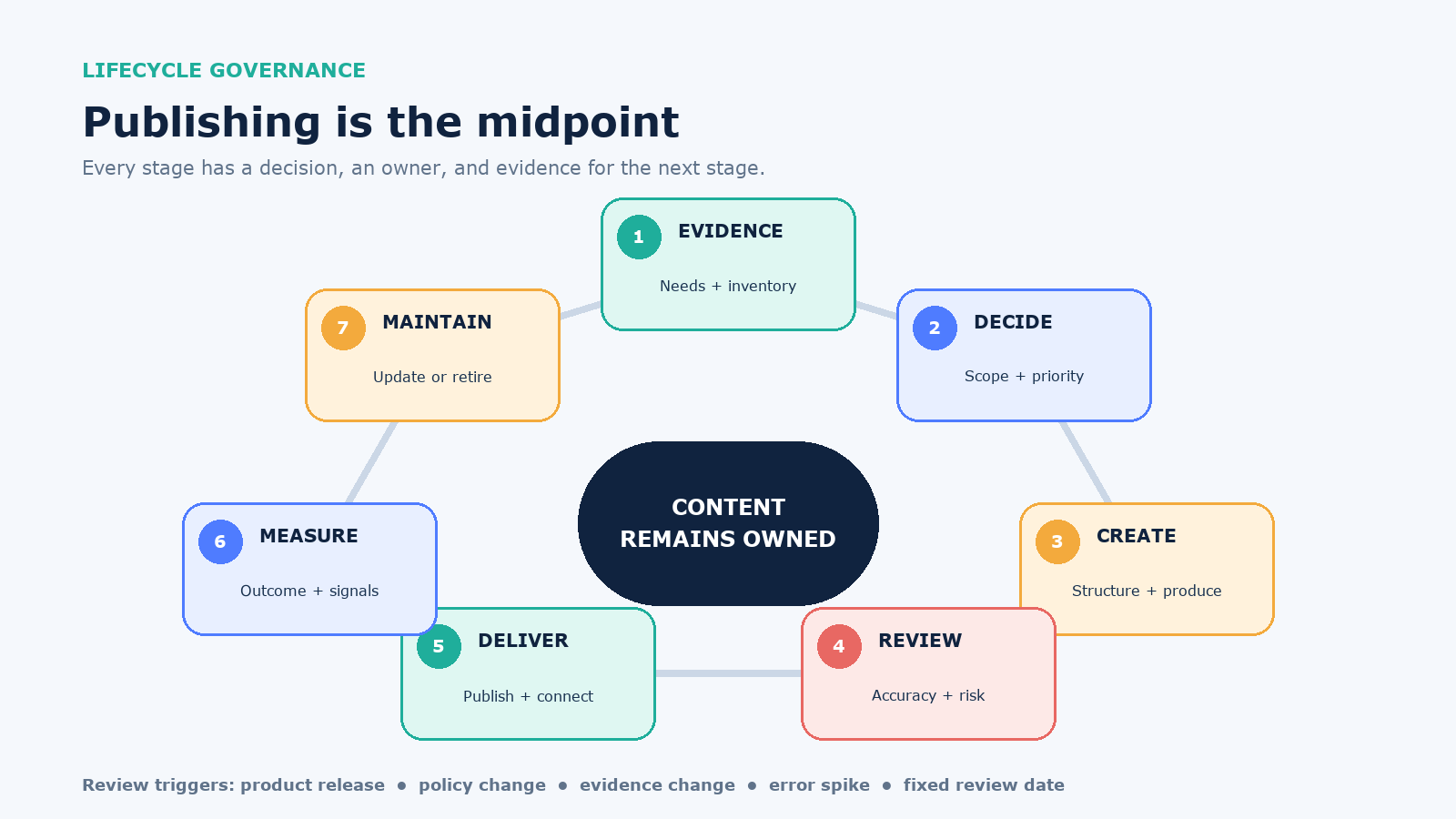
Every high-value content type needs a small governance record:
- accountable owner and subject-matter reviewer
- evidence or source of truth
- approval level based on risk, not hierarchy alone
- publication permissions and accessibility checks
- review trigger, such as a product release, policy change, error spike, or fixed date
- retirement rule and redirect or archive behavior
Governance should speed up ordinary decisions. If every low-risk edit needs six executives, the model is not protective; it is a queue. Define which decisions authors can make, which require specialist review, and who resolves disagreement. Content Marketing Institute’s digital-governance overview emphasizes clear accountability for strategy, policy, and standards.
Do not leave old content outside the strategy. GOV.UK’s transition guidance recommends using analytics, user research, and operational insights to find heavily used, outdated, or duplicate material and to decide what deserves migration. The same evidence can support consolidation, correction, archival, or deletion.
Measure an outcome chain, not one vanity number
Connect three levels of measurement:
- Audience outcome: did people complete the task, understand the decision, avoid the error, or make a suitable choice?
- Organizational contribution: did that behavior affect qualified demand, activation, retention, support cost, compliance, or another stated goal?
- Content diagnostics: where did people find, read, watch, abandon, search again, click, or escalate?
Diagnostics explain performance but are not automatically the objective. More page views can accompany worse task completion. A shorter support article may reduce time on page because users act faster. Define the intended direction before reviewing the data.
Google’s people-first content guidance asks whether a site has an intended audience and primary focus, whether content offers original value, and whether a reader leaves able to achieve their goal. Search discovery can support a strategy; publishing unrelated subjects only to capture visits is not a coherent audience or value choice.
Recognize the common substitutes for strategy
| Substitute | Why it fails | Strategic repair |
|---|---|---|
| “Publish more” | Volume is an activity without an audience outcome | Name the task and the evidence gap first |
| Persona poster | Demographics do not reveal the triggered need or context | Pair a priority audience with observed jobs and constraints |
| Channel-first plan | The team makes videos or posts whether or not the task needs them | Select delivery after mapping the journey |
| Keyword ownership | A query can be relevant to a market but irrelevant to the organization’s value | Require audience fit, credible contribution, and next-step fit |
| Launch-and-leave | No one detects product, policy, or evidence changes | Assign owners and event-based review triggers |
| Dashboard strategy | Available metrics replace the intended outcome | Write the outcome chain before selecting reports |
Build a one-page content strategy
A useful first version can fit on one page. Complete these fields with evidence and decisions, not slogans:
- Priority audience and task: who, when, what they must accomplish, and the consequence of failure
- Evidence: the behaviors, conversations, and inventory findings that justify the priority
- Content promise: the useful and credible contribution the organization can repeatedly make
- Scope: three things included and three explicitly excluded
- System: authoritative sources, journeys, formats, channels, structure, and reuse
- Governance: decision owner, contributors, risk review, publication rights, maintenance, and retirement
- Outcome chain: audience result, organizational contribution, and diagnostic signals
- First experiment: one bounded change, baseline, review date, and decision that the result will inform
Test the page with three real proposals: an obvious priority, a tempting off-strategy idea, and a necessary but low-traffic item. If the strategy cannot distinguish among them, tighten the audience, scope, value, or decision rules. Then convert the accepted work into a content plan and calendar.
The finished payroll example would prioritize the rejected-submission path, connect error messages to one canonical guide, give support and product teams defined roles, and measure successful recovery—not raw article output. That is the practical meaning of content strategy: a durable reason for the content, a system for delivering it, and accountable decisions throughout its life.