Name common punctuation and keyboard symbols, distinguish similar-looking characters, and verify the exact code point when context or software matters.
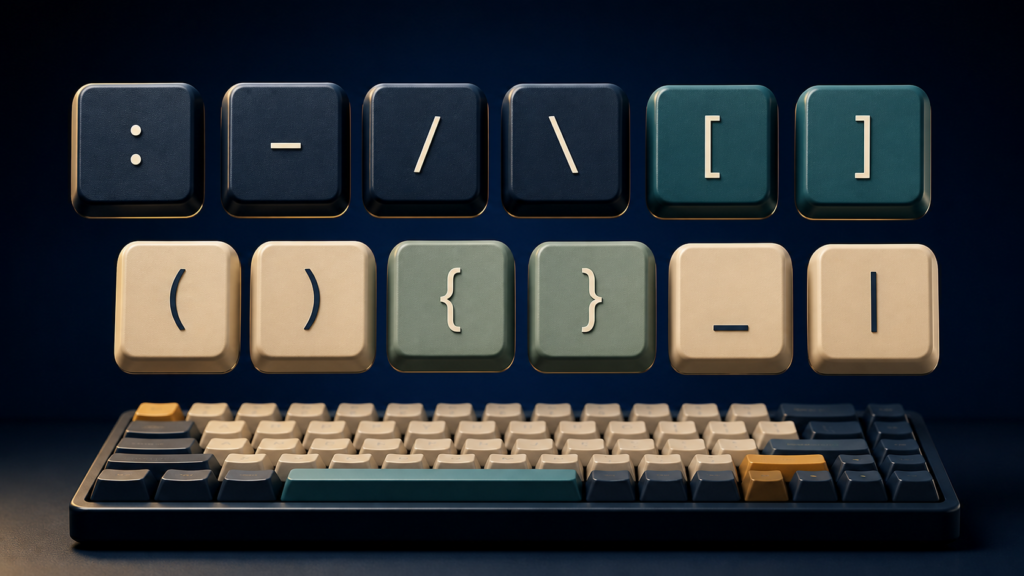
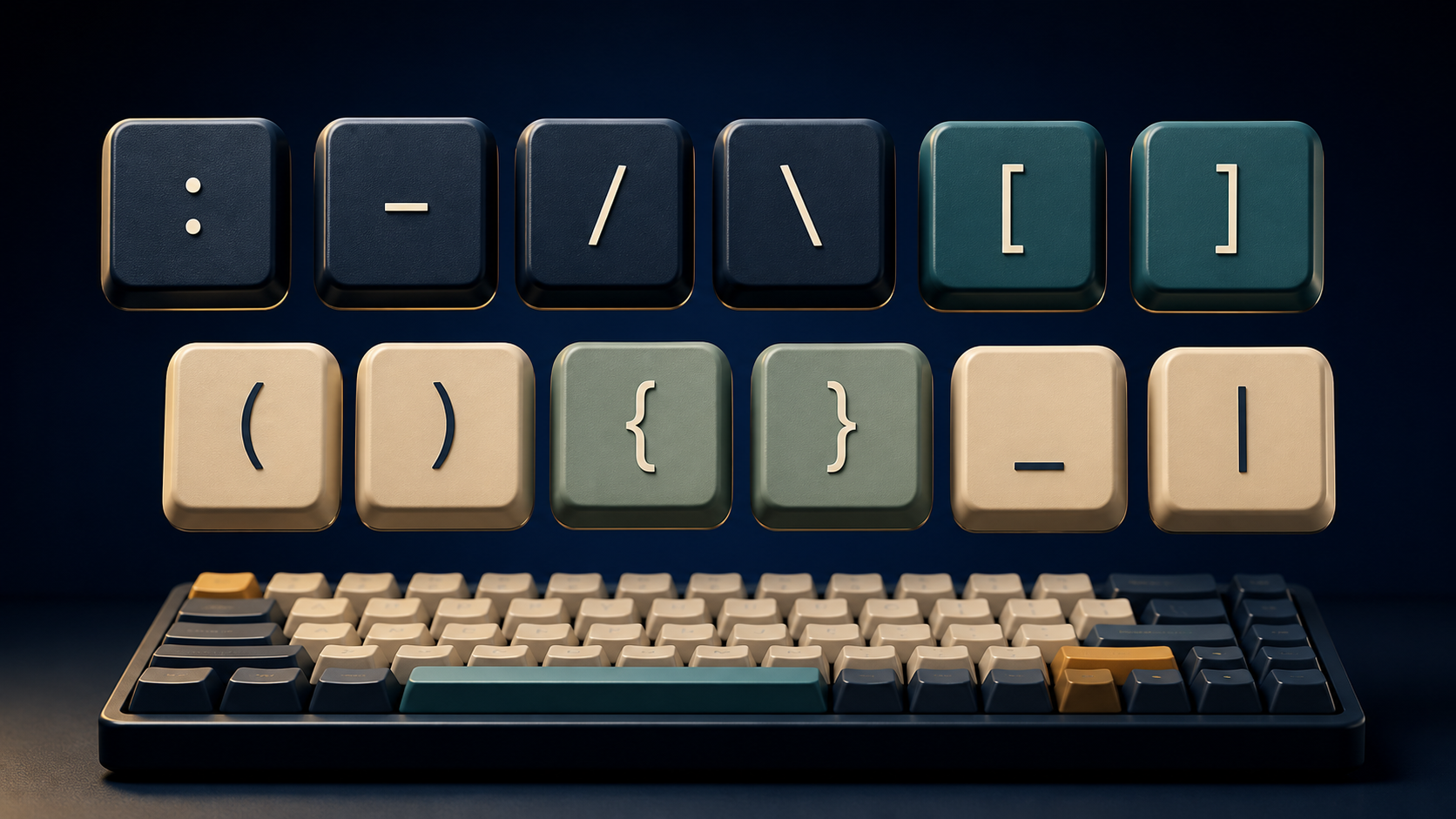
If your search was “what is called,” the missing object is probably a symbol. The most common matches are : (colon), - (hyphen-minus), / (slash or Unicode “solidus”), [ (left square bracket), and ] (right square bracket). Copy the exact character and compare its Unicode code point when the distinction matters.
Names for common keyboard symbols
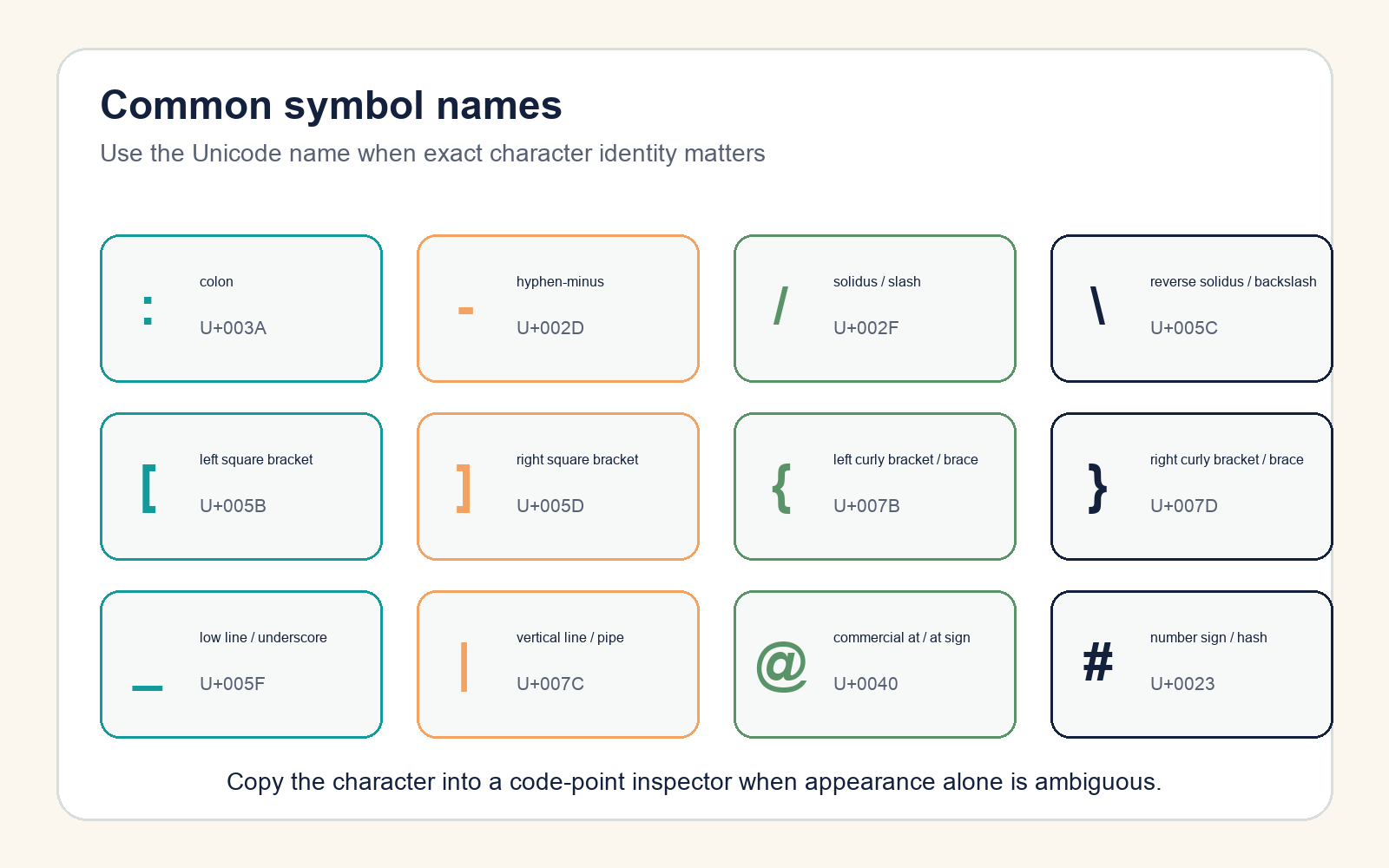
| Symbol | Common name | Unicode name and code point |
|---|---|---|
: |
Colon | COLON, U+003A |
- |
Hyphen, dash, or minus in informal use | HYPHEN-MINUS, U+002D |
/ |
Slash, forward slash | SOLIDUS, U+002F |
|
Backslash | REVERSE SOLIDUS, U+005C |
[ |
Opening or left square bracket | LEFT SQUARE BRACKET, U+005B |
] |
Closing or right square bracket | RIGHT SQUARE BRACKET, U+005D |
{ } |
Curly brackets or braces | LEFT/RIGHT CURLY BRACKET, U+007B/U+007D |
( ) |
Parentheses; singular parenthesis | LEFT/RIGHT PARENTHESIS, U+0028/U+0029 |
_ |
Underscore | LOW LINE, U+005F |
| |
Vertical bar; “pipe” in many command contexts | VERTICAL LINE, U+007C |
@ |
At sign | COMMERCIAL AT, U+0040 |
# |
Number sign, hash; sometimes pound sign | NUMBER SIGN, U+0023 |
What is : called?
The : symbol is a colon, Unicode U+003A. In prose it can introduce an explanation, list, quotation, or elaboration according to the applicable style. In time it may separate hours and minutes; in programming and data formats it may have a language-defined function.
Do not call ; a colon. That symbol is a semicolon, U+003B, and software treats it as a different character.
What is - called?
The ordinary keyboard - is formally hyphen-minus, U+002D. It is an ASCII-era character commonly used as a fallback for a hyphen, minus sign, or dash. Unicode also defines distinct characters:
‐U+2010 HYPHEN‑U+2011 NON-BREAKING HYPHEN–U+2013 EN DASH—U+2014 EM DASH−U+2212 MINUS SIGN
Use the character required by the context. A mathematical minus sign and a hyphen in a compound word do different jobs, even if a font makes them look close.
What is / called?
The / symbol is commonly called a slash or forward slash; its Unicode name is SOLIDUS, U+002F. It appears in URLs, paths, fractions written informally, alternatives such as “and/or,” dates in some locales, and programming syntax.
The opposite-leaning is a backslash, formally REVERSE SOLIDUS, U+005C. It has different uses in file paths, escape sequences, and programming languages. “Forward slash” is useful when speaking aloud to distinguish the pair.
What are [ and ] called?
They are square brackets. Individually, [ is the opening or left square bracket (U+005B), and ] is the closing or right square bracket (U+005D). Editing, mathematics, citations, programming, and data formats assign them different functions.
Do not confuse them with parentheses ( ), braces { }, or angle brackets < >. When giving instructions, name both the shape and direction—for example, “type a left square bracket”—instead of saying only “open bracket.”
Similar-looking symbols are different data
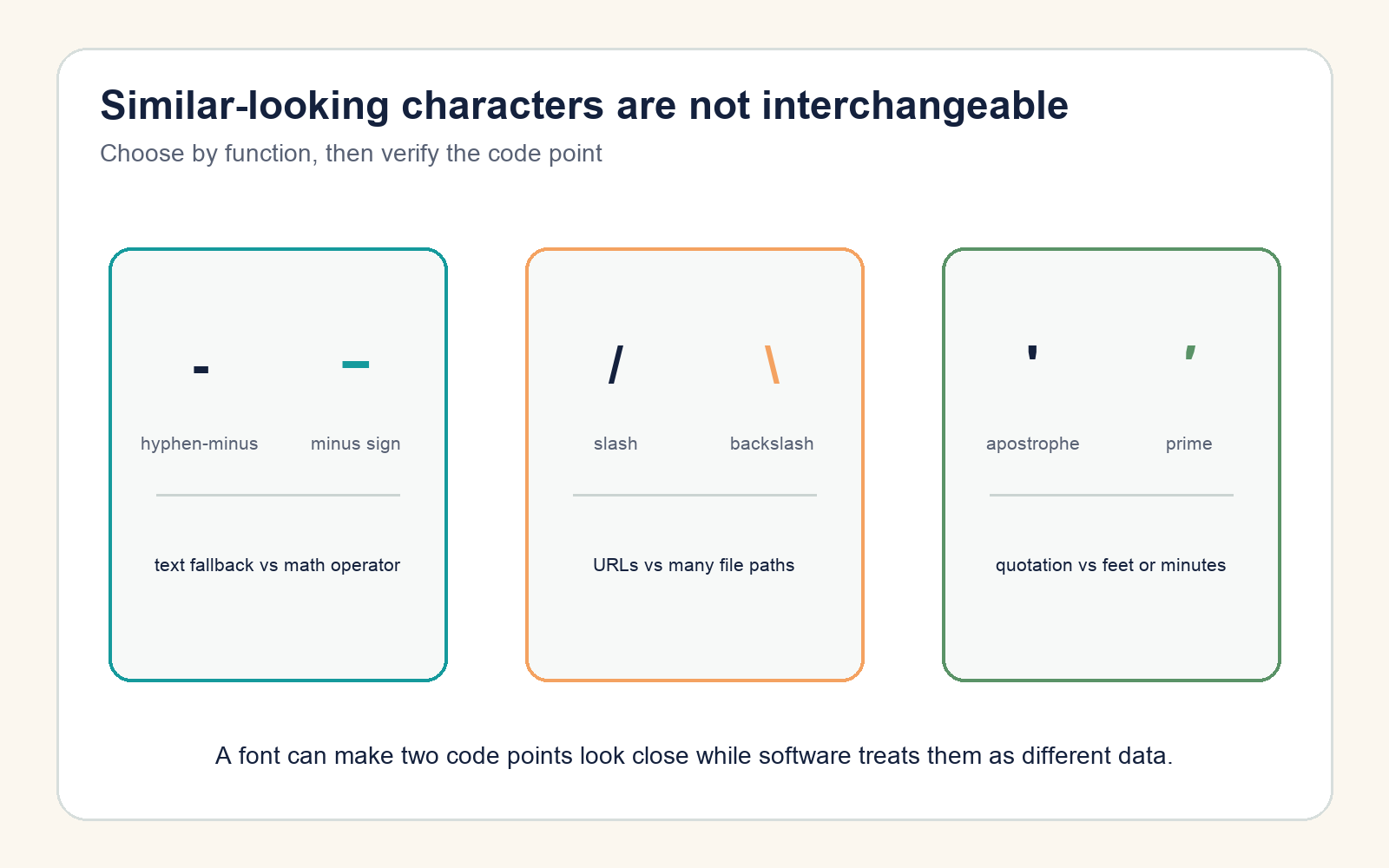
Unicode assigns a code point and formal name to each encoded character. Software compares, sorts, searches, parses, and renders those code points. A font controls appearance, so two different characters may look nearly identical and one character may look different across fonts.
This matters with quotation marks versus primes, ordinary spaces versus non-breaking spaces, hyphen-minus versus minus, and Latin letters versus lookalikes from another script. Passwords, source code, URLs, spreadsheet formulas, and identifiers can fail when a lookalike is substituted.
How to identify an unknown symbol
- Copy it exactly. Do not redraw or type what seems similar.
- Paste it into a Unicode-aware character inspector. Record the character, code point in
U+XXXXform, and Unicode name. - Check the surrounding context. A symbol may be called “pipe” in a shell command but “vertical bar” in a character reference.
- Compare nearby alternatives. Confirm direction, length, height, spacing behavior, and code point.
- Use an escape when needed. W3C documents hexadecimal HTML references such as
:for a colon and CSS escapes based on the Unicode code point.
How to describe a symbol clearly
For ordinary conversation, use the familiar name: “slash,” “colon,” or “left bracket.” For technical specifications, accessibility instructions, bug reports, or data cleanup, include all four elements:
visible symbol + common name + Unicode name + code point
Example: / — slash — SOLIDUS — U+002F.
That format resolves the incomplete question “what is called” into an answer that both a person and software can verify.