OpenAI owns and operates ChatGPT; a nonprofit foundation controls the OpenAI group even though economic equity is shared among several shareholder groups.
ChatGPT is an OpenAI product. In ordinary language, OpenAI owns and operates ChatGPT. More precisely, OpenAI Foundation—a nonprofit—controls OpenAI Group PBC, the for-profit public benefit corporation. OpenAI’s US consumer Terms are with OpenAI OpCo, LLC. Microsoft is a major shareholder and technology partner, but it does not own ChatGPT or control OpenAI. No single founder or executive personally owns ChatGPT.
That answer reflects OpenAI’s official structure and terms checked on August 16, 2026. Corporate arrangements can change, so a future reader should recheck the linked primary sources rather than repeat the percentages without a date.
Four meanings of ownership
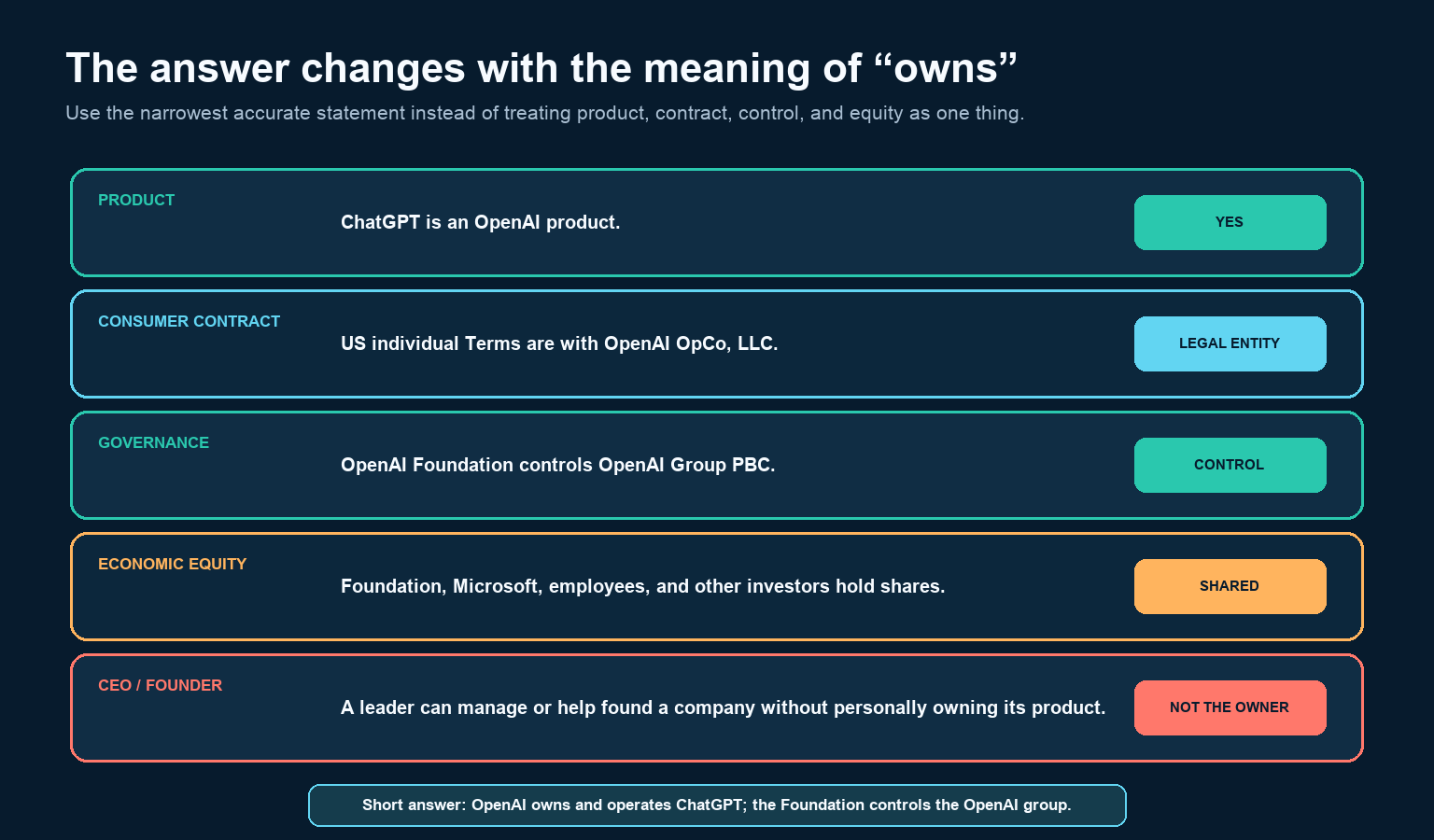
Product ownership asks whose service ChatGPT is. OpenAI introduced ChatGPT on November 30, 2022, in its official launch announcement. OpenAI’s current Terms also place ChatGPT among OpenAI’s services and state that OpenAI and its affiliates own the rights, title, and interest in those services.
Contracting entity asks which legal entity a user makes an agreement with. OpenAI’s current US individual Terms of Use say the agreement is with OpenAI OpCo, LLC. Different regions or business products may use another OpenAI entity or agreement. OpCo is a legal operating entity within the wider OpenAI organization; its appearance in the Terms does not mean it is a separate outside owner.
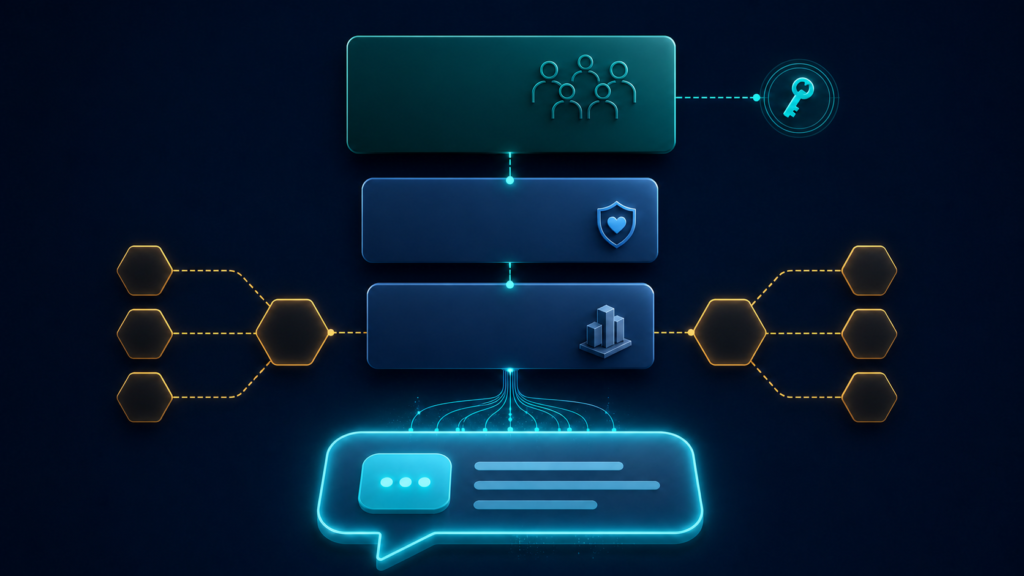
Governance control asks who can direct the corporate group. OpenAI says its nonprofit Foundation controls OpenAI Group PBC through special voting and governance rights. Economic equity asks who participates in the Group’s financial value. That ownership is split among the Foundation, Microsoft, employees, former employees, and other investors.
Who controls OpenAI
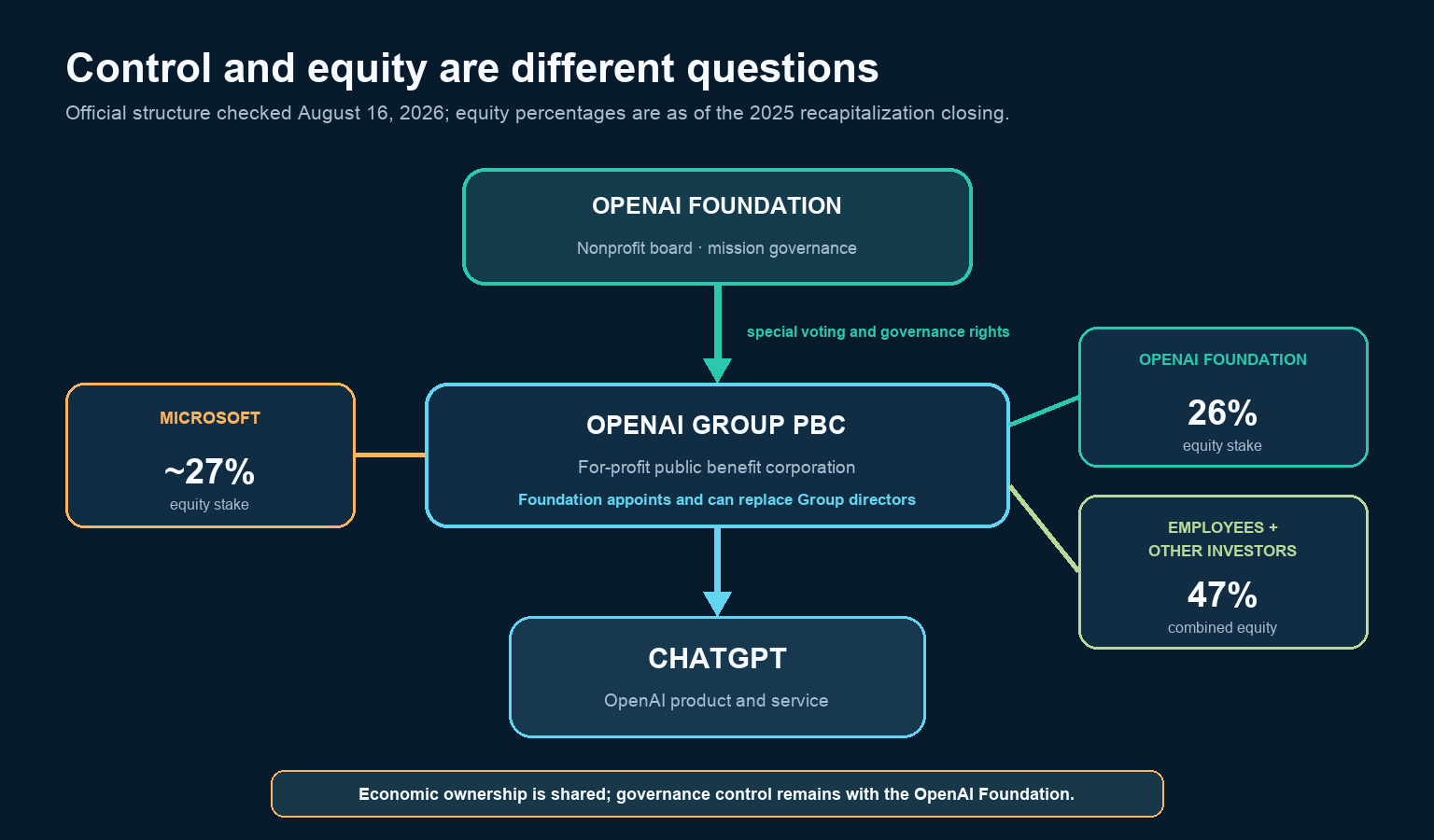
OpenAI began as a nonprofit in 2015 and created a for-profit subsidiary in 2019. Under the structure announced on October 28, 2025, the nonprofit is called OpenAI Foundation and the for-profit is OpenAI Group PBC, a public benefit corporation. OpenAI’s official structure page says the Foundation continues to control the Group.
The mechanism is more important than the label. The Foundation holds special voting and governance rights, appoints every director of OpenAI Group, and can replace Group directors. The Foundation board therefore retains corporate control even though the Foundation does not hold a majority of the Group’s conventional equity.
A public benefit corporation is still a for-profit corporation. OpenAI says this form requires the Group to advance its stated mission and consider the broader interests of stakeholders. The Foundation and Group share the mission of ensuring that artificial general intelligence benefits all of humanity.
The equity snapshot
At the closing of the 2025 recapitalization, OpenAI disclosed the following economic stakes in OpenAI Group:
- OpenAI Foundation: 26%. The Foundation also received a warrant that may provide additional shares if a valuation milestone is met.
- Microsoft: roughly 27%. OpenAI described the stake on an as-converted diluted basis, inclusive of all owners.
- Current and former employees and other investors: 47% combined.
These numbers answer who held economic equity at that closing; they do not transfer governance control to the largest percentage holder. A 27% stake is substantial, but it is not the same thing as owning the entire company, appointing its board, or owning each product outright.
Does Microsoft own ChatGPT?
No. Microsoft is a major shareholder, commercial partner, technology partner, and cloud partner. It has held licenses to OpenAI intellectual property and participates financially in OpenAI’s growth. Those rights can be economically and strategically important without making ChatGPT a Microsoft-owned product.
OpenAI’s October 2025 partnership announcement recorded Microsoft’s roughly 27% stake. A later April 2026 agreement update continued to describe Microsoft as a major shareholder and revised cloud, IP-license, and revenue-sharing terms. Neither announcement says Microsoft controls OpenAI or owns ChatGPT.
Another company can also distribute access to OpenAI models or integrate OpenAI technology into its products. Distribution, cloud hosting, licensing, investment, and ownership are separate relationships. When a feature appears inside a Microsoft product, that does not convert OpenAI’s ChatGPT service into a Microsoft product.
Does Sam Altman own ChatGPT?
No single executive personally owns ChatGPT. Sam Altman is OpenAI’s CEO and, according to the current structure page, a member of the OpenAI Foundation board. A CEO leads an organization; a board governs; shareholders hold economic interests; and the corporate group owns and operates products. Those roles can overlap, but they are not synonyms.
The same rule applies to founders, researchers, and early employees. Helping create a company or product does not make the product a person’s private property. A founder may hold shares or a governance role, but the product belongs within the legal organization that developed and operates it.
Repair the common ownership claims
| Claim | More accurate statement |
|---|---|
| “Microsoft owns ChatGPT.” | Microsoft holds a major stake in OpenAI Group and has partnership and licensing rights; OpenAI owns and operates ChatGPT. |
| “Sam Altman owns ChatGPT.” | Sam Altman is OpenAI’s CEO and a Foundation board member; ChatGPT is an OpenAI product. |
| “The largest shareholder controls OpenAI.” | The OpenAI Foundation controls the Group through special voting and governance rights. |
| “OpenAI OpCo is a different company that bought ChatGPT.” | OpenAI OpCo, LLC is the entity named in current US individual Terms within the OpenAI organization. |
| “The nonprofit owns all the economic value.” | The Foundation controls the Group and held 26% of conventional equity at recapitalization, plus a warrant; other shareholders hold the rest. |
| “Owning a ChatGPT output means owning ChatGPT.” | Contractual rights in generated content are distinct from ownership of the service, models, software, and brand. |
Do users own what they create?
This is a different ownership question. Under the current US individual Terms, as between the user and OpenAI and to the extent permitted by applicable law, the user retains ownership rights in input and owns output; OpenAI assigns any rights it may have in that output. The Terms also warn that output may not be unique and that other users may receive similar output.
That contractual allocation does not guarantee that every output receives copyright protection, eliminate third-party rights, or give a user ownership of ChatGPT itself. Applicable law, the source material in a prompt, employment agreements, and third-party content can change the analysis. For important commercial or legal use, read the current terms that apply to the specific account and jurisdiction.
The precise one-sentence answer
ChatGPT is owned and operated by OpenAI; OpenAI Foundation controls OpenAI Group PBC, while economic equity in the Group is shared among the Foundation, Microsoft, employees, former employees, and other investors.
If the question is about a subscription, a business contract, a regional service, an output, or a Microsoft integration, name that narrower subject. “Who owns ChatGPT?” is a product question; control, shares, contracts, licenses, and content rights each require their own answer.