
Three to five sentences is a useful classroom starting point, not a definition: a paragraph should be as long as needed to develop one controlling idea.
There is no required number of sentences in a paragraph. Three to five sentences is a useful classroom starting point, but a complete paragraph may contain one sentence or more than six if it develops one controlling idea clearly for its audience and purpose.
If an instructor, exam, client, or publication gives a specific requirement, follow it. Otherwise, count sentences only after asking whether the paragraph is unified, adequately developed, coherent, and easy to read in its format.

Understand why “three to five sentences” is not a rule
The familiar range teaches beginners that a body paragraph normally needs more than a claim. It leaves room for a point, explanation, support, and a connection. That makes it a useful scaffold, not a grammatical definition.
A five-sentence requirement can become harmful when the writer repeats a point, stretches sentences, or adds a hollow conclusion only to reach the count. George Mason University’s guidance on writing concisely identifies exactly-five-sentence thinking as a source of wordiness and redundancy.
The better definition is functional: a paragraph is one sentence or a group of related sentences that develops a central idea. It ends when that unit of thought is sufficiently developed—or when the focus shifts enough that readers need a new boundary.
Use sentence counts as warning lights, not laws
A count can still help during revision. Treat each range as a question:
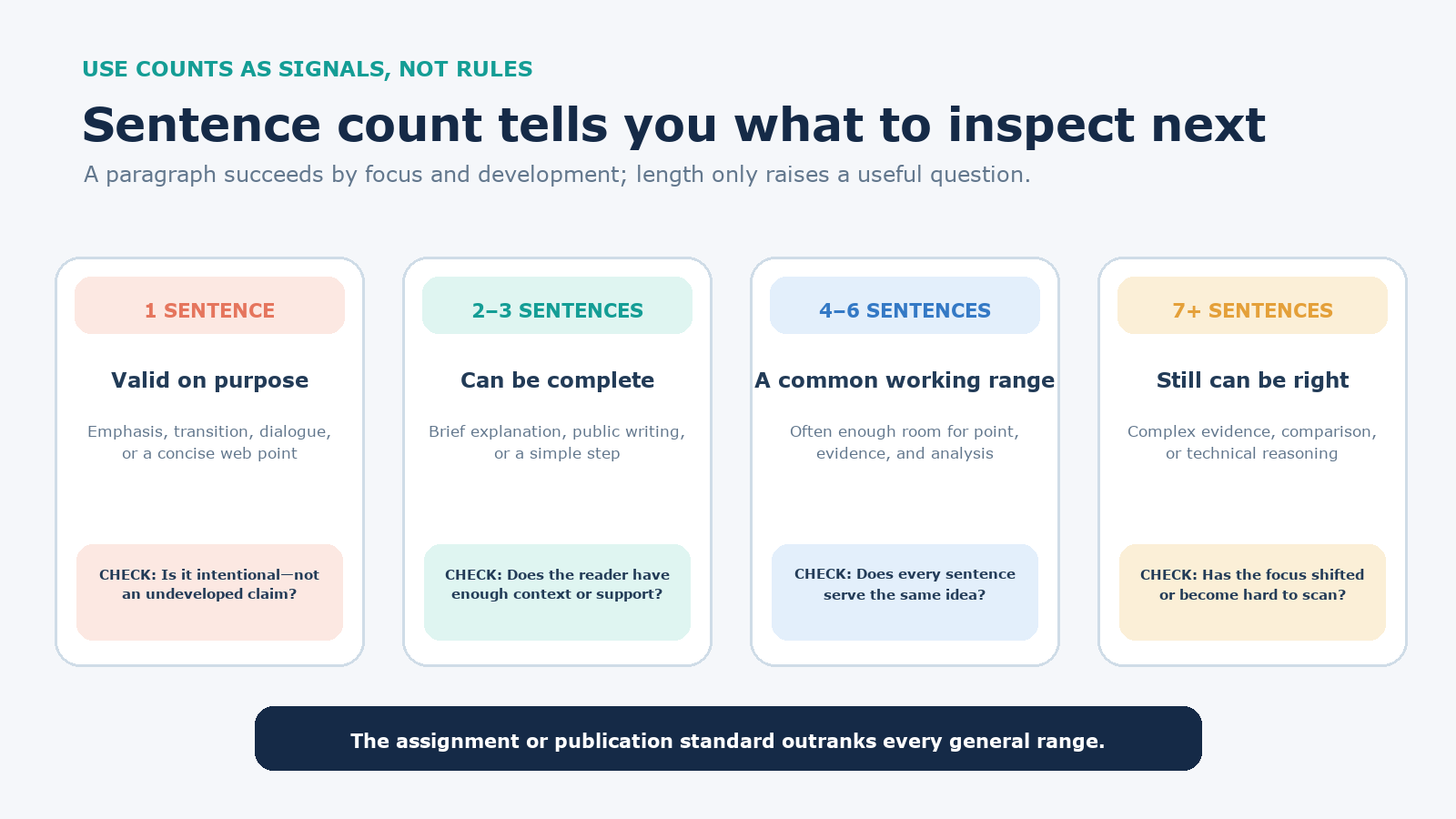
- One sentence: valid for emphasis, transition, dialogue, a concise web point, or an intentionally brief introduction. Check that it is not simply an unsupported claim stranded on the page.
- Two or three sentences: often enough for a simple procedure, brief explanation, email, or public-facing page. In an evidence-based essay, check whether analysis or context is missing.
- Four to six sentences: a practical working range for many body paragraphs because it can hold a point, evidence, analysis, and consequence. Do not preserve the range if two ideas are competing.
- Seven or more sentences: not automatically too long. Complex evidence or technical reasoning may need the space. Check for a focus shift, repeated point, buried conclusion, or wall of text.
Google’s current developer documentation guidance says a paragraph longer than five or six sentences often deserves inspection, while explicitly allowing one-sentence paragraphs and longer paragraphs that still address one idea.
Build the paragraph by function
Instead of assigning one mandatory sentence to each slot, identify the work the paragraph must do. An academic or analytical body paragraph often needs some combination of:
- a point or controlling idea;
- context the reader needs;
- evidence, an example, or a concrete detail;
- analysis explaining why that support matters;
- a qualification, synthesis, or consequence;
- a transition when the relationship is not already clear.
Those functions do not map one-to-one to sentences. One sentence can combine context and evidence; an analysis may need three sentences; a transition may be unnecessary.
Consider this original four-sentence example:
Placing a shade canopy over a bus stop can make waiting more tolerable during hot weather. The structure blocks direct sunlight while leaving space for air circulation. A solid rear wall, however, may trap heat, so designers must consider orientation and airflow. The decision therefore depends on the site rather than on canopy size alone.
The first sentence states the point. The second explains the mechanism. The third qualifies the claim with a design constraint. The fourth draws a practical consequence. It works because the functions create development and progression—not because four is a privileged number.
Adjust the range to the writing context
| Context | Useful starting expectation | What decides the boundary |
|---|---|---|
| Elementary or structured school assignment | Often three to five sentences if the lesson specifies it | The teacher’s scaffold, rubric, and learning goal |
| College academic writing | Often longer than a short classroom formula | Enough evidence and analysis to support one point |
| Web or technical documentation | Frequently one to four concise sentences | Scannability, screen size, task, and one idea per paragraph |
| Business email or memo | Short blocks are usually easier to act on | Decision, request, context, and reader time |
| News or public writing | Short and varied; occasional one-sentence paragraphs are normal | Pacing, emphasis, clarity, and column width |
| Fiction or dialogue | Highly variable | Speaker change, action, rhythm, point of view, and scene control |
The University of Toronto notes that academic paragraphs vary with their needs and often occupy roughly one-third to two-thirds of a double-spaced page, while very short academic paragraphs may be underdeveloped. Its public-writing guidance separately accepts occasional one-sentence paragraphs. The apparent difference is a genre difference, not a contradiction.
Check unity, development, and coherence
A paragraph is long enough when it has done the work promised by its controlling idea. Ask three tests:
- Unity: Can you state the paragraph’s central point in one clear sentence? Does every sentence support, explain, qualify, or advance it?
- Development: Would a skeptical but reasonable reader need evidence, an example, a definition, a cause, a comparison, or analysis that is missing?
- Coherence: Does each sentence connect logically to what came before, and is the new information introduced in an order the reader can follow?
A topic sentence often helps in academic prose, especially near the beginning, but not every paragraph needs an explicit one. Introductions, conclusions, transitions, narrative moments, and dialogue can perform different jobs. Likewise, a final sentence should add a consequence, synthesis, or useful turn—not merely restate the opening.
Decide whether to keep, expand, split, or merge
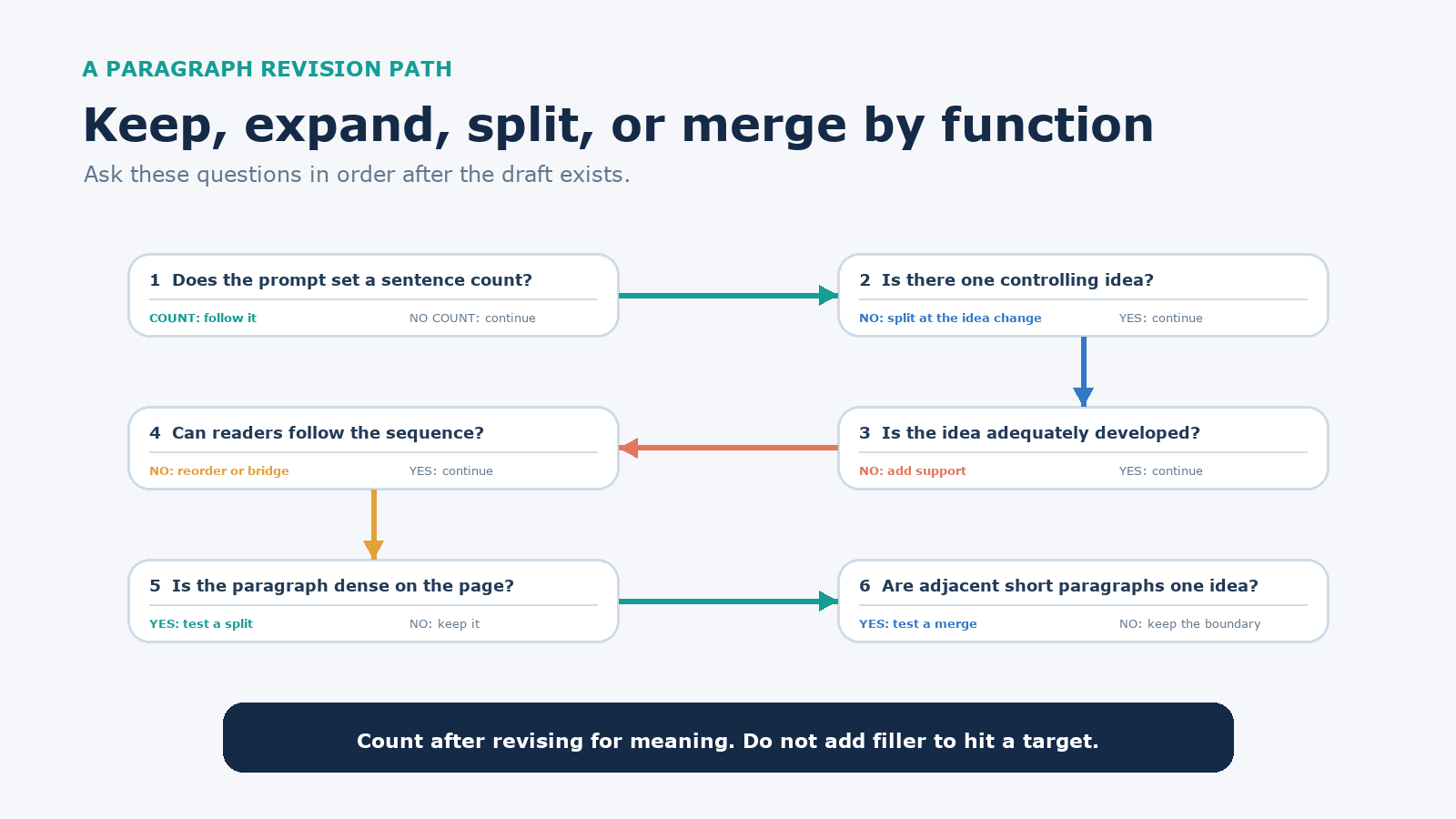
Expand when a short paragraph makes an important assertion but gives the reader no reason, evidence, example, or explanation. Do not expand a minor transition just because it contains one sentence.
Split where the controlling idea changes, the paragraph turns from problem to solution, a second example needs its own analysis, or the block becomes difficult to scan. The best split point is logical; it is not automatically after sentence five.
Merge adjacent short paragraphs when they serve the same point and the boundary creates a choppy stop without adding emphasis. Keep them separate when the pause marks a real change in speaker, step, time, claim, or rhetorical effect.
Count sentences accurately when a requirement is explicit
If a prompt requires a number, count complete sentences—not visual lines. A sentence may wrap across several lines, and a long sentence with semicolons is still one sentence. Headings and list fragments do not automatically become sentences because they occupy separate lines.
Word processors can miscount abbreviations, initials, decimal points, ellipses, quotations, and fragments. For a short assignment, read each candidate aloud and identify a complete independent statement in context. For a formal test, use the evaluator’s stated convention.
Do not game a minimum by joining independent ideas with semicolons, and do not game a maximum by creating run-ons. Sentence boundaries should clarify relationships. The requirement governs the count; grammar and meaning govern how you reach it.
Use the shortest paragraph that fully develops the idea
If no external rule applies, start with three to five sentences only as a drafting convenience. Then remove repetition, add missing support, and move any second controlling idea into its own paragraph. A deliberate one-sentence paragraph and a coherent eight-sentence paragraph can both be correct.
The final test is not “Did I hit five?” It is “Can the reader identify the point, see how it is supported, and move to the next idea without confusion?” When the answer is yes, the paragraph is finished.