
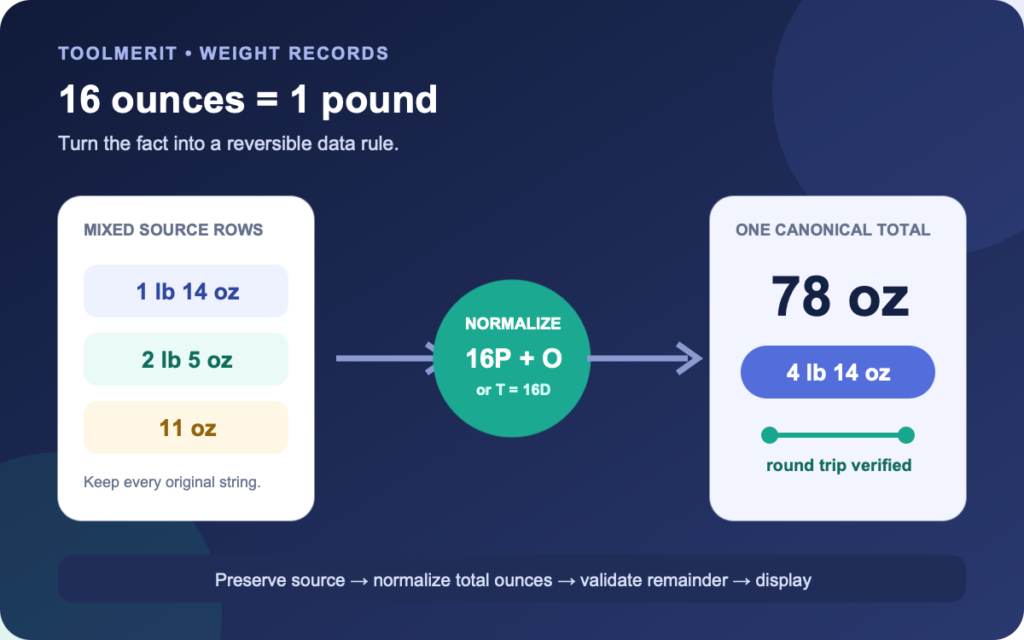
A data-entry workflow for turning mixed pound-and-ounce values into one auditable total and back again.
Does a field such as 3.5 lb 8 oz describe one weight or accidentally count the eight ounces twice? The familiar “16” answers only part of that question. A usable record also needs one unit system, one storage value, and a rule for rejecting impossible or ambiguous combinations.
There are exactly 16 avoirdupois ounces in 1 pound. For a mixed weight, total ounces = (whole pounds × 16) + leftover ounces. Store or compare that total, then display it as whole pounds plus a remainder from 0 to 15 ounces: 2 lb 6 oz becomes 38 oz, while 45 oz becomes 2 lb 13 oz.
This page treats 16 ounces per pound as a data-normalization rule. It is for inventory rows, shipping worksheets, product records, and operational handoffs that must survive sorting, addition, import, and export without changing the quantity.
Lock the unit identity before normalization
The 16-to-1 relationship belongs to avoirdupois mass, the ordinary system used for most goods and body weights in the United States. NIST’s 2026 General Tables of Units of Measurement show 16 avoirdupois ounces per pound and distinguish that system from troy mass and fluid volume.
Do not send every field labeled oz through the same rule:
- lb, oz, net wt, scale weight: normally ordinary avoirdupois mass; the 16-to-1 rule applies.
- fl oz: volume, not mass; route fluid-ounce records to the volume conversion.
- oz t or troy ounce: a different mass system; do not combine it with an ordinary pound field.
- oz with no context: preserve the source text and request the unit identity when product type or workflow leaves room for doubt.
If the job is simply to convert one known weight, use the general pound-to-ounce guide for one-off conversions. The current workflow has a different responsibility: make many mixed records structurally consistent and auditable.
Use one canonical record for mixed weights
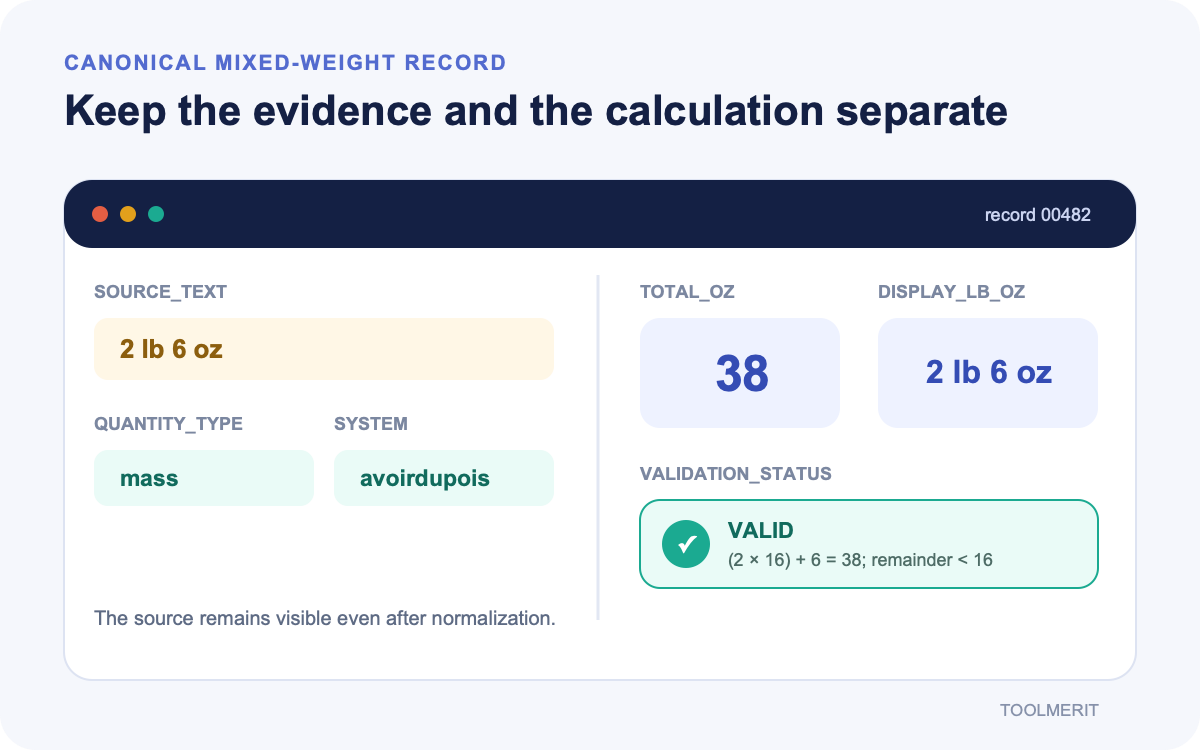
Keep the source exactly as received, but do not use that text as the calculation field. A practical canonical record contains six fields:
| Field | Example | Purpose |
|---|---|---|
| source_text | 2 lb 6 oz | Preserves what the person, scale, label, or file supplied |
| quantity_type | mass | Prevents fluid volume from entering the weight calculation |
| system | avoirdupois | Separates ordinary, troy, and other unit systems |
| total_oz | 38 | Single numeric field used for sorting, addition, comparison, and rules |
| display_lb_oz | 2 lb 6 oz | Human-readable reconstruction |
| validation_status | valid | Shows whether the source parsed cleanly or required review |
This separation follows the same logic used when teams separate source data from governed analytical fields: raw evidence remains available, while downstream calculations rely on a defined model. Never overwrite a suspicious source string with a repaired value and erase the reason for the change.
Normalize every input through total ounces
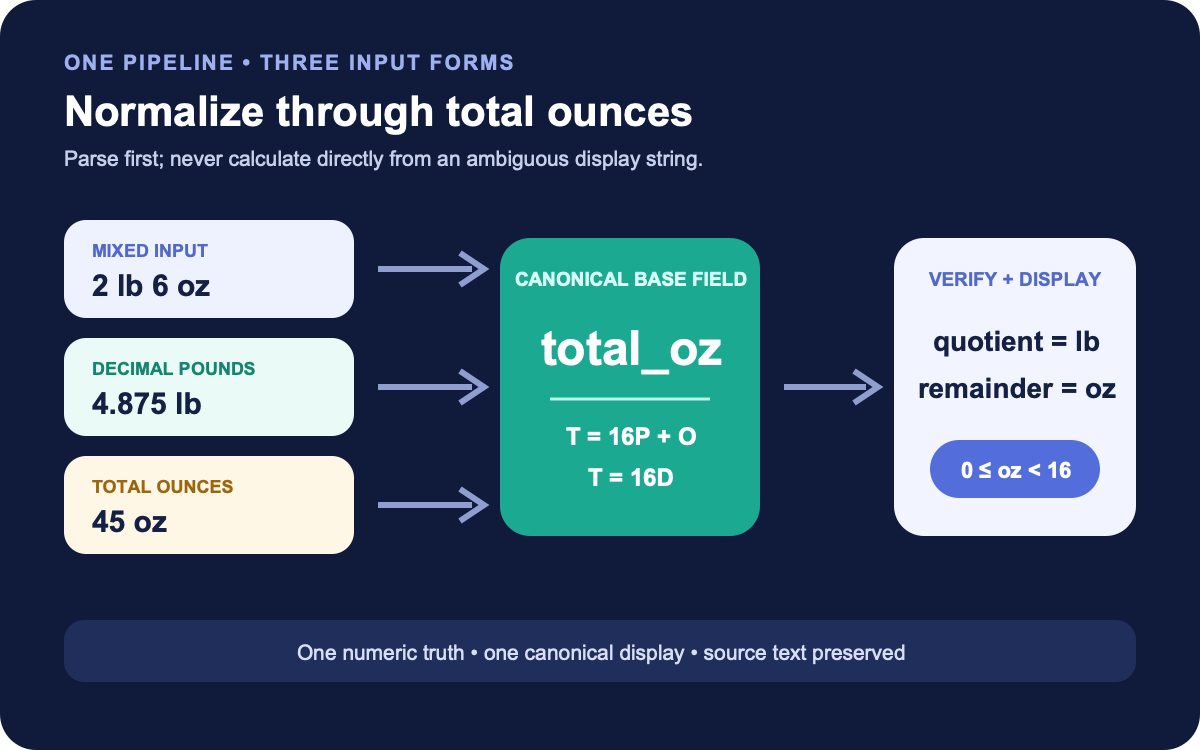
Use one path regardless of how the source is written:
- Parse the source. Identify mixed lb + oz, total ounces, decimal pounds, or another unit.
- Convert to total ounces. Mixed input uses
T = 16P + O; decimal pounds useT = 16D. - Validate the total. Confirm that the sign, unit identity, and allowed precision fit the field.
- Reconstruct the display. Whole pounds are the integer quotient of
T ÷ 16; the ounce remainder is what remains.
| Input form | Normalization | Canonical result |
|---|---|---|
| 2 lb 6 oz | (2 × 16) + 6 | 38 oz |
| 45 oz | Already total ounces | 45 oz → 2 lb 13 oz |
| 4.875 lb | 4.875 × 16 | 78 oz → 4 lb 14 oz |
| 2.38 lb | 2.38 × 16 | 38.08 oz → 2 lb 6.08 oz |
For a broader reference covering fractions, reverse calculations, and implementation formulas, use the full notation and spreadsheet formula guide. If the source is kilograms, convert kilogram inputs before applying the lb-and-oz display; do not relabel a kilogram number as pounds.
Reject or repair noncanonical entries
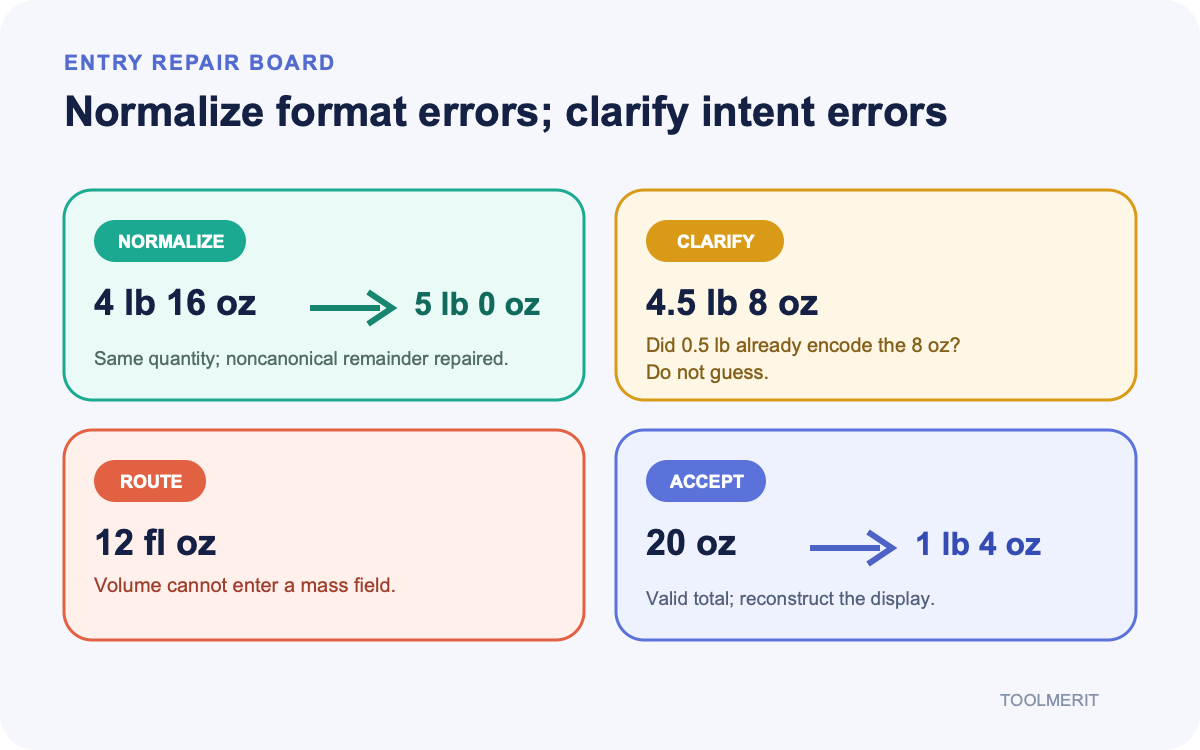
A canonical remainder is at least zero and less than 16 ounces. That rule makes one quantity produce one display. It does not mean every noncanonical source can be silently repaired.
| Source entry | Problem | Safe action |
|---|---|---|
| 4 lb 16 oz | Remainder reached a full pound | Normalize to 5 lb 0 oz; retain the source text |
| 4.5 lb 8 oz | The half-pound may already represent eight ounces | Reject for clarification; literal addition would produce 5 lb, but intent is unresolved |
| 4 lb −2 oz | Negative remainder is noncanonical | If it is an intentional adjustment, calculate 62 oz and display 3 lb 14 oz; otherwise reject |
| 20 oz | Valid total, not a mixed display | Store 20 oz and display 1 lb 4 oz |
| 12 fl oz | Volume entered in a mass field | Reject and route to the volume workflow |
| 7 oz, context unknown | Unit system is not proven | Hold for identification when troy or fluid use is plausible |
The decimal-versus-remainder trap is not unique to weight. You can compare the same decimal-versus-mixed trap in feet and inches: 5.7 ft is not the same notation as 5 ft 7 in. When a small mass arrives in grams or milligrams, use unit cancellation when scaling smaller metric masses instead of inserting the number into an ounce field.
Add mixed weights without losing ounces
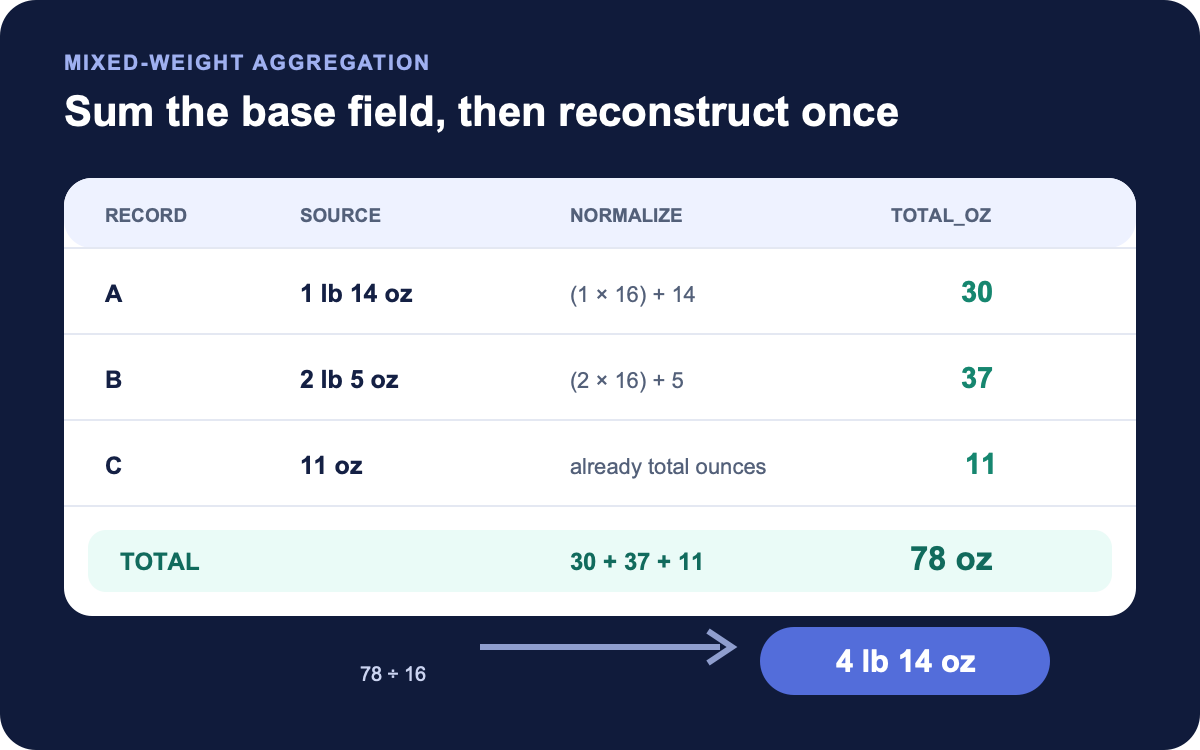
Add the normalized totals, not the displayed components independently. Consider three inventory lines:
| Record | Source | Total-ounce calculation | total_oz |
|---|---|---|---|
| A | 1 lb 14 oz | (1 × 16) + 14 | 30 |
| B | 2 lb 5 oz | (2 × 16) + 5 | 37 |
| C | 11 oz | 11 | 11 |
| Total | — | 30 + 37 + 11 | 78 |
Now reconstruct once: 78 ÷ 16 gives 4 whole pounds with 14 ounces left, so the total is 4 lb 14 oz. If you maintain this as a working table, build the normalization ledger in Excel with separate source, parsed-pound, parsed-ounce, total-ounce, display, and status columns.
Run a round-trip check before export
A normalized record passes only when its display reconstructs the stored total:
stored total_oz = (display pounds × 16) + display ounces
For the ledger total, 4 lb 14 oz returns (4 × 16) + 14 = 78 oz. The remainder is also within the canonical interval 0 ≤ O < 16. Both conditions must pass. A display of 3 lb 30 oz reconstructs the same 78 oz, but it fails the canonical-remainder rule and should not leave the system.
The round trip should also preserve the original quantity at the precision actually supplied. NIST’s conversion-writing guidance warns against reporting more significant digits than the source data justifies. An exact conversion factor does not make a coarse scale reading more precise.
Keep fractional ounces when the source supports them
Whole-ounce storage is appropriate only when the source itself resolves whole ounces. A reading of 2 lb 6.4 oz should normalize to 38.4 oz and reconstruct as 2 lb 6.4 oz. Rounding it to 38 oz changes the quantity; rounding it to 38.40 oz implies an extra decimal place the source did not supply.
Decimal pounds require the same care. The entry 2.38 lb is not shorthand for 2 lb 38 oz. It equals 38.08 total ounces, or 2 lb 6.08 oz. If the destination accepts only whole ounces, record the rounding policy and keep the unrounded normalized value available for audit.
Verify the completed record
The three-row ledger finishes with this export record:
- source_text: “1 lb 14 oz + 2 lb 5 oz + 11 oz”
- quantity_type: mass
- system: avoirdupois
- total_oz: 78
- display_lb_oz: 4 lb 14 oz
- validation_status: pass—
(4 × 16) + 14 = 78and14 < 16
The answer began with 16 ounces in a pound, but the useful result is a record that can be added, sorted, exchanged, and rebuilt without interpretation. Preserve the source, normalize through total ounces, and let the round trip prove the displayed weight.
If the recipient requires metric mass, first pass the avoirdupois round trip, then produce an exact gram field for metric handoff. NIST SP 811 lists one avoirdupois ounce as exactly 28.349523125 g and one avoirdupois pound as exactly 453.59237 g; choose the displayed precision from the source measurement.