
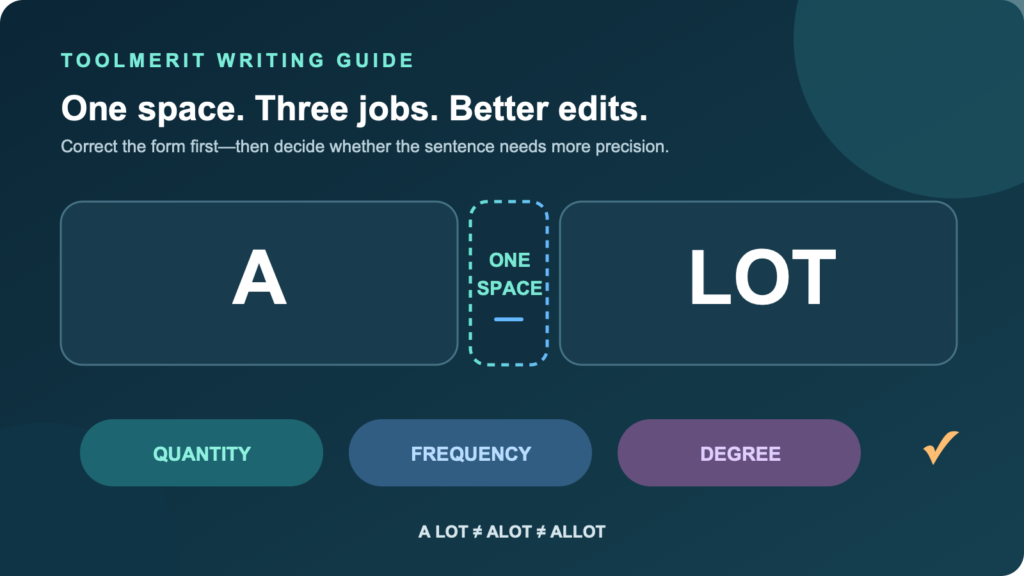
A practical editing guide to the spelling, grammar, agreement, and context-sensitive alternatives for ‘a lot.’
“A lot” is ordinary English, not automatically bad writing. The real editing questions are whether you spelled it correctly, used it in the right sentence frame, matched the verb to the noun, and gave the reader enough precision.
Write ‘a lot’ as two words when you mean a large amount, a large number, frequently, or to a great degree. ‘Alot’ is not the standard spelling. ‘Allot’ is a different verb meaning to assign or distribute. Use ‘a lot of’ before a noun, but use ‘a lot’ without ‘of’ after a verb or before a comparative. In formal or data-sensitive writing, replace the phrase with the exact number or a more specific quantifier or adverb.
That rule handles most cases. The rest of this guide shows how to apply it without replacing a natural phrase with a stiff synonym—or leaving a vague claim where a number belongs.
Separate a lot, alot, and allot in one pass
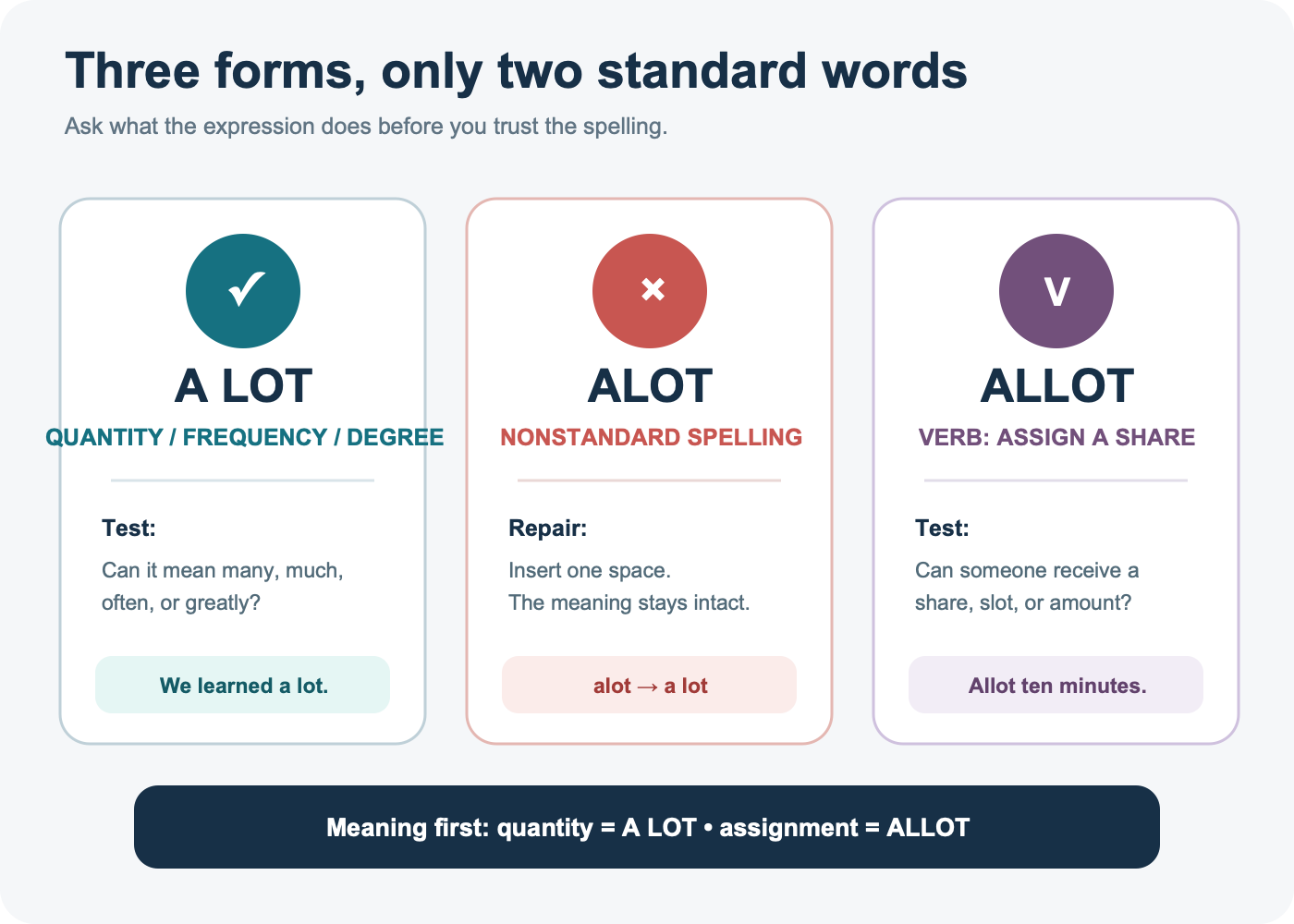
The space is meaningful. A lot combines the article a with lot. Merriam-Webster’s “A Lot” and “Allot” usage guide treats alot as an error in standard writing and distinguishes it from allot, a verb meaning to assign a share or portion. The Chicago Manual of Style’s usage answer is equally unambiguous about the one-word spelling.
| Form | Job | Quick test | Example |
|---|---|---|---|
| a lot | Large quantity, frequency, or degree | Could it mean “many,” “much,” “often,” or “to a great degree”? | We learned a lot. |
| alot | Nonstandard spelling | Would inserting a space preserve the meaning? | Change “alot” to a lot. |
| allot | Verb: assign or distribute | Can it take a person or thing receiving a share? | We allot ten minutes to each speaker. |
The two forms can appear correctly in the same sentence: “We allotted a lot of time to testing.” The first is an action; the second describes the amount of time. A spellchecker may not catch a correctly spelled but wrongly chosen allot, so verify meaning as well as letters. ToolMerit’s word-verification method gives you a repeatable pronunciation–meaning–grammar check for other uncertain spellings.
Find the phrase’s job before editing it
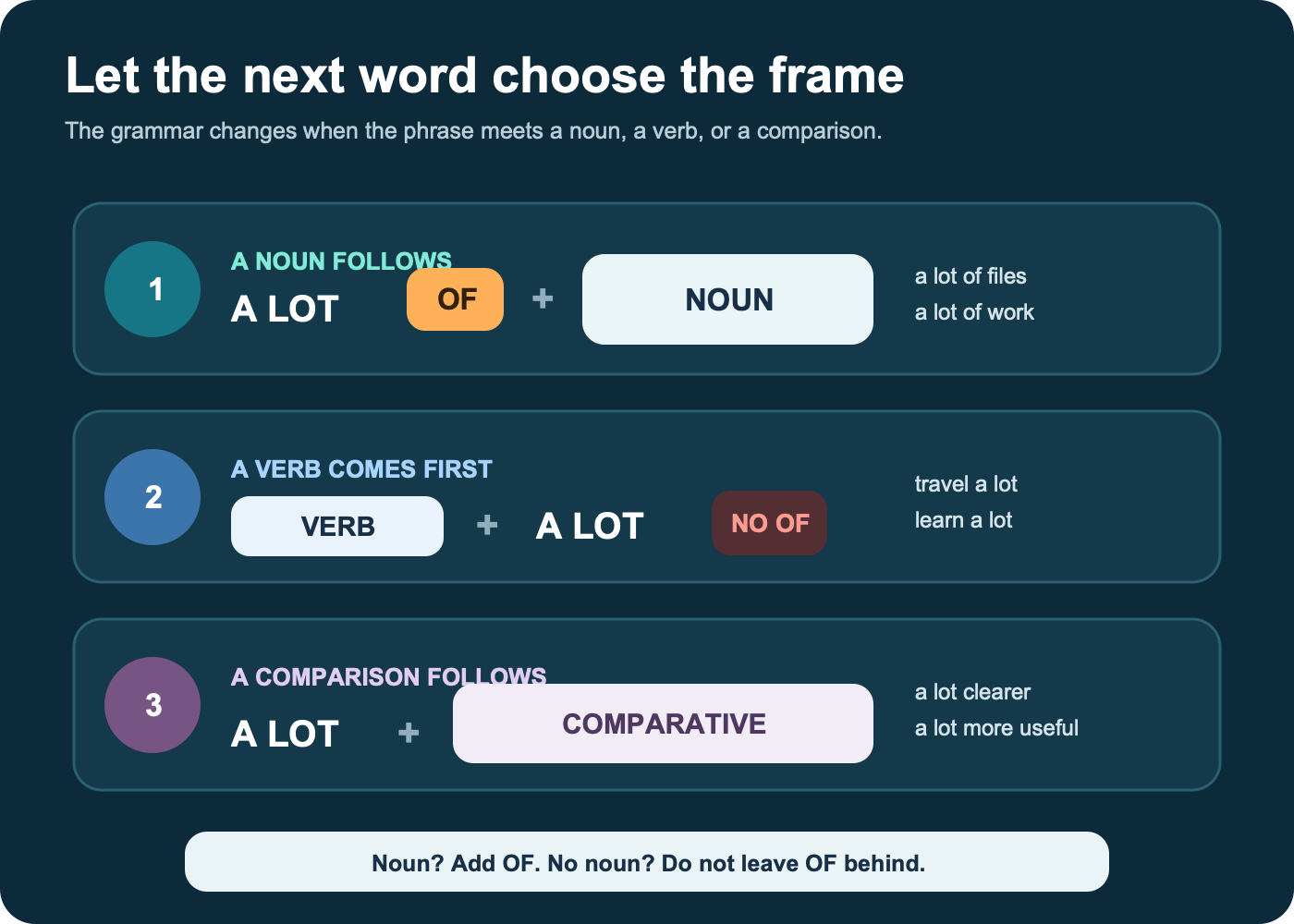
A lot moves through three common sentence frames. Finding the frame tells you whether of belongs and which alternatives are grammatical.
| Sentence frame | What it expresses | Correct example | Common error |
|---|---|---|---|
| a lot of + noun | Quantity of people, things, or a substance | A lot of files are missing. | A lot files are missing. |
| verb + a lot | Frequency, degree, or an understood amount | We travel a lot. | We travel a lot of. |
| a lot + comparative | Difference in degree | This draft is a lot clearer. | This draft is a lot clear. |
Cambridge Grammar’s quantifier guide explains that a lot of can quantify both plural count nouns and singular uncountable nouns. It also shows that when no noun follows, a lot can stand alone or act adverbially; of then disappears. Merriam-Webster’s dictionary entry for “a lot” records the degree and frequency senses, as in liking something a lot or traveling a lot.
The comparative frame needs an actual comparative: a lot better, a lot more useful, or a lot less expensive. “A lot useful” fails because useful has not been turned into a comparison. Tools in ToolMerit’s AI writing category may flag that pattern, but the frame test explains why the edit is needed and prevents blind acceptance of an awkward rewrite.
If the noun after of is hard to classify, use the noun identification tests before deciding on quantity wording or agreement.
Make the verb agree with the noun after of
A frequent agreement mistake comes from treating lot as the head noun in every sentence. In the quantity phrase a lot of X, let the noun represented by X control the verb:
- Plural count noun: A lot of requests are waiting.
- Singular mass noun: A lot of work is waiting.
- Plural count noun in the past: A lot of pages were revised.
- Singular mass noun in the past: A lot of information was removed.
The same rule applies after existential there. Use “There are a lot of options” but “There is a lot of uncertainty.” The Editor’s Manual’s there is/there are guide likewise bases agreement on whether the following noun is plural or a singular mass noun. “There’s a lot of options” is common in conversation, but edited formal prose normally keeps the plural agreement.
Fast agreement test: Cover the words “a lot of.” If the remaining noun naturally takes are/were, use the plural verb. If it naturally takes is/was, use the singular verb.
The same agreement decision appears in questions; the is-there and are-there agreement guide shows how the following noun controls the verb.
Keep it when plain, conversational quantity is enough
Replacing every instance of a lot does not automatically improve a draft. The phrase is concise, familiar, and flexible. It works well in dialogue, personal writing, explanatory articles, support messages, and general workplace prose when the exact quantity is unknown or unimportant.
Cambridge’s guide to a lot, lots, and plenty describes a lot and lots as characteristic of informal style, with lots even more informal. That is a tone observation, not a ban. “Thanks—a lot has changed since your last visit” may fit a friendly update better than “a considerable number of conditions have changed.” The formal alternative is longer and shifts the voice.
Keep a lot when all three conditions are true:
- The reader only needs the broad idea of a large quantity, frequent action, or marked degree.
- The surrounding voice is conversational or neutral rather than highly formal.
- The phrase does not hide a decision-making number, threshold, date, or source.
Also avoid “upgrading” it to a near-synonym with a different claim. Plenty usually suggests enough or more than enough; most suggests a majority. Neither simply means “a large but unspecified amount.”
Replace a lot only when the sentence needs more precision
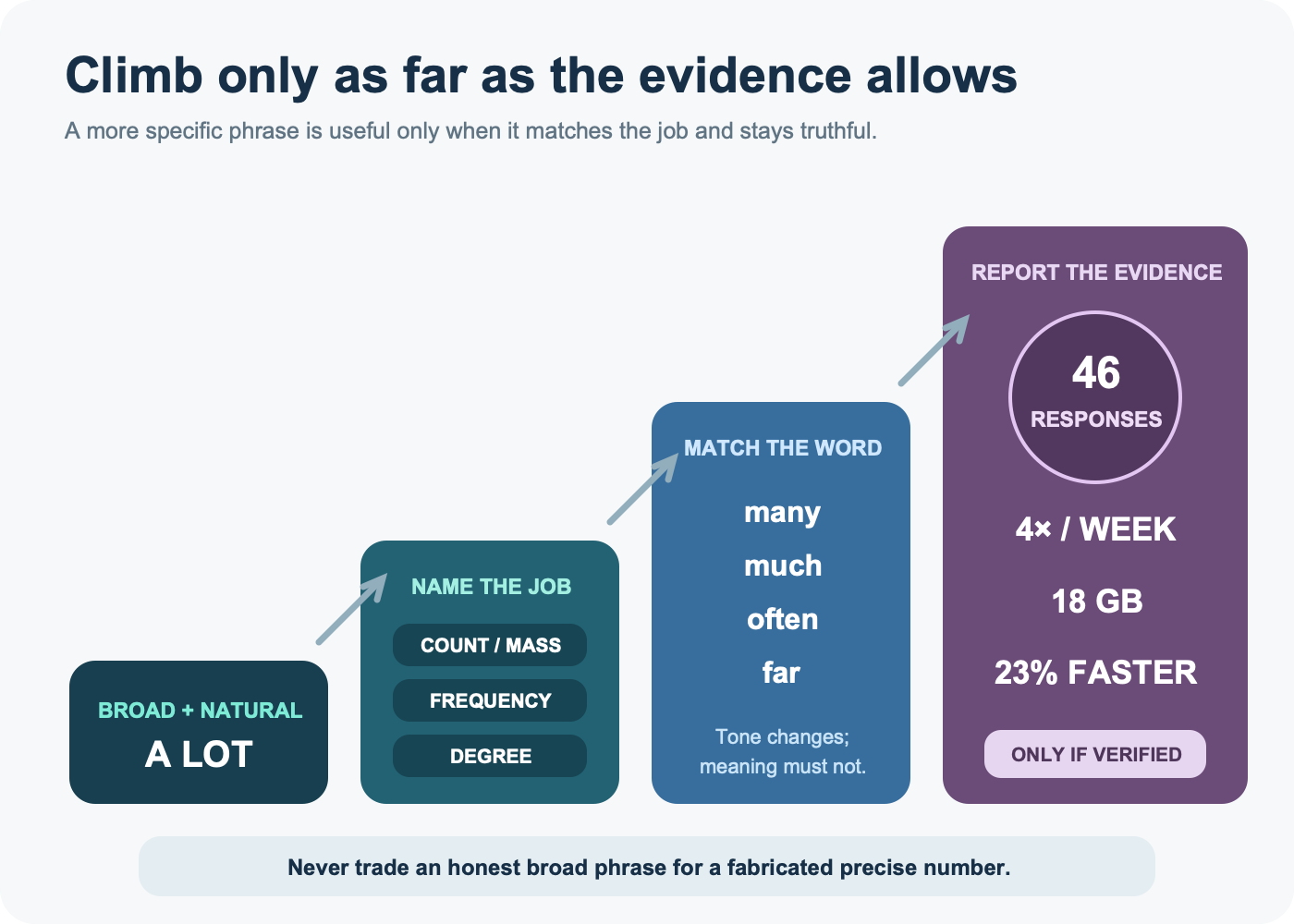
The best replacement depends on what a lot is doing. A flat synonym list mixes count, mass, frequency, degree, and evidence claims that are not interchangeable. Use this ladder instead:
| If “a lot” means… | Natural general option | More formal option | Most precise option |
|---|---|---|---|
| Many countable items | many | numerous / a large number of | the count: 46 responses |
| Much of a mass noun | much | a considerable amount of | the measure: 18 GB |
| Frequent action | often | frequently | the rate: four times per week |
| Greater degree | much / far | substantially | the measured change: 23% faster |
| Strong effort or effect | greatly | considerably | the observable outcome |
Use the rightmost column only when you actually have that evidence. Do not turn “a lot faster” into “23% faster” unless a defined comparison produced 23%. A specific-looking invention is worse than an honest broad phrase.
Different documents create different precision needs. A short introduction benefits from one concrete proof point, which is why the elevator-pitch workflow asks writers to connect value to evidence. A business plan that must withstand questions needs dates, units, assumptions, and sourced numbers instead of “a lot of demand.” Meeting records need named decisions and owners; the meeting-minutes template shows how to replace vague discussion summaries with accountable actions.
Repair five common sentences
These examples show why the reason for editing matters more than a blanket rule.
- Spelling: “We received
alota lot of replies.” The meaning was already clear; only the space was missing. - Agreement: “A lot of feedback
werewas useful.” Feedback is a singular mass noun. If you mean individual items, write “Many comments were useful.” - Comparative form: “The new version is
a lot efficienta lot more efficient.” The phrase intensifies a comparison, so more is required. - Frequency: “We check the queue a lot.” This is grammatical. If the schedule matters, revise it to “We check the queue every two hours.”
- Different word: “We allot a lot of time to review.” Allot names the assignment; a lot of describes the amount.
A sixth pattern deserves caution: “A lot of users prefer the redesign.” The grammar may be fine, but the evidence is incomplete. How many users? Out of what sample? Measured how? If the claim supports a product decision, report the count, denominator, method, and date. If it is only a casual observation, label it as such rather than borrowing the tone of a measured result.
Edit a lot in 30 seconds
Run this sequence on each occurrence:
- Meaning: Does it express quantity, frequency, or degree? Write a lot. Does it mean assign? Write allot.
- Frame: Does a noun follow? Use a lot of + noun. Otherwise remove of; if an adjective follows, make it comparative.
- Agreement: In a lot of + noun + verb, match the verb to the count or mass noun after of.
- Tone: If the phrase is natural and the broad meaning is enough, keep it. For alternative phrasing or revision support, browse ToolMerit’s editing and repurposing tools.
- Evidence: If the reader must act on the quantity, replace the phrase with a verified count, measure, rate, comparison, or clearly scoped estimate.
The final decision rule is simple: correct the spelling and grammar every time; increase the precision only when the reader’s task requires it and your evidence supports it.
For a full-document check, continue with the multi-pass proofreading workflow so this phrase is reviewed alongside agreement, spelling, and meaning.