A practical plan for proving a podcast format, recording reliably, controlling the RSS feed, clearing rights, and launching without losing momentum.
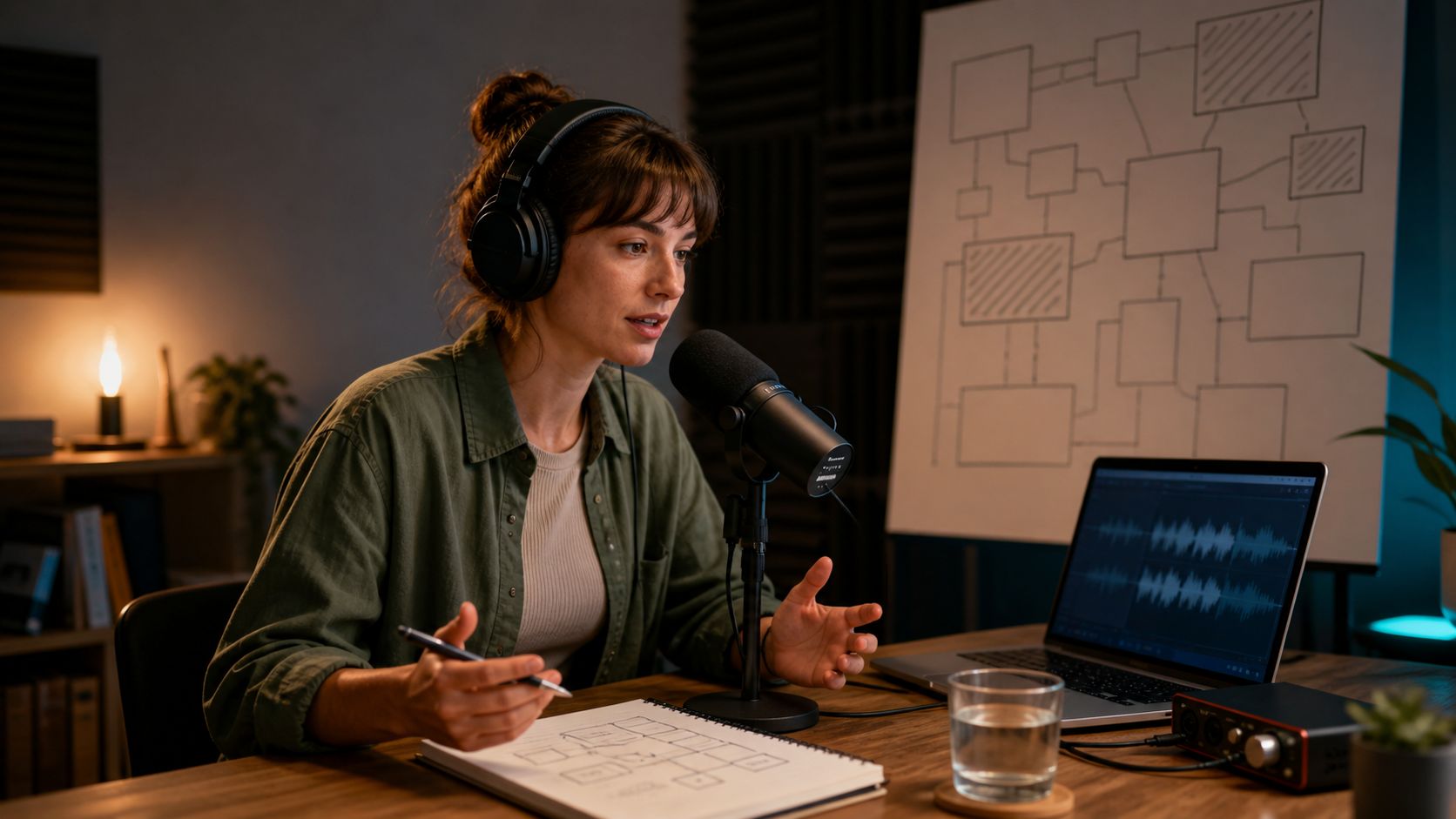
To start a podcast, define one listener and one repeatable promise, produce a private three-episode pilot, build a simple recording and backup routine, choose a host that gives you control of the RSS feed, prepare the show artwork and metadata, validate the feed, submit it to listening directories, and launch only when the next episode is already in production. The microphone matters less than a quiet room, a format you can repeat, and a feed you can move later.
Do not announce the show after recording one exciting conversation. A pilot should answer three harder questions: Can you generate enough distinct episodes? Can you make them at a sustainable quality and cost? Will a new listener understand the benefit within the first minute?
Write a promise that can produce a season
A podcast topic is not yet a show. “Marketing,” “football,” and “local history” name fields; they do not tell a listener why this series deserves recurring attention. Complete this sentence:
For [specific listener], this show helps [observable outcome] through [repeatable format or evidence], without [frustrating alternative].
For example: “For independent restaurant owners, this show explains one operating decision each week through a real menu, staffing, or purchasing case—without startup mythology.” That promise creates selection rules. A celebrity interview may attract clicks but still fail the show if it cannot deliver the promised decision.
Before choosing a name, list 12 viable episode questions. Give each a one-sentence listener payoff and the evidence, guest, demonstration, or story that would carry it. If several ideas are merely different titles for the same discussion, narrow or redesign the promise. A viable series has a recognizable lens but does not repeat the same answer.
Build a three-episode pilot before you publish
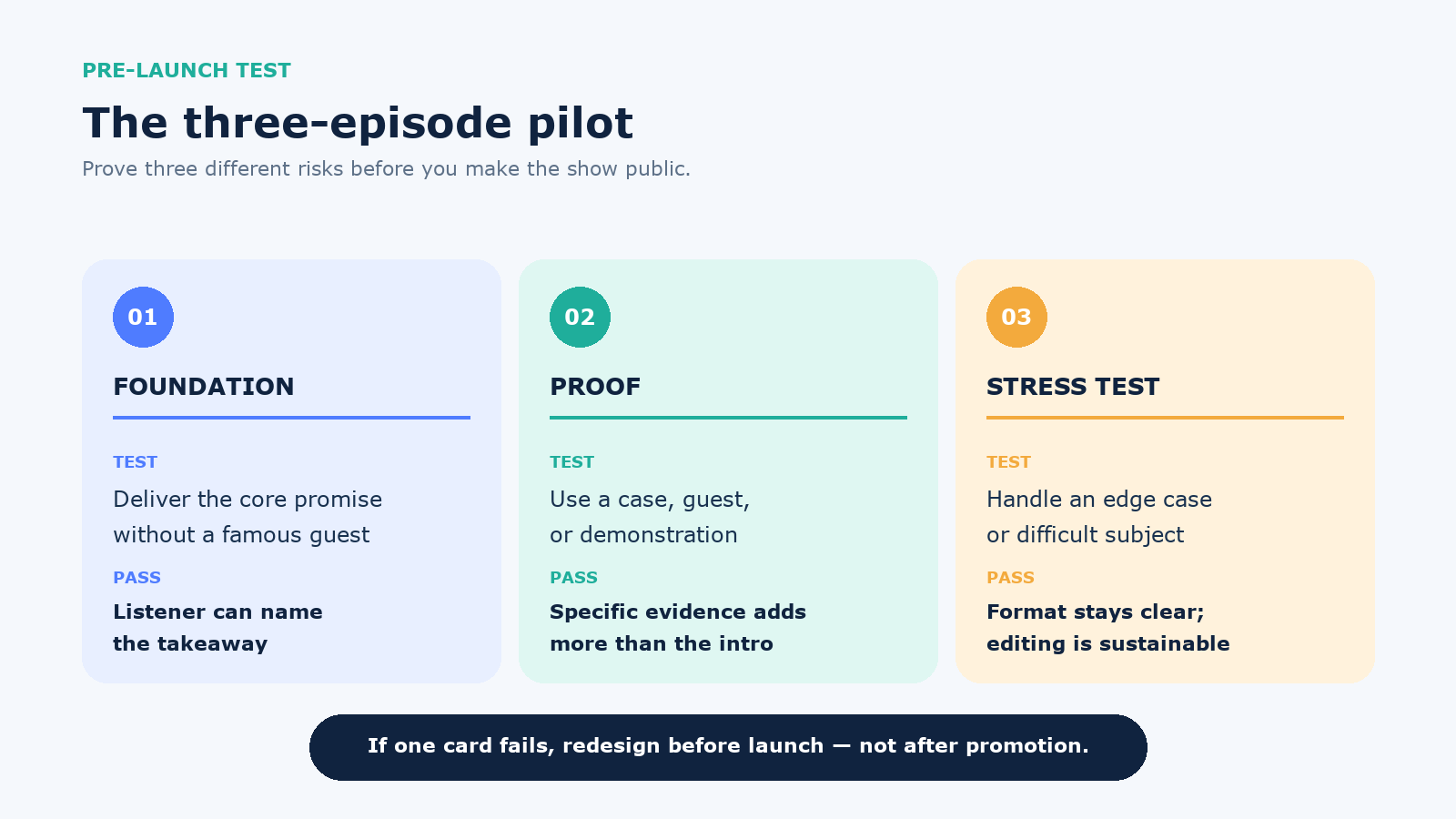
Record three private episodes with deliberately different jobs:
| Pilot episode | What it tests | Pass condition |
|---|---|---|
| Foundation | Can one episode deliver the show’s central promise without a famous guest? | A target listener can state the takeaway after one listen |
| Proof | Can an interview, case, or demonstration add evidence rather than filler? | The episode contains specific facts, decisions, or examples unavailable in the introduction |
| Stress test | Can the format handle an edge case, weak guest, or complex subject? | The structure remains understandable and the editing burden is sustainable |
Time every production stage: research, outreach, outline, recording, edit, transcript, artwork, upload, and promotion. The total is your real episode cost. If a 35-minute episode consumes 14 hours and you have four hours a week, “weekly” is not a publishing plan. Shorten the format, reduce edit complexity, share production, or publish less often.
Ask two people who resemble the intended listener to hear the pilots without a long explanation. Ask where attention dropped, what felt assumed, what they would remove, and what question they expected next. Do not ask only whether they “liked it”; politeness is weak product evidence.
Use a minimum recording chain, not a gear fantasy
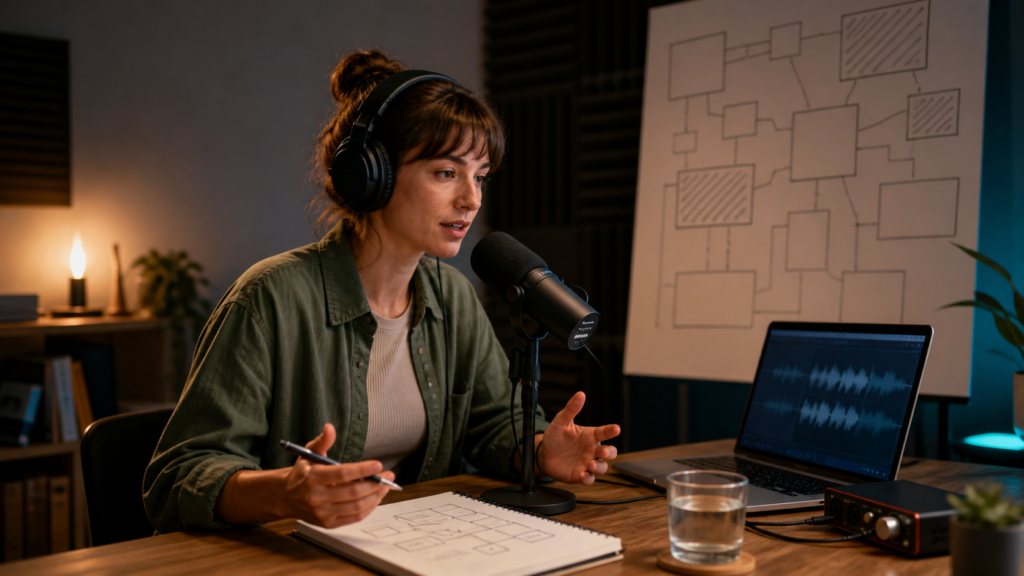
The minimum workable chain is a quiet, soft-furnished space; a microphone positioned consistently; closed-back headphones; recording software; and a second recording path. A modest microphone close to the speaker in a controlled room usually gives you more usable material than a costly microphone hearing reflections, traffic, or a loud computer fan.
| Layer | Minimum decision | Pre-record check |
|---|---|---|
| Room | Choose the quietest room; use curtains, rugs, or soft furnishings to reduce reflections | Record 20 seconds of silence and listen on headphones |
| Voice | Keep the microphone a consistent hand-width away and slightly off-axis | Say the loudest expected line and confirm it does not distort |
| Monitoring | Wear headphones during setup and remote calls | Check hum, echo, clothing noise, and sound leaking from speakers |
| Tracks | Record each remote participant separately when the tool allows it | Confirm every track is moving before the conversation begins |
| Backup | Make a local backup or a second independent recording | Name the file and verify free storage before pressing record |
At the start, capture room tone, state the episode and participant names, and make a sharp hand clap if separate devices need synchronization. After recording, stop every device, play a section from each file, then copy the originals before editing. Never discover a silent guest track after deleting the backup.
Give guests a production brief and a consent boundary
Send a one-page brief at least a day before recording: the listener, episode purpose, approximate duration, recording link, microphone and room instructions, topics in scope, topics excluded, and whether edits are possible. Confirm the guest’s name, title, pronunciation, links, and any commercial relationship.
Obtain permission to record and publish in a form appropriate to your location and use. A release should cover the recording, editing, distribution, promotional clips, and supplied materials; it should not quietly claim unrelated rights. Laws on recording consent and privacy vary, so treat a reusable template as a starting point for local legal advice, not universal permission.
During the session, identify statements that need a citation or follow-up. Mark sensitive sections aloud or in notes. Afterward, send only the review process you promised: fact check, quotation approval, or full edit approval are different commitments.
Edit for meaning first and sound second
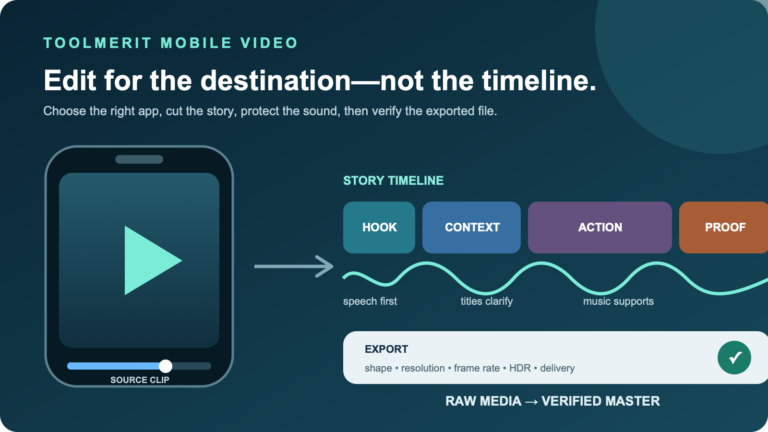
Make a structural edit before polishing individual noises. Remove false starts, duplicated explanations, irrelevant detours, and sections that fail the episode promise. Then improve pacing, repair distracting noise where practical, balance voices, and add only music or effects you have the right to use. Over-processing cannot rescue an unclear conversation.
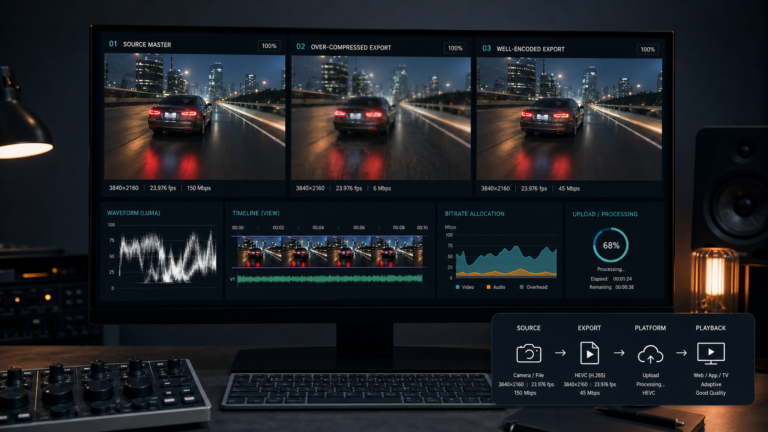
Keep an archival master and create a distribution copy. Apple Podcasts currently accepts MP3 or AAC for RSS-distributed episodes; its audio requirements list example MP3 data rates of 96–128 Kbps for mono and 128–256 Kbps for stereo. Those are delivery parameters, not reasons to convert a poor recording repeatedly. Export once from the highest-quality edited master you retain.
Listen to the final file through headphones, a phone speaker, and at low volume. Verify the opening, one middle transition, the ending, inserted clips, ads, and the complete duration. Check that private pre-roll conversation and editing notes are absent.
Choose a host by control and recovery
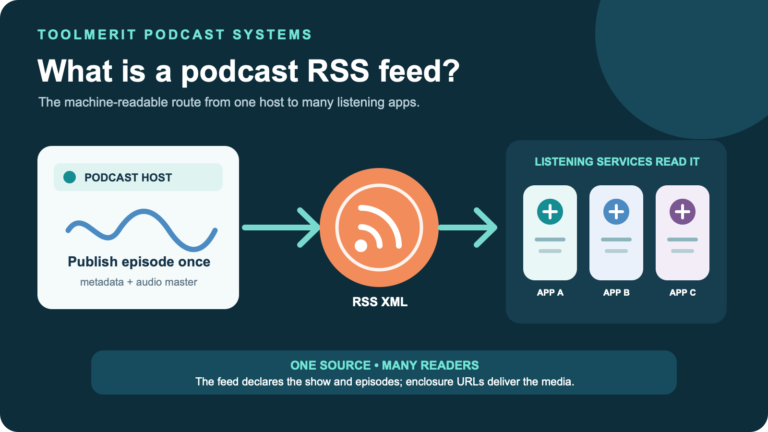
A podcast host stores the media, produces the RSS feed, and usually supplies publishing and analytics tools. Listening apps read the feed. Before buying a plan, test the operational questions below rather than comparing storage headlines:
- Can you export episode metadata and download original or high-quality audio?
- Can you use a show email and accounts that the organization controls?
- Does the host support a permanent redirect when you leave?
- Will existing episode GUIDs remain unchanged during migration?
- What happens to the feed, audio, and analytics after cancellation?
- Can collaborators have separate permissions and multifactor authentication?
- Which measurements are platform-specific, and which are host estimates?
Feed portability is not an abstract concern. Apple’s feed-change guidance says a self-hosted move should use an HTTP 301 redirect and the new-feed URL tag for at least four weeks, while retaining original episode GUIDs. Changing GUIDs can create duplicate episodes and damage analytics continuity. Ask a prospective host exactly how it performs that move.
If you use Spotify for Creators, its RSS guidance says a feed is created after the first episode is published, enabling it exposes the email address in the feed, and submission to other platforms is still your responsibility. Use a role-based podcast email, not a private address you cannot afford to expose.
Prepare the feed, artwork, and metadata
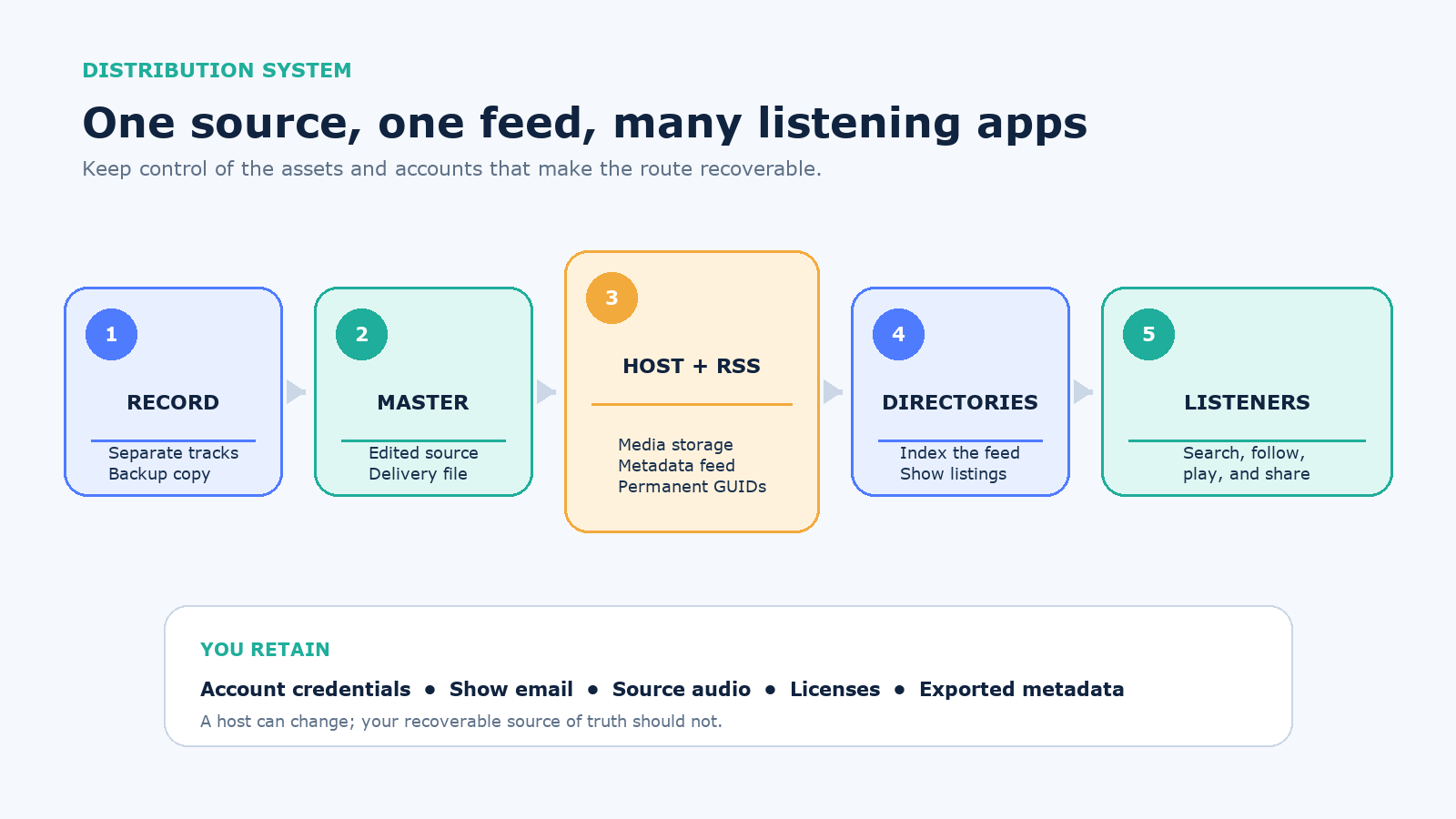
Prepare these assets before directory submission:
- a unique, searchable show title that does not borrow another show’s identity
- a one-sentence promise and a fuller description written for a new listener
- host and publisher names, category, language, explicit-content status, and copyright details
- episode titles that communicate a payoff instead of only “Episode 1”
- an accessible web page with listening links, contact information, and a transcript or useful show notes
- square show artwork that remains legible at small sizes
Apple’s current show-cover specification prefers 3000 × 3000 pixels; RSS submissions may use 1400 × 1400 through 3000 × 3000 pixels. The file must be PNG or JPG with a solid background and no transparency. Test the art at phone-thumbnail size. A detailed poster that looks impressive on a monitor may become visual noise in a listening app.
The Apple RSS requirements also call for a public RSS 2.0 feed, required tags, at least one episode and artwork, unique enclosure information, and a permanent GUID for every episode. The media server must support HEAD and byte-range requests. These details are usually handled by a podcast host, but ownership means knowing where the feed is and how to inspect it.
Validate, submit, and test the listener route
Publish an episode or trailer to the host, open the public RSS URL in a feed validator, and use the major directories’ own submission tools. Apple notes that technical validation checks feed function but does not equal content approval. Resolve every feed error before announcing a launch date.
After approval, test the real route on a device where you are not already signed in:
- Find the show by its title and by the listener’s likely topic query.
- Play from the beginning, seek into the middle, pause, and resume.
- Open the show notes and website link.
- Follow the show and confirm the newest episode appears.
- Check that artwork, author, explicit label, date, and episode order are correct.
Directory availability is not instant or identical. Keep a launch sheet with each directory account owner, submission date, show URL, status, and recovery method. Do not solve a delay by creating a second feed; that can split followers and create duplicate listings.
Clear rights and disclose commercial relationships
“Found online” and “royalty-free” do not by themselves prove permission. The U.S. Copyright Office explains that a musical composition and a particular sound recording are separate protected works. A license for one may not cover the other or your intended podcast, clip, territory, and duration. Keep the license, receipt, source URL, terms, and asset file together.
For sponsors, free products, affiliate links, or other material relationships, make the disclosure understandable and close to the endorsement. The FTC’s endorsement guidance says disclosures must be clear and conspicuous and endorsements must be honest and not misleading. Put an audible disclosure in the episode when the endorsement is heard; repeating it in show notes can improve the record but should not hide the spoken relationship.
Use a launch gate, then improve on a fixed review cycle
| Launch gate | Ready means | If not ready |
|---|---|---|
| Editorial | Three pilots prove the promise and six more episode questions are viable | Change the premise or format before branding |
| Production | Recording, backup, edit, export, and file naming have been repeated successfully | Run another private pilot |
| Ownership | You control the host, RSS address, show email, source files, and recovery credentials | Move access to organization-controlled accounts |
| Distribution | The feed validates and a device test confirms playback, artwork, metadata, and links | Repair the single feed; do not create a duplicate |
| Rights | Guest permissions, music licenses, credits, and sponsor disclosures are documented | Replace or remove unclear material |
| Continuity | The next episode has an owner, outline, recording date, and publication target | Delay the announcement |
Launch with a trailer and two or three complete episodes if that helps a new listener understand the range of the show, but do not manufacture volume you cannot sustain. Review the first three public episodes for listener questions, completion patterns where reliable, production hours, correction requests, and which parts people quote or share. Change one variable at a time so you can learn what improved the result.
Your next action is not to buy a microphone. Write the listener promise and 12 episode questions, select three that test different demands on the format, and put their recording dates on a calendar. If those pilots survive the launch gate, the show is ready for a name, artwork, feed, and audience.