
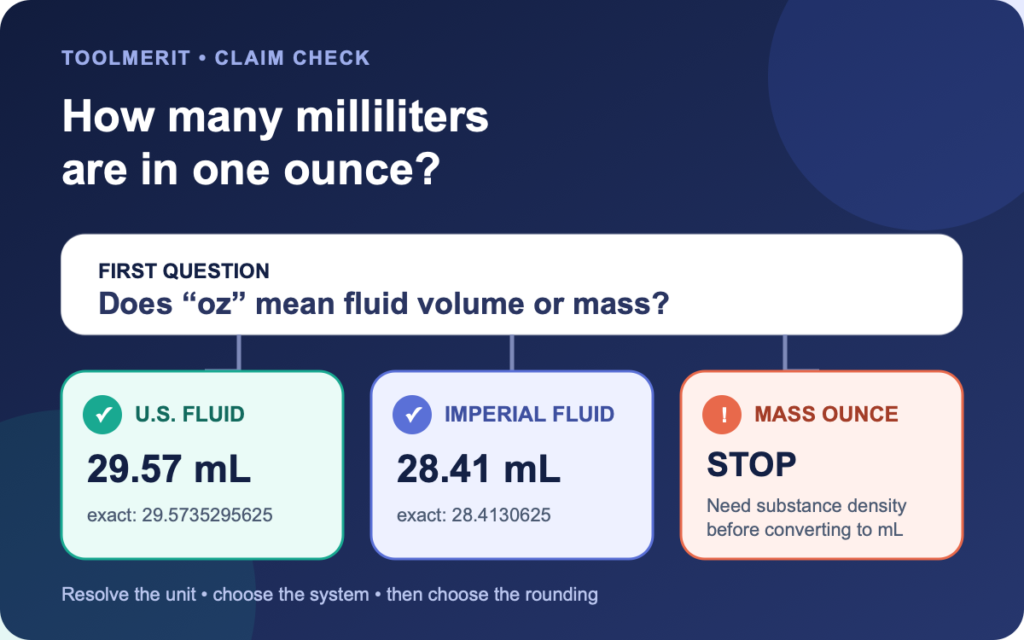
A one-ounce claim-check method for deciding whether 29.57, 30, or 28.41 mL is correct—and rejecting weight-ounce conversions without density.
The word ounce is incomplete for this conversion. A milliliter measures volume, while an unqualified ounce often measures mass. Even after you confirm fluid ounce, the US and Imperial systems assign different volumes to that name.
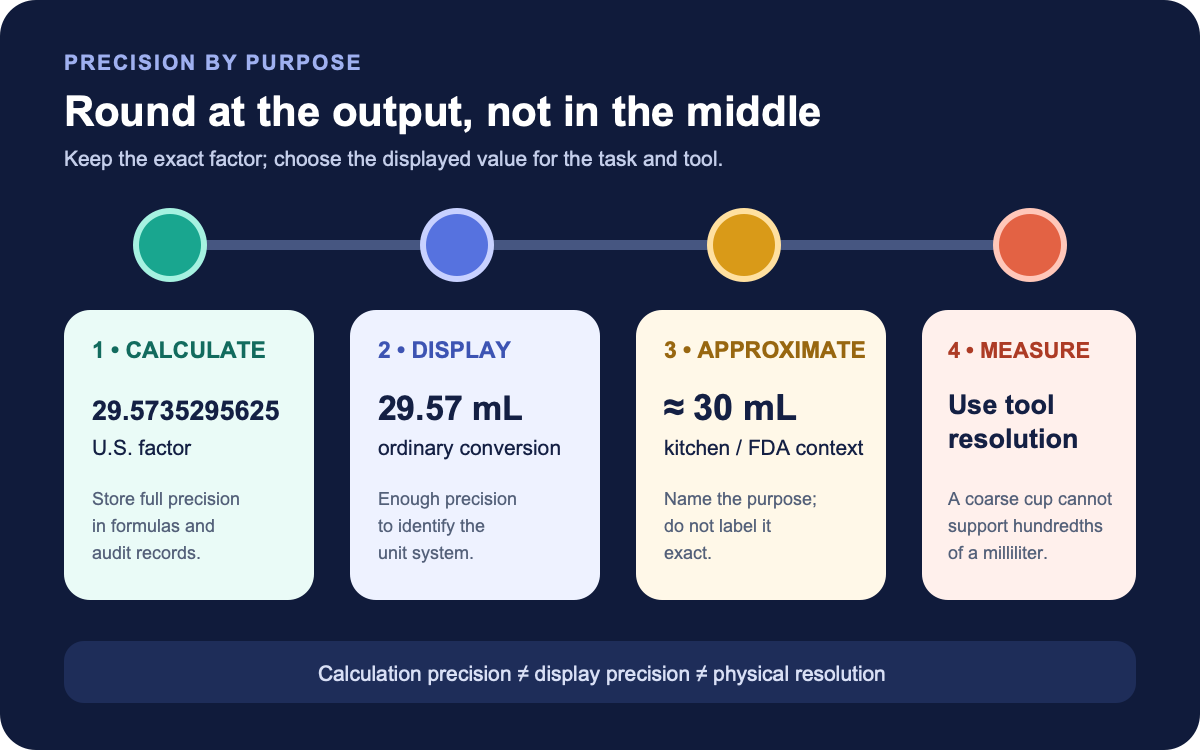
One US fluid ounce equals exactly 29.5735295625 milliliters, usually rounded to 29.57 mL or about 30 mL. One Imperial fluid ounce equals exactly 28.4130625 mL. If “ounce” means weight rather than fluid volume, there is no universal mL equivalent; the substance’s density is required.
This page has a narrow job: audit a claim about one ounce. It shows how to decide whether 29.57, 30, 28.41, or a different number is defensible from the source text, unit system, and rounding purpose.
Start with the missing word: fluid
Do not convert until the source identifies the kind of quantity. Look for fl oz, fluid ounce, a liquid container, or a capacity statement. Plain oz on a food’s net weight, parcel, ingredient mass, or scale reading normally means an avoirdupois mass ounce.
| Source wording | Quantity type | Can it become mL directly? | What is missing? |
|---|---|---|---|
| 1 US fl oz water | US fluid volume | Yes | Nothing; use the US factor |
| 1 Imperial fl oz syrup | Imperial fluid volume | Yes | Nothing; use the Imperial factor |
| Net wt 1 oz nuts | Mass | No | Density and a reason to express volume |
| 1 oz oil | Ambiguous | Not yet | Whether oz means mass or fluid volume, plus the fluid-ounce system if applicable |
Mass and volume can be connected only when density is known for the relevant substance and conditions. If the source means mass, recognize the weight ounce used inside a pound and keep weight quantities on the pounds-and-grams path. A similar-looking abbreviation can also change the dimension: separate milligrams from milliliters before calculating.
Audit the number instead of memorizing it
Compare the claimed value with this verdict table. A rounded answer is not automatically wrong, but its purpose must be visible.
| Claim for 1 ounce | Likely meaning | Verdict |
|---|---|---|
| 29.5735295625 mL | Exact US fluid ounce | Exact conversion factor |
| 29.57 mL | US fluid ounce rounded to two decimals | Good for ordinary numerical conversion |
| 29.6 mL | US fluid ounce rounded to one decimal | Acceptable when one decimal matches the reporting precision |
| 30 mL | Household approximation or a defined nutrition-label convention | Useful in that context; not the exact physical factor |
| 28.4130625 mL | Exact Imperial fluid ounce | Exact conversion factor |
| 28.41 mL | Imperial fluid ounce rounded to two decimals | Good when the source explicitly uses Imperial units |
| 28.35 mL | Likely confusion with the gram value of a weight ounce | Reject as a fluid-volume conversion |
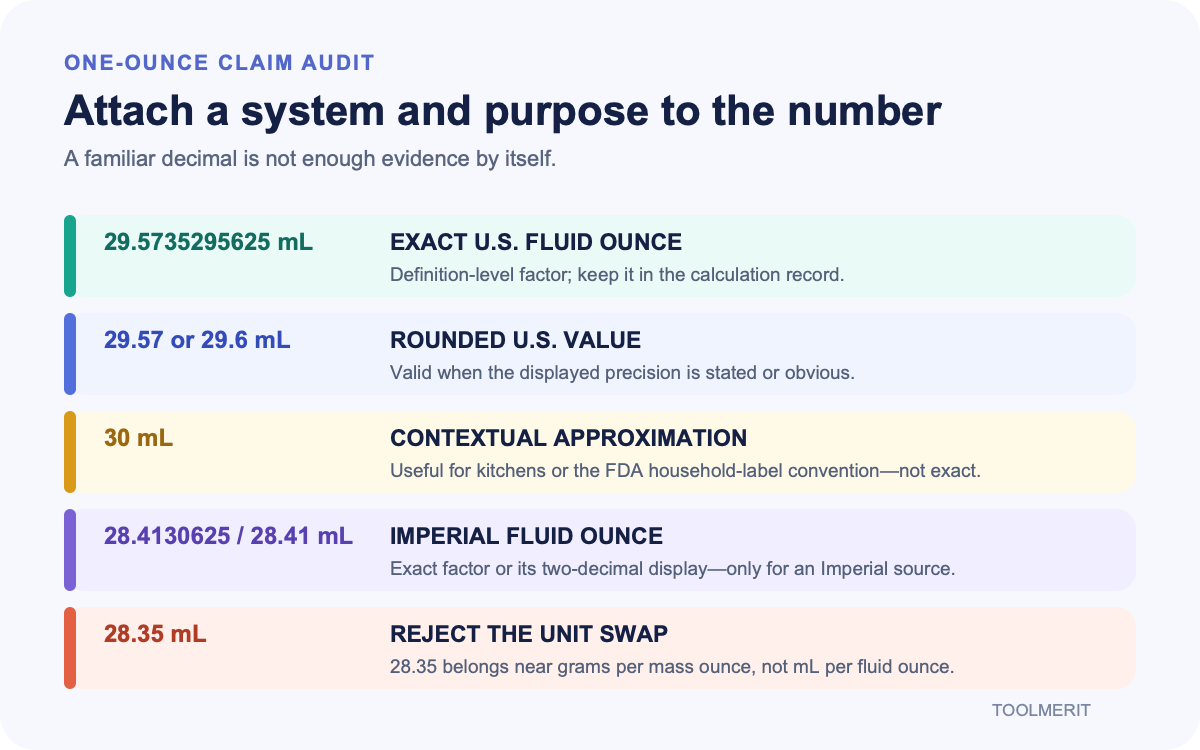
The FDA’s household-measure guidance for nutrition labels defines 1 fluid ounce as 30 mL for that labeling purpose. NIST’s general approximate conversion table gives 29.57 mL. These sources are not contradicting each other: one supplies a context-specific household convention; the other supplies a closer numerical conversion.
If your task is to understand all the contexts rather than audit one statement, compare why 29.57, 30, and 28.41 mL all appear. The current page instead asks a stricter question: does the source’s particular number support the claim it makes?
Derive both exact values from their definitions
An independent derivation is stronger than copying a converter result. For the US system, NIST’s 2026 general tables of units identify one US gallon as exactly 231 cubic inches and exactly 128 US fluid ounces. Because one inch is exactly 2.54 centimeters, one cubic inch is exactly 16.387064 cubic centimeters, and NIST identifies 1 mL with 1 cm³.
The US chain is therefore:
(231 × 16.387064 mL) ÷ 128 = 29.5735295625 mL per US fl oz
For the Imperial system, the traditional official definition chain sets one gallon at 4.54609 liters, one pint at one-eighth of a gallon, and one fluid ounce at one-twentieth of a pint. The calculation is:
(4.54609 L × 1,000 mL/L) ÷ 160 = 28.4130625 mL per Imperial fl oz
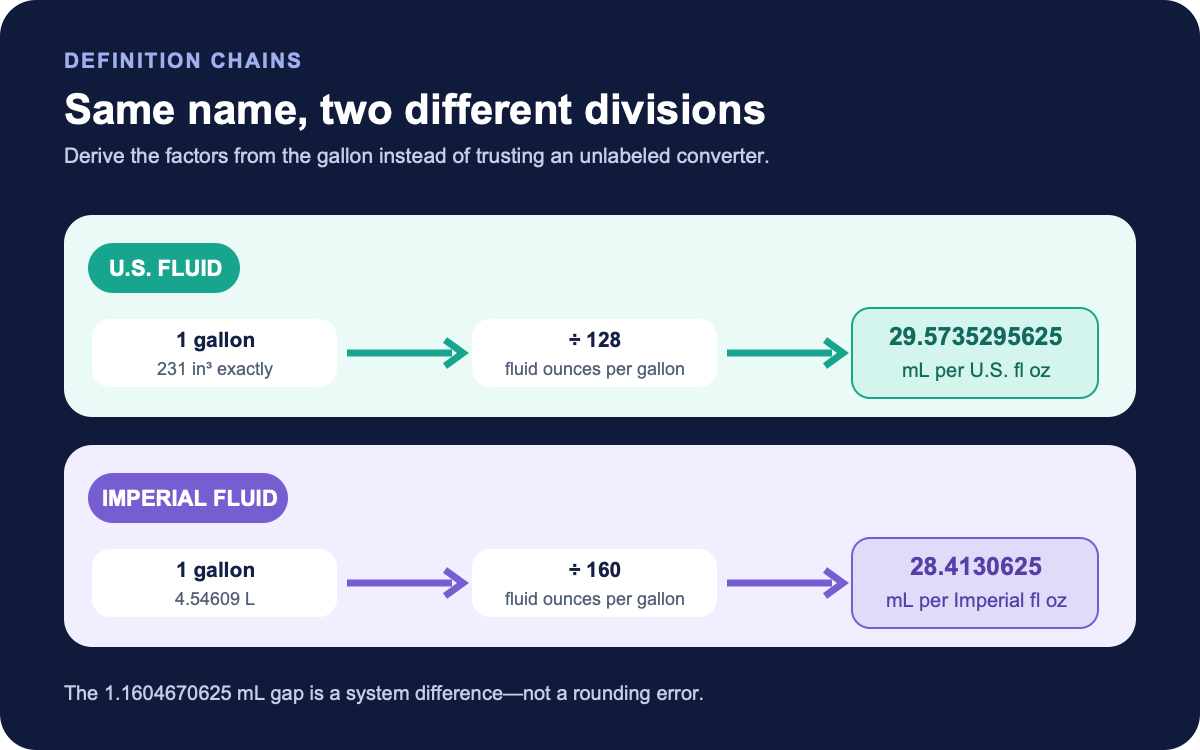
The UK Weights and Measures Act definition table records the 4.54609-cubic-decimeter gallon and the one-twentieth-pint fluid ounce. NIST’s alphabetical conversion factors independently lists both US and Imperial fluid ounces as different milliliter quantities.
This system split appears in larger kitchen units too. To see why a familiar capacity name can still be ambiguous, see how system identity also changes pint conversions.
Reverse-check a one-ounce claim
A forward conversion multiplies fluid ounces by milliliters per fluid ounce. A claim audit runs the operation backward:
claimed mL ÷ official mL-per-fl-oz factor = reconstructed fluid ounces
| Claim | System checked | Reverse result | Interpretation |
|---|---|---|---|
| 29.57 mL | US | 29.57 ÷ 29.5735295625 ≈ 0.99988 fl oz | Normal two-decimal rounding of one US fl oz |
| 30 mL | US | 30 ÷ 29.5735295625 ≈ 1.01442 fl oz | About 1.44% above the exact factor; suitable only as an explicit approximation or convention |
| 28.41 mL | Imperial | 28.41 ÷ 28.4130625 ≈ 0.99989 fl oz | Normal two-decimal rounding of one Imperial fl oz |
| 28.41 mL | US | 28.41 ÷ 29.5735295625 ≈ 0.96066 fl oz | Not a US one-fluid-ounce result |
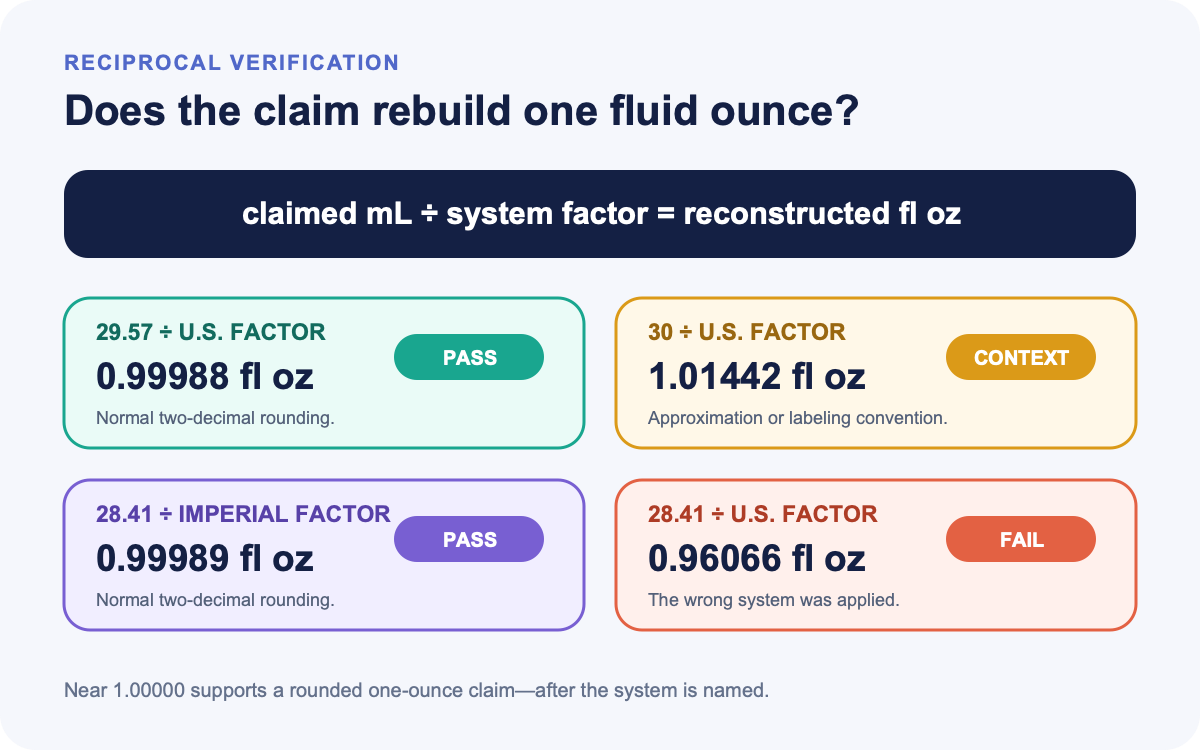
Keep more digits than you plan to display during the check. A difference caused by final rounding is expected; a difference caused by using the other unit system is not. For quantities other than one ounce, use the full US-and-Imperial conversion guide for other amounts. For repeated audits, build the reverse check into an Excel table with separate columns for source text, system, factor, raw result, displayed result, and verdict.
Choose rounding from the purpose, not habit
The exact factor belongs in the calculation record. The displayed answer should match the decision and the measuring method.
- Reference or reusable formula: store 29.5735295625 for US or 28.4130625 for Imperial; round only the output.
- Ordinary conversion: 29.57 mL or 28.41 mL normally preserves enough precision to identify the system.
- Kitchen estimate: about 30 mL is practical when the recipe does not depend on high precision.
- Nutrition-label household measure: use the convention the applicable rule specifies; the FDA source above uses 30 mL.
- Physical measurement: do not report hundredths of a milliliter from a cup or spoon whose graduations cannot resolve them.
NIST’s volume-unit guidance identifies the preferred symbol as mL and equates 1 mL with 1 cm³. Its SI writing guidance says to place a space between the number and symbol—29.57 mL, not 29.57mL—and not to pluralize the symbol.
For an everyday recipe, you may also need to continue recipe scaling with cups and pints. Keep the same US or Imperial system throughout instead of switching systems at each convenient rounded value.
Repair claims that look plausible
“1 oz = 29.57 mL.” Repair it to “1 US fluid ounce = 29.57 mL, rounded.” The missing word and system are part of the fact.
“1 fl oz is exactly 30 mL.” Repair it to “1 US fluid ounce is about 30 mL for household use” or name the nutrition-label convention. Exactness and convenience are different claims.
“1 Imperial oz = 29.57 mL.” Replace the factor with 28.4130625 mL before rounding. The error is a system substitution.
“1 oz of flour = 29.57 mL.” Stop. The ounce is probably mass, and flour’s bulk volume depends on density, packing, and method. A fluid-ounce factor cannot supply that missing information.
“28.35 mL is one ounce.” Check whether someone copied the approximate gram value of one avoirdupois ounce and changed the unit label. Numbers do not become volume merely because mL is appended.
Record a verdict someone else can reproduce
A trustworthy one-ounce check needs six fields:
- Source text: copy the original quantity and nearby context.
- Quantity type: fluid volume, mass, or unresolved.
- System: US, Imperial, or not applicable.
- Reference factor: include units and source.
- Arithmetic and rounding: preserve the raw result and state the display rule.
- Verdict: exact, valid rounded value, context-specific approximation, wrong system, or unsupported.
Example: “Recipe says 1 fl oz; US cookbook; factor 29.5735295625 mL/US fl oz; raw result 29.5735295625 mL; rounded to nearest whole milliliter; verdict 30 mL is a valid kitchen approximation.” That record explains both the answer and its limit.
If the source gives container dimensions instead of a capacity, calculate container volume when no capacity is stated, then convert that result. Do not infer US fluid ounce, Imperial fluid ounce, or mass from the bare letters oz. When the source remains ambiguous, the correct audit result is “unit system unresolved,” not a confident decimal.