

One meter equals exactly 100 cm. Use both conversion directions, a reference table, mixed-unit examples, and checks for precision and squared units.
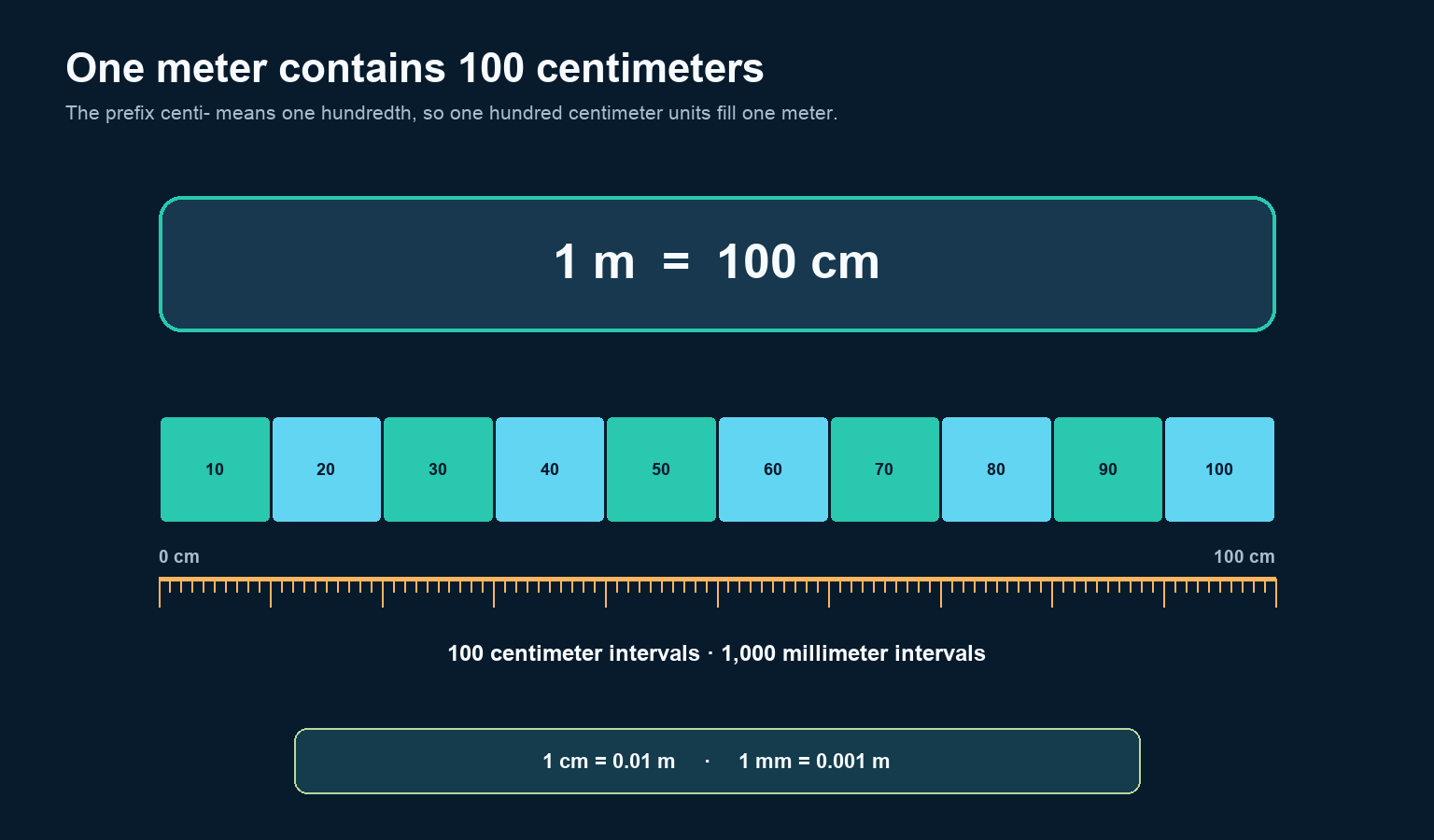
There are exactly 100 centimeters (cm) in 1 meter (m). Multiply a length in meters by 100 to get centimeters; divide a length in centimeters by 100 to get meters. The conversion is exact, not an approximation.
For example, 1.68 m = 168 cm, while 245 cm = 2.45 m. Keep the unit beside the number so the two directions cannot be confused.
Why one meter equals 100 centimeters
The prefix centi means one hundredth: 1 cm = 0.01 m. A hundred lengths of 0.01 m make 1 m. NIST’s SI prefix table lists centi as 10−2, deci as 10−1, and milli as 10−3. Thus 1 m also equals 10 dm or 1,000 mm.
Convert meters to centimeters
centimeters = meters × 100
Writing the units inside the calculation shows why the result is in centimeters: 1.68 m × (100 cm / 1 m) = 168 cm. The meter units cancel. In decimal notation, multiplication by 100 moves the decimal point two places to the right.
| Meters | Centimeters |
|---|---|
| 0.01 m | 1 cm |
| 0.1 m | 10 cm |
| 0.3 m | 30 cm |
| 0.5 m | 50 cm |
| 0.75 m | 75 cm |
| 1 m | 100 cm |
| 1.25 m | 125 cm |
| 1.5 m | 150 cm |
| 1.68 m | 168 cm |
| 2 m | 200 cm |
| 2.5 m | 250 cm |
| 2.7 m | 270 cm |
| 10 m | 1,000 cm |
| 12 m | 1,200 cm |
Convert centimeters to meters
meters = centimeters ÷ 100
For example, 45 cm ÷ 100 = 0.45 m, and 250 cm ÷ 100 = 2.5 m. In factor-label notation, 245 cm × (1 m / 100 cm) = 2.45 m. Centimeters cancel, leaving meters.
For a positive length, the number gets smaller in this direction because a meter is the larger unit. Zero remains zero in either direction.
Convert a mixed measurement
If a note says 2 m 35 cm, convert the meter portion first: (2 × 100) + 35 = 235 cm. Dividing by 100 gives 2.35 m, not 2.35 cm.
To express 235 cm as meters plus a remainder, take the whole-number quotient of 235 ÷ 100: 2 whole meters, with 35 cm left. For a specification or calculation, the single-unit forms 235 cm and 2.35 m are clearer than carrying mixed units forward.
Three checks that catch conversion mistakes
- Direction: the same positive length needs 100 times as many centimeters as meters. A result of 0.02 cm for 2 m is wrong; it should be 200 cm.
- Benchmark: compare with 1 m = 100 cm. Half a meter must be 50 cm, and 0.4 m must be 40 cm.
- Reverse: undo your calculation. If 3.2 m becomes 320 cm, then 320 ÷ 100 should return 3.2 m.
Do not use 100 for square or cubic units
The linear factor is applied once per dimension. A one-meter square contains 100 rows of 100 one-centimeter squares; a one-meter cube has another dimension of 100.
- Length: 1 m = 100 cm
- Area: 1 m² = 100 × 100 cm² = 10,000 cm²
- Volume: 1 m³ = 100 × 100 × 100 cm³ = 1,000,000 cm³
A factor of 100 alone is wrong for either m² to cm² or m³ to cm³. NIST’s prefix and unit-symbol rules explain that the prefix remains part of the unit when it is raised to a power.
Measure first, then convert without adding false precision
Conversion changes the unit, not the quality of the reading. If 1.2 m was measured only to the nearest 0.1 m, report the result as 120 cm, measured to the nearest 10 cm. Writing 120.000 cm would imply detail that the measurement did not establish. NIST’s conversion and rounding guidance distinguishes the computed number from the justified precision of the original value.
Measure from the scale’s zero mark, which may not coincide with a ruler’s physical edge. If you start at another mark, subtract the starting reading: an endpoint at 37 cm with a start at 5 cm gives 32 cm, or 0.32 m. Keep the scale aligned with the length being measured; an angled reading measures a different path.
A conversion cannot correct damaged equipment, stretch, or misalignment. For practical marking and comparisons with a yard, use the separate guide to measuring and visualizing one meter.
Write meter and centimeter symbols correctly
Use lowercase m and cm. Join the prefix to the unit symbol, but separate the number from it: 25 cm, not 25cm or 25 c m. Symbols do not take a plural s or an abbreviation period; a period may still end the sentence. Write a leading zero in 0.5 m.
These conventions follow NIST’s rules for expressing quantities. If a form already labels a field “Length (cm),” enter the numerical value there rather than changing the unit: a length of 1.68 m calls for 168, not 1.68.
Common centimeter equivalents
For adjacent units: 1 mm = 0.1 cm; 1 dm = 10 cm; 1 km = 100,000 cm. These follow the same decimal-prefix relationships. For inches, the separate exact factor is 1 in = 2.54 cm; see inch-to-centimeter conversion, including fractions when the original measurement is in inches.