

A practical source-verification guide for separating discovery, peer review, publication status and evidence quality in Google Scholar results.

“Scholarly” and “peer reviewed” are often used as if they mean the same thing. They do not. A dissertation can be scholarly without being a journal article. A preprint can report serious research before journal peer review. An editorial can appear on a journal website without receiving the review used for original research.
Google Scholar is a scholarly-literature search engine, but a result appearing there is not automatic proof that it is peer reviewed or reliable. Scholar can include journal and conference papers, theses, academic books, preprints, abstracts, technical reports, patents, and court opinions. Verify the document type, the venue’s review policy, the exact version and DOI, any corrections or retractions, and whether the study’s methods actually support your claim.
Google Scholar is a discovery index, not a certification
Google describes Scholar as a way to search scholarly literature across disciplines and sources. Its documented coverage is deliberately broad: journal and conference papers, theses and dissertations, books, preprints, abstracts, reports, court opinions and patents can all appear. That breadth is why Scholar is useful for finding versions, citations and literature outside one subscription database.
Indexing and evaluation are different jobs. Scholar’s systems find, parse, group and rank records from publishers, repositories, universities and other sites. The result page does not perform a new peer review of each work. It also cannot guarantee uninterrupted coverage of every source. Treat inclusion as a discovery signal: the item resembles or belongs to scholarly literature and still needs classification.
Scholarly, peer reviewed, published, and reliable are different claims
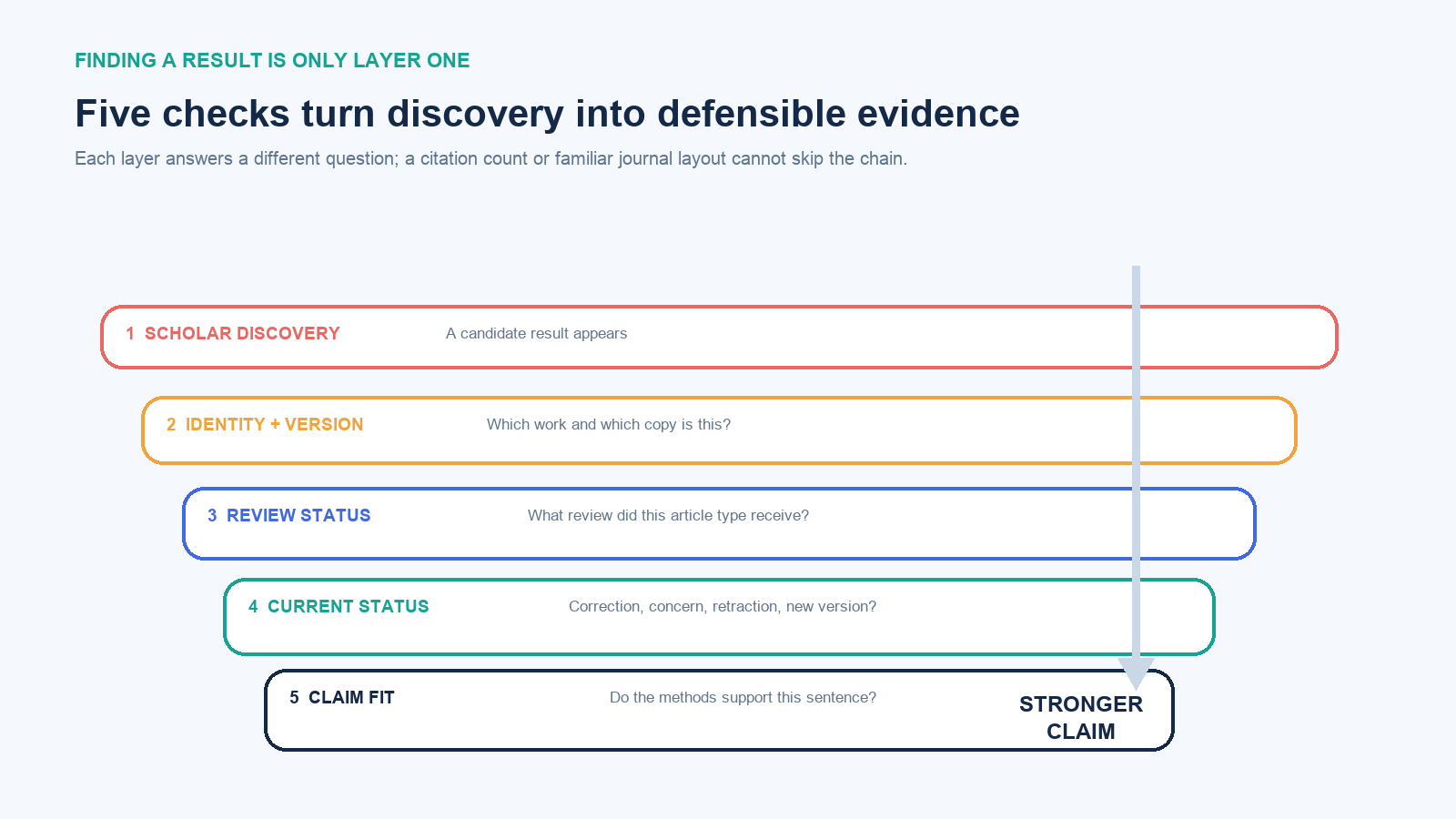
- Scholarly usually describes work created for an academic or professional knowledge community, commonly with authorship, references and an evidence-based argument.
- Peer reviewed means relevant experts evaluated a manuscript under a stated editorial process before acceptance. The model and rigor vary by venue, discipline and article type.
- Published means a work was made publicly available. A preprint, repository manuscript and final journal article are all published in the ordinary sense, but they represent different stages.
- Current means you checked whether the work has a correction, new version, expression of concern, withdrawal or retraction.
- Reliable for this claim means the methods, data and scope adequately support the exact statement you intend to make. Peer review improves scrutiny; it is not a guarantee of truth or applicability.
These are cumulative questions, not interchangeable badges. A peer-reviewed study can be too small, too old or aimed at the wrong population. A high-quality government technical report may be strong evidence without journal peer review. State what the source actually is rather than granting it a vague label.
Identify the document type first
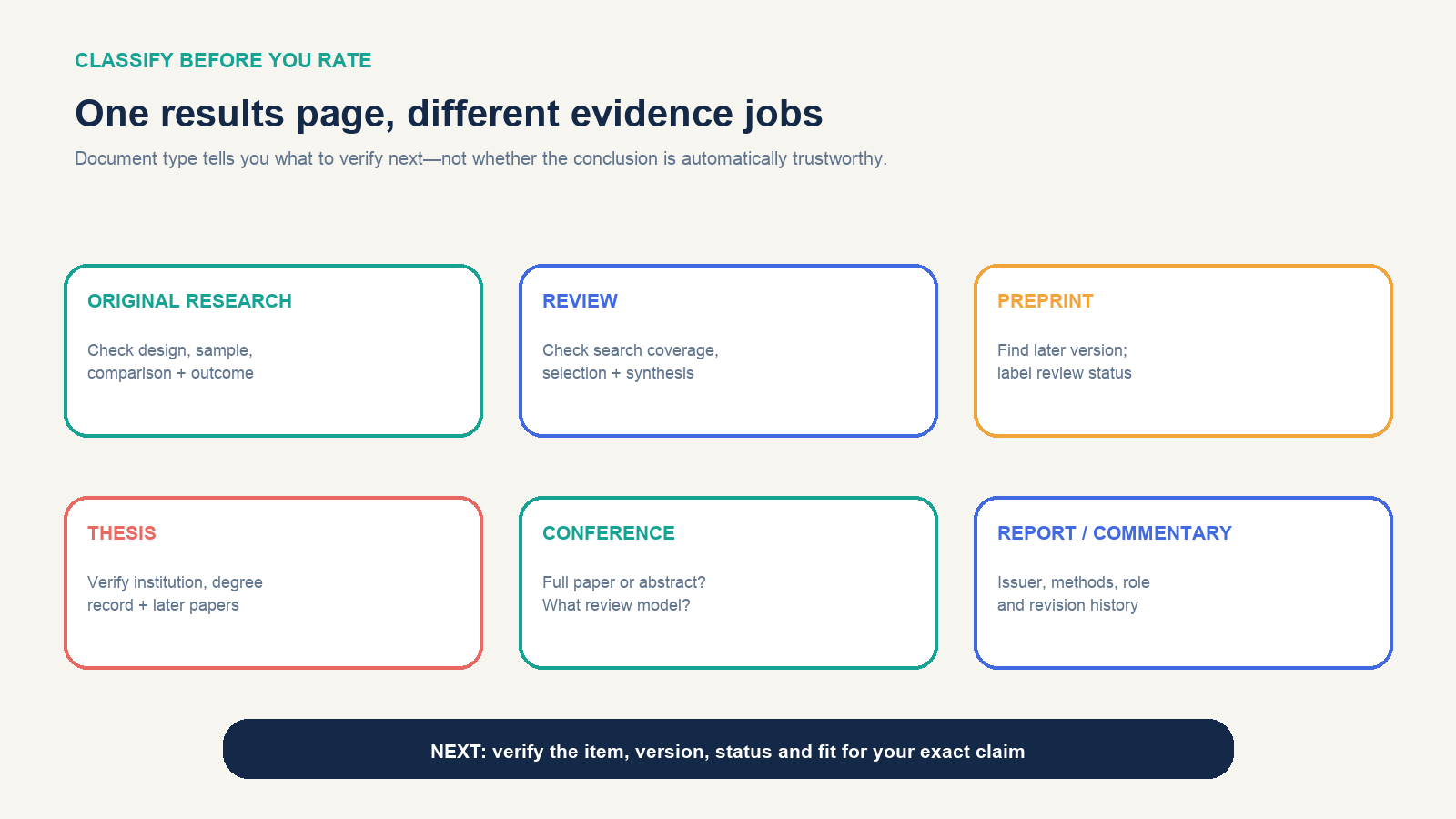
| Result type | What it may offer | What to verify next |
|---|---|---|
| Original journal research | Primary methods, data and results | Article type, peer-review policy, design, sample, analyses and update status |
| Review or meta-analysis | A synthesis of multiple studies | Search coverage, inclusion criteria, appraisal method, heterogeneity and currency |
| Preprint or working paper | Early access to emerging work | Whether it was reviewed later, which version you read and whether findings changed |
| Thesis or dissertation | Detailed methods, data and literature context | Institution, degree record, committee process and whether later publications supersede it |
| Conference paper | Recent or field-specific work | Full paper versus abstract, review model, maturity and subsequent journal version |
| Technical or government report | Operational data, standards or policy analysis | Issuing body, authors, methods, review statement, revision history and conflicts |
| Editorial, letter, commentary or book review | Interpretation, debate or expert position | Whether it contains original evidence and whether the assignment permits this source type |
Do not infer type from the PDF’s visual design. Open the landing page and look for labels such as Research Article, Review, Editorial, Proceedings, Preprint, Thesis or Report. In biomedical searching, PubMed exposes publication types such as clinical trial, review, preprint, editorial, letter, correction and retracted publication. A specialist index can therefore clarify a result that Scholar presents more generically.
Verify peer review at the journal and article level
Start with the journal’s own editorial or peer-review policy, reached from its official website rather than an advertising directory. A transparent policy should say whether content is reviewed, who reviews it, which model is used, how decisions are made and whether some article types are exceptions. DOAJ’s transparency principles explicitly call for journals to disclose these details.
Then verify the particular item. A journal can peer review research articles while handling editorials, corrections, letters or invited material differently. Look for the article-type label and, when available, submitted, revised and accepted dates. Some journals publish reviewer reports or editorial histories; others use anonymous review. The absence of public reviews is not proof that review did not occur, and a journal-level policy is not proof that every page received identical treatment.
Avoid weak shortcuts:
- A university repository copy does not tell you whether that version was peer reviewed.
- A DOI identifies a registered object; having one does not certify research quality or peer review.
- Open access describes how readers can access the work, not whether the methods are sound.
- A journal title that sounds prestigious is not enough; verify the exact site, publisher and policy.
For an unfamiliar open-access journal, a current DOAJ record can add evidence that the journal passed DOAJ’s inclusion and transparency review. It is still not a substitute for reading the article or checking its specific type.
Match the work and the version
Scholar may group a preprint, accepted manuscript, repository copy and final publisher record under All versions. Citation counts may also be combined across versions. Before using the source, write down the title, authors, year, venue and persistent identifier, then compare them with the document itself.
- Open the publisher or repository landing page, not only a downloaded PDF.
- Resolve the DOI when one is present and compare title, author order, venue, date, volume, issue and pages.
- Label the version you read: preprint, accepted manuscript, version of record, corrected version or another edition.
- Check whether a later journal article supersedes an earlier conference paper or thesis chapter.
- Cite the version that supports your claim and that your reader can identify.
Crossref records many scholarly content types, including journal articles, books, proceedings, datasets, reviews of manuscripts, posted content, reports and dissertations. That variety is another reason a DOI lookup establishes identity, not a universal quality grade.
Check what happened after publication
A paper’s status can change. On the publisher page, search for Correction, Erratum, Expression of Concern, Retraction, Withdrawal, New Version or an update notice. Follow the links in both directions: from the article to the notice and from the notice back to the affected article.
If the page or PDF carries a Crossmark button, open it. Crossref explains that Crossmark can expose corrections, retractions and other significant updates registered by participating publishers. It can also provide editorial metadata. Crossref cautions that Crossmark’s presence is not itself a guarantee, so combine it with the publisher record and a relevant disciplinary database.
For health research, PubMed records publication types and links such as retraction notices, corrected articles and expressions of concern when available. For any discipline, search the exact title and DOI together with terms such as correction, retraction or expression of concern. A PDF saved months ago should not be assumed current merely because the file opens.
Evaluate the evidence, not only the container
Once identity and status are clear, compare the study with the claim you want to make. Write the proposed sentence first, then inspect:
- Population or material: Who or what was studied, where, and under which inclusion rules?
- Intervention or exposure: What actually happened, at what dose, duration or intensity?
- Comparison: Was there a meaningful control, baseline or alternative explanation?
- Outcome: Was the measured result the same as the outcome in your sentence, or only a proxy?
- Design: Can the design support causation, association, description, prediction or only a hypothesis?
- Magnitude and uncertainty: How large and precise is the result, not merely whether it crossed a significance threshold?
- Transferability: Do the setting, date and constraints resemble the context where you plan to apply it?
- Conflicts and limitations: What funding, competing interests, missing data or author-stated limitations affect interpretation?
A source can pass venue checks and still fail claim fit. If a cross-sectional survey finds an association, do not rewrite it as proof that one variable caused the other. If a laboratory result uses a narrow material or dose, do not silently generalize it to all real-world conditions.
Why citation count is not a quality score
Scholar’s Cited by link is valuable for tracing later research, criticism, replications and applications. The number beside it measures indexed citation relationships, not agreement or validity. Papers accumulate citations at different rates by age, field, language and document type. A work can be cited because it is foundational, convenient, controversial or wrong.
Use the citing literature diagnostically. Read several newer papers and ask whether they reproduce, refine, dispute or merely mention the original. A low count can mean a recent or narrow paper; a high count can point to influence without resolving whether the result supports your particular claim.
A seven-minute Google Scholar source check
- Minute 1—classify: identify the document type and the host.
- Minute 2—match: compare title, authors, venue, date and DOI across the landing page and document.
- Minute 3—review: read the venue’s peer-review policy and check whether this article type is an exception.
- Minute 4—version: determine whether you have a preprint, accepted manuscript or version of record.
- Minute 5—status: look for corrections, concerns, retractions or a later version.
- Minute 6—method: inspect the abstract and methods for design, sample, comparison, outcome and limitations.
- Minute 7—fit: compare those facts with the sentence you intend to support and record any caveat.
This is a screening routine, not a full critical appraisal. If a source fails one check, do not hide the problem. Replace it, narrow the claim, or describe the source accurately—for example, “a 2026 preprint reported” rather than “research proves.”
When the quick check is not enough
Medical, legal, financial, engineering-safety and public-policy decisions require stronger domain-specific evaluation. Use official guidance, specialist databases, applicable standards and qualified professional review. A systematic review requires a documented protocol, multiple databases, reproducible searches, explicit selection rules, critical appraisal and transparent synthesis; browsing Scholar alone cannot establish comprehensive coverage.
For ordinary research, use this decision rule: a Google Scholar result is a candidate source, not a finished credibility judgment. Name its document type, verify its review and version, check its current status, and read the methods against your exact claim. If you cannot complete those checks, describe the uncertainty or choose a source you can verify.