

Google Akademik and Google Scholar are the same service, not separate databases. Use a bilingual query ladder and the right Turkish research source to avoid missing relevant work.

“Google Akademik Scholar” looks like the name of a special Turkish database. It is actually a mixed-language way of asking for the familiar Google academic-search service.
Google Akademik is the Turkish name for Google Scholar, not a separate academic database. Open the official service at scholar.google.com and select Turkish if you want Turkish menus. For a complete topic search, run separate Turkish and English queries, harvest terminology from relevant records, follow Cited by and All versions, and check TR Dizin, DergiPark, or the YÖK National Thesis Center when Turkish journals or theses matter.
Open the right Google Akademik
The safest starting point is scholar.google.com. In Turkish materials, Google itself uses Google Akademik for the product commonly called Google Scholar in English. The country-domain form scholar.google.com.tr may also lead to the service, but a locale is not a different catalog.
Check the address bar before signing in. A result that imitates the Scholar name but asks you to install an extension, pay for “activation,” or enter a university password on an unrelated domain is not the normal route. The official search can be used without creating a Scholar profile; signing in is useful for a library, alerts, and profile features, not for unlocking a supposedly hidden search engine.
If you only need a conventional orientation to the controls, the broader Google Scholar search guide covers exact-title and author searches, citation export, alerts, and lawful full-text routes. This page concentrates on the extra problem introduced by Turkish-English research.
Separate the three language layers
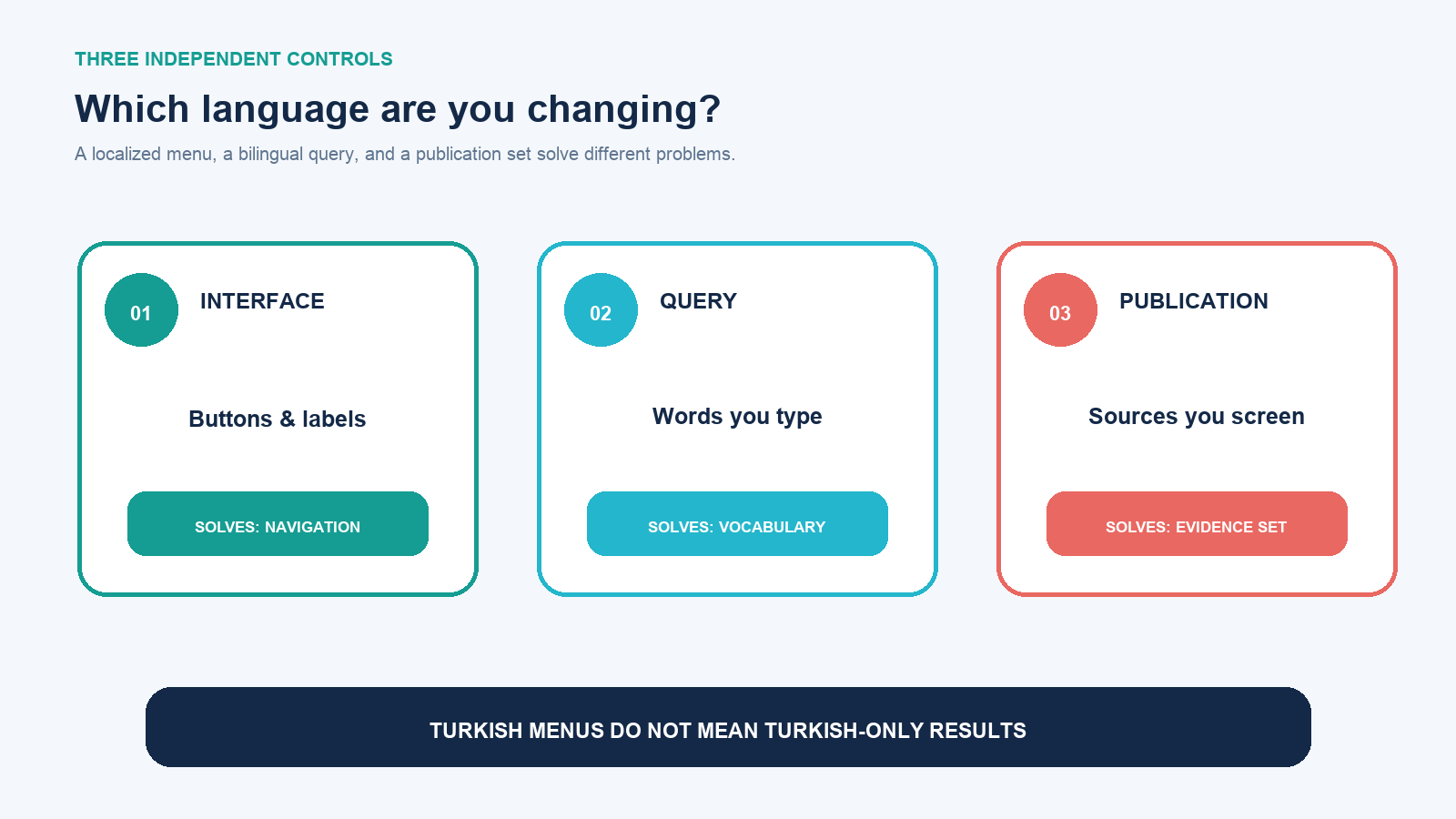
| Layer | What it changes | What it does not guarantee |
|---|---|---|
| Interface language | Labels such as search, date, save, cite, and settings | That results will be written in Turkish |
| Query language | The words Scholar tries to match in titles, abstracts, metadata, and indexed text | That all relevant authors use the same translation |
| Publication language | The language of the paper, thesis, book, or abstract you may need to read | That a full-text copy is freely available |
For Turkish menus, use Scholar’s menu and settings, or open the service with ?hl=tr appended to the base address. A signed-in Google Account can also influence the display language across Google services. If a language keeps reverting, check the Scholar setting, the account’s web-language preference, and any saved locale in the browser; changing one layer does not rewrite the other two.
Avoid interpreting localization as a coverage filter. Google describes Scholar as a broad search across articles, theses, books, abstracts, technical reports, court opinions, publishers, repositories, and universities. That breadth is valuable for discovery, but it also means the result set is heterogeneous. Turkish menus neither certify Turkish sources nor make every indexed item peer reviewed.
Build a query map before you search
A literal translation is a starting hypothesis, not a complete search strategy. Write the research question as two or three concept groups, then add native terminology, common English terminology, spelling variants, and older field language. Consider the sample question: How does teacher self-efficacy relate to online learning in secondary schools?
| Concept | Turkish candidates | English candidates |
|---|---|---|
| Population | öğretmen, ortaöğretim öğretmeni | teacher, secondary-school teacher, high-school teacher |
| Construct | öz yeterlik, özyeterlik, öğretmen yeterliği | self-efficacy, teacher efficacy, teaching efficacy |
| Context | çevrim içi öğrenme, uzaktan eğitim, online eğitim | online learning, distance education, remote teaching |
The spacing variant öz yeterlik/özyeterlik illustrates why exact-phrase searches alone can miss useful records. So do discipline-specific choices: one author may discuss uzaktan eğitim while another uses çevrim içi öğrenme. Record the alternatives instead of silently replacing the original wording.
Start with a compact combination, not every synonym at once. Scholar’s public help documents quotation marks for exact titles and the author: operator for authors. Its Advanced search can constrain author, title, publication, and date fields. Use these controls to answer a specific question—such as whether a known paper exists—not to create a visually complicated query whose logic you cannot later explain.
Run a five-pass bilingual search
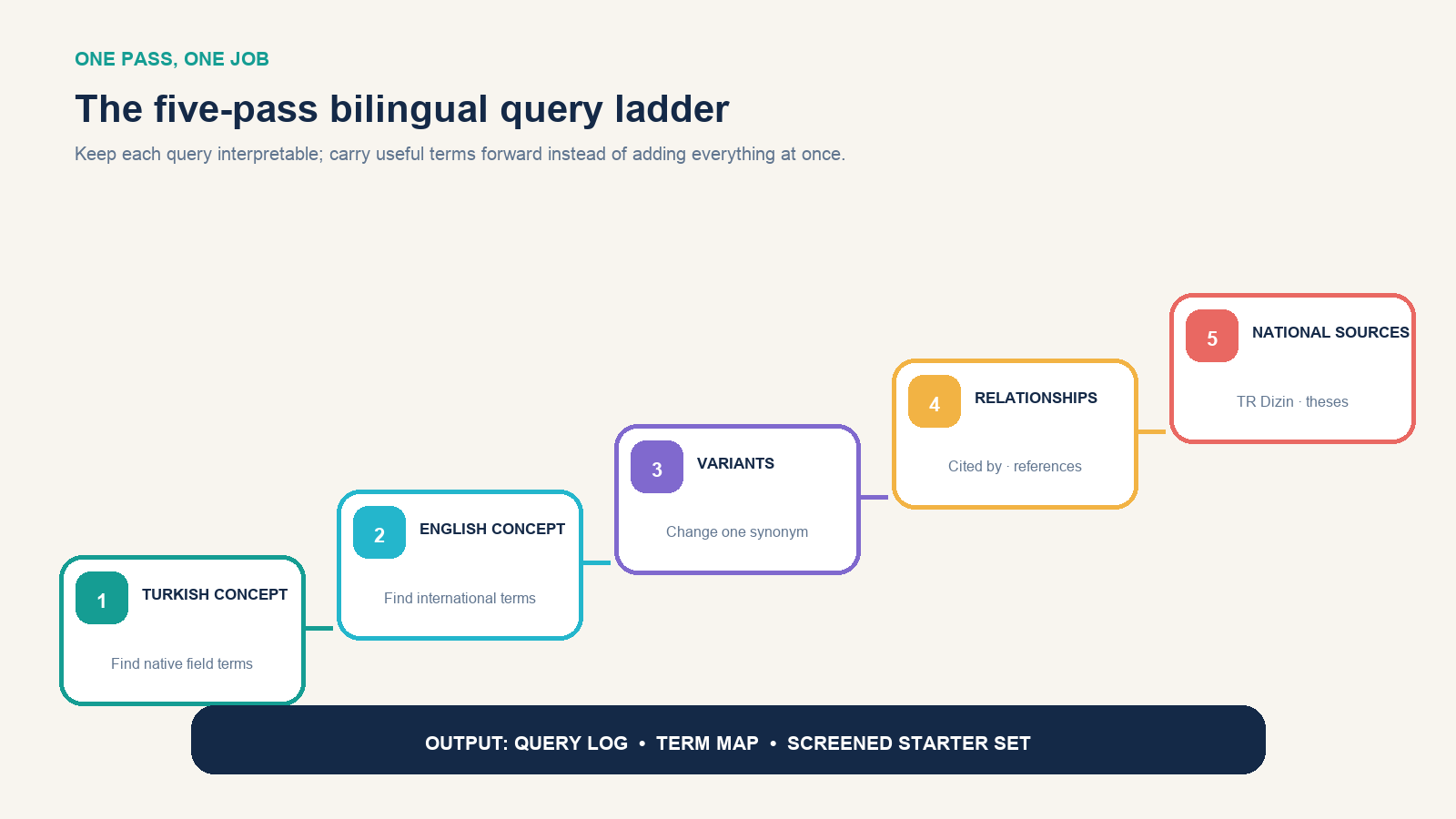
- Native-concept pass: search the clearest Turkish phrase. Scan titles and abstracts for the terminology Turkish authors actually use.
- International-terminology pass: search the leading English combination separately. Note established construct names, instrument names, acronyms, and subject headings.
- Variant pass: rerun the most useful combinations with one synonym changed at a time. Preserve a query log so you know which wording found which paper.
- Relationship pass: on a strong seed paper, use Cited by for later citing work, Related articles for neighboring records, its references for earlier foundations, and All versions for alternate copies.
- Source-specific pass: test the refined Turkish terminology in TR Dizin, DergiPark, and the YÖK thesis catalog when national journal coverage, hosted full text, or graduate theses are part of the question.
Keep relevance sorting for conceptual discovery; use a recent-year limit when the topic changes quickly. “Sort by date” answers a different question—what was added most recently—so do not assume it produces the best evidence. For continuing projects, create an alert from a precise query only after you have removed noisy meanings.
Do not translate proper names, scales, chemical compounds, software names, or standardized instruments unless the literature uses a recognized translated form. Search the original term, the abbreviation, and any validated local version. One well-chosen seed paper can reveal more authentic vocabulary than a generic translator.
Read the result card as a lead, not a verdict
A Scholar result normally presents a title, author and publication line, snippet, and relationship controls. A right-side PDF or HTML link may lead to a repository, publisher, preprint, or another readable version. These are discovery clues. They do not establish that the item is the version of record, passed peer review, remains current, or supports your claim.
Open the record and identify the document type. A thesis, conference abstract, preprint, book chapter, court opinion, and journal article require different evaluation. Compare the title, authors, venue, year, volume, issue, pages or article number, and DOI across the Scholar entry and the publisher or repository. If versions differ, note whether you are reading a submitted manuscript, accepted manuscript, preprint, or final publication.
Citation count is context, not a quality score. Older work has had more time to accumulate citations; a widely cited method can be cited critically; a result may collect duplicate versions; and a new but decisive study may have few citations. The Scholar source-verification guide gives a fuller procedure for checking peer review, corrections, retractions, and claim fit.
Know when Google Akademik is not the final stop
| Need | Best first stop | Why |
|---|---|---|
| Broad international discovery and citation paths | Google Scholar / Google Akademik | Cross-disciplinary reach, versions, cited-by links, and publisher or repository routes |
| Selected Turkish national peer-reviewed journals | TR Dizin | ULAKBİM describes a criteria-based national journal index with bibliographic records and some full text |
| Articles hosted by Turkish academic journals | DergiPark | It provides journal hosting and editorial-process infrastructure; it explicitly does not control each journal’s content |
| Turkish graduate theses | YÖK National Thesis Center | It is the dedicated national collection for organizing graduate theses |
| Definitive publication status | Publisher, journal, DOI record, or repository | The primary record is the right place to check version, corrections, license, and access |
These sources overlap but are not interchangeable. DergiPark hosting does not by itself mean a journal is included in TR Dizin; TR Dizin selection does not mean every item is freely downloadable; a Scholar listing does not certify either status. Search each source for the purpose it is designed to serve.
This is also why a localized label must not drive the entire review. The Spanish and Portuguese naming issue follows the same principle; the Google Académico access guide explains that variant without repeating the Turkish-specific source map here.
Verify a record before treating it as evidence
- Confirm the bibliographic identity: title, full author list, venue, year, pages or article number, and DOI where present.
- Identify the version and document type. Prefer the final record for citation while noting any substantive difference in the copy you read.
- Check the journal or publisher page for peer-review policy, correction, expression of concern, or retraction information.
- Read the methods and results relevant to your question. Do not infer the finding from a title or search snippet.
- Test claim fit: population, setting, intervention or exposure, comparator, outcome, and date should match the statement you intend to make.
- Record why the item was included or excluded. Language alone should not be a hidden exclusion rule.
When the Turkish and English versions of an abstract disagree, do not choose the wording that better supports your argument. Treat the original publication as authoritative unless the publisher identifies a corrected translation, and document any translation judgment that affects interpretation.
Avoid four bilingual-search traps
One-query completeness: a Turkish phrase and its English translation do not have identical semantic boundaries. Run both and compare the vocabulary they expose.
Translation by intuition: everyday equivalents can differ from terms used in a discipline. Harvest wording from authoritative articles, subject thesauri, validated instruments, and specialist databases.
Language-filter blindness: excluding a language for practical reasons may be legitimate, but the resulting review is narrower. State the rule and its likely effect instead of implying universal coverage.
Discovery equals evidence: a polished Scholar result can still be a preprint, an abstract-only record, a duplicate, or a document that mentions the topic without testing it. Verification begins after discovery.
Complete a disciplined first search in 30 minutes
Spend the first five minutes defining the question and listing two concept groups in Turkish and English. Use the next ten minutes for the native and international passes, saving only five to eight strong candidates and recording each query. Spend five minutes harvesting terminology, authors, instruments, and one promising citation trail. Use the next five minutes to repeat the best Turkish terms in the national sources. Reserve the final five minutes to verify two candidate records and write the next query you would run.
The output is not “all the literature.” It is a reproducible starter set: a query log, a bilingual concept map, a few screened records, a list of new terms, and named gaps for the next session. If you cannot reconstruct how a paper entered the set, the search is already too loose.
Use this decision rule: change the interface language when you cannot navigate the controls; change the query language when you are missing vocabulary; change the database when its documented scope better matches the source type you need. Google Akademik gets you into the same Scholar service—good research comes from knowing which of those three problems you are actually solving.