
A complete numerical-fraction method using the greatest common factor, a repeated-factor fallback, boundary cases, mistake repairs, and checked practice.
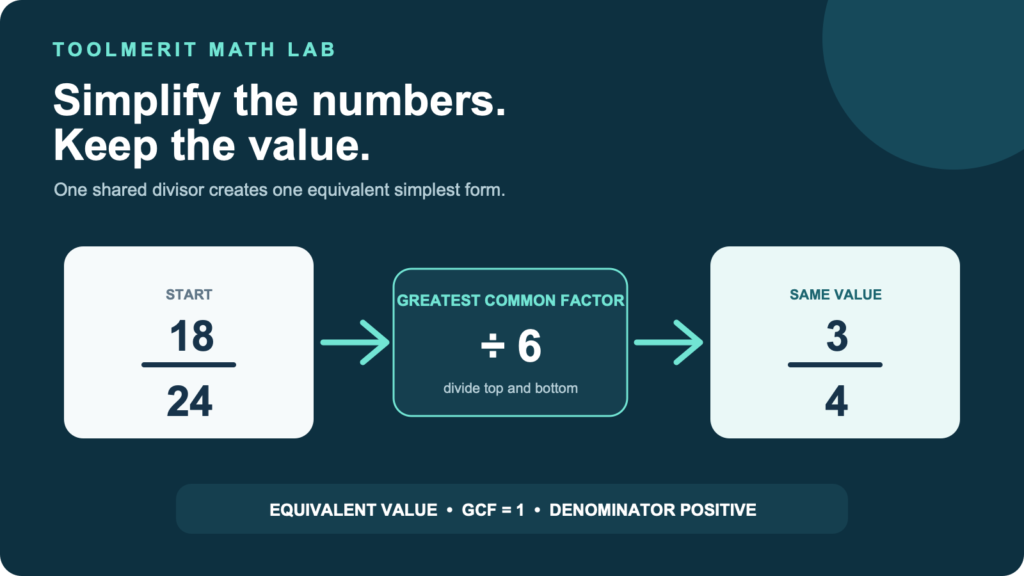
Start with 18/24. The largest whole number that divides both 18 and 24 is 6. Divide the top and bottom by 6:
18/24 = (18 ÷ 6)/(24 ÷ 6) = 3/4
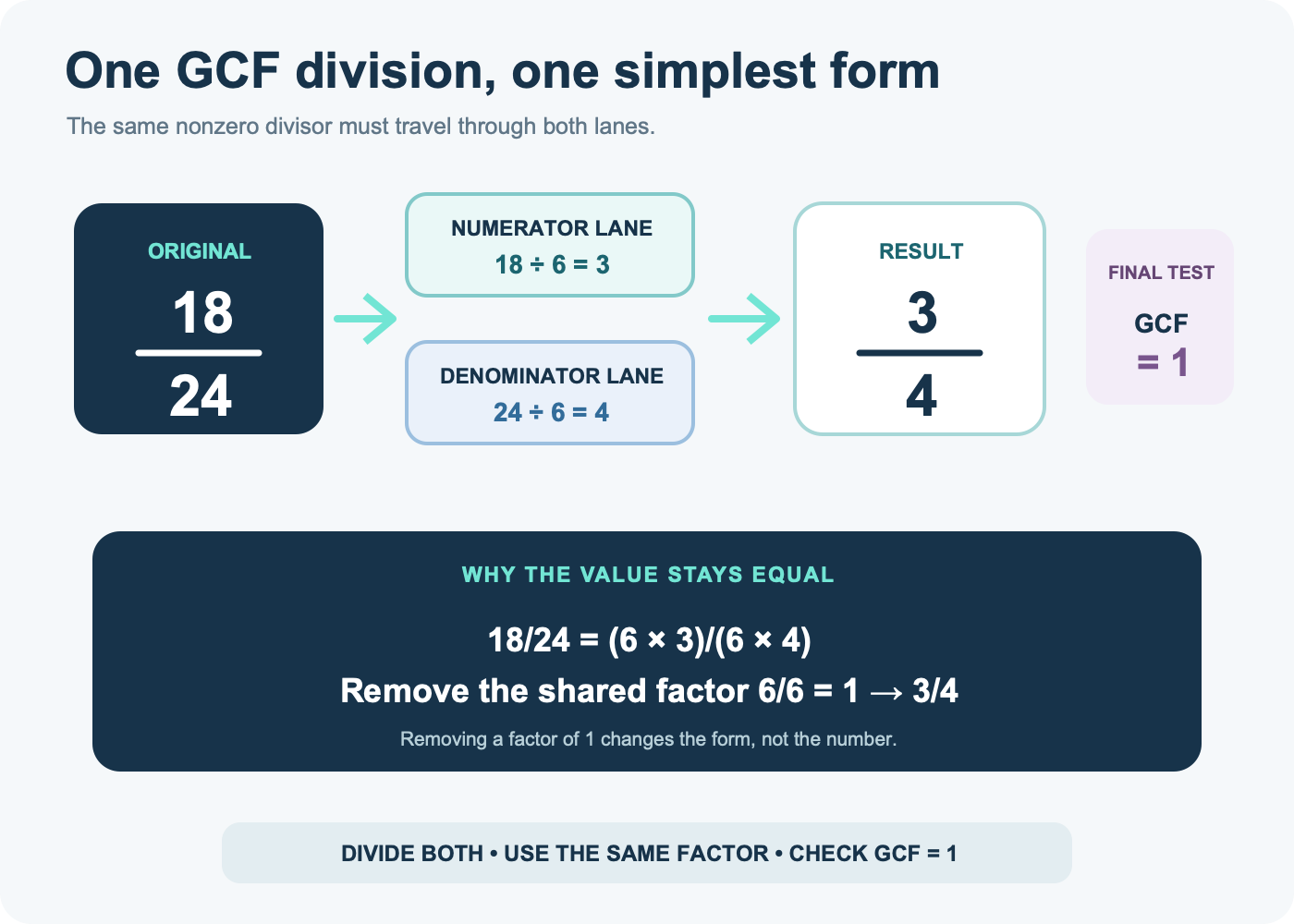
To simplify a fraction, divide the numerator and denominator by their greatest common factor (GCF). For 18/24, the GCF is 6, so (18 ÷ 6)/(24 ÷ 6) = 3/4. The value stays the same because both parts are divided by the same nonzero number. The answer is in simplest form when the numerator and denominator share no factor greater than 1.
That one-pass method handles most ordinary numerical fractions. When the GCF is not obvious, you can divide by smaller common factors repeatedly and reach the same result. This guide covers both routes and the cases that need a different decision.
Know what “simplest form” actually means
For a numerical fraction a/b, the numerator is a, the denominator is b, and b cannot be zero. The fraction is in simplest form when the only positive factor shared by |a| and b is 1. In compact notation:
GCF(|a|, b) = 1, with the denominator written as a positive number.
OpenStax gives the same operational definition: a fraction is simplified when numerator and denominator have no common factor other than 1. “Smaller numbers” are a consequence, not the test. For example, 207/331 has fairly large numbers but is already in simplest form because they share no factor greater than 1.
Simplifying does not change the fraction’s value. It uses the equivalent-fractions principle in reverse. The Common Core fraction-equivalence standard expresses the forward direction as a/b = (n × a)/(n × b) for a nonzero multiplier. Reversing that move means removing the same nonzero factor from both parts.
Simplest form is not the only useful representation; use the fraction-to-percentage workflow when the reader needs a percent instead.
Use the GCF method to simplify in one pass
- Normalize the sign. Put any negative sign in the numerator and keep the denominator positive.
- Find the GCF. Use the absolute value of the numerator and the positive denominator.
- Divide both parts. Divide numerator and denominator by that same GCF.
- Check. Confirm that the new numerator and denominator have no common factor greater than 1.
For 84/126, prime factorization makes the GCF visible:
84 = 2 × 2 × 3 × 7126 = 2 × 3 × 3 × 7- The shared prime factors are
2 × 3 × 7 = 42. (84 ÷ 42)/(126 ÷ 42) = 2/3.
For smaller numbers, listing factors may be faster. The factors of 18 are 1, 2, 3, 6, 9, 18; the factors of 24 are 1, 2, 3, 4, 6, 8, 12, 24. Their greatest shared factor is 6. For larger numbers, prime factorization or a GCF calculator can help, but the final division rule is unchanged.
Use repeated common factors when the GCF is not obvious
You do not have to find the greatest factor first. Divide by any common factor greater than 1, then repeat until no common factor remains:
84/126 → 42/63 → 14/21 → 2/3
- Divide both parts by 2:
84/126 = 42/63. - Divide both parts by 3:
42/63 = 14/21. - Divide both parts by 7:
14/21 = 2/3.
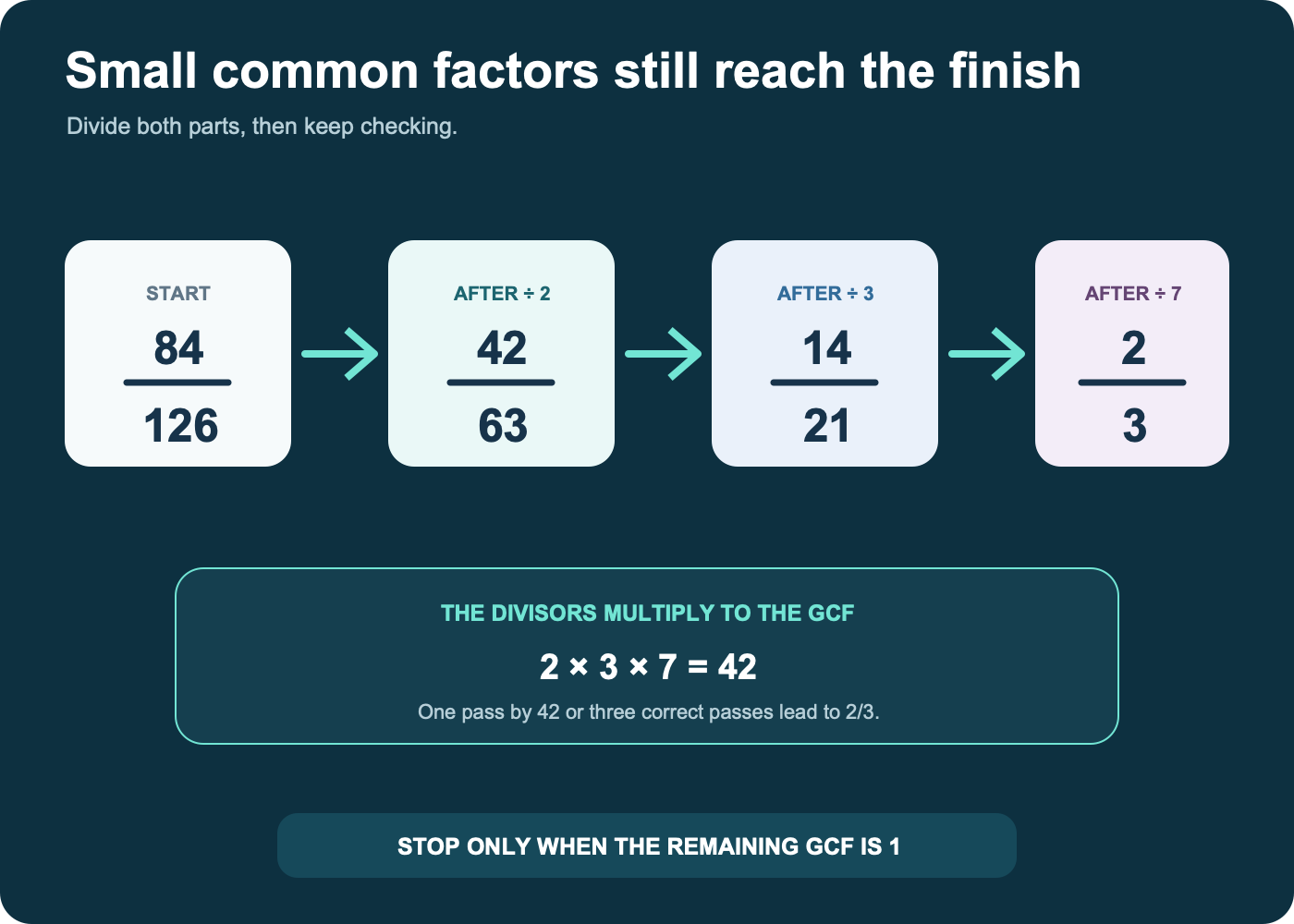
The order does not affect the final simplest form. The risk is stopping too early. 42/63 is equivalent to the original, but it is not simplified because both numbers are still divisible by 3, 7, and 21.
Use fast divisibility tests to spot the next factor. OpenStax’s factor and divisibility guide notes that a number is divisible by 2 when its last digit is even, by 3 when its digit sum is divisible by 3, by 5 when it ends in 0 or 5, and by 10 when it ends in 0. Test both numerator and denominator with the same rule.
Route zero, negative, and improper fractions correctly
| Input type | Correct move | Example |
|---|---|---|
| Zero numerator | If the denominator is nonzero, the value is 0. Write the simplified result as 0. |
0/15 = 0 |
| Zero denominator | Stop. Division by zero is undefined; there is no fraction to simplify. | 15/0 is undefined |
| One negative sign | Keep one negative sign, conventionally in front or in the numerator, then simplify absolute values. | -45/60 = -3/4 |
| Two negative signs | The quotient is positive; remove both signs before simplifying. | -18/-24 = 3/4 |
| Improper fraction | Simplify normally. Convert to a mixed number only if the task asks for it. | 42/18 = 7/3, optionally 2 1/3 |
| Mixed number | If only reducing the fractional part, simplify that part. For multiplication or division, convert the whole expression as instructed. | 2 6/8 = 2 3/4 |
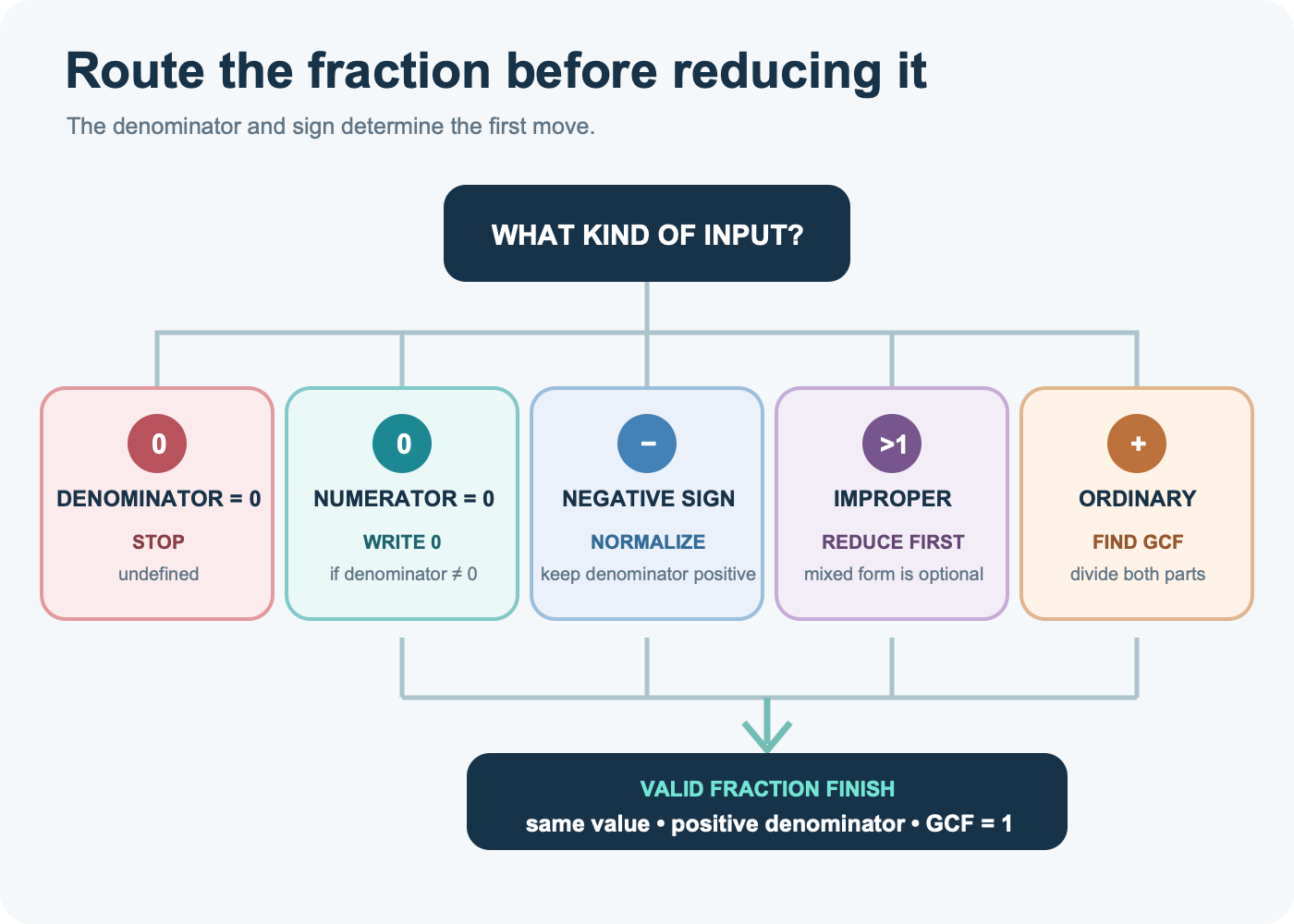
OpenStax explicitly notes that a simplified improper fraction does not have to become a mixed number. Those are two separate formatting decisions. This distinction also matters in measurements: ToolMerit’s feet-and-inches guide explains why a mixed measurement such as 5 ft 7 in is not the decimal number 5.7 ft.
Check that the value stayed equal
Use two checks, because they answer different questions:
- Equivalence check: for
a/b = c/d, with nonzero denominators, verifya × d = b × c. For18/24 = 3/4, both cross-products are 72. - Simplest-form check: verify that
GCF(|c|, d) = 1. For 3 and 4, the GCF is 1.
A decimal comparison can catch some errors, but it is weaker when values repeat or rounding is involved. For example, both 1/3 and a rounded decimal may appear as 0.333, yet they are not exactly equal. Cross-products preserve an exact check.
You can also reverse your last step. Since 3/4 came from dividing by 6, multiply both parts by 6: (3 × 6)/(4 × 6) = 18/24. OpenStax’s equivalent-fractions explanation uses the same “multiply both parts by the same nonzero number” rule.
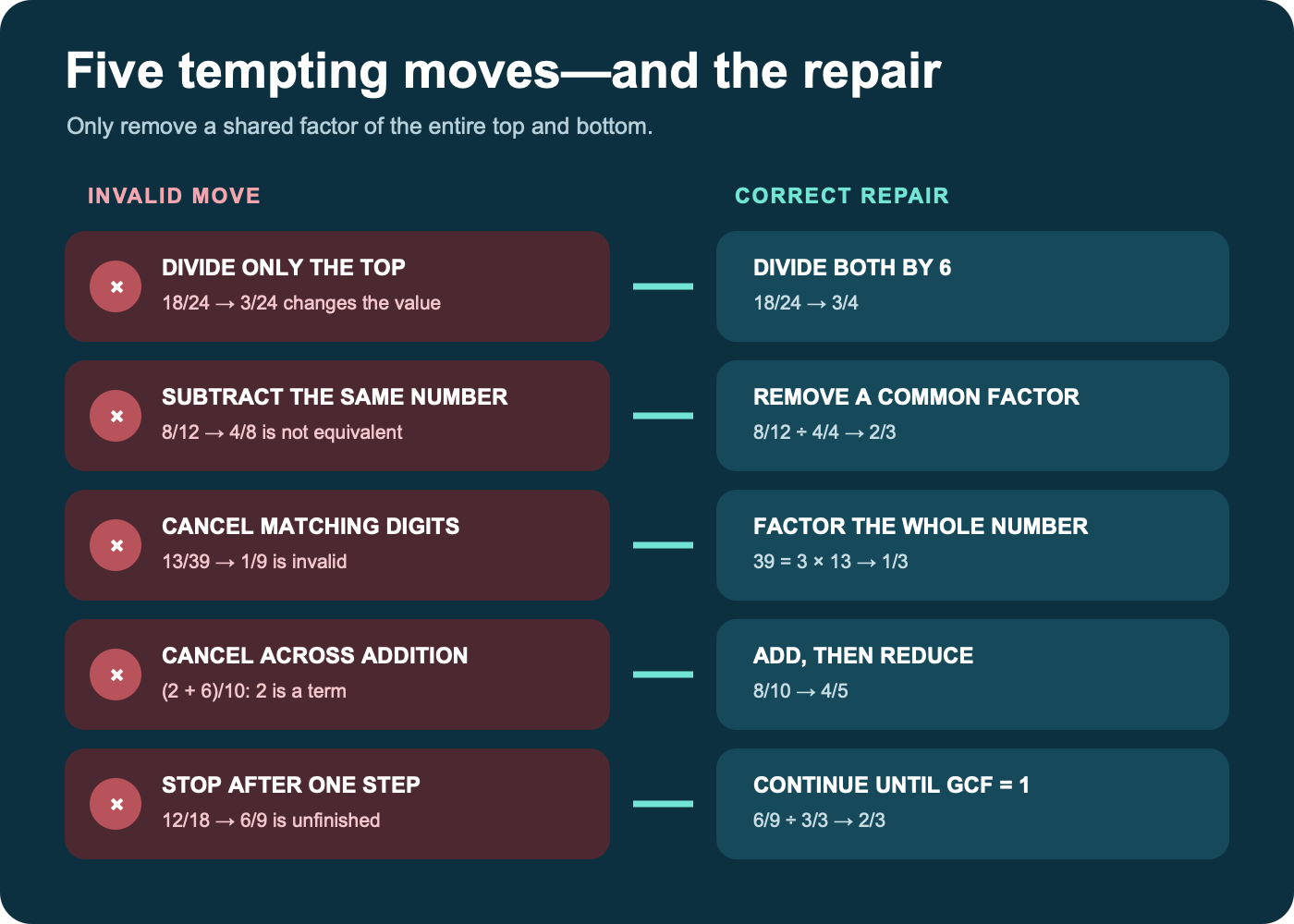
Repair the five most common simplification mistakes
| Mistake | Why it fails | Repair |
|---|---|---|
| Divide only the numerator | 18/24 → 3/24 changes the value. |
Divide numerator and denominator by the same nonzero factor. |
| Subtract the same number | 8/12 → 4/8 gives 1/2, not 2/3. |
Remove a shared multiplicative factor; do not subtract. |
| Cancel matching digits | 13/39 → 1/9 is invalid because the digit 3 is not a factor of the entire numerator. |
Factor the whole numbers: 39 = 3 × 13, so the result is 1/3. |
| Cancel across addition | In (2 + 6)/10, the 2 is a term, not a factor of the entire numerator. |
Add first to get 8/10, then divide both parts by 2 to get 4/5. |
| Stop after one division | 12/18 → 6/9 is equal but still shares a factor of 3. |
Continue to 2/3 or divide by the GCF 6 at the start. |
Do not confuse number factors with measurement units. Unit cancellation has its own dimensional rule: a unit cancels only when the same unit appears as a multiplicative factor in both numerator and denominator. ToolMerit’s milligram-to-gram guide demonstrates a verified unit-cancellation check.
Use simplified fractions in real calculations
Simplest form makes an exact relationship easier to recognize and reuse:
- Recipes: reducing
6/8cup to3/4cup makes the quantity easier to read. The cups-and-pints recipe guide applies fractions while scaling kitchen volumes. - Length: reducing a fractional inch measurement can make a drawing or cut list clearer before conversion. The inch-to-centimeter guide shows how fractional and decimal measurements interact with an exact conversion factor.
- Weight: reducing a part-of-a-pound ratio can clarify the share before switching units. ToolMerit’s ounces-per-pound guide covers whole, mixed, and decimal weight cases.
Keep the exact fraction as long as the task benefits from exact arithmetic. Convert to a decimal only when the destination requires one, and round only at the final step.
Practice with six fractions and check every answer
Try each problem before reading the right column.
| Problem | Simplified answer | Reasoning |
|---|---|---|
12/18 |
2/3 |
GCF = 6; divide both parts by 6. |
35/49 |
5/7 |
GCF = 7. |
84/126 |
2/3 |
GCF = 42, or divide successively by 2, 3, and 7. |
0/15 |
0 |
A zero numerator over a nonzero denominator equals zero. |
-28/42 |
-2/3 |
Keep one negative sign; GCF(28, 42) = 14. |
45/18 |
5/2 |
GCF = 9. The optional mixed-number form is 2 1/2. |
For each result, run both checks: cross-multiply against the original to verify equal value, then confirm the final GCF is 1.
For room and material measurements, the square-footage calculation guide shows where fractional lengths enter the formula and where units must stay visible.
Know where this method stops
This procedure is for ordinary numerical fractions. A fraction with a zero denominator is undefined, not reducible. A rational expression containing variables requires factoring the entire numerator and denominator and preserving excluded values. A complex fraction requires simplifying or dividing its inner fractions. A decimal may need conversion before exact fraction reduction is possible.
Within the numerical scope, the finish line is precise: the denominator is positive, the value matches the original, and the numerator and denominator share no positive factor greater than 1.
When the fraction belongs to a three-dimensional measurement, continue with the volume formula and checking guide rather than treating simplification as the final result.