

A side-by-side guide to what I and what do I, including embedded questions, noun-like what clauses, wh-clefts, punctuation and common repairs.

“What I” usually opens a clause with statement order, as in “I know what I need,” “She asked what I wanted,” or “What I need is time.” It is not normally a complete direct question. To ask the simple-present question itself, use “What do I …?”—for example, “What do I need?” Keep I before the verb inside an embedded what-clause, and let the whole sentence determine whether it ends with a period or question mark.
The two-word fragment is common because many useful sentences begin or continue with it: what I know, what I saw, what I meant, what I need to do. The phrase alone does not tell you whether the clause reports a question, means “the thing that,” or sets up a point of focus. You must read the larger sentence.
Compare the three sentence frames
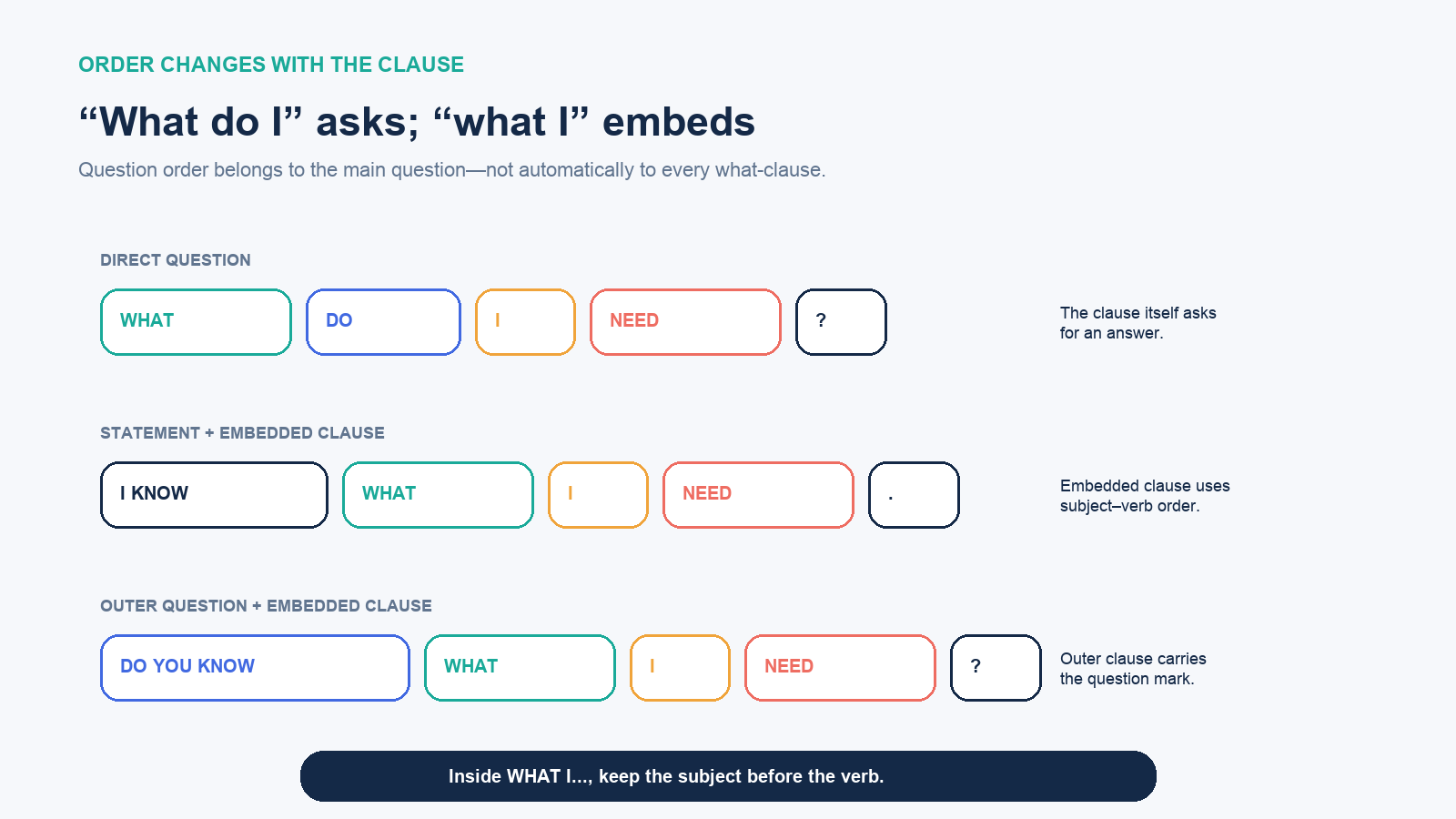
These three sentences reuse the same core meaning but assign the question to different levels:
- What do I need? The what-clause is the whole direct question. Present-simple object questions use do + subject + base verb.
- I know what I need. The main clause is a statement. What I need is embedded as the object of know and uses subject–verb order.
- Do you know what I need? The main clause is a direct yes–no question, so do appears before you. The embedded clause remains what I need; it does not acquire a second inversion.
A common error combines the orders: “Do you know what do I need?” The first do already builds the outer question. Inside it, use “what I need.” Cambridge’s discussion of reported wh-questions states that the reported clause takes statement order, not question order.
Four jobs a what I clause can do
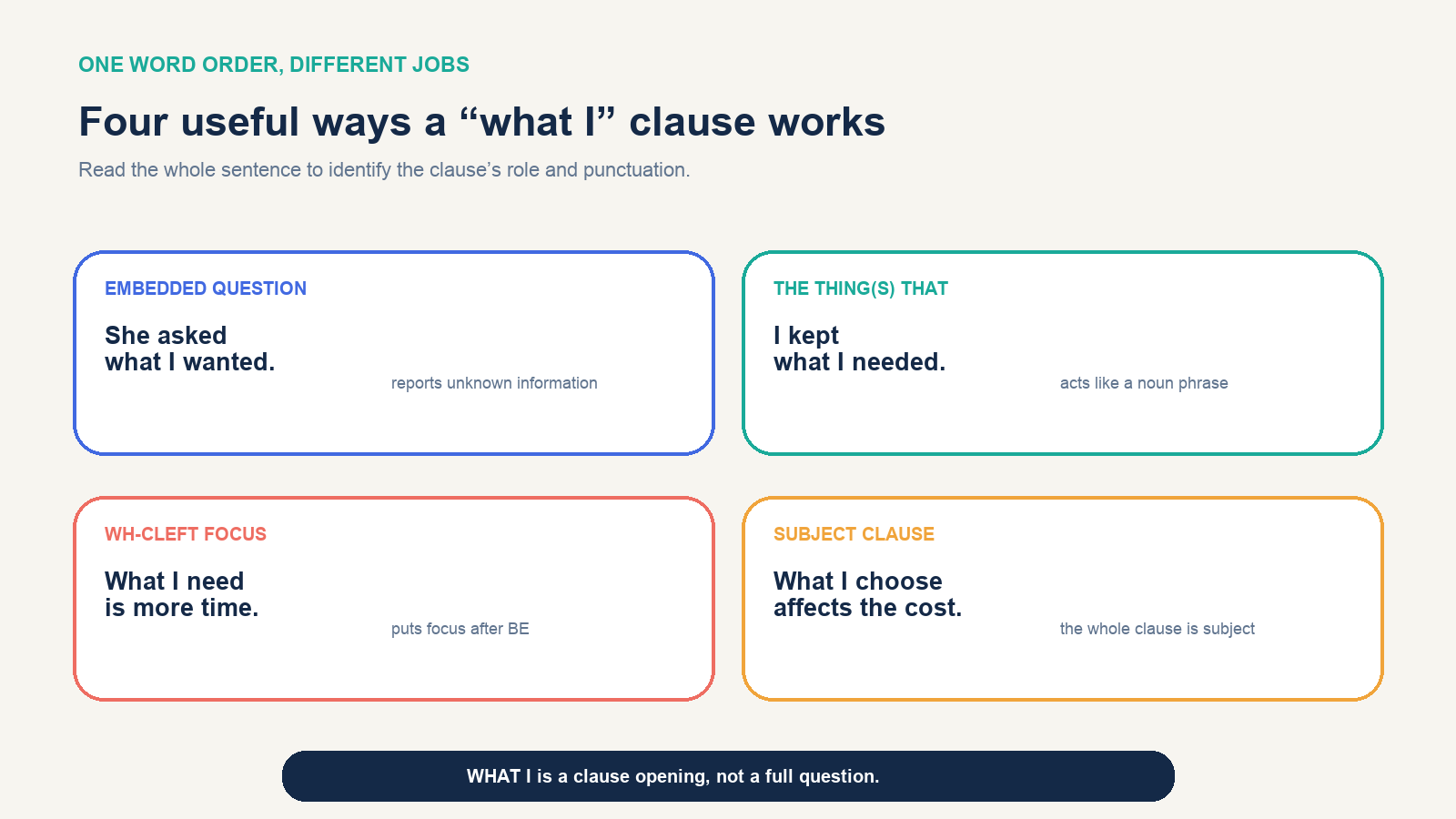
An embedded or reported question preserves the unknown information without directly asking it: “She asked what I wanted.” A corresponding direct question could be “What do you want?” Pronouns and tense may change when a speaker reports someone else’s words.
A noun-like clause meaning “the thing(s) that” names content rather than reporting a request for information: “I kept what I needed” means “I kept the things that I needed.” Cambridge describes this use of what as a pronoun: “what I have” can mean “the things that I have.”
A wh-cleft divides one message so that the new information receives focus: “What I need is more time.” The opening clause sets up an understood gap; the material after is supplies the focused answer.
A clause acting as the subject can control the rest of a sentence: “What I choose affects the cost.” The entire clause occupies the subject position. You can often paraphrase it as “The thing I choose affects the cost.”
Convert a direct question without carrying its inversion inside
Use this repeatable conversion whenever a question becomes part of a larger sentence:
- Write the direct question: “What did I miss?”
- Identify the question phrase: what.
- Return the remaining clause to statement order: I missed …
- Remove the do-support that existed only to form the direct question: what I missed.
- Attach the main clause and punctuate the whole: “Please explain what I missed.”
| Direct question | Embedded form | Complete sentence |
|---|---|---|
| What do I need? | what I need | I wrote down what I need. |
| What did I miss? | what I missed | Can you explain what I missed? |
| What am I doing? | what I am doing | I know what I am doing. |
| What have I changed? | what I have changed | The log shows what I have changed. |
| What should I choose? | what I should choose | I cannot decide what I should choose. |
Do not delete every auxiliary. Delete or move only the inversion that formed the direct question. In what I am doing, am remains because it builds the continuous verb phrase. In what I have changed, have remains because it builds the perfect. In what I should choose, the modal remains before the base verb but follows the subject.
Let the main clause decide the punctuation
The word what does not automatically require a question mark. Decide whether the complete sentence directly asks the reader or listener for an answer.
- Statement: “I wonder what I should bring.” The speaker reports uncertainty; use a period.
- Reported question: “She asked what I wanted.” The sentence reports an earlier question; use a period.
- Outer direct question: “Can you tell me what I should bring?” The whole sentence asks the listener; use a question mark.
- Direct quotation: “I asked, ‘What do I need?’” The quoted words preserve direct-question order and their question mark.
Polite openings such as “Could you tell me…?” and “Do you know…?” are still direct questions at the outer level. That is why the final mark is a question mark even though the embedded clause itself uses statement order.
What can mean the thing or things that
In “I relied on what I had,” what I had does not modify an earlier noun. It supplies both the broad meaning “the thing(s)” and the link into the clause. This is why these pairs are close in meaning:
- I recorded what I observed. → I recorded the things that I observed.
- Take what I prepared. → Take the material that I prepared.
- What I learned changed the plan. → The information that I learned changed the plan.
But after an expressed noun, standard English uses that or which, or no object relative pronoun—not what. Write “the tool that I need,” “the tool which I need,” or “the tool I need,” rather than “the tool what I need.” Cambridge’s relative-pronoun guide makes this boundary explicit.
A practical test is to try adding the thing(s) that. If the replacement works and there is no noun immediately before the clause, standalone what may be correct. If a noun is already present, use a relative form that refers back to that noun.
Use What I need is to focus the answer
A wh-cleft deliberately splits a simple message into two parts. Compare:
- Neutral: “I need a clear deadline.”
- Focused: “What I need is a clear deadline.”
The focused version treats the need as understood and presents a clear deadline as the answer. Cambridge notes that wh-clefts connect understood information with new, focused information. They are useful for correction, contrast, diagnosis and recommendations:
- What I meant was the export date, not the publication date.
- What I found was a permissions error.
- What I need to do is call the client before noon.
- What I want you to check is the final total.
Do not insert direct-question order after what: “What do I need is…” is not the wh-cleft pattern. It is the beginning of the direct question “What do I need?” followed by an incompatible continuation.
I or me inside the clause
Use I when the pronoun is the subject of the following verb: what I need, what I saw, what I have finished. Use me when the pronoun is an object: what they gave me, what the delay cost me.
One sentence can contain both because they serve different clauses: “They asked me what I needed.” Me is the object of asked; I is the subject of needed. Also capitalize the pronoun I wherever it appears, including mid-sentence. Search fragments may be lowercase, but edited English should not be.
Repair six common what I errors
| Draft | Repair | Reason |
|---|---|---|
| I know what do I need. | I know what I need. | Embedded clause uses statement order |
| Can you tell me what did I miss? | Can you tell me what I missed? | The outer clause carries the question |
| She asked what I wanted? | She asked what I wanted. | The whole sentence reports rather than directly asks |
| The file what I need is missing. | The file that I need is missing. | An expressed noun takes a relative form |
| What me need is time. | What I need is time. | The pronoun is subject of need |
| What i changed is listed below. | What I changed is listed below. | The pronoun I is always capitalized |
The final diagnostic is compact. If the words themselves ask the direct question, use the needed question order: “What do I need?” If the clause sits inside a statement or another question, keep I before its verb: “I know what I need” or “Do you know what I need?” If what means “the thing(s) that,” make sure no separate noun already needs that or which. If the pattern is “What I need is…,” use the second half to deliver the focus.
That whole-sentence view resolves the apparent conflict: what do I is direct-question order, while what I is a flexible clause opening whose role and punctuation come from the sentence around it.