
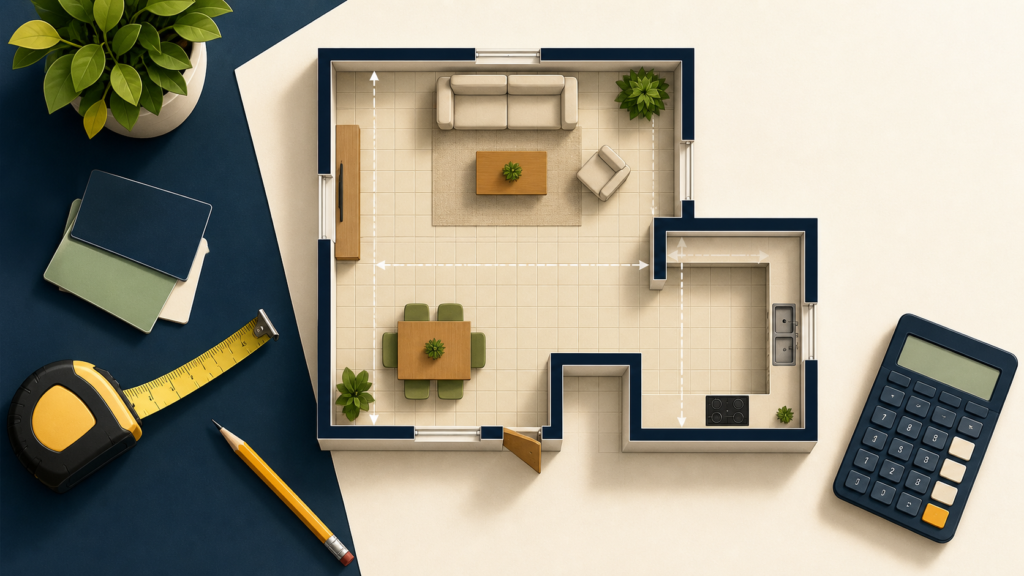
Calculate square feet accurately with shape formulas, worked examples, unit conversion, irregular-room steps, and purchasing guardrails.
To calculate square feet, measure the area’s dimensions in feet, then multiply length by width. A room that is 12 feet long and 10 feet wide is 120 square feet: 12 ft × 10 ft = 120 ft². For an irregular area, split the outline into simple shapes, calculate each piece, and add the results.
Do not multiply feet by inches. Convert every measurement to the same unit first. Divide inches by 12 to express them as decimal feet—for example, 6 inches is 0.5 foot.
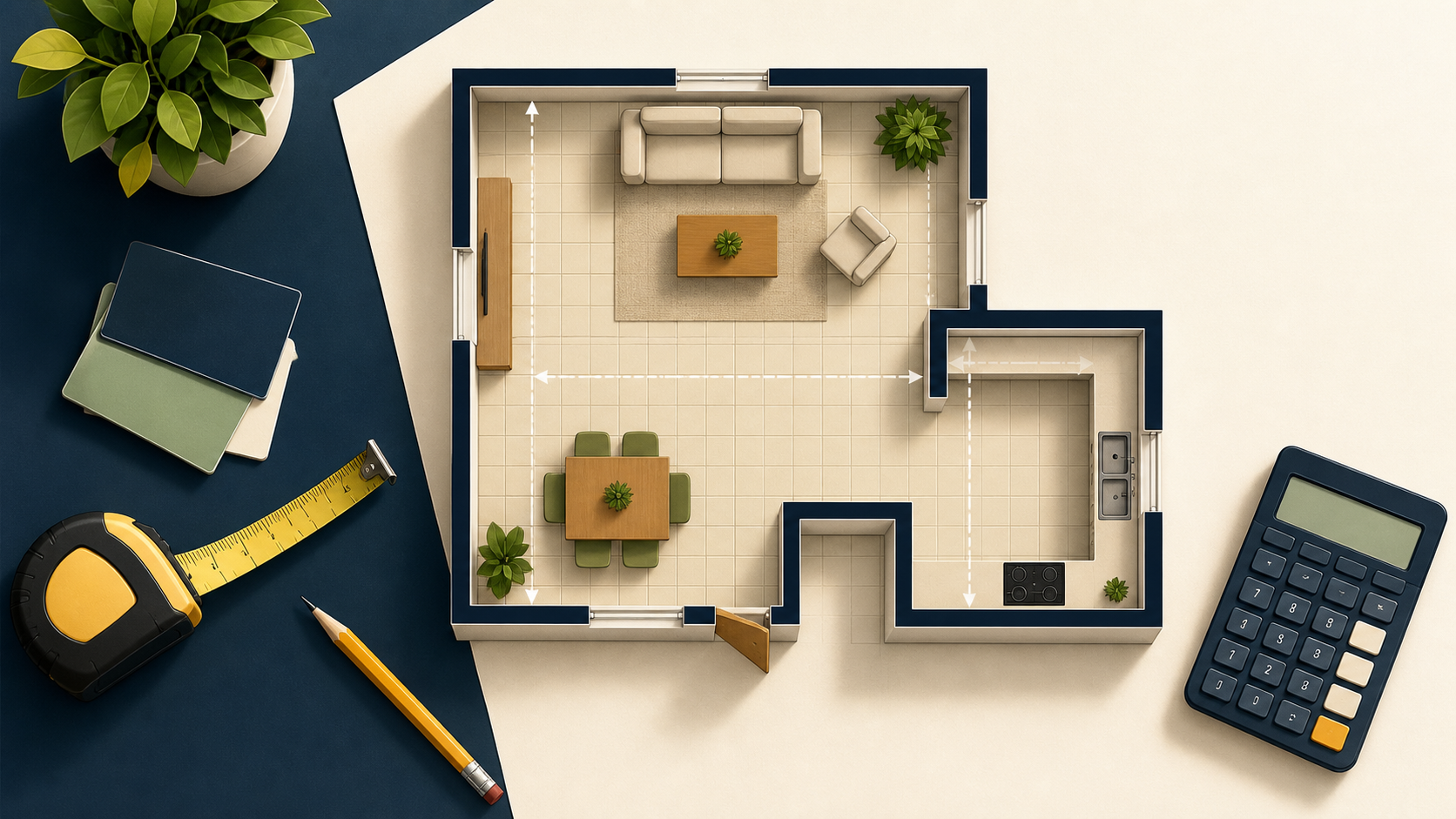
Square-foot formulas
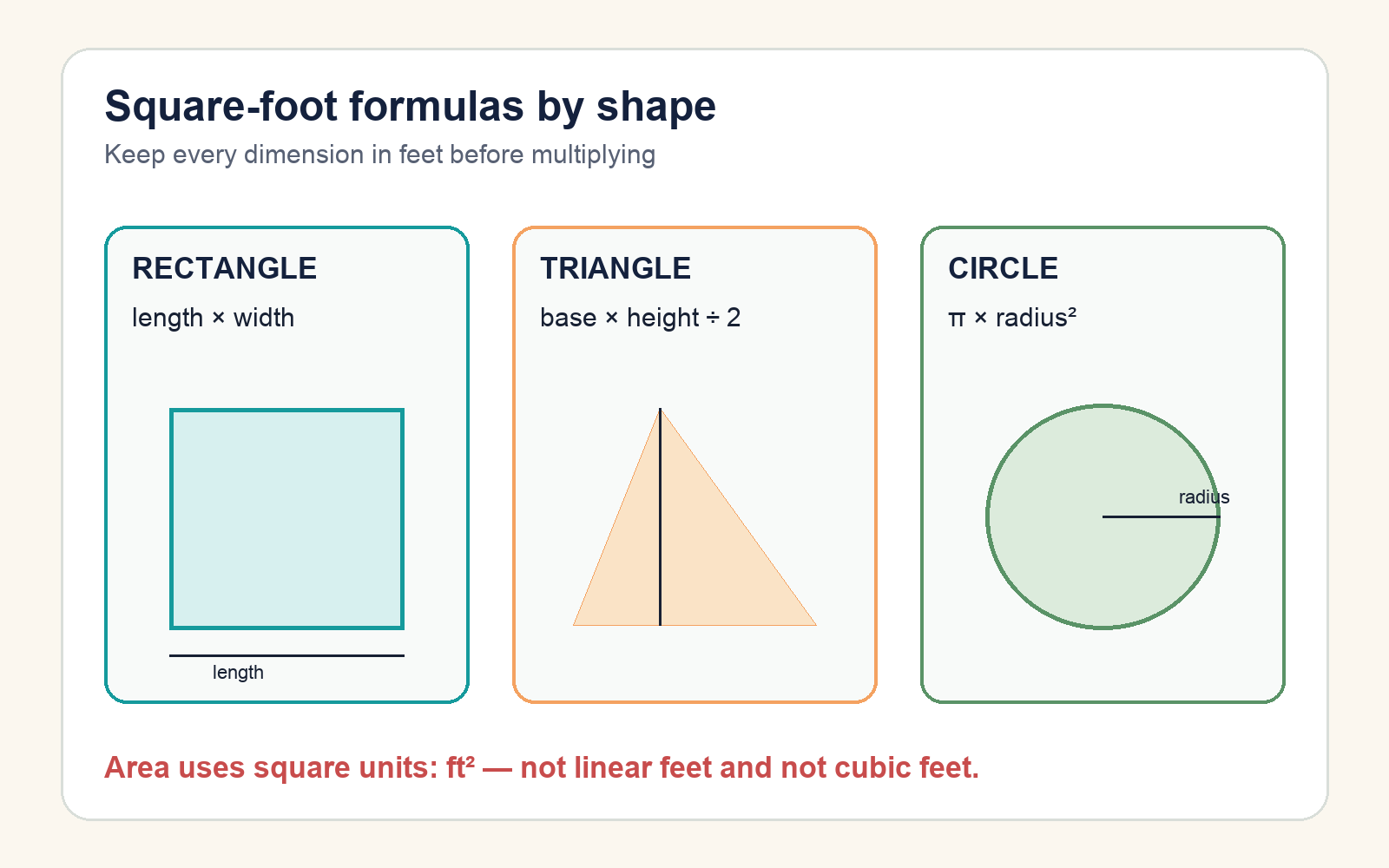
| Shape | Formula | Example |
|---|---|---|
| Square or rectangle | Length × width | 12 ft × 10 ft = 120 ft² |
| Triangle | Base × perpendicular height ÷ 2 | 10 ft × 8 ft ÷ 2 = 40 ft² |
| Circle | π × radius² | 3.1416 × 5 ft × 5 ft ≈ 78.54 ft² |
| Semicircle | π × radius² ÷ 2 | 3.1416 × 4 ft × 4 ft ÷ 2 ≈ 25.13 ft² |
The U.S. National Institute of Standards and Technology (NIST) explains that a calculated area carries the square of the length unit used. Feet multiplied by feet therefore produces square feet, written ft². This is an area, not a perimeter or volume.
Convert feet and inches before multiplying
Measurements from a tape often contain both feet and inches. Convert the inches to a fraction or decimal of a foot:
decimal feet = feet + (inches ÷ 12)
For a room measuring 12 feet 6 inches by 9 feet 3 inches:
12 + (6 ÷ 12) = 12.5 ft9 + (3 ÷ 12) = 9.25 ft12.5 × 9.25 = 115.625 ft²
Report 115.6 square feet if one decimal place is useful, or 116 square feet for a whole-foot planning estimate. Keep the unrounded value until the final step; rounding both dimensions too early can move the result noticeably.
Calculate an L-shaped or irregular room
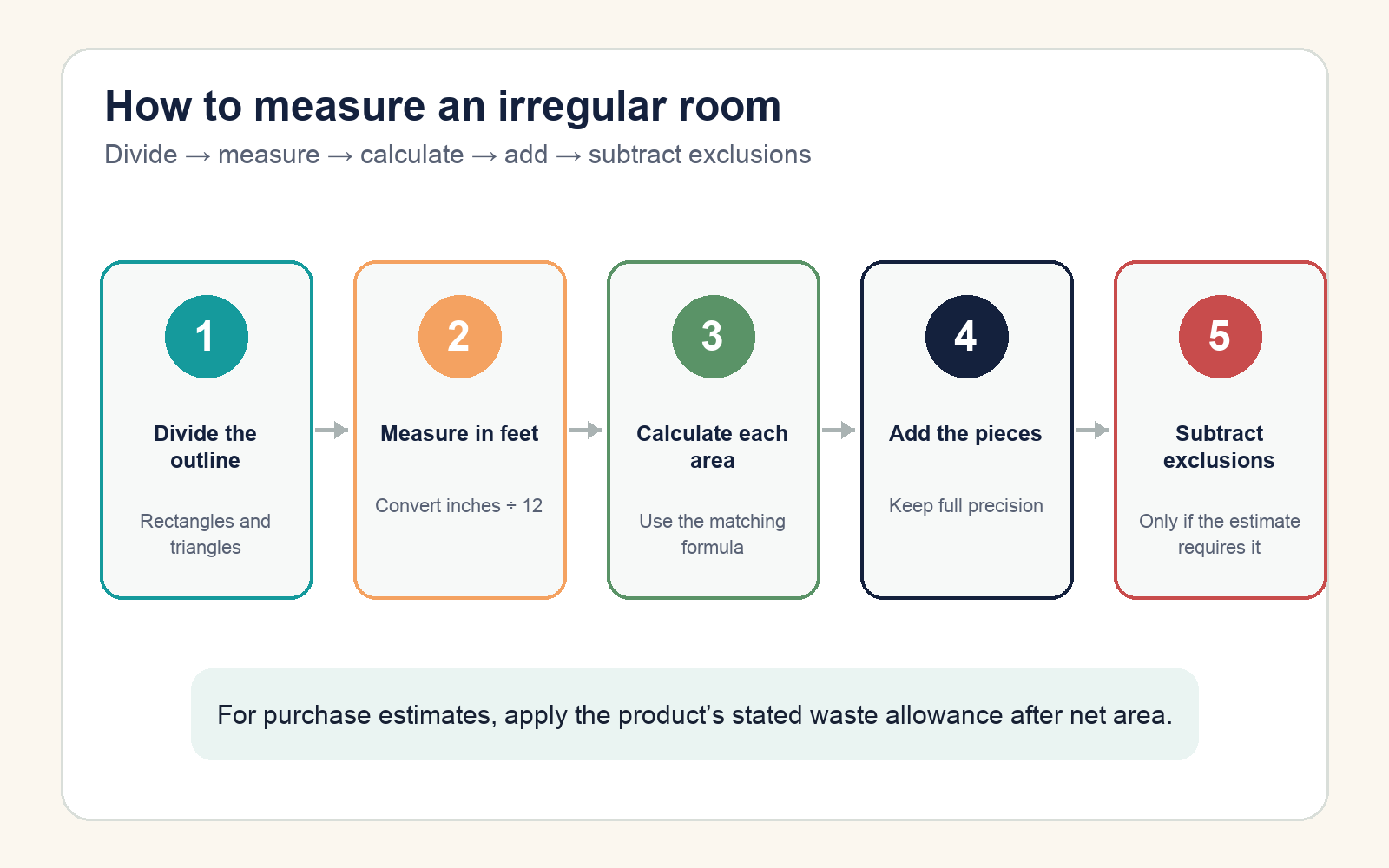
Draw a simple top-down sketch. Divide the floor into rectangles and, where necessary, triangles or circular sections. Label each dimension, calculate the pieces separately, and add them once.
Suppose an L-shaped room can be divided into a 14-by-10-foot rectangle and a 6-by-4-foot rectangle:
- Main rectangle:
14 × 10 = 140 ft² - Extension:
6 × 4 = 24 ft² - Total:
140 + 24 = 164 ft²
An equally valid method may calculate one large outer rectangle and subtract a missing corner. Use whichever sketch makes overlap and omission easiest to spot. If two shapes share an edge, that edge does not add area by itself.
Floor area, wall area, and home area are different
“Square footage” is incomplete until the boundary is defined. For flooring, measure the horizontal floor. For a wall, multiply that wall’s width by height, then decide whether doors and windows should be deducted. For paint, the product’s coverage instructions and surface condition also matter.
A listing’s home square footage is not automatically the sum of measurements taken with a tape. Appraisal, tax, insurance, building-code, and real-estate standards can define included space differently. For an official transaction, use the applicable local standard and a qualified measurer instead of presenting a DIY estimate as certified living area.
Convert square feet to square meters
The international foot is exactly 0.3048 meter, so one square foot is exactly 0.09290304 m². To convert square feet to square meters:
square meters = square feet × 0.09290304
Thus, 120 square feet is 120 × 0.09290304 = 11.1483648 m², usually reported as about 11.15 square meters. Do not convert area using the linear factor 0.3048; the conversion factor must also be squared.
Add waste only for the purchasing decision
The measured net area and the quantity to buy are separate numbers. Flooring, tile, wallpaper, roofing, and fabric may require extra material for cuts, pattern matching, damage, or future repairs. Apply the manufacturer’s or installer’s stated allowance after calculating net area.
For example, if a 164-square-foot floor uses a 10% planning allowance:
164 × 1.10 = 180.4 ft²
Package sizes may force the purchase upward again. Record all three values—net measured area, allowance, and purchase quantity—so another person can see where the difference came from.
Measurement checklist
- Define exactly which surface and boundary count.
- Measure each dimension at least twice and note the unit.
- Convert inches to feet before using a square-foot formula.
- Sketch irregular shapes and make sure pieces neither overlap nor leave gaps.
- Keep full precision through the calculation and round only the result.
- Separate net area from waste allowance and package rounding.
- Use the governing professional standard when the number affects a contract, permit, appraisal, or claim.
The practical rule is: measure in feet, calculate each shape in square feet, add the non-overlapping pieces, and document every adjustment.