
The exact 1 L = 1,000 mL relationship, two-way formulas, common values, cubic-volume explanation, practical measurement checks and safety boundaries.
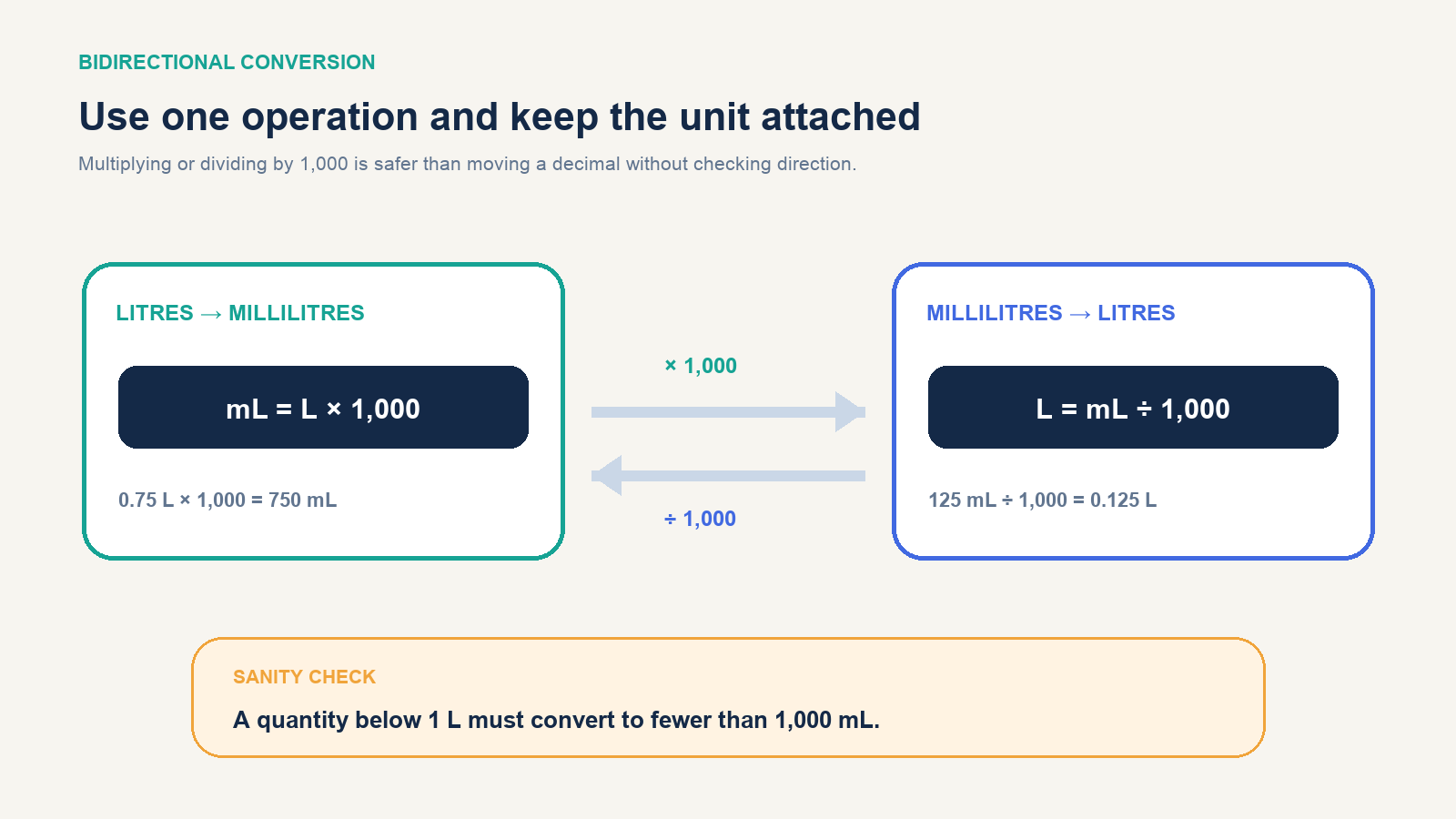
There are exactly 1,000 milliliters (mL) in 1 liter (L). Convert liters to milliliters by multiplying by 1,000. Convert milliliters to liters by dividing by 1,000. For example, 0.75 L = 750 mL, while 125 mL = 0.125 L.
This is an exact metric relationship, not a kitchen approximation. It is the same for water, milk, oil, paint, fuel, medicine, or the capacity of an empty container because liters and milliliters both measure volume. The substance matters when you convert volume to mass, but not when you change the unit used to express the same volume.
Why the answer is exactly 1,000
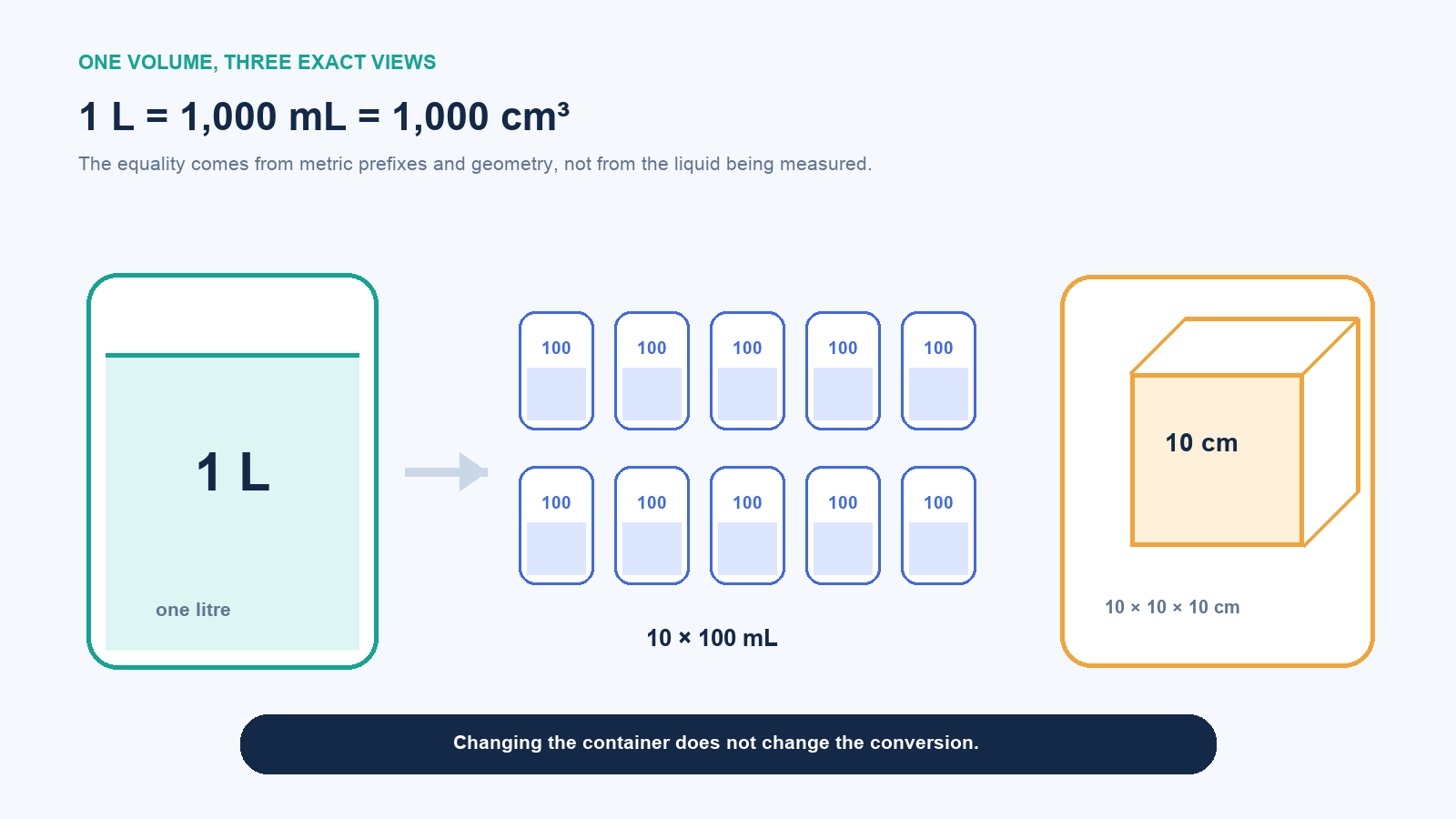
The prefix milli means one-thousandth, or 10−3. One milliliter is therefore one-thousandth of a liter:
1 mL = 0.001 L
It takes 1,000 of those thousandths to make the whole:
1,000 mL = 1 L
The geometry gives the same result. NIST defines a liter as a special name for a cubic decimeter (dm³), and a milliliter as a special name for a cubic centimeter (cm³). A decimeter is 10 centimeters, so a cube measuring 10 cm × 10 cm × 10 cm has a volume of 1,000 cm³. Therefore:
1 L = 1 dm³ = 1,000 cm³ = 1,000 mL
Do not confuse 1,000 cm³ with 1,000 mm³. Cubic units scale in three dimensions. Since 1 cm = 10 mm, one cubic centimeter contains 10 × 10 × 10 = 1,000 cubic millimeters. One liter is consequently 1,000,000 mm³.
The two conversion formulas
Liters to milliliters
milliliters = liters × 1,000
Example: convert 1.6 L to mL.
1.6 L × 1,000 mL/L = 1,600 mL
The liters cancel in the written unit factor, leaving milliliters. A useful magnitude check is that a positive volume below 1 L must become fewer than 1,000 mL, while a volume above 1 L must become more than 1,000 mL.
Milliliters to liters
liters = milliliters ÷ 1,000
Example: convert 2,350 mL to L.
2,350 mL ÷ 1,000 = 2.35 L
You can describe that amount as 2.35 L or as 2 L 350 mL, depending on context. For a calculation, keeping a single unit is usually cleaner. Packaging rules may also prescribe how a quantity is declared, so do not assume that a mixed-unit phrase is the required label format.
Liter-to-milliliter conversion table
| Liters | Milliliters | Useful interpretation |
|---|---|---|
| 0.005 L | 5 mL | A small measured dose or sample |
| 0.015 L | 15 mL | A small ingredient quantity |
| 0.05 L | 50 mL | One twentieth of a liter |
| 0.1 L | 100 mL | One tenth of a liter |
| 0.125 L | 125 mL | One eighth of a liter |
| 0.25 L | 250 mL | One quarter of a liter |
| 0.5 L | 500 mL | Half a liter |
| 0.75 L | 750 mL | Three quarters of a liter |
| 1 L | 1,000 mL | One liter |
| 1.5 L | 1,500 mL | One and a half liters |
| 2 L | 2,000 mL | Two liters |
| 5 L | 5,000 mL | Five liters |
The same relationship works for numbers not listed in the table. Multiply 0.0375 L by 1,000 to get 37.5 mL. Divide 680 mL by 1,000 to get 0.68 L. Preserve the precision of the original quantity rather than automatically adding zeros that imply a more precise measurement.
How to convert without a calculator
Break an awkward value into familiar parts. For 1.275 L, treat the amount as 1 L + 0.2 L + 0.07 L + 0.005 L. Those parts are 1,000 mL + 200 mL + 70 mL + 5 mL, giving 1,275 mL. This method makes each place value visible and is easy to check against the original decimal.
For the reverse direction, read the last three digits as thousandths of a liter. The value 3,408 mL is 3,000 mL + 408 mL, or 3 L + 0.408 L = 3.408 L. Leading zeros matter: 8 mL is 0.008 L, not 0.8 L, because eight milliliters are eight thousandths of a liter.
Metric units between L and mL can also serve as checkpoints:
- 1 L = 10 deciliters (dL)
- 1 L = 100 centiliters (cL)
- 1 L = 1,000 milliliters (mL)
Each step down from liter to deciliter, centiliter, and milliliter multiplies the number by 10. These intermediate units are common in some countries and fields, but converting directly between L and mL remains the least ambiguous approach when those are the two units in the problem.
Choose a reporting unit that keeps the value readable
Both 0.002 L and 2 mL are mathematically correct, as are 12.5 L and 12,500 mL. The clearer version depends on scale and audience. Small doses, samples, and ingredient amounts are usually easier to read in mL; bottles, tanks, and batch totals are usually easier in L. A practical threshold is not a change in the measurement—it is a presentation choice.
For data entry, keep one unit throughout a column and state it in the heading. A spreadsheet mixing 0.5 L, 250 mL, and 1.2 L as bare numbers cannot be summed safely. Normalize everything first—for example, 500, 250, and 1,200 mL—then calculate the total. Preserve the original measurements separately if traceability matters.
Worked examples in real tasks
Scale a recipe batch
A recipe uses 0.6 L of stock per batch, and you are making three batches. Calculate the total in liters first: 0.6 × 3 = 1.8 L. Then convert once: 1.8 × 1,000 = 1,800 mL. Converting each portion and adding also works, but one conversion reduces the number of opportunities to copy a value incorrectly.
Find how many portions a container holds
A 1.5 L container holds 1,500 mL. If each planned portion is 200 mL, then 1,500 ÷ 200 = 7.5. It holds seven complete 200 mL portions with 100 mL remaining. The conversion answers the unit mismatch; the division answers the portion question.
Combine quantities written in different units
Suppose you have 0.8 L and add 350 mL. Convert one value so both use the same unit: 0.8 L = 800 mL. Then 800 mL + 350 mL = 1,150 mL, which is 1.15 L. Never add 0.8 and 350 before aligning the units.
Scale a concentrate ratio
If instructions call for 25 mL of concentrate per liter of final solution, a 4 L batch uses 25 × 4 = 100 mL of concentrate, subject to the product’s exact mixing directions. “Per liter of final solution” is not always the same as “add to one liter of water”; follow the label’s stated basis.
Four mistakes that change the answer
- Reversing the operation. Liters are larger units, so a volume expressed in milliliters usually has the larger number. If 0.4 L becomes 0.0004 mL, you divided in the wrong direction; the correct result is 400 mL.
- Moving the decimal without a reason. “Move three places” works only when you remember the direction and have written enough placeholder zeros. The ×1,000 or ÷1,000 formula is easier to audit.
- Confusing mL with mg. Milliliters measure volume; milligrams measure mass. They cannot be exchanged without a substance-specific density or concentration. Even if 1 mL of water is close to 1 g under ordinary conditions, that is not a general rule for oils, syrups, powders, medicines, or solutions.
- Rounding before the task is finished. If a multi-step calculation produces 83.333… mL per portion, keep additional digits while multiplying the number of portions, then round according to the measuring device and task. Repeated early rounding can change the total.
Converting a number is not the same as measuring it
The equality 1 L = 1,000 mL is exact, but a mark on a household jug is not infinitely precise. Choose equipment sized for the quantity. A one-liter jug may be suitable for 750 mL but poor for 5 mL; a graduated cylinder, syringe, pipette, or purpose-made measuring cup can provide finer graduations for smaller volumes.
Place a transparent vessel on a level surface and read the scale at eye height. For many water-like liquids in narrow glassware, the surface curves into a meniscus and the specified reading is taken at the appropriate part of that curve. The correct convention depends on the liquid and instrument. Do not estimate extra decimal places between coarse marks, and do not assume a decorative bottle’s advertised capacity makes it a measuring instrument.
For cooking, the necessary precision depends on the ingredient and recipe. A small difference may not matter in soup but can matter in baking, candy, fermentation, or a concentrated additive. Use the recipe’s original unit when possible and convert the entire quantity once.
Medication is a special case
A liter-to-milliliter calculator can change units, but it cannot determine a safe dose. Medication directions can depend on concentration, patient factors, timing, maximum limits, and clinical instructions. A label such as “100 mg per 5 mL” contains both mass and volume; converting mL to L does not tell you how many milligrams to administer unless the concentration and prescribed dose are applied correctly.
Follow the medicine label and instructions from a qualified clinician or pharmacist. The FDA advises against using household spoons because their volumes vary. Use the supplied or recommended device marked in milliliters, such as an oral syringe or dosing cup, and make sure its units match the directions. If the label, prescription, device, or concentration is unclear, stop and ask a pharmacist rather than estimating.
Write liters and milliliters clearly
- Use L for liter and mL for milliliter. NIST prefers uppercase L in the United States because lowercase l can resemble the number 1.
- Keep the prefix attached to the unit symbol: mL, not “m L.”
- Put a space between the number and symbol: 250 mL and 1 L.
- Do not pluralize symbols: write 500 mL, not “500 mLs.” Written-out names can be plural: 500 milliliters.
- “Liter” and “litre” are regional spellings of the same unit. The numerical conversion does not change.
The complete rule fits on one line: 1 L = 1,000 mL; multiply liters by 1,000 and divide milliliters by 1,000. Then apply three checks: keep volume separate from mass, align units before combining quantities, and measure with equipment whose graduations match the precision and consequences of the task.