

A practical question-building guide for choosing what do, what does, what did, or a form with no extra do—and fixing the errors each choice creates.

“What do” begins an English information question when what asks about the object or complement, the tense is present simple, and the subject is I, you, we, they, or a plural noun: “What do the results show?” Use does with he, she, it, or a singular noun; use did for the past simple. Do not add do when what is the subject—“What happened?”—or when the clause already uses be, have, or a modal as its auxiliary.
The fragment what do is not normally a complete question. It needs at least a subject and a main verb: “What do you need?” The related fragment what do the needs a plural noun after the, then a base-form verb: “What do the numbers mean?” Understanding those slots is more useful than memorizing isolated phrases.
First decide whether what is the subject or object
This one decision explains why some questions use do and others do not.
In “What changed?”, what is the subject—the unknown thing performed the action. The matching statement is “Something changed.” There is no separate subject to place after an auxiliary, so ordinary affirmative subject questions use statement-like order.
In “What did they change?”, they is the subject and what is the unknown object. The matching statement is “They changed something.” Moving the unknown object to the front leaves a simple-past clause that needs did.
| Underlying statement | Unknown part | Question | Why |
|---|---|---|---|
| Something caused the error. | Subject | What caused the error? | What replaces the subject; no do-support |
| The update caused something. | Object | What did the update cause? | The subject remains, so past-simple did is used |
| Something shows the total. | Subject | What shows the total? | Present-simple subject question |
| The charts show something. | Object | What do the charts show? | Plural subject takes present-simple do |
Cambridge’s guidance on wh-questions makes the same distinction: when what, who, which, or whose is the subject or part of it, English normally does not insert an auxiliary. When the wh-word is an object, the question uses auxiliary–subject order.
Use the five-slot builder
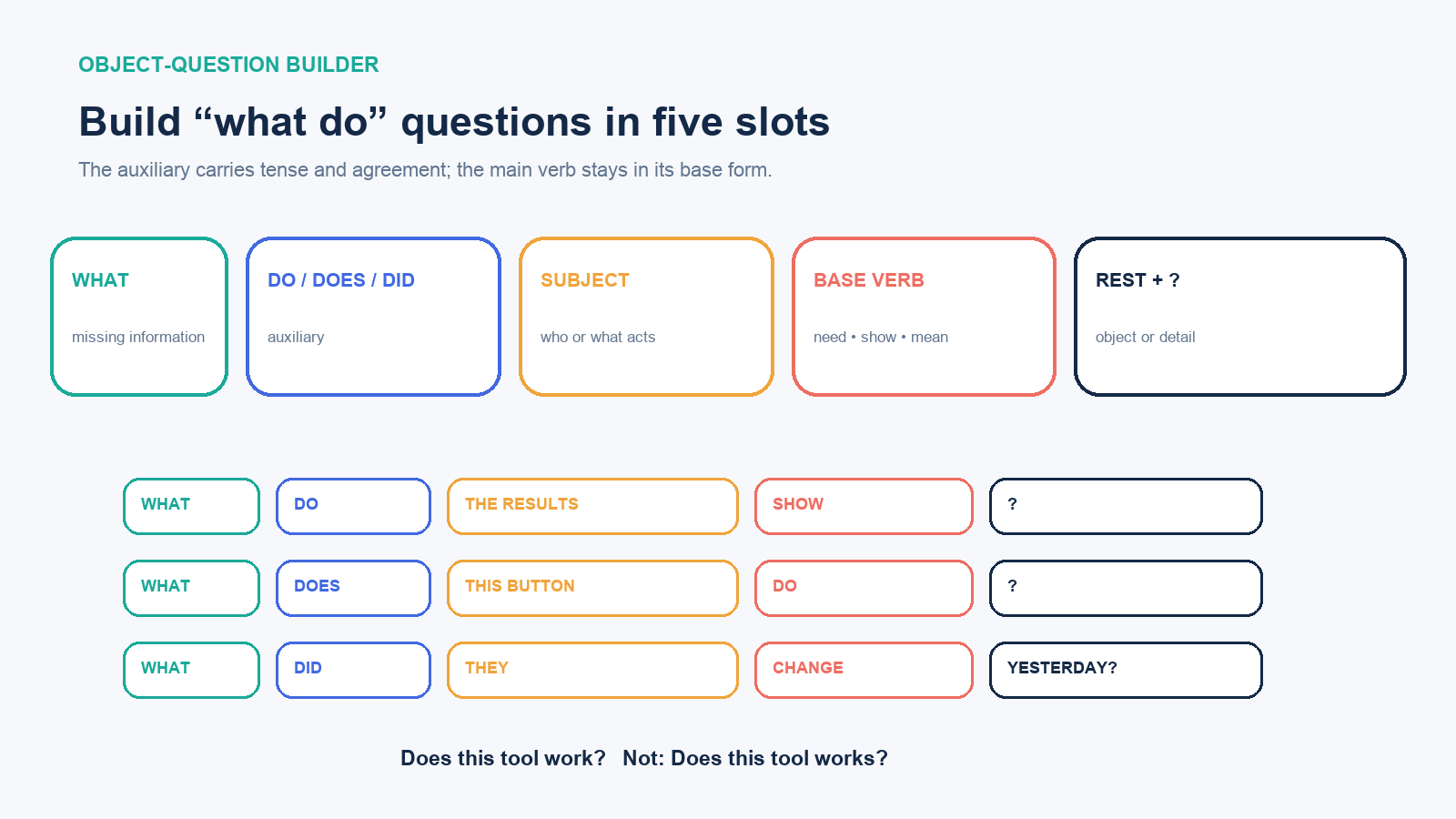
For a present- or past-simple object question with an ordinary main verb, use:
WHAT + DO / DOES / DID + SUBJECT + BASE VERB + REST + ?
Start from a statement and replace the unknown information:
- Statement: “The customers need something.”
- Move the unknown object to the front: “What …?”
- The tense is present simple and customers is plural, so choose do.
- Keep the main verb in its base form: need.
- Result: “What do the customers need?”
Try the same process with a singular subject: “This symbol means something” becomes “What does this symbol mean?” The -s moves from the main verb to does. With the past, “The update changed something” becomes “What did the update change?” The past marking moves to did.
Choose do, does or did by tense and subject
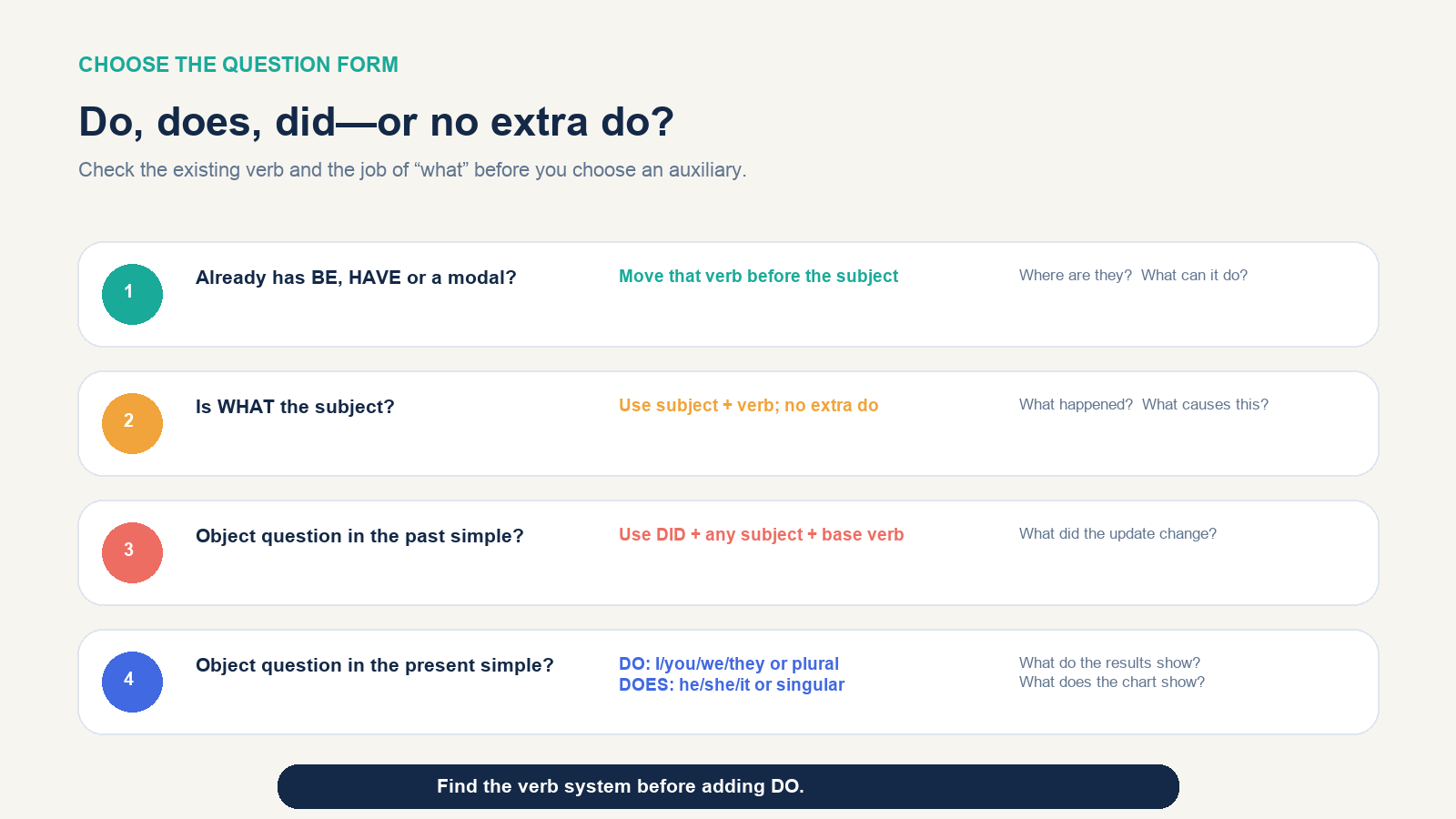
Use do in the present simple with I, you, we, they and plural noun phrases:
- What do you recommend?
- What do we need to bring?
- What do the warning lights indicate?
Use does in the present simple with he, she, it and singular noun phrases:
- What does she manage?
- What does this setting control?
- What does the blue icon mean?
Use did in the past simple with every subject:
- What did I miss?
- What did he send?
- What did the reviewers find?
The British Council’s present-simple reference summarizes the agreement rule: does serves third-person singular subjects; do serves the others. Its question-form guide uses did for the past simple regardless of subject.
After does or did, use the base verb
English marks the relevant tense and agreement once. When does carries third-person singular agreement, the main verb loses its -s. When did carries past tense, the main verb loses its past form.
| Statement | Correct question | Incorrect question |
|---|---|---|
| This tool works offline. | What does this tool do offline? | What does this tool does offline? |
| The report shows a trend. | What does the report show? | What does the report shows? |
| They changed the schedule. | What did they change? | What did they changed? |
| She went home. | What did she do? | What did she did? |
The Cambridge grammar entry for do as an auxiliary specifies the same pattern: present-simple do/does and past-simple did are followed by the subject and the main verb. Treat the auxiliary as the location where the clause displays agreement or past tense.
Do not add do when another auxiliary is already present
The five-slot builder is not universal. If the finite verb is be, move it before the subject:
- They are ready. → When are they ready?
- The problem is serious. → How serious is the problem?
- She was doing something. → What was she doing?
If the clause already has a modal, move that modal:
- They can export something. → What can they export?
- We should choose something. → What should we choose?
- The plan will cost something. → What will the plan cost?
If have is an auxiliary in a perfect construction, move have/has/had: “What have they finished?” and “What has she changed?” When have means possession, contemporary usage often uses do-support: “What do they have?” Variation exists, especially in British patterns, but do not stack auxiliaries into forms such as “What do they can export?” or “What does she has changed?”
How to finish what do the
What do the is a grammatical beginning, but it is incomplete. The article the must introduce a noun phrase. Because the auxiliary is do, that subject must normally be plural or coordinated:
- What do the results show?
- What do the red and blue lines represent?
- What do the terms in this contract mean?
- What do the designer and developer need?
With a singular noun, switch to does: “What does the result show?” The noun closest to do is not always the whole subject, so identify the head: in “the list of errors,” list is singular, giving “What does the list of errors contain?” In “the errors in the list,” errors is plural, giving “What do the errors indicate?”
What do you do has a conventional meaning
The two instances of do have different jobs in “What do you do?” The first is the auxiliary that builds the present-simple question. The second is the main verb. Without more context, the question often asks about a person’s occupation or regular work. In a discussion about household responsibilities, it can instead ask about a routine or role.
To ask about an action happening around now, use the present continuous: “What are you doing?” To ask for an opinion, use “What do you think?” To ask for a next step, “What do I do?” is possible, while “What should I do?” more explicitly asks for advice.
Context can also license a preposition at the end: “What do you use this for?” Cambridge notes that this kind of preposition stranding is common, especially in ordinary or informal styles. “For what do you use this?” is possible but markedly formal and uncommon in conversation.
Repair the error by finding where grammar is already marked
| Error | Diagnosis | Repair |
|---|---|---|
| What do the chart show? | Singular subject with do | What does the chart show? |
| What does the charts show? | Plural subject with does | What do the charts show? |
| What did she bought? | Past tense marked twice | What did she buy? |
| What do they are testing? | Are is already the auxiliary | What are they testing? |
| What does this can do? | Modal already present | What can this do? |
| Do you know what do the results mean? | Direct-question order inside an indirect question | Do you know what the results mean? |
The last error is important. A direct question uses “What do the results mean?” After an introduction such as “Do you know…,” “Can you tell me…,” or “I wonder…,” the embedded question uses statement order: “Do you know what the results mean?” The outer clause is already the direct question.
A six-sentence self-check
Complete each question before reading the answers.
- Something opened the file. → What ___ the file?
- The buttons control something. → What ___ the buttons ___?
- The button controls something. → What ___ the button ___?
- They found something. → What ___ they ___?
- She can see something. → What ___ she see?
- You know the answer to “What do the symbols mean?” → Do you know what ___?
Answers: (1) opened—what is the subject, so no do-support. (2) do, control—plural present subject. (3) does, control—singular present subject and base verb. (4) did, find—past tense moves to did. (5) can—the modal is already the auxiliary. (6) the symbols mean—an indirect question uses statement order.
If those six results make sense, the fragment what do is no longer a phrase to guess. You can identify the missing information, locate the subject, inspect the existing verb system, mark tense and agreement once, and build the rest of the question in the correct order.