
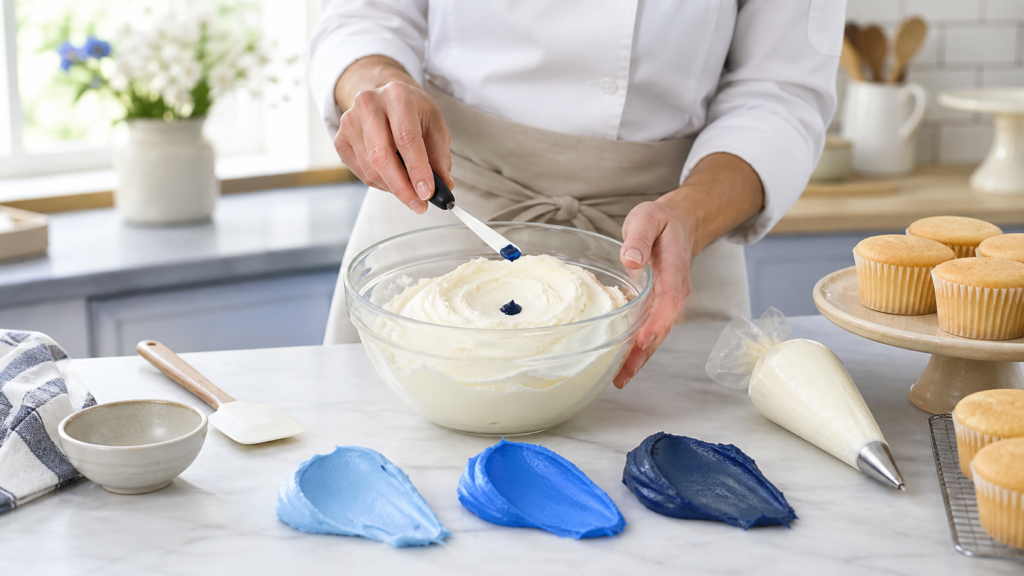
A food-specific guide to making reliable blue frosting and icing with an approved blue colorant, controlled samples, shade modifiers, rest time, and batch records.
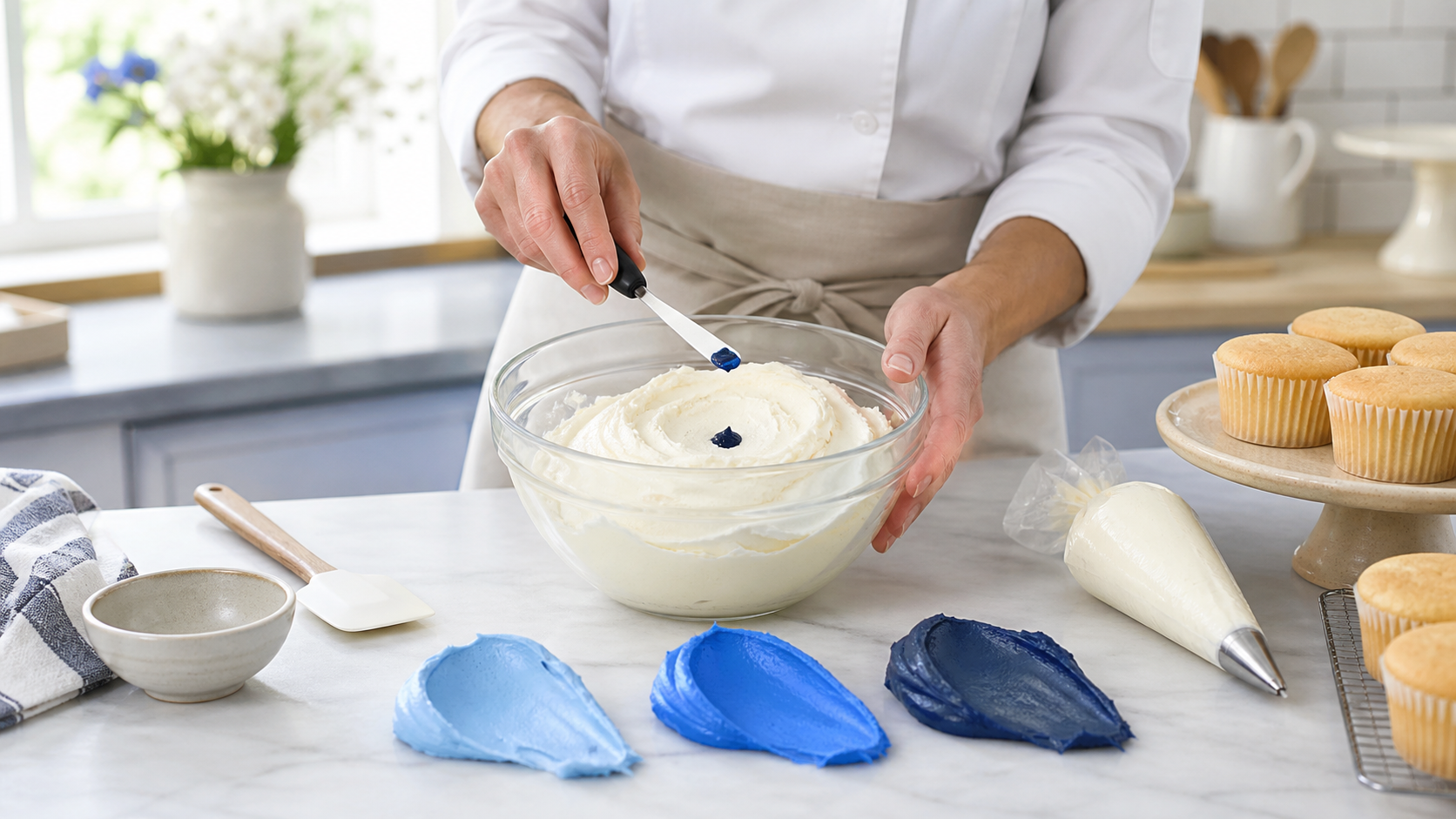
For frosting and other foods, you do not make a clean blue by mixing two non-blue colors. Start with a food-approved blue colorant that is permitted for the intended food and jurisdiction, then adjust the shade. Use a white base for the cleanest result, add color gradually, and let the mixture rest before deciding whether it needs more.
The question what colors make blue changes when the thing being colored will be eaten. Paint, ink, cosmetic pigment, craft dust, and a color described only as “non-toxic” are not substitutes for an edible food color. This guide focuses on frosting, icing, fondant, glaze, batter, and similar food bases.
First check that the color belongs in food
Use a sealed product from a traceable supplier with an ingredient statement, intended-food directions, lot or date information, and any warnings needed in your market. Confirm that its exact use is authorized where the food will be made and sold. In the United States, the FDA maintains separate listings and conditions for color additives; its current summary references FD&C Blue No. 1 and Blue No. 2 among colors permitted for human food, subject to the applicable regulations.
- “Natural,” “plant-based,” or “exempt from certification” does not mean unregulated. FDA says both certified and certification-exempt food colors must meet the applicable safety standard and conditions.
- “Non-toxic” does not mean edible. The FDA advises bakers not to use glitter or dust on food unless it is specifically manufactured to be edible.
- Approval for cosmetics, crafts, drugs, or food packaging does not automatically authorize direct addition to food.
- For a food business, keep supplier specifications and lot traceability, and verify local labeling and allergen obligations.
The label—not the apparent color of the bottle—is the gate. If the intended food, dose instruction, or ingredient identity is unclear, do not improvise.
Why red, yellow, and green will not make a clean blue
A typical decorating set treats blue as a starting color. Red plus yellow moves toward orange; yellow plus blue moves toward green; red plus blue moves toward purple. Combining red, yellow, and green cannot recover a clean blue because those mixtures already introduce warm or green components that mute it.
You can shift an existing blue with a second color, but the blue component still has to come from somewhere. In food, that means a permitted blue color additive or a deliberately prepared food ingredient whose blue appearance is compatible with the recipe. A digital hex code or a paint-wheel recipe does not identify an edible ingredient.
Choose the format for the food
| Color format | Often useful for | Main control point |
|---|---|---|
| Liquid drops | Thin glaze, drinks, simple batter, pale frosting | Added water can loosen a sensitive mixture; drop size varies by bottle |
| Gel or paste | Buttercream, royal icing, fondant, deep shades | High concentration demands very small additions and thorough mixing |
| Powder | Dry mixes, fat-sensitive or low-moisture applications when the product is specified for them | Disperse completely and follow the supplier’s use and hydration directions |
| Natural-source blue product | Recipes or labels built around that ingredient system | Heat, pH, light, storage, and base chemistry may shift or fade the color |
| Lake/pigment dispersion sold for food | Fat-based or low-water applications when specifically directed | Use only the product’s stated food applications and handling instructions |
Wilton’s icing guidance favors concentrated gel color because it can create a strong shade without changing frosting consistency as much as a larger quantity of liquid. That is a product-category advantage, not permission to ignore the specific label.
A repeatable method for blue frosting
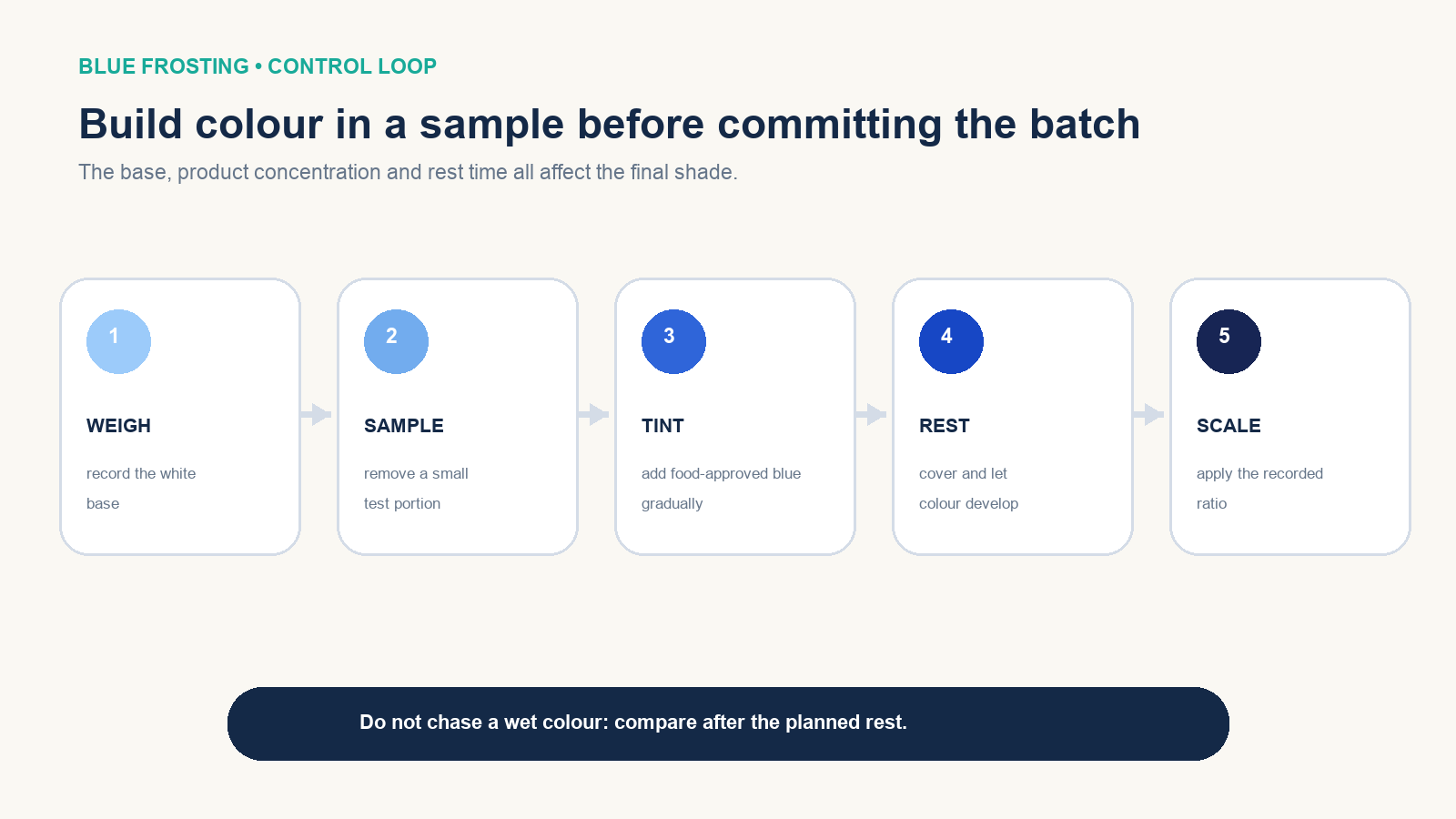
- Define the target. Place a physical reference under the light in which the dessert will be displayed. A phone screen is useful for direction, not an exact edible-color standard.
- Prepare and weigh the base. Finish the frosting first, including flavor and texture adjustments. Record its weight and temperature.
- Remove a test portion. A 100 g sample makes later scaling easy and protects the full batch.
- Add approved blue in tiny increments. Use a clean toothpick for concentrated gel or a repeatable micro-measure suitable for the product. Mix completely and log every increment.
- Cover and rest. Follow the manufacturer’s development guidance. If none is given, compare at consistent checkpoints rather than reacting immediately; some colors deepen, while some natural systems can shift or fade.
- Inspect in context. Smear a thin layer at the final thickness or pipe a small test. A deep bowl of frosting looks darker than a thin surface.
- Adjust one variable. Add blue for intensity or a tiny modifier for direction. Keep an unmodified portion available for recovery.
- Scale from the approved sample. Multiply the recorded amount by the ratio of full-batch weight to sample weight, then approach the final dose conservatively.
McCormick’s mixing chart begins with white frosting or white cake mix, and Wilton recommends experimenting with a small amount before coloring the full job. Both ideas matter more than memorizing a drop count, because brands, droppers, formulations, and frosting bases are not standardized.
The base is part of the color
| Base condition | Likely effect on blue | Planning response |
|---|---|---|
| Bright white icing | Cleanest and easiest to lighten | Use as the calibration batch where possible |
| Yellow buttercream | Can push blue toward green or make it look dull | Whip the butter lighter, choose clear/pale flavoring, or accept a warmer target |
| Brown vanilla, caramel, cocoa, or fruit base | Mutes and darkens the result | Design the shade for that base rather than trying to imitate a white-base formula |
| Highly aerated buttercream | Scattered light makes the color appear paler | Judge after the final mixing and piping method |
| Acidic or alkaline recipe | Some natural pigments shift hue | Use a product documented for the recipe conditions and run a storage test |
| Hot or light-exposed application | Some colors lose strength or change | Test the actual bake, display, and holding conditions |
If the base is yellow, the most predictable fix is often to improve the base rather than pour in more blue. More color can make the icing darker without making it cleaner, and excessive liquid can change consistency.
Move from blue to the shade you need
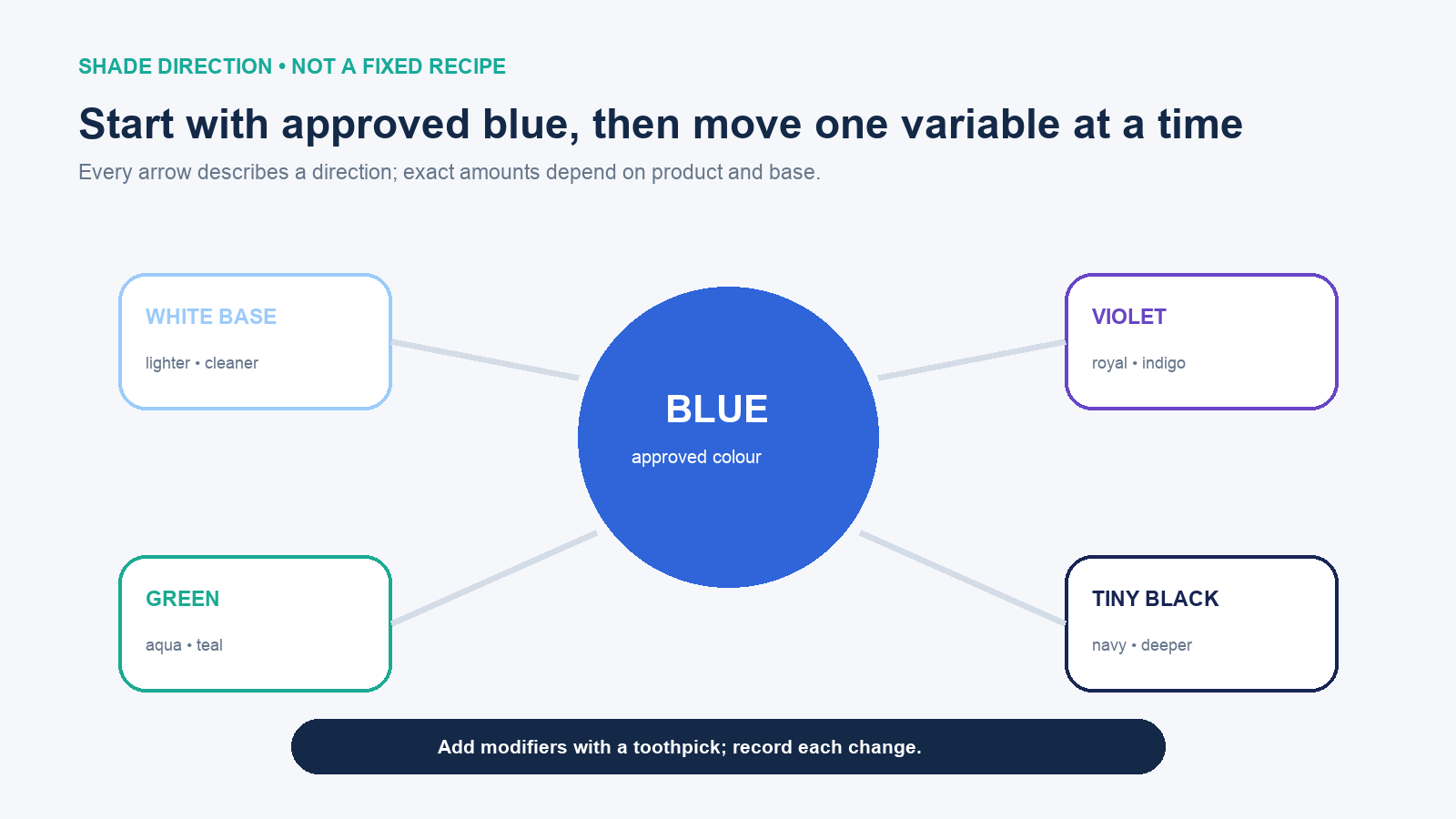
| Target direction | Start with | Add carefully | Stop when |
|---|---|---|---|
| Baby or sky blue | White base | A trace of blue, or dilute a colored sample with more white base | The piped test matches after rest |
| Royal or indigo blue | Medium blue | A tiny amount of approved violet | The color gains depth without becoming purple |
| Navy blue | Strong blue | Very small black or violet/black modifier | The frosting is dark blue, not gray or black |
| Aqua | Light-to-medium blue | A trace of green | The result is blue-green but still light |
| Teal | Medium blue | Green in controlled increments | The hue balances between blue and green |
These directions deliberately avoid universal drop ratios. One brand’s “royal blue” can have different concentration and undertone from another’s. Even a valid manufacturer chart assumes its own products and stated amount of base; scale or substitute only after a test.
Natural blue needs its own test plan
Natural-source blue can be effective, but it is not one interchangeable ingredient. A commercial spirulina-based color, a butterfly-pea preparation, and a red-cabbage-derived kitchen color differ in hue, stability, taste, pH response, and legal status for commercial use. King Arthur’s home method, for example, uses purple cabbage and a small alkaline adjustment to obtain blue; that illustrates chemistry, not a plug-in formula for every frosting or food business.
Test the exact product in the exact recipe through the full process: mixing, heating if any, chilling, freezing, thawing, light exposure, and intended shelf life. Photograph samples beside a neutral reference at scheduled checkpoints and record pH when it is relevant to the supplier’s guidance. Do not promise a natural blue will behave like a certified synthetic dye.
When deeper color changes the frosting
Adding more dye is not the only way to increase saturation. In a 2026 King Arthur test on Swiss meringue buttercream, an immersion blender produced visibly more intense color by incorporating the color more thoroughly, but it also made the frosting denser and changed perceived texture and sweetness. The test found a middle path by folding a smaller intensely blended portion back into unblended frosting.
Treat that as a technique for an appropriate emulsion, not a universal instruction. Use a narrow, high-sided container; avoid splashing; monitor temperature; and stop if the texture begins to break. Royal icing, fondant, glaze, and whipped cream have different structures and need their own handling.
Scale the approved sample, not the original guess
Suppose a 100 g test portion reaches the approved shade after four recorded micro-additions of blue and one trace of violet. A 1,000 g batch has a theoretical scale factor of 10. Add perhaps 80–90% of the calculated blue first, mix fully, rest for the same interval, and finish by comparison. This margin accounts for measuring error, mixing efficiency, and the fact that a large mass can look darker in the bowl.
For commercial food, the batch sheet should name the color product, supplier, lot, amount, base weight, recipe version, process, rest time, final use, and label declaration. In the United States, FDA guidance says certified color additives must be declared by their listed names or permitted abbreviations; other markets have their own rules. The result is not just blue frosting—it is a repeatable, traceable food batch made from an authorized ingredient.