

A shape-first method for calculating volume, choosing the correct boundary, converting cubic units, measuring irregular objects, and catching common errors.

To find volume, identify the three-dimensional shape, measure its required dimensions in the same length unit, substitute them into the matching volume formula, and report the answer in cubic units. For any prism or cylinder, the organizing rule is volume = base area × perpendicular height. Pyramids and cones use one-third of that product; a sphere uses V = (4/3)πr³. Composite objects are split into simpler solids whose volumes are added or subtracted.
This is a decision problem before it is an arithmetic problem. A correct multiplication with the wrong radius, exterior dimensions, slant height, or unit can produce a polished-looking wrong answer. The workflow below covers regular solids, hollow and composite objects, liquids, and irregular objects—and includes checks that catch the mistakes a calculator cannot.
Start by deciding what “volume” means in the problem
Volume is the three-dimensional space occupied by matter or enclosed by a surface. The National Institute of Standards and Technology (NIST) identifies the cubic meter (m³) as the SI unit of volume. Before selecting a formula, determine which boundary the question cares about:
| The problem asks for… | Measure this boundary | Typical use |
|---|---|---|
| Material volume | The solid material itself | Concrete, metal, plastic, or wood required |
| Internal capacity | The usable inside dimensions | Water a tank can hold |
| External displacement | The full outside boundary | Space occupied by a package or submerged object |
| Free volume | Container capacity minus contents or obstructions | Remaining storage or headspace |
For a storage box, wall thickness makes the internal capacity smaller than the volume calculated from exterior length, width, and height. For a hollow pipe, the material volume is the outer cylinder minus the inner cylinder. Write one sentence defining the required region before reaching for a formula; that simple step prevents boundary errors.
Use the shape router, not a memorized guess
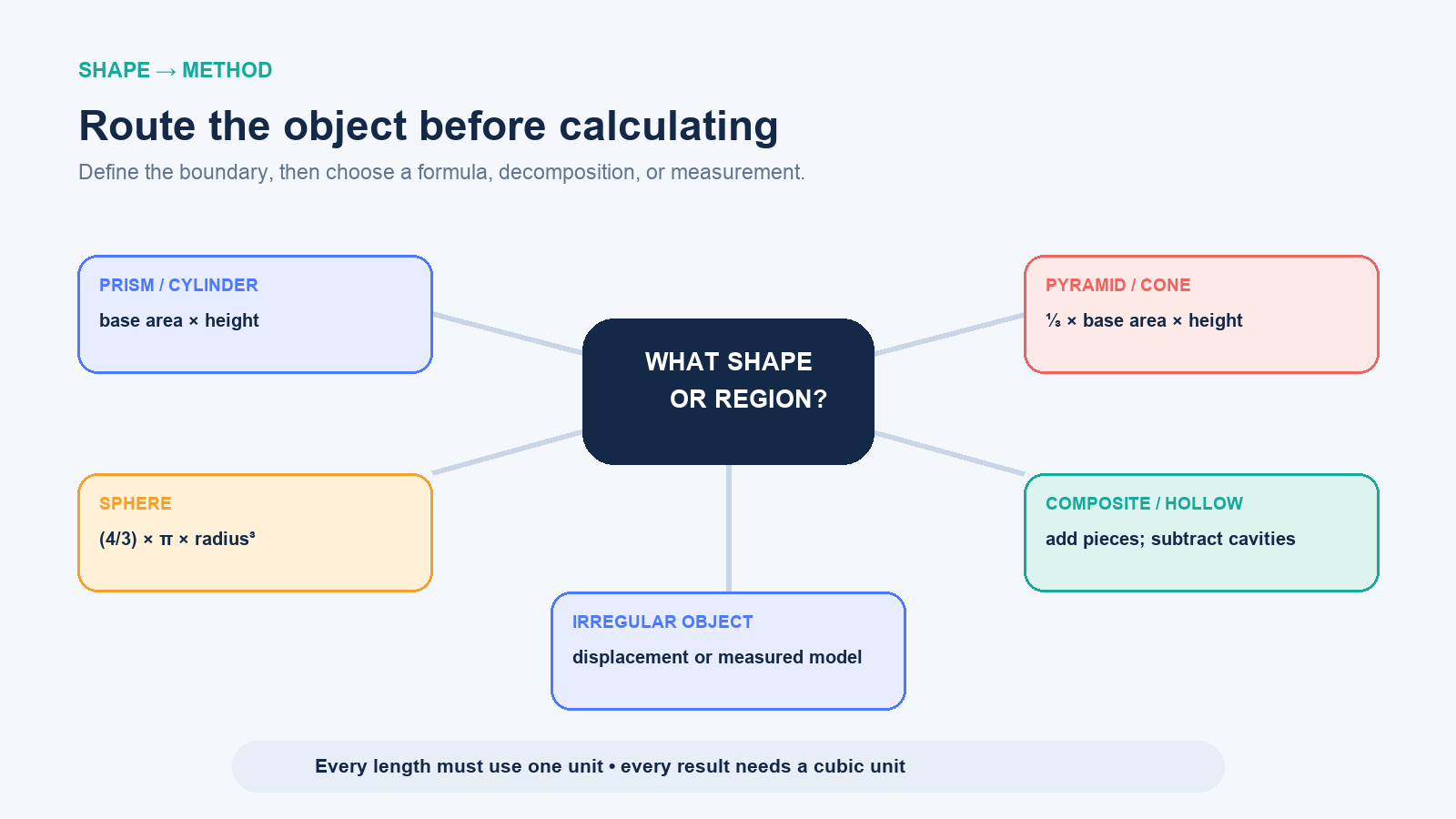
The formula table below uses B for the area of the base, h for perpendicular height, r for radius, and s for a cube’s side length. NASA’s geometry reference confirms the standard equations for the sphere, cylinder, rectangular prism, cube, and cone; OpenStax presents the same formulas through the base-area and slicing framework.
| Solid | Volume formula | Measurements needed | Common trap |
|---|---|---|---|
| Rectangular prism | V = l × w × h | Inside or outside length, width, height | Mixing the two boundaries |
| Cube | V = s³ | One side | Computing 3s instead of s³ |
| Any prism | V = B × h | Base area and perpendicular height | Using surface area for B |
| Circular cylinder | V = πr²h | Radius and perpendicular height | Using diameter as radius |
| Pyramid | V = (1/3)Bh | Base area and perpendicular height | Omitting one-third |
| Circular cone | V = (1/3)πr²h | Radius and perpendicular height | Using slant height |
| Sphere | V = (4/3)πr³ | Radius | Cubing the diameter |
The height in these formulas is the shortest distance perpendicular to the base. A leaning prism still uses perpendicular height, not a sloped edge. A cone diagram may label a slant length along its side; that length belongs in surface-area work, not directly in the volume formula.
Follow one calculation sequence every time
- Sketch and label the boundary. Mark the part being filled, occupied, or manufactured.
- Name the solid or pieces. If it is not one basic solid, draw the split lines or the cavity to remove.
- List the required dimensions. Convert diameter to radius and slant length to perpendicular height if the given information permits it.
- Standardize the units. Convert every length before multiplying.
- Write the formula symbolically. Keep π exact during intermediate work.
- Substitute values with units. The units multiply along with the numbers.
- Round once at the end. Use the precision of the measurements or the problem’s instruction.
- Check scale and dimensions. The result must be positive, plausible, and expressed as length cubed or an equivalent capacity unit.
Example: a rectangular organizer has interior dimensions 12 cm by 7.5 cm by 4 cm. The capacity is V = 12 × 7.5 × 4 = 360 cm³. Because 1 cm³ equals 1 mL, it can theoretically enclose 360 mL up to the measured height. Real usable capacity may be lower if corners are rounded or headspace is required.
Worked example: find the volume of a cylinder
Suppose a cylindrical container has an inside diameter of 10 cm and an inside height of 18 cm.
- Convert diameter to radius: r = 10 ÷ 2 = 5 cm.
- Write the formula: V = πr²h.
- Substitute: V = π × (5 cm)² × 18 cm.
- Simplify without rounding π early: V = 450π cm³.
- Approximate at the end: V ≈ 1,413.7 cm³, or about 1.414 L.
A fast plausibility check is to imagine the cylinder inside a 10 cm × 10 cm × 18 cm rectangular prism. That box has a volume of 1,800 cm³, so the cylinder’s answer must be smaller. It is. If you mistakenly use 10 cm as the radius, the calculation becomes 5,654.9 cm³—larger than the bounding box—which immediately exposes the error.
Composite and hollow solids: add what exists, subtract what does not
Many real objects are not a single textbook solid. Use a signed inventory: assign a plus sign to material or space that belongs in the answer, and a minus sign to holes, cutouts, or empty regions that do not.
Consider a cylindrical planter with outer radius 10 cm and height 12 cm. Its cylindrical cavity has radius 8.5 cm and depth 10 cm, leaving a base beneath the cavity. The volume of material is:
V = π(10²)(12) − π(8.5²)(10) = 477.5π ≈ 1,500.1 cm³.
Do not subtract a 12 cm-high inner cylinder: the cavity is only 10 cm deep. Also do not subtract a rounded lip, drainage hole, or tapered wall unless its dimensions are given or a justified approximation is allowed. State approximations instead of disguising them as exact geometry.
Keep the unit conversion outside the geometry
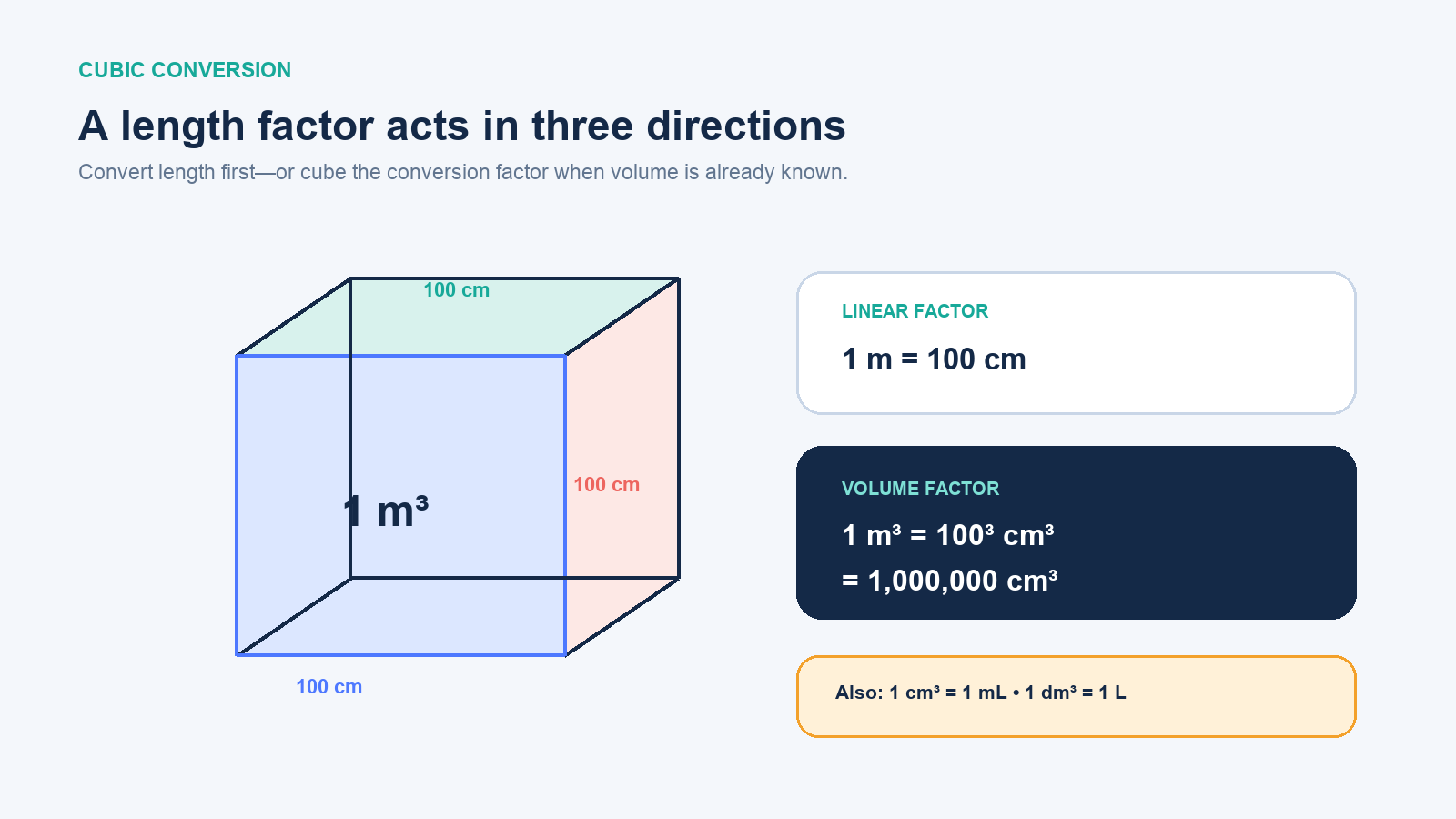
According to NIST, 1 L = 1 dm³, 1 mL = 1 cm³, and 1 m³ = 1,000 L. These identities are useful bridges between geometric volume and liquid capacity. But a linear conversion factor must be applied in all three dimensions:
- 1 m = 100 cm, so 1 m³ = (100 cm)³ = 1,000,000 cm³.
- 1 ft = 12 in, so 1 ft³ = 12³ in³ = 1,728 in³.
- A tank holding 0.72 m³ has a capacity of 720 L.
The safest sequence is to convert the original length measurements to one unit and then apply the formula. If you must convert an already calculated volume, write the cubic conversion factor explicitly. NIST also advises expressing all dimensions in the same unit before calculating area or volume.
Irregular objects: measure displacement when geometry is unsuitable
If a small object is nonporous, does not react with the liquid, fits in a graduated vessel, and can be fully submerged, its volume can be found by liquid displacement:
object volume = final liquid reading − initial liquid reading.
If the water rises from 425 mL to 612 mL, the object displaces 187 mL, so its volume is 187 cm³. A NIST training example describes the same before-and-after method for determining a cylinder’s volume. Read the meniscus at eye level and use a vessel whose graduations are fine enough for the result you need.
Displacement is not automatically valid for an object that floats, traps air, absorbs water, dissolves, reacts, or cannot be fully submerged. A sinker or coating changes the experiment and must be accounted for. For a large irregular tank or landscape, a measured cross-section model, numerical integration, 3D scan, or manufacturer specification is usually more appropriate than a household displacement test.
Check the answer with four independent signals
| Check | Pass condition | What a failure often means |
|---|---|---|
| Dimensions | The unit is cm³, m³, in³, ft³, mL, L, or another volume unit | Area or a raw length was reported |
| Bounding shape | The result fits inside a simple upper or lower estimate | Radius/diameter or one-third error |
| Scaling | Doubling every length multiplies volume by eight | The formula is not truly three-dimensional |
| Precision | The answer is not more precise than the measurements justify | Calculator digits were mistaken for measurement certainty |
One more practical check: ask whether the number answers the intended decision. A 2 m × 1 m × 0.5 m tank encloses 1 m³, but “How much water should I order?” may require subtracting wall thickness, freeboard, equipment, and the volume already occupied. Geometry supplies the idealized boundary; the use case determines which adjustments belong.
If the object does not match a standard formula
Do not force the nearest-looking formula. First see whether the object can be decomposed into prisms, cylinders, cones, pyramids, or spheres. If not, choose a measurement method that matches the object: displacement for a suitable small solid, cross-sectional slicing for a changing profile, a 3D model for a complex manufactured part, or a calibrated capacity test for a container. Record whether the result is exact, measured, or estimated.
The final line should contain three things: the numerical result, the correct volume unit, and the assumption that defines the boundary. For example: “The usable interior volume is approximately 1.41 L, based on a 10 cm inside diameter and an 18 cm fill height.” That statement is more useful—and more defensible—than a number with no explanation of what was measured.