

One fluid ounce can appear as 29.57, 30, or 28.41 mL. The correct number depends on U.S. conversion, labeling rules, rounding, or Imperial units.

One U.S. fluid ounce is exactly 29.5735295625 milliliters, normally written as 29.57 mL. Use 30 mL for ordinary kitchen approximation and when a U.S. nutrition-label rule defines a household fluid ounce that way. One Imperial fluid ounce is 28.4130625 mL. If the source says only oz and means weight, it cannot be converted to mL without the substance’s density.
The three common answers are not interchangeable mistakes. They answer different versions of the question. Choose the number from the context before copying it into a recipe, label check, worksheet, or dose.
Pick the answer that matches your task
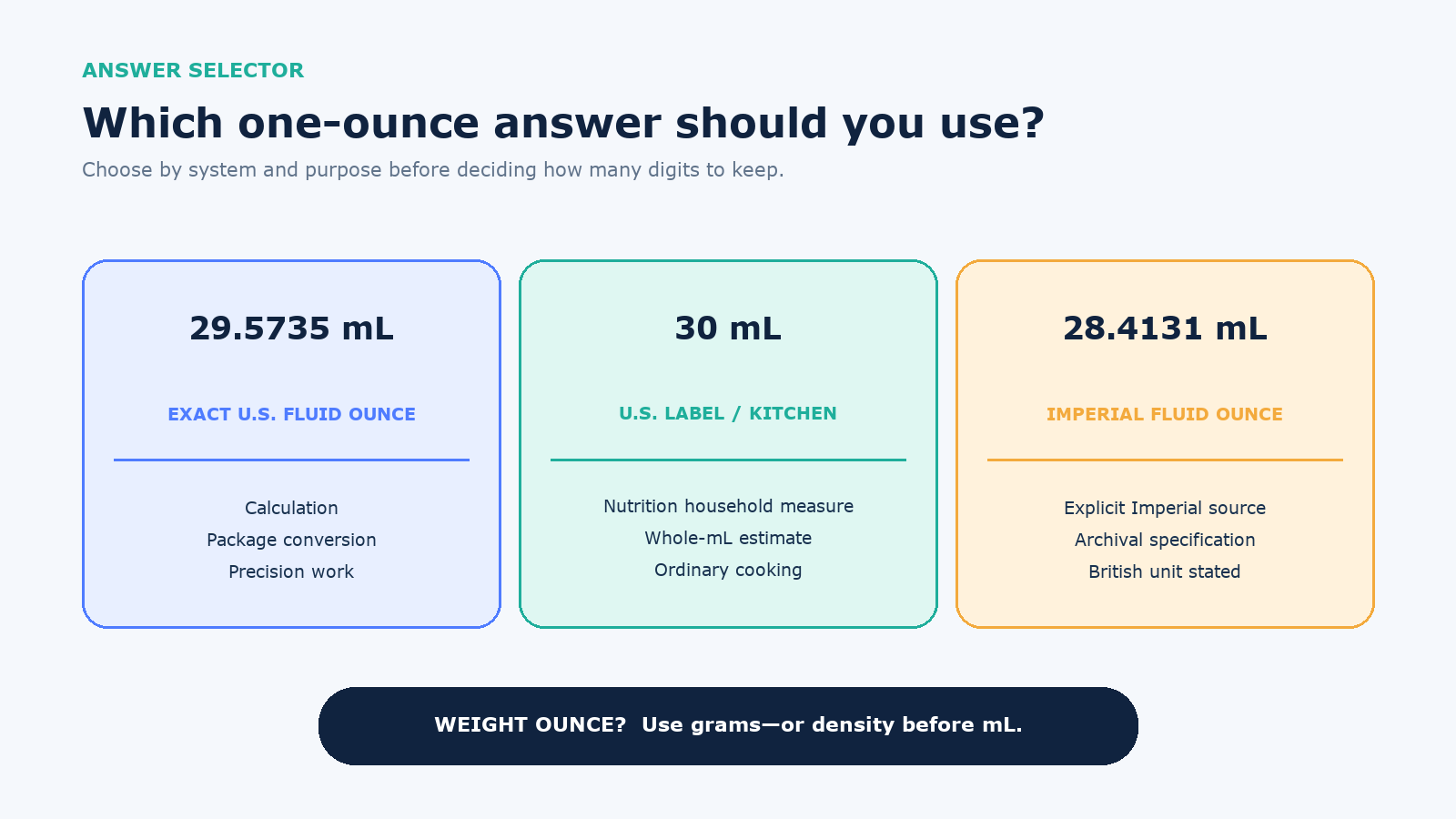
| Your source or task | Use for 1 ounce | Why |
|---|---|---|
| U.S. recipe, beverage, cosmetic, or package conversion | 29.5735295625 mL; usually report 29.57 mL | This is the U.S. fluid-volume conversion |
| Quick home-cooking estimate | About 30 mL | The measuring tool rarely supports hundredths of a milliliter |
| U.S. Nutrition Facts household measure | 30 mL | FDA guidance defines 1 fluid ounce as 30 mL for that labeling purpose |
| Imperial or explicitly British fluid ounce | 28.4130625 mL; usually report 28.41 mL | The Imperial fluid ounce is a different unit |
| Ounce by weight, such as flour, cheese, or a parcel | No fixed mL answer | Mass becomes volume only when density is known |
| Liquid medicine directions | Use the stated mL amount and supplied device | A general conversion should not replace the product’s dosing instruction |
NIST’s current U.S. conversion table gives 29.57 mL per U.S. fluid ounce. Its more detailed SI conversion factors list both the U.S. and Canadian/U.K. Imperial fluid ounces, which is why a source can correctly return either 29.57 or 28.41 after the system is specified.
Why 30 mL can also be correct
Rounding 29.5735295625 mL to a whole milliliter gives 30 mL. The difference is about 0.4265 mL, or roughly 1.44% of one U.S. fluid ounce. That gap is usually smaller than the reliable resolution of an ordinary kitchen cup.
There is also a specific regulatory context. FDA nutrition-labeling guidance states that, for nutrition labeling, one fluid ounce means 30 mL, just as a tablespoon means 15 mL and a cup means 240 mL. That is a standardized household-measure convention for the label; it does not redefine the underlying U.S. fluid ounce.
For a package’s metric declaration of net contents, FDA guidance instead supplies the conversion factor 0.02957353 liter per fluid ounce and gives rules for significant digits and rounding. In other words, a serving-size convention and a net-quantity conversion can legitimately apply different rounding instructions to the same familiar unit.
How far apart are the three values?
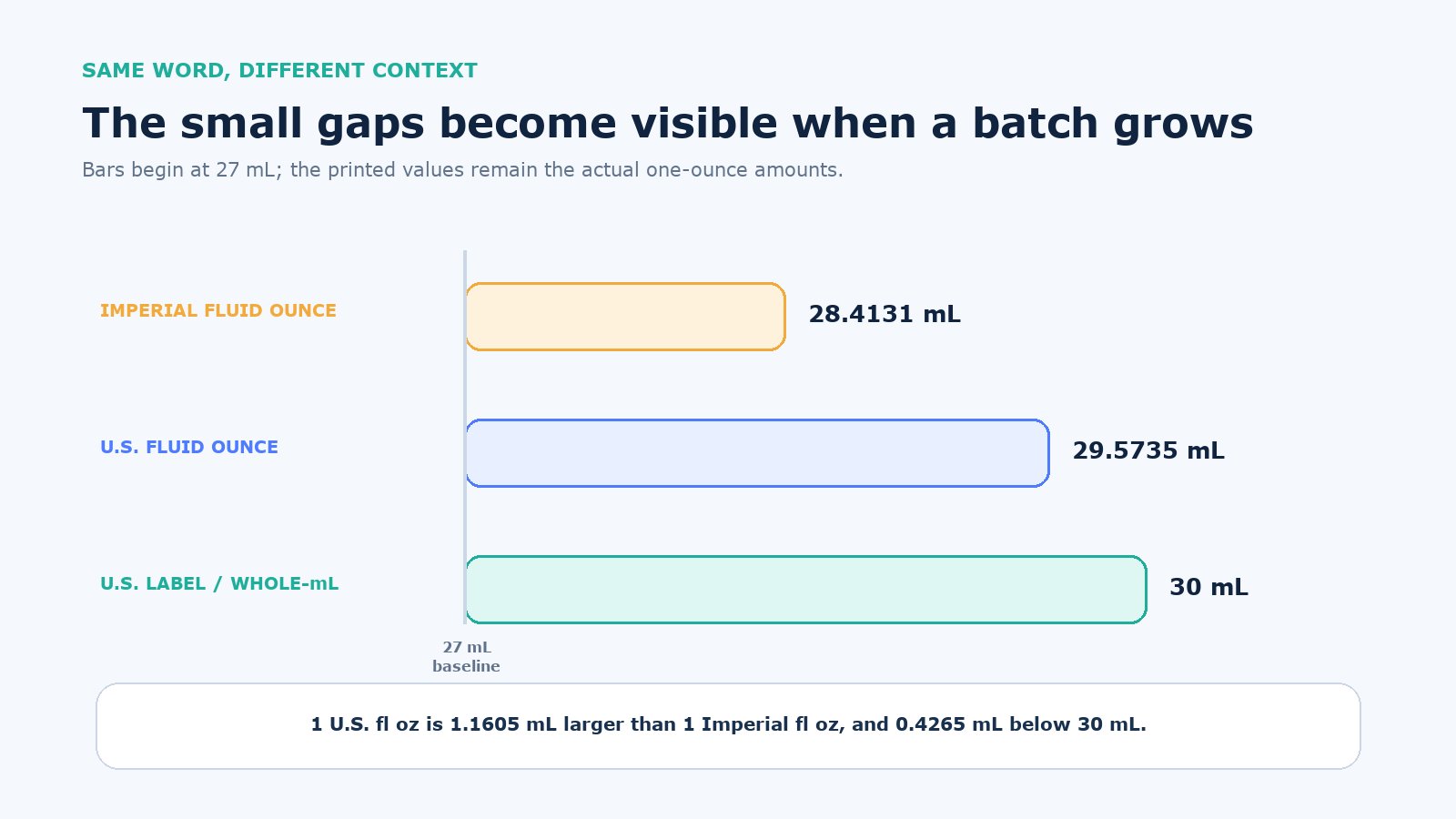
| Comparison | Difference for 1 ounce | Difference for 8 ounces |
|---|---|---|
| Exact U.S. vs 30 mL | 0.4265 mL | 3.4118 mL |
| U.S. vs Imperial | 1.1605 mL | 9.2837 mL |
| 30 mL vs Imperial | 1.5869 mL | 12.6955 mL |
For one casual serving, the distinction may not change the result you can measure. For a scaled batch, formula, package declaration, or older Imperial recipe, the gap accumulates. State the system instead of silently choosing the first conversion result.
Use the exact U.S. formula when precision matters
For U.S. fluid ounces:
milliliters = U.S. fluid ounces × 29.5735295625
For Imperial fluid ounces:
milliliters = Imperial fluid ounces × 28.4130625
Carry the full factor in the calculation and round the final result. For example, 1.25 U.S. fl oz is:
1.25 × 29.5735295625 = 36.966911953125 mL
Reasonable reports include 36.97 mL for a calculation that supports hundredths, 37.0 mL for a vessel marked in tenths, or about 37 mL for ordinary measuring. Using 30 mL as the factor would give 37.5 mL. That is a deliberate approximation, not the exact conversion.
Do not convert a weight ounce as though it were liquid
The symbol makes the distinction:
- fl oz is fluid volume and can convert directly to mL.
- oz on a scale or after “net wt” is ordinarily mass and converts to grams.
- mL is volume, so changing a mass ounce into mL requires density in grams per milliliter.
One avoirdupois weight ounce is 28.349523125 grams. The similar-looking 28.35 number is not the U.S. fluid-ounce conversion. A one-ounce mass of water occupies roughly 28.35 mL near ordinary conditions, while the same mass of oil, syrup, flour, or metal occupies a different volume. The ingredient and conditions matter.
Read the original wording before calculating
Use these clues:
- If the source says fl oz, identify U.S. or Imperial from the country, document, or stated measurement system.
- If a current U.S. liquid product gives fl oz and mL, treat the values as a dual label and respect its stated rounding.
- If a recipe comes from a modern U.K. source, do not assume it uses Imperial fluid ounces merely because the author is British; many recipes use metric mL directly.
- If the source says oz by weight, use grams or obtain ingredient-specific density.
- If the unit is unclear, ask for the original label or recipe rather than guessing.
FDA’s metric declaration guidance uses 0.02957353 L per U.S. fluid ounce for product-label conversions. FDA’s cosmetics labeling summary also specifies that liquid measure uses the U.S. gallon and its quart, pint, and fluid-ounce subdivisions. These sources are useful when a bottle, rather than a recipe, created the question.
Four one-ounce examples
| Source text | Answer to use | Reason |
|---|---|---|
| “Add 1 fl oz” in a U.S. cocktail specification | 29.57 mL | U.S. fluid-volume conversion |
| “Serving size: 1 fl oz (30 mL)” on U.S. nutrition information | 30 mL for reading that label | Labeling convention already supplies the intended metric amount |
| “1 Imperial fl oz” in an archival formula | 28.41 mL | The source explicitly selects the Imperial unit |
| “1 oz cocoa” in a weight-based recipe | 28.35 g, not a universal mL value | The ingredient is specified by mass |
So the short answer to “how many mL an ounce?” is 29.57 mL for a U.S. fluid ounce. Copy 30 mL when the task calls for whole-milliliter kitchen rounding or the U.S. nutrition-label convention, and use 28.41 mL only when the ounce is Imperial. If “fluid” is missing and the item was weighed, stop before converting.